
Cultural Education Programmes in Wakefield: A Guide to Choosing the Right Approach
Cultural education programmes Wakefield communities can shape together do more than introduce people to heritage. They create opportunities to share knowledge, develop skills and influence what happens next. Choosing an approach can feel difficult when participants have different needs or the purpose of an activity is still taking shape. Start by listening to local voices, then connect cultural activity with clear learning aims and meaningful participation.
A useful programme respects heritage, feels relevant to the people taking part and supports wider community priorities. This guide offers a practical way to compare approaches, from focused arts and heritage activities to ongoing learning and partnership-building. You’ll find ways to involve participants in shaping activities, consider the role of South Asian arts and heritage, and plan for reflection. The aim is cultural learning that is inclusive, locally grounded and shaped by the people involved in Wakefield.
Table of Contents
What cultural education programmes in Wakefield can offer communities
Cultural education programme formats: compare workshops, projects and heritage activities
Addressing concerns about relevance, inclusion and lasting cultural learning
Plan a cultural education programme in Wakefield around clear community aims
How Communities Together supports cultural education programmes in Wakefield
What cultural education programmes in Wakefield can offer communities
Cultural education programmes are structured opportunities to explore culture, heritage and learning through active participation. Instead of only receiving information, participants can share knowledge, ask questions, develop creative skills and reflect on what cultural practices mean to them. In Wakefield, this can connect personal histories with shared heritage and a stronger understanding of the places people call home.
A museum visit, performance or one-off arts activity can be valuable, but it isn’t automatically a cultural education programme. What matters is the learning journey: participants have chances to engage, make connections and contribute, guided by clear aims. Creative practice can form part of that journey. This broad overview of arts education offers useful context for its role in learning.
For a local point of reference, watch this introduction to SPARK Wakefield.
How cultural learning connects heritage, identity and place
Heritage is living knowledge, carried through language, stories, creative practice, everyday traditions and relationships between generations. A programme can invite participants to share what they know, explore how traditions have changed and listen to perspectives different from their own. This helps people consider how identity connects with place, while recognising that no single account represents an entire community.
South Asian arts and heritage activities offer meaningful ways into cultural learning, creative expression and continuity across generations. They are one example, not a substitute for the many histories and cultural knowledge present in Wakefield. Thoughtful programmes let communities help decide what is explored and how it is shared.
Who can take part in Wakefield cultural education
Community groups, educators and local organisations can contribute to cultural education programmes that Wakefield communities find relevant. Depending on the programme, they might share knowledge, support learning or help shape activities around local priorities. Plan participation for different ages, backgrounds and learning needs, with clear invitations to contribute and options for taking part at a comfortable pace.
When learning combines cultural knowledge with active involvement, it can create opportunities for understanding, confidence and connection without reducing heritage to a display or one-off event.
Cultural education programme formats: compare workshops, projects and heritage activities
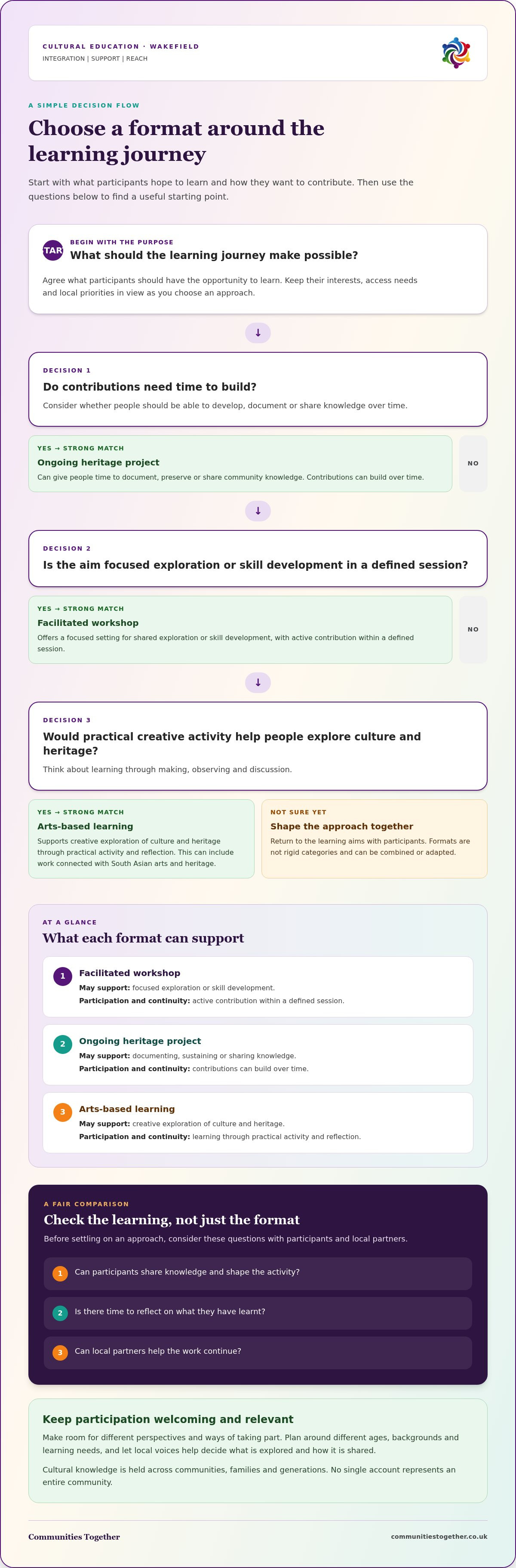
The right format depends on what participants hope to learn, how they want to contribute and whether the aim is a focused experience or learning that develops over time. When comparing cultural education programmes in Wakefield, weigh up purpose, participation and continuity before choosing activities. First agree what participants should have the opportunity to learn. Then consider which format gives them and local partners a meaningful role in achieving that aim.
When a workshop, heritage project or arts activity may fit
A facilitated workshop provides a focused setting for shared exploration and skill development. An ongoing heritage project gives people time to document, preserve or share community knowledge. Arts-based activities, including creative work connected with South Asian arts and heritage, can make cultural participation hands-on, with opportunities to learn through making, observing and discussion.
These formats aren’t rigid categories. A longer project might include workshops and creative activities, while an arts session could lead to broader discussion about heritage and place. Let participants’ interests, access needs and the programme aims guide the design.
How to compare programme approaches fairly
Rather than ranking formats, check how well each supports the intended learning. Can participants share knowledge and shape the activity? Is there time to reflect on what they’ve learnt? Can local partners help the work continue? The Cultural Education Network offers wider context on cultural learning and collaboration between educators and cultural organisations.
For more context on sustaining and sharing cultural knowledge, explore Communities Together’s heritage preservation work. Connect the chosen format to the programme’s longer-term purpose, while keeping local voices and community priorities central.
Addressing concerns about relevance, inclusion and lasting cultural learning
Cultural learning can feel distant when examples and interpretations have already been decided without participants. People may not recognise their experiences in the material, or may feel expected to represent an entire culture. A more inclusive approach treats them as contributors, makes room for different viewpoints and recognises that cultural knowledge is held across communities, families and generations.
For cultural education programmes Wakefield communities can shape, relevance starts with listening. Explore local context with participants rather than making assumptions in advance. Their interests, cultural knowledge and relationship with place can help determine the questions, examples and activities, while clear aims keep learning purposeful.
How programmes can feel relevant to Wakefield participants
Invite participants and community partners to identify what they want to explore and what knowledge they’d like to share. Depending on those conversations, a programme might draw on personal stories, creative practices or connections to place. Facilitate discussion so nobody is expected to speak for others, and different experiences can be heard without being treated as one account.
What helps cultural learning continue beyond one activity
Continuity doesn’t have to mean repeating the same session. It could include time for reflection, shared documentation or a chance to contribute to a later activity. Partners can help sustain relationships and carry learning forward. Regular participant feedback can show whether the programme still feels useful and engaging.
Inclusion also depends on practical choices. Provide clear information, flexible ways to contribute and activities suited to different learning needs. Respectful facilitation and attentive listening help participants feel their contributions matter. Consider these choices from the planning stage, rather than waiting until barriers arise.
Set aims that are clear enough to review, without treating intended benefits as guaranteed outcomes. A programme might aim to support cultural understanding, skills or participation. Review can then consider who took part, what they learnt and what they would change or continue. Feedback, reflection and partner discussion provide useful evidence for adapting the work without overstating its impact.
Reviewing the programme can also reveal when the format, examples or pace need adjusting. Compare participant feedback with the original aims to strengthen relevance and accessibility, and to be clear about what the programme has and hasn’t achieved.
Plan a cultural education programme in Wakefield around clear community aims
A clear planning process turns an initial idea into learning that participants and partners can shape together. If you’re developing cultural education programmes in Wakefield, begin with local aims and knowledge, then choose activities that fit. Starting with a format and looking for a purpose afterwards can make it harder to keep the programme relevant.
Identify the community aim. Clarify what the programme should help people explore or learn, such as a cultural practice, shared heritage or connection with place. Make the aim specific enough to guide decisions and review progress.
Identify participants and invite their input. Consider who the programme is for, what they may want to learn and how they could contribute. Don’t assume people’s interests or cultural knowledge. Invite them to shape the focus.
Map partners and relevant knowledge. Identify community groups, educators and local organisations that can contribute perspectives, skills or relationships. Agree roles early, including how participants and partners can influence the programme as it develops.
Choose activities around the aims and access needs. Select workshops, arts activities or heritage projects based on the intended learning and how people can take part. Plan for accessible participation, respectful facilitation and different ways to share ideas or knowledge.
Plan for reflection and review. Decide how participants can reflect on what they’ve learnt and share feedback. Use that learning to assess whether the activity met its aims and guide future planning, without assuming outcomes in advance.
Set aims with participants and local partners
Good aims balance direction with openness. For example, a programme could explore a cultural theme through shared learning while allowing participants to influence which stories, practices or questions receive attention. Partners can help create the conditions for that contribution. Their role is to support community participation, not speak on behalf of participants.
Choose activities and review what participants learn
Match the activity to the agreed aim. A focused workshop may suit a defined learning topic, while a heritage project gives people time to gather and share knowledge. Build in feedback and reflection so participants can say what felt relevant, what they learnt and what they’d like to explore next. If partnership development is a central aim, allow time to consider how shared skills, relationships and capacity can grow.
Communities Together connects cultural learning with community engagement, partnership-building and capacity development. Explore its community engagement programmes for ideas on developing participation around local aims.
How Communities Together supports cultural education programmes in Wakefield
Communities Together brings cultural learning, community engagement and heritage activities together, with programmes shaped around local priorities. It works in Wakefield as well as Huddersfield, Halifax, Leeds and Bradford. Across these communities, the approach centres the knowledge, interests and aims of the people involved.
Through South Asian arts and heritage activities, participants can explore cultural knowledge through learning and participation. Heritage preservation creates opportunities to share and sustain knowledge, connecting cultural continuity with educational activity. This is one strand of cultural learning, not a representation of every community or heritage in Wakefield. Community contributions and respectful facilitation help keep activities grounded and inclusive.
Bringing South Asian arts and heritage into shared learning
Arts and heritage activities offer practical ways to explore traditions, creative skills and knowledge passed between generations. Participants can bring their own perspectives and experiences, helping shape what is discussed and how learning takes place. This supports opportunities for cultural preservation while making heritage accessible as living knowledge. The focus is meaningful participation, not presenting culture as a fixed or uniform story.
Building partnerships around community priorities
Programmes are more relevant when community groups and local partners can help shape their direction. Communities Together combines community engagement with partnership-building and community capacity development, supporting activities based on shared aims. Partners can contribute local knowledge, relationships and skills, while participants have opportunities to influence what they explore and how they take part.
Depending on the aims, cultural learning can also connect with skills development, personal development, wellbeing and resilience. These are areas a programme can aim to support, not guaranteed outcomes. Clear aims and participant feedback help guide reflection and future activity. By connecting heritage, learning and collaboration, cultural education programmes Wakefield communities develop can respond to local priorities and create opportunities for participation and cultural continuity.
If you’re considering a programme, explore Communities Together’s work and think about the community aims you’d like it to support.
Build a cultural programme around what matters locally
Cultural education programmes Wakefield communities develop work best when they start with clear aims and the voices of the people they’re intended to involve. Choosing between a workshop, arts activity or longer heritage project becomes easier when the format supports those aims, makes participation accessible and leaves room for reflection.
Local relevance grows through collaboration. Educational arts and heritage activities can connect shared learning with living knowledge, while community engagement and capacity-building partnerships help participants and local organisations shape the work together. Communities Together works in Wakefield, Huddersfield, Halifax, Leeds and Bradford, bringing these approaches into programmes grounded in community priorities.
A programme can begin with a shared interest, a cultural question or a desire to create more opportunities for learning and participation. Thoughtful planning and strong partnerships can develop that starting point into activity shaped by the people involved.
Your community’s knowledge and aspirations can help make cultural learning relevant, welcoming and lasting. Explore Communities Together’s community programmes to start a conversation about your aims.
Frequently Asked Questions
What are cultural education programmes?
Cultural education programmes are structured learning activities that explore culture and heritage through participation. People might share knowledge, develop creative skills, discuss traditions or reflect on their connection to place. Unlike a one-off visit or performance, a programme gives people opportunities to engage with the learning itself. Its format and aims can vary according to the community involved, participants’ interests and the cultural themes they want to explore.
What cultural education activities are available in Wakefield?
Activities can include facilitated workshops, arts-based learning and heritage projects that let participants explore culture and contribute their knowledge. The best fit depends on who will take part, what they hope to learn and whether the aim is a focused session or continuing engagement. Communities Together supports community engagement and cultural learning in Wakefield, Huddersfield, Halifax, Leeds and Bradford.
How can a cultural education programme support local communities?
A cultural education programme can create opportunities for shared learning, cultural participation and exchange between generations. Participants may explore traditions, share experiences and build understanding through activities shaped around their interests. These are opportunities, not guaranteed outcomes. Clear aims, relevant content and meaningful involvement all matter. Listening to participants and making room for different perspectives helps connect a programme with local priorities.
Can cultural education programmes include South Asian arts and heritage?
Yes. South Asian arts and heritage can be a meaningful focus for cultural learning and preservation. Activities can help participants explore creative practices, share knowledge and consider how traditions are carried forward. Develop them respectfully, recognising that communities are diverse and no single perspective represents everyone. Communities Together’s work includes South Asian arts and heritage activities, connecting educational opportunities with cultural participation and continuity.
How do you choose a cultural education programme for a community group?
Start by discussing participants’ interests, learning aims, access needs and whether the group wants a one-off activity or continuing involvement. Then compare workshops, arts activities and heritage projects against those priorities. A workshop may suit focused exploration, while an ongoing project allows contributions to develop over time. Choose an approach that gives participants meaningful ways to take part, share knowledge and reflect on what they learn.
How can schools and community organisations work together on cultural learning?
Schools and community organisations can agree what participants should have the opportunity to learn, then involve relevant community voices in shaping the focus. Clarify what each partner can contribute, such as cultural knowledge, learning support or opportunities for participation. Make room for participants to reflect and share feedback. Clear communication and shared aims help keep learning relevant, respectful and connected to the people involved.
How can the impact of a cultural education programme be reviewed?
Review a programme against its agreed aims, using participant feedback, engagement and reflections on learning. These can show what activities took place and how participants experienced them, but activity alone doesn’t prove wider change. Record what participants say they learnt, what they valued and what could be improved. Partners can use these reflections to adapt future activity without claiming outcomes that haven’t been measured.


Comments