
Community Engagement Partnerships in the UK: A Practical Guide
What if a community partnership began with local people shaping the plan, rather than simply being asked to comment on it? Consultation can gather views without giving communities meaningful influence. That can leave organisations and residents with different expectations and little shared ownership. Strong community engagement partnerships UK organisations build with local groups make room for people to help set priorities and shape decisions from the outset.
Building that kind of relationship takes more than an initial meeting. Partners need to recognise the knowledge, time and capacity each person or organisation can contribute. They also need to agree how decisions will be made and keep communication open as priorities evolve. These practical steps create a more reciprocal foundation for trust, participation and locally relevant outcomes.
This guide explains what makes a partnership genuinely collaborative and offers practical steps for agreeing roles, priorities and ways of working. It explores how locally grounded activities, including arts and heritage, wellbeing and learning, can bring partners together around shared aims. Whether you’re developing a new initiative or strengthening an existing relationship, you’ll find a clear approach to sharing decisions and learning together.
Table of Contents
UK community engagement partnerships in practice
Community engagement partnerships UK organisations develop are sustained relationships in which community members and organisations share priorities, shape decisions and contribute to activity over time. Unlike one-off consultation or information sharing, partners work together to understand local needs, agree what to do and learn from the results. Partners may include community groups, charities, public bodies and educational institutions.
The value comes from bringing different contributions together. Community members can share knowledge of local priorities, relationships and barriers. Organisations may contribute facilitation, learning opportunities or practical resources. The balance will vary, so partners should agree what matters locally rather than assume that everyone will benefit in the same way.
This video offers an example of community engagement and partnership working:
How partnership differs from one-way consultation
Consultation asks people for their views. Partnership involves working out together what those views mean for decisions and activity. A group might be asked to comment on a proposed workshop, for example, or invited to help choose its focus, shape how it is delivered and review what should change afterwards. The right arrangement depends on the purpose and the people involved, rather than on one fixed model.
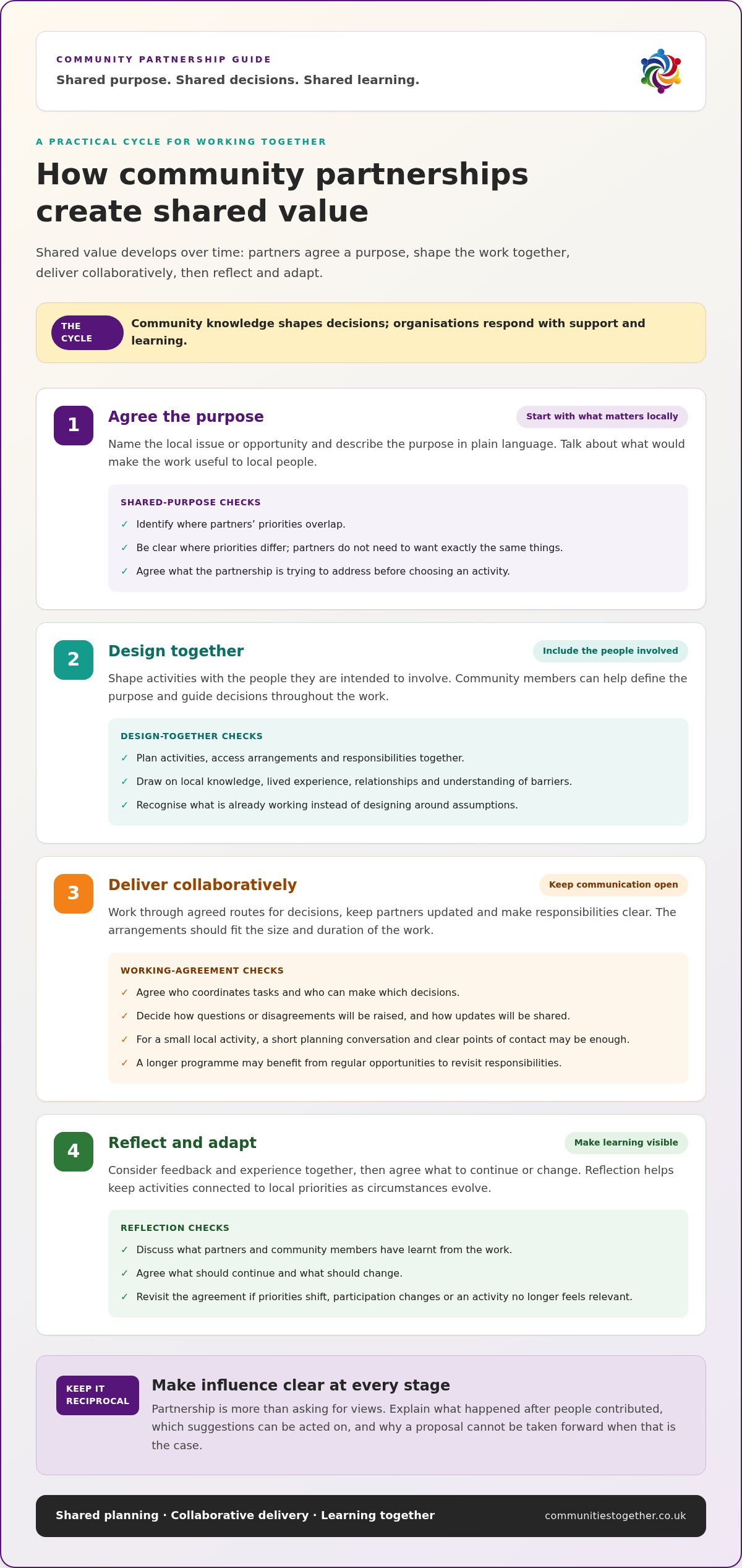
Participation is more meaningful when people can see what happened after they contributed. Partners should listen carefully, explain which suggestions they can act on and give clear reasons when they can’t take a proposal forward. This makes influence visible and creates a basis for honest discussion, including when partners have different priorities.
What partners can contribute and gain
Community groups often bring trusted relationships, lived experience and an understanding of local histories, strengths and barriers. Their insights can help organisations reach people, recognise what is already working and avoid designing activities around assumptions. Community members are not simply a source of information: they can help define the purpose and guide decisions throughout the work.
Charities, public bodies and educational institutions may contribute facilitation, knowledge, learning opportunities or practical resources. The mix depends on the partnership. For instance, a local group might help shape a heritage activity around residents’ interests, while an organisation supports planning and shared learning. The group may gain space to develop its ideas, while the organisation gains a closer understanding of community priorities. Neither outcome is automatic, which is why partners should agree expectations and revisit them as the work develops.
Community foundations offer one example of organisations that connect local giving with community priorities. The UK Community Foundations network provides a useful point of reference for understanding community philanthropy in the UK, alongside partnerships built through shared planning and delivery.
How community engagement partnerships create shared value
Shared value develops through a cycle, not a single meeting or activity: partners agree a purpose, design together, deliver collaboratively, then reflect and adapt. At each stage, community members and organisations can shape the work, understand their responsibilities and respond to what they learn. This helps keep activities connected to local priorities, even as those priorities or circumstances change.
Reciprocal partnerships are stronger because community knowledge shapes decisions, while organisations contribute support and learning in response to locally identified priorities. For community engagement partnerships UK organisations want to sustain, reciprocity needs to show up in everyday arrangements, not just in the partnership’s stated aims. The UK Government Community Engagement Principles can also inform thoughtful approaches to listening and working with communities.
Agree purpose: Identify the local issue or opportunity partners want to address.
Design together: Shape activities, access arrangements and responsibilities with the people they are intended to involve.
Deliver collaboratively: Keep communication open and make decisions through agreed routes.
Reflect and adapt: Consider feedback and experience, then agree what to continue or change.
Agreeing purpose, roles and decision-making
Before choosing an activity, describe the purpose in plain language and discuss what would make the work useful to local people. A shared purpose doesn’t require every partner to have identical priorities. It does require clarity about where those priorities overlap and where they differ. Agree who will coordinate tasks, who can make which decisions, how questions or disagreements will be raised and how updates will be shared.
Keep these arrangements proportionate to the work. A small local activity may need a short planning conversation and clear points of contact. A longer programme may benefit from regular opportunities to revisit responsibilities. Make space to reconsider the agreement if community priorities shift, participation changes or a planned activity no longer feels relevant.
Learning and accountability across the partnership
Reflection works best as a shared process, not simply a report prepared by the organisation leading the work. Partners can bring together participant feedback, community members’ perspectives, observations from delivery and project records, then discuss what they show. Make the conversation accessible: share what has been heard, note different viewpoints and explain how learning will inform the next decision.
Distinguish intended outcomes from evidence of what has happened. Partners may aim to make an activity more accessible or strengthen opportunities for local participation, but those aims aren’t proof of impact. Record what was delivered, what participants said and what partners observed. Be open about gaps or unexpected results. This supports honest accountability without promising that a particular social outcome will follow.
For practical examples of facilitated community work that supports shared planning and learning, explore community engagement and capacity-building work from Communities Together.
Which community engagement partnership approach fits your aims?
There’s no single structure that suits every community or project. The right approach depends on what local people want to achieve, how much influence they want and what each partner can realistically contribute. For community engagement partnerships UK organisations are developing, collaboration can begin with a modest shared activity and grow as trust, relationships and capacity develop. Limited organisational capacity doesn’t rule out partnership: the arrangement can be scaled to the purpose.
Think of these models as flexible examples, not fixed categories. In each case, discuss who sets priorities, where decisions sit and how much coordination the work will need:
Community-led: Residents or a local group identify the purpose and guide key choices, with a charity or public body contributing resources, facilitation or specialist knowledge. This can suit a locally defined priority. Partners should still be clear about the support and coordination they can sustain.
Charity-community: A charity and community group develop an activity together, such as a learning opportunity or wellbeing workshop. The group can shape its relevance and participation, while the charity helps coordinate delivery. Agree who makes decisions about the activity and how community input will influence them.
Institution-community: An educational institution or public body works with local people on a shared project. Partners might explore heritage, skills or local learning, with community members contributing to its focus and design. More formal processes may require additional coordination, so keep ways of working understandable and proportionate.
Choosing a partnership structure for the work
A focused project partnership can suit partners with a defined activity to deliver. Longer-term capacity-building collaboration may be a better fit when the aim is to strengthen a group’s ability to plan and lead work over time. Arts, heritage, wellbeing or learning can give partners a practical shared focus, provided the activity reflects community interests rather than being chosen for convenience. Roles can change as needs and relationships develop.
To choose an approach, discuss what the community wants to lead, what support would be useful and how often partners can realistically meet. A simple activity may need clear responsibilities and a way to share updates; broader work may call for more regular planning. Neither structure is inherently better. Suitability depends on the purpose and the capacity available on all sides.
Recognising and addressing unequal influence
Differences in time, resources and institutional authority can affect whose views shape the work. A partner with staff, formal decision routes or control of resources may have more influence than a volunteer-led group, even when everyone is committed to collaboration. Make contributions and decision-making visible: agree who controls which choices, record how resources are being used and explain how community input affects the next step.
Share facilitation where practical, offer more than one way to contribute and allow people time to consider decisions. Partners can keep meetings focused, share information in accessible language and invite feedback outside formal gatherings. These adjustments won’t remove every difference, but they can make participation more workable and help partners respond together as priorities change.
How to build community engagement partnerships across West Yorkshire
Good partnership design starts with the people and relationships already present, not with a ready-made activity looking for participants. Huddersfield, Halifax, Leeds, Bradford and Wakefield each include varied neighbourhoods, groups and local priorities. Don’t assume an approach that fits one place will automatically suit another. Local priorities should shape partnership design, not follow it.
For organisations developing community engagement partnerships UK-wide, the steps below offer a practical starting point for West Yorkshire. Adapt them to the community, the purpose and the capacity of the people involved.
Start with local knowledge and relationships
Before approaching new partners, map existing relationships. Which community groups are active? Who already brings people together? What activity or local knowledge could inform the work? Listen through trusted connections and existing group activity, taking time to understand the concerns and interests people identify. Culturally rooted arts and heritage activities can offer a meaningful way to participate, share knowledge and explore what matters locally.
1. Listen first. Talk with community members and groups through relationships they already trust. Ask what they value, what they would like to change and how they prefer to take part.
2. Map what exists. Note current groups, activities, relationships and useful connections before creating something new. This can help partners build on existing strengths rather than duplicate activity.
3. Agree a shared aim. Bring community members and potential partners together to identify a purpose that reflects what people have said. Be clear about what is within the partnership’s influence and what is not.
4. Choose a manageable first activity. Agree a practical starting point, such as a learning activity, heritage project or wellbeing workshop, if it responds to the shared aim. In Huddersfield, Halifax, Leeds, Bradford or Wakefield, the right focus will come from local conversations, not the town name alone.
5. Set roles and communication. Agree who will coordinate, what each partner can contribute and how updates or questions will be shared. Make participation accessible by offering suitable ways for people to contribute, including feedback during and after the activity.
6. Reflect and agree next steps. Gather participants’ feedback and partners’ observations, then discuss what to continue, adapt or pause. Decide together whether another activity would be useful and what support it would need.
Neighbourhoods and communities aren’t interchangeable. Local histories, relationships, interests and existing capacity can differ, even within the same town or city, so keep listening as plans take shape. A partnership might begin with a focused activity and develop into wider collaboration, but growth should follow what participants find useful, not an assumption that every project needs to expand.
For broader planning, consider how these steps could fit within a strategic community engagement programme, with local groups contributing to the planning as well as the activity itself.
How Communities Together supports community engagement partnerships
Communities Together delivers community engagement and capacity-building programmes that help local groups contribute to shared planning, activity and learning. Its work in Huddersfield, Halifax, Leeds, Bradford and Wakefield connects partnership aims with locally grounded programmes, while recognising that each community brings its own relationships, interests and knowledge.
For organisations considering community engagement partnerships UK-wide, the practical point is that partnership means more than bringing people together. It means creating useful ways for people to shape and take part in activity. The approach can be adapted around local priorities and the contributions partners are able to make.
Connecting partnership aims with community programmes
Community engagement programmes can help local groups strengthen community infrastructure and build their capacity to plan and participate. Depending on the shared aim, a partnership might centre on South Asian arts and heritage activities that support cultural participation and preservation, or on wellbeing and resilience workshops that offer non-clinical learning and personal development.
Learning, skills and personal development can also provide a practical focus for shared activity. These settings give partners a reason to plan together, invite participation and make room for community knowledge. The activity should follow the purpose identified with local people, rather than becoming an end in itself.
Where a partnership wants to focus on the foundations that help local groups plan, contribute and continue their work, Communities Together’s community capacity-building approach connects with that wider infrastructure aim.
Taking a practical next step together
A useful first conversation can begin with a few straightforward points: which community or local group is involved, what people have said matters to them, what shared aim partners want to explore and what form of collaboration feels realistic. It can also help to discuss what each partner hopes to contribute, what support could be useful and how the group would like to take part in decisions.
Starting with these questions keeps the conversation grounded and gives partners room to shape an approach together. You don’t need every detail resolved before exploring an idea. Being clear about what you know, what you’re still learning and whose perspective should guide the next step can establish a constructive basis for discussion.
To see how this collaborative approach connects with local activity, explore Communities Together’s community engagement work. Organisations considering a shared project can use these points to frame a conversation about the community, aims and form of collaboration.
Turn shared intent into a thoughtful next step
A partnership doesn’t need to begin with a fully formed programme. It can start with a considered conversation about what local people want to influence, what partners can learn from one another and what would make a useful first step. Staying open to new perspectives helps keep decisions responsive, rather than treating the original plan as fixed.
For community engagement partnerships UK organisations want to nurture, the value lies in maintaining community influence beyond the initial idea. Make time to check whose voices are shaping the direction, whether the approach still feels relevant and what partners have learned together. Small, deliberate adjustments can help a collaboration stay grounded as relationships and priorities evolve.
Communities Together welcomes organisations interested in practical, locally grounded collaboration. A conversation can be a helpful place to explore what shared work might look like and how to build it together.
With care, openness and a willingness to learn together, partners can take a positive next step at a pace that feels right for their community.
Frequently Asked Questions
Is community engagement the same as community partnership?
They’re related, but engagement can be a single activity, while partnership describes an ongoing way of working together. For example, a residents’ group might comment on a proposed session without sharing responsibility for it. Partners could instead involve the group in choosing the session’s focus and reviewing it afterwards. Community engagement partnerships UK organisations develop should reflect the purpose, local context and level of involvement community members want.
Can small community groups take part in UK engagement partnerships?
Yes. A group doesn’t need to take on every task or attend every planning meeting to make a valuable contribution. Members could, for instance, identify suitable ways to invite local people to an activity while another partner coordinates arrangements. Discuss what the group has capacity to do, what support would help and how decisions will be shared. A focused contribution can be a practical starting point for collaboration.
How do partners build trust with communities?
Trust grows through respectful follow-through over time, rather than through a single event. If residents raise a concern about an activity, explain what can be changed, what can’t and why, then return with an update. Be consistent about who is making decisions and how people can raise questions. Local history and experience shape relationships, so don’t assume trust will develop at the same pace in every community.
What happens if community partners disagree about priorities?
Partners can work through disagreement by making different concerns clear before deciding what to do. It may help to separate the shared aim from the proposed approach: people might agree that an activity should reach more residents but differ on its format. Record the options and who each affects, then agree whether to adapt the plan, gather further views or revisit the decision later. Don’t let one partner’s greater resources settle the issue by default.
Do community engagement partnerships need a formal agreement?
Not every partnership needs the same level of formality, but a written record can help prevent different assumptions from becoming problems. For a small project, partners might note the shared purpose, each person’s responsibilities, how decisions will be made and where updates will be shared. More complex work may call for more detailed arrangements agreed between the organisations. This is practical guidance, not legal advice; partners should decide what documentation suits their circumstances.
How can people take part if they cannot attend meetings?
Partners can offer different ways to contribute, such as asking for feedback during an existing group activity, inviting written comments or arranging an individual conversation. Someone who can’t join a planning meeting might still review a proposed activity in a format that works for them. Explain how people’s views will be used and, where possible, share what happened as a result. Choose options with participants, rather than assuming one method suits everyone.
How can a partnership demonstrate that its work is useful?
Agree what the partnership hopes to learn or change, then gather evidence that relates to that intention. Participant feedback, partners’ observations and a record of decisions or adjustments can help show what the activity involved and how it was received. Attendance alone won’t explain people’s experience. Be clear about what the evidence supports, and distinguish immediate feedback or learning from longer-term effects that haven’t been established.


Comments