
Group Therapy Alternatives in Bradford: A Practical Guide
If a group setting feels uncomfortable, inaccessible or simply unsuited to your circumstances, exploring group therapy alternatives Bradford residents can access may help you find a different kind of connection and encouragement. Depending on what you need, that could mean clinical support, peer connection, learning or taking part in a community activity.
It’s understandable to want support that feels welcoming and practical, while also knowing whether an activity offers clinical care or community-based wellbeing. These options serve different purposes: peer support and shared activities can offer opportunities to build connection and learn, but they don’t diagnose or treat mental health conditions or replace professional care.
This guide explains the differences between therapy, peer support and community activities, and outlines options to consider in Bradford, including NHS Talking Therapies, wellbeing hubs and community-led arts, heritage and resilience activities. You’ll also find practical ways to choose a suitable next step, consider community participation alongside clinical support, and recognise when to seek clinical or urgent help.
Table of Contents
Group therapy alternatives in Bradford: what kind of support are you looking for?
Five group therapy alternatives Bradford residents can compare
How to compare Bradford wellbeing options and choose a next step
What to expect from non-clinical community wellbeing in Bradford
Community wellbeing in Bradford: a complementary option through Communities Together
Group therapy alternatives in Bradford: what kind of support are you looking for?
Group therapy is structured clinical support in which people work on mental health concerns together, usually with guidance from a trained therapist. Its format and therapeutic approach can vary; Group psychotherapy offers an overview of how group-based treatment can work. Community activities, by contrast, can bring people together to learn, meet others or take part in shared interests, but they are not therapy.
Clinical treatment addresses mental health needs; non-clinical wellbeing activities offer connection, learning and participation. Keeping this distinction in view can help you compare group therapy alternatives Bradford residents may consider according to what they need: professional support, connection with peers or a community setting in which to participate.
When might someone explore a different format?
Wanting a different format is reasonable. You might prefer more privacy, a slower pace, a setting that feels less clinical or an activity that better fits your access needs, culture or daily commitments. Feeling uncomfortable in a therapy group doesn’t mean you don’t need support; it may simply mean you’re looking for another way to receive it. Needs can change, and community activities can be considered alongside professional guidance.
What community-based support can and cannot offer
Workshops, peer activities, creative sessions and learning groups can offer shared conversation, practical learning and meaningful participation. The experience depends on the activity and its purpose: a facilitated discussion differs from a heritage or arts activity, for example. Community programmes do not diagnose or treat mental health conditions, and they can’t replace clinical care when that’s needed.
If you’re unsure what level of support would help, a GP or mental health professional can help you consider suitable options. If your needs exceed the scope of a community activity, seek clinical support; if you need urgent help, contact NHS services or emergency support. You don’t have to choose between connection and treatment: community participation may sit alongside professional care, while each serves a distinct role.
Five group therapy alternatives Bradford residents can compare
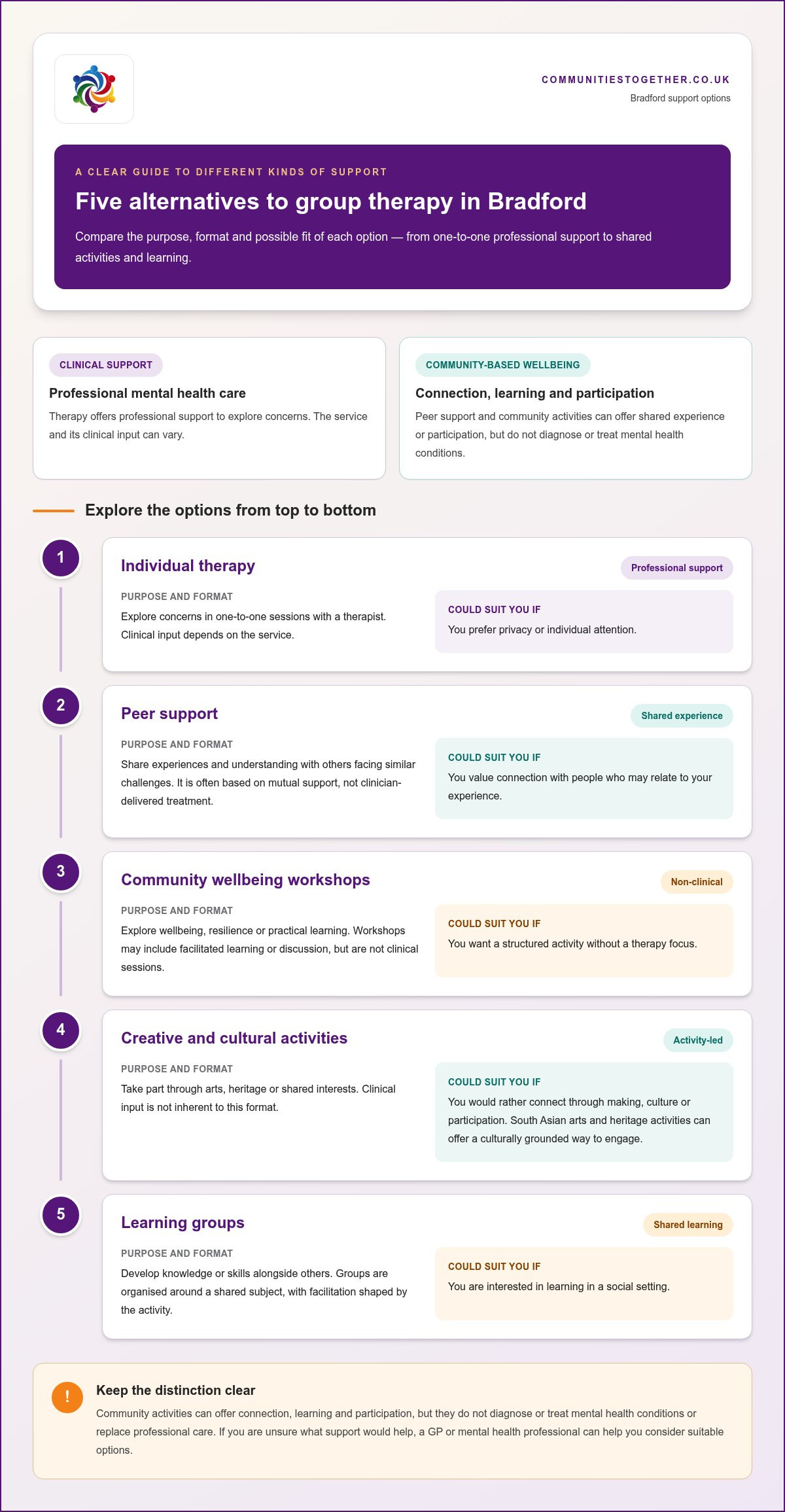
These options serve different purposes, so the best fit depends on whether you’re looking for professional mental health support, shared experience or a welcoming way to take part in community life. Use the table to compare their typical purpose and format, then focus on the kind of support you need. For clinical services and local information, see the Bradford District Care NHS Foundation Trust.
Peer support, individual therapy and community workshops
Peer support centres on listening and shared understanding, rather than assessment or treatment. Individual therapy offers a different professional format, which may suit someone seeking privacy, but it isn’t automatically the right substitute for group therapy. Community wellbeing workshops can focus on learning, resilience and participation; they shouldn’t be mistaken for clinical sessions.
Creative, cultural and skills-based activities
Creative or heritage activities give people a shared focus, while learning groups bring participants together around a subject or skill. Neither promises a particular wellbeing outcome, but each can create space for participation and social connection. South Asian arts and heritage activities can offer a culturally grounded way to engage. Communities Together’s community engagement programmes bring people together through shared learning and participation, alongside non-clinical wellbeing and resilience workshops.
As you compare group therapy alternatives Bradford offers, consider whether you need clinical care, peer connection or an activity with a shared purpose. Communities Together’s community-based work can be a useful option if participation, learning or cultural connection feels like a suitable next step.
How to compare Bradford wellbeing options and choose a next step
Once you have a sense of the support you want, compare options by purpose and practical fit, not just by their name. The right next step may be clinical care, peer connection, learning or cultural participation, and it can change as your circumstances change. If you’re considering group therapy alternatives Bradford residents can access, these questions can help make the differences clearer:
What do I need most? Is it professional help with mental health concerns, a chance to connect with people, learning or participation in a culturally meaningful activity?
How is the activity facilitated? Is it a clinical session led by a therapist, a peer-led space, a workshop or a shared-interest activity?
Will the format work for me? Consider access needs, location, timing, language or cultural relevance, and whether you feel comfortable with group discussion.
What will taking part involve? Look at the activity’s purpose and format, including whether it centres on discussion, practical learning, arts or heritage.
You don’t need to get the choice perfect first time. If your needs, health or practical circumstances change, it’s reasonable to review the kind of support you’re seeking and discuss changes with a relevant professional where appropriate.
Use local information for the right kind of support
The Bradford District Care NHS Foundation Trust is a useful route for information about local mental health services. Use its service information to understand clinical support options, rather than treating a community activity as a substitute for care. Bradford FYI is more relevant to readers seeking information for children, young people and families; it isn’t the main route for an adult wellbeing decision.
Urgent support is separate from non-clinical community programmes. If you or someone else needs immediate help, use NHS or local mental health crisis guidance rather than relying on an old contact number. If there is immediate danger, use emergency services.
If you’re exploring participation, learning or resilience, Communities Together’s community wellbeing and resilience activities offer a way to learn more about its non-clinical work. These activities can sit alongside professional support, while clinical services remain the route for assessment and treatment.
What to expect from non-clinical community wellbeing in Bradford
Community wellbeing activities can take different forms, so it helps to approach them with a simple plan rather than expecting a therapy-style session. Depending on its focus, a workshop might include practical learning, creative participation or facilitated discussion. Communities Together’s community engagement programmes are part of a wider approach to inclusive local participation, where shared activity can provide a way to take part and learn alongside others.
Preparing to take part at your own pace
Start by identifying what would make an activity feel accessible and worthwhile for you. You might be looking for a chance to learn, contribute to a shared interest or spend time in a community setting. Consider practical needs, such as the type of activity and how much discussion it involves, without assuming every programme uses the same format.
A useful sequence is:
Identify your aim: decide what you hope to explore, such as learning, participation or connection.
Choose a relevant activity: look for a format that aligns with that aim and your circumstances.
Take part at a comfortable pace: where the format allows, listening or observing before contributing can be a reasonable way to begin.
Reflect afterwards: consider what felt manageable, meaningful or different from what you expected.
There’s no need to measure success by how much you speak or do in one visit. A community activity isn’t a clinical assessment, and it can’t promise reduced isolation, improved symptoms or a particular personal outcome. Its purpose is shaped by the programme, whether that is learning, creative involvement or shared discussion.
For a wider view of how inclusive local participation can support community connection and capacity, read the community engagement programmes guide.
Recognising when community activity is not enough
Community participation may be valuable, but it isn’t a substitute for professional or prescribed care. If distress is significant, mental health needs are affecting day-to-day life, or you need assessment or treatment, seek appropriate clinical support through a GP or relevant NHS service. You can explore community activity alongside that care, but it shouldn’t delay or replace it.
If you have an urgent mental health concern, follow NHS or local crisis guidance. Community wellbeing programmes are designed for participation and learning, not crisis response.
Community wellbeing in Bradford: a complementary option through Communities Together
For people exploring group therapy alternatives Bradford offers, community-based activity can provide a different kind of support: a place to learn, participate and connect through shared interests. Communities Together delivers non-clinical wellbeing and resilience workshops, community engagement, learning and skills development, and South Asian arts and heritage activities in Bradford and across Huddersfield, Halifax, Leeds and Wakefield.
These activities can sit alongside other forms of support when they fit what you’re looking for. They aren’t clinical mental health treatment, and they don’t diagnose or treat mental health conditions or replace therapy. If you need assessment or treatment, seek support from an appropriate health professional; community participation has a separate purpose.
Wellbeing, resilience and shared learning
Wellbeing and resilience workshops create opportunities to explore learning and personal development in a community setting. Depending on the activity, this may involve shared discussion, practical learning or another form of participation. Their focus is non-clinical, so they shouldn’t be treated as therapy or a route to clinical care. You can read more about Communities Together’s wellbeing and resilience workshops as part of its wider community work.
Shared learning can give people a common focus and a reason to take part, while community engagement programmes support inclusive participation and local capacity. The value lies in the opportunity to engage, rather than a guaranteed change in mood, symptoms or circumstances.
Arts, heritage and community connection
South Asian arts and heritage activities offer culturally grounded ways to participate, learn and engage with shared traditions. Through arts and heritage, people can explore cultural knowledge and continuity in a collective setting. These activities are not clinical interventions, and no particular personal or mental health outcome can be promised.
If this kind of participation feels relevant, you can explore Communities Together’s community engagement programmes at a pace that suits you. A practical next step is to identify what you’re looking for, whether that’s learning, resilience, cultural participation or professional care, then choose support accordingly. If your needs call for clinical help, contact an appropriate health professional; if there’s an urgent mental health concern, follow NHS or local crisis guidance.
Choose support that fits your needs
The right next step depends on what you’re looking for: clinical care, peer connection, shared learning or a way to participate in community life. Comparing group therapy alternatives Bradford residents can explore means considering the purpose and format of each option, while remembering that community activities can complement professional support but don’t replace treatment.
Communities Together offers non-clinical wellbeing and resilience workshops, learning and skills development, and South Asian arts and heritage activities. These provide opportunities for participation and shared learning, without promising clinical outcomes. If you need assessment or treatment, seek appropriate professional care; community involvement can remain a separate source of connection.
Take the next step at a pace that feels right for you. Start by identifying what would help today, then choose a form of support that fits and revisit that choice if your needs change.
Frequently Asked Questions
What are alternatives to group therapy in Bradford?
Options include individual therapy, peer support, community wellbeing workshops, creative or heritage activities, and learning groups. They differ in purpose: therapy provides clinical support, whilst community activities offer opportunities to participate, learn or connect. Communities Together delivers non-clinical workshops and community activities in Bradford and across West Yorkshire, including Huddersfield, Halifax, Leeds and Wakefield.
Can community workshops replace group therapy?
No. Community workshops can offer shared learning, discussion or activities focused on wellbeing and resilience, but they aren’t clinical treatment and don’t diagnose or treat mental health conditions. They may complement professional care if the activity suits your needs, but they shouldn’t replace therapy or delay seeking help. If you’re unsure what support is appropriate, speak with a GP or mental health professional about your options.
Is peer support the same as group therapy?
No. Peer support usually centres on people sharing experiences and offering mutual understanding, whilst group therapy is a structured clinical service led by a therapist. The format and purpose can differ, so peer support shouldn’t be treated as assessment or treatment. It may suit someone seeking connection with others who have similar experiences, while clinical concerns may call for professional advice or care.
How do I find mental health support in Bradford?
For clinical support, Bradford District and Craven Talking Therapies offers NHS help for people aged 16 and over who are registered with a local GP. Self-referral is available online or by calling 01274 221234. Healthy Minds is a local directory for finding mental health and wellbeing services. For urgent concerns, use NHS or local crisis guidance; if there’s immediate danger, contact emergency services.
Can arts and heritage activities support wellbeing?
Arts and heritage activities can give people a shared interest through which to learn and participate. South Asian arts and heritage activities, for example, can provide culturally grounded opportunities to engage with traditions and cultural knowledge. These activities aren’t clinical interventions and can’t promise a particular mental health outcome. They may complement other support as a form of community participation, but they don’t replace professional care when it’s needed.
What should I consider when choosing a wellbeing activity?
Start with what you’re looking for: clinical care, peer connection, learning or cultural participation. Then consider how the activity is facilitated, how much discussion it involves, whether it feels accessible and culturally relevant, and how comfortable you are in a group setting. It’s also fine to reconsider if your needs or circumstances change.


Comments