
Youth engagement programmes in Leeds: a practical guide to choosing the right approach
A busy programme isn’t necessarily meaningful if young people have little say in what happens or which decisions follow. When comparing youth engagement programmes Leeds organisations may consider, look beyond attendance: can participants influence the activities, priorities or decisions that affect them?
It’s understandable to want an approach that feels welcoming and practical, without consultation that leaves young people’s contributions disconnected from action. This guide explains how to assess a programme’s purpose, accessibility and opportunities for influence, and what to look for in its approach to listening, co-design and feedback.
You’ll also find ways to connect participation with creative, cultural and skills-based activities, and to use partnerships to support ongoing community involvement. Communities Together brings community engagement and capacity building together with South Asian arts and heritage, wellbeing, resilience, learning and skills activities. Its work supports collaborative community projects in Leeds and neighbouring West Yorkshire locations, including Huddersfield, Halifax, Bradford and Wakefield.
Table of Contents
What should youth engagement programmes in Leeds help young people shape?
Which youth engagement approaches can connect participation with learning and culture?
How can Leeds organisations assess whether a youth programme is genuinely participatory?
How should you plan a youth engagement programme with Leeds communities?
How Communities Together can support youth engagement programmes in Leeds
What should youth engagement programmes in Leeds help young people shape?
Youth engagement is the process of involving young people in shaping activities, priorities or decisions that affect them. For organisations comparing youth engagement programmes Leeds, the practical test is whether participants have a real opportunity to influence the work, not just attend it.
Meaningful participation has a clear purpose and gives young people an appropriate way to contribute. They might help plan an activity, identify priorities or reflect on decisions. The form of involvement will depend on the project and the people taking part. Organisers should explain what participants can shape, how decisions will be made and what happens to the ideas they share.
This short talk offers another perspective on making youth engagement more inclusive:
How is youth engagement different from simply offering activities?
An activity can be enjoyable and valuable, but attendance alone doesn’t show that young people have influenced its direction. Sustained participation gives them opportunities to contribute before, during and after delivery. Organisers should be clear about what can be shaped and how decisions will be made. This distinction is central to youth participation, which can take different forms depending on the context.
For example, participants might suggest themes for a creative session, help set priorities for a community project or give feedback that informs future plans. Organisers don’t have to adopt every suggestion, but they should close the feedback loop: explain what they heard, what will happen next and, if an idea can’t be taken forward, why. This makes the process more transparent and helps participants see how their input was considered.
Why does Leeds context matter when planning engagement?
Leeds offers a city-wide participation context through Child Friendly Leeds, whose stated ambition includes enabling young people to express their views, feel heard and be involved in decisions affecting their lives. This can provide a useful reference point for organisations, while leaving room to shape engagement around the people and communities involved.
Local groups have different interests, experiences and priorities, so an approach that works in one neighbourhood may not suit another. Start by identifying who the project is intended to involve, listening to what matters to them and agreeing how their input can influence the work. Clear purpose, shared influence and timely feedback help participants understand their role and help organisers learn from their contributions.
Which youth engagement approaches can connect participation with learning and culture?
Activities can offer a welcoming way into participation, but the format should follow the purpose of the work and the interests of the young people involved. For organisations considering youth engagement programmes Leeds, creative, cultural, skills-based and wellbeing activities are possible routes into involvement, not formats that will suit every group or guarantee a particular result.
Connect the activity to clear opportunities to contribute. Participants might choose a theme, shape how a session runs, share knowledge or discuss what should happen next. Shared planning can also make room to explore skills, personal development and community contribution, while keeping young people’s choices and perspectives central.
When can arts and heritage activities support youth participation?
Creative and cultural activity can offer a practical way to explore identity, lived experience and community themes. A group might use art, storytelling or heritage learning to decide which histories and perspectives they want represented. The activity is more participatory when young people can influence its subject, format and direction, rather than simply taking part in a session planned without them.
South Asian arts and heritage activities can create space for cultural knowledge and experience to be shared and valued. Their relevance depends on the people involved and the project’s purpose. Invite participants to help decide what feels meaningful and how their contributions can inform the work.
How can skills and wellbeing activities contribute to engagement?
Learning and skills development can sit alongside wider community engagement, giving participants opportunities to explore practical interests and contribute ideas through shared tasks. A programme might focus on personal development, collaboration or a community priority identified by participants. These can be useful elements of a programme, but a particular activity alone does not guarantee a specific outcome.
Wellbeing and resilience workshops can provide educational, non-clinical opportunities for reflection and learning. They are community-based activities, not clinical mental health treatment. Young people can help shape topics and activities so the format responds to their interests and the project’s purpose.
Communities Together combines community engagement and capacity building with South Asian arts and heritage, wellbeing, resilience, learning and skills activities. To explore how these approaches can work together in local partnership projects, visit Communities Together’s community engagement work.
How can Leeds organisations assess whether a youth programme is genuinely participatory?
A useful assessment looks beyond whether young people were invited or attended. For organisations comparing youth engagement programmes Leeds, consider what participants can influence, how the process includes different perspectives and what organisers do with the learning. Consultation risks becoming tokenistic when young people share ideas but receive no clear response about what was heard or what happens next.
Meaningful influence doesn’t mean participants must control every decision. Organisers may have practical responsibilities or project boundaries, but they should explain these, identify where young people can shape the work and show how contributions are considered. Use this framework to compare approaches:
What questions reveal whether young people can influence a programme?
Ask which parts participants can shape, from activity design and themes to priorities or delivery choices. Find out how ideas will be considered, who will respond and how young people can give feedback during and after the activity. A credible approach makes these routes clear from the outset, rather than treating feedback as an optional final step.
How should inclusion and learning feature in programme assessment?
Consider whether the approach recognises that young people have different experiences, interests and potential barriers to taking part. Accessible participation means offering suitable ways to contribute and listening to what helps people feel able to do so. The right method depends on the programme and its participants.
Look for an honest review process. Organisers can explain what they learnt, what changed, what did not and why. Sharing this account closes the feedback loop, supports accountability and gives young people a clearer sense of how their contributions mattered. Agree the approach to review in advance, rather than relying on measures that haven’t been defined.
How should you plan a youth engagement programme with Leeds communities?
A clear planning sequence can turn a broad idea into participation that is purposeful, collaborative and responsive to local priorities. For youth engagement programmes Leeds communities can take part in, first identify the issue or opportunity the work will address. Then decide which parts young people can influence. Avoid settling on an activity format before hearing what matters to the people you hope to involve.
How do you move from a project idea to shared planning?
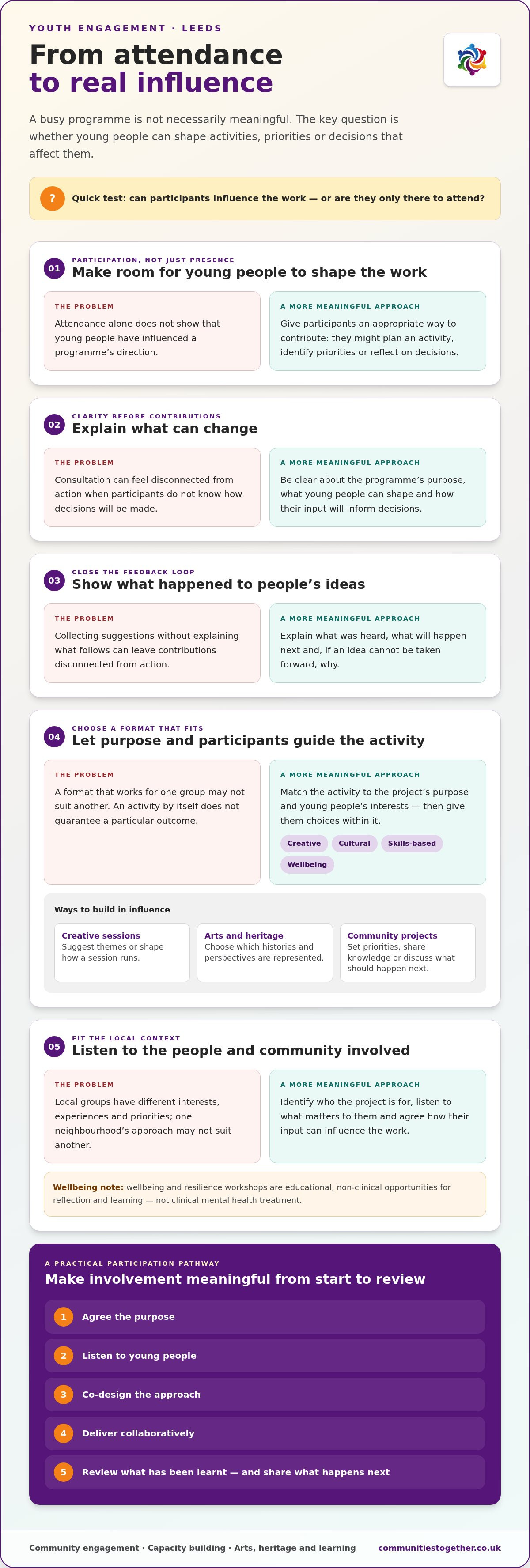
Use these five steps to build shared ownership from the outset:
Agree the purpose. Set out the community aim and identify the decisions participants can help shape.
Listen. Give young people and relevant community partners an early opportunity to share interests, experiences and priorities before the format is fixed.
Co-design. Use those contributions to develop the activity, agree how people can take part and make responsibilities clear.
Deliver collaboratively. Keep participants involved as the work unfolds, with room to adapt activities in response to what you learn.
Review learning. Gather feedback, reflect on what happened and explain how it will inform future activity or decisions.
Choose who to involve based on the purpose, not on an assumption that every project has the same audience. Consider which young people have a stake in the issue, whose perspectives may be missing and which local community groups or partners have relevant relationships or knowledge. Across Leeds, priorities and connections differ between communities, so early listening can help shape both who takes part and how.
Choose activities once you have agreed the purpose and heard what participants are interested in. Creative, cultural, learning or wellbeing activities may each provide a useful setting for engagement, but the format should support the decisions and contributions the programme is designed to make possible. A wider community engagement programmes guide can also help organisations consider how partnership supports inclusive participation and local capacity building.
How can partners review engagement and sustain learning?
Build reflection into delivery rather than leaving it until the project has finished. Partners can agree when they’ll pause to hear feedback, how it will be recorded and who will share updates with participants. After each reflection point, explain what the feedback suggests, what may change and why some proposals might not be taken forward.
Partnership and capacity building can help carry learning beyond a single event, supporting relationships and shared practice for future work. Communities Together delivers community engagement and capacity-building programmes and works with local partners across Leeds and neighbouring West Yorkshire locations.
How Communities Together can support youth engagement programmes in Leeds
Meaningful youth engagement depends on more than selecting an activity. It needs a clear community purpose, thoughtful partnership and a process that makes room for young people’s perspectives. Communities Together works with local partners through community engagement and capacity-building programmes, connecting participation with community development, learning and cultural activity.
What can Communities Together bring to a collaborative programme?
Communities Together works across Leeds and neighbouring West Yorkshire locations, including Huddersfield, Halifax, Bradford and Wakefield. This local partnership work can be shaped around the community, the programme’s aims and the people it hopes to involve.
South Asian arts and heritage activities can offer culturally grounded ways to explore identity, experience and community themes. Learning, skills, wellbeing and resilience workshops can also form part of a wider engagement approach. Let the programme’s purpose and participants’ interests guide activity choices, rather than treating an activity as a guaranteed route to a particular outcome. Young people can help shape content and direction, while partners bring together local knowledge, relationships and resources.
Partnership and community capacity building can create a foundation for sustained work. Rather than treating an event as a stand-alone opportunity, organisations can plan how to share responsibilities, gather feedback and carry learning into future activity. This supports a more connected approach to youth engagement programmes Leeds communities can help shape.
What are practical next steps for Leeds organisations?
Before starting a partnership conversation, clarify the community purpose and the role young people could have in shaping the work. Consider which perspectives are relevant, what local priorities are already known and what you still need to learn. Sharing this context early helps partners develop an approach that fits the intended participants and programme aims.
It also helps to outline how young people’s contributions will be considered, how partners will communicate updates and how learning will inform future decisions. Communities Together brings community engagement, cultural activity, personal development and local partnership work together to support organisations planning participation with Leeds communities.
Find out more about Communities Together’s community engagement support.
Build youth engagement around shared purpose
Strong youth engagement starts with a clear purpose and a genuine opportunity for young people to influence activities, priorities or decisions. When assessing youth engagement programmes Leeds, look for a thoughtful fit between the programme’s aims, young people’s interests and the ways their contributions will be heard and considered.
Creative, cultural, skills-based and wellbeing activities can each offer routes into participation, but the right approach depends on the people and community involved. Planning together, responding transparently to feedback and reviewing what has been learnt can help keep engagement meaningful beyond a single event.
Communities Together works collaboratively with local partners through community engagement and capacity-building programmes. Its activities span South Asian arts and heritage, wellbeing, resilience and skills development, with work across Leeds and neighbouring West Yorkshire communities. These approaches can support locally grounded participation and partnership.
A considered first step can create space for young people’s perspectives and stronger collaboration. With a shared purpose and an open approach, your next programme can grow from what matters to the community.
Frequently Asked Questions
What are youth engagement programmes?
Youth engagement programmes involve young people in shaping activities, priorities or decisions that affect them. They may include creative sessions, cultural activities, learning opportunities or community projects, but attendance alone doesn’t make a programme participatory. The key is whether young people have a meaningful opportunity to contribute, understand how their ideas are considered and hear what happens as a result.
How can an organisation find youth engagement programmes in Leeds?
Start by defining the community purpose and the young people you hope to involve, then explore local partnerships and community engagement opportunities that align with those aims. In Leeds, consider how city-wide participation initiatives such as Child Friendly Leeds relate to your project, while recognising that priorities differ between communities. Assess each approach by its purpose, accessibility, opportunities for influence and plans for responding to participants’ contributions.
What makes a youth engagement programme meaningful rather than tokenistic?
A meaningful programme gives young people a clear way to influence activities, priorities or delivery choices, and explains how their input will be considered. Consultation can feel tokenistic if people share ideas but receive no response or see no connection between their contributions and decisions. Organisers don’t need to adopt every suggestion, but should communicate what changed, what didn’t and why.
Can arts and heritage activities be part of youth engagement?
Yes. Arts and heritage activities can create opportunities to explore identity, experience and community themes, particularly when participants help shape the subject and direction. Young people might suggest which stories or cultural perspectives an activity should include. South Asian arts and heritage activities can be part of a wider engagement programme, with the format guided by the project purpose and participants’ interests.
How do you measure the success of a youth engagement programme?
Begin with the programme’s purpose and agree how you’ll review participation and learning, rather than relying on measures that haven’t been defined. Gather feedback during and after activities, consider whose perspectives were included and record how contributions informed decisions. A useful review explains what was learnt, what changed, what did not and why, then shares that account with participants and partners.
Who can work with Communities Together on youth engagement in Leeds?
Communities Together works collaboratively with local partners on community engagement and capacity building. Organisations and community groups can plan shared activity that connects participation with South Asian arts and heritage, wellbeing, resilience, learning or skills development. Its local work includes Leeds and neighbouring West Yorkshire communities, including Huddersfield, Halifax, Bradford and Wakefield. The approach can be shaped around the community purpose and relevant local priorities.
Are community wellbeing workshops a substitute for mental health treatment?
No. Community wellbeing and resilience workshops are non-clinical, educational activities and aren’t a substitute for clinical mental health treatment. They can form part of community development or a wider engagement programme, with topics shaped around its purpose and participants’ interests. Being clear about the workshop’s role helps participants understand what it offers and ensures wellbeing activities are represented accurately within the programme.


Comments