
How to start a community group in Halifax: examples of groups and collective action
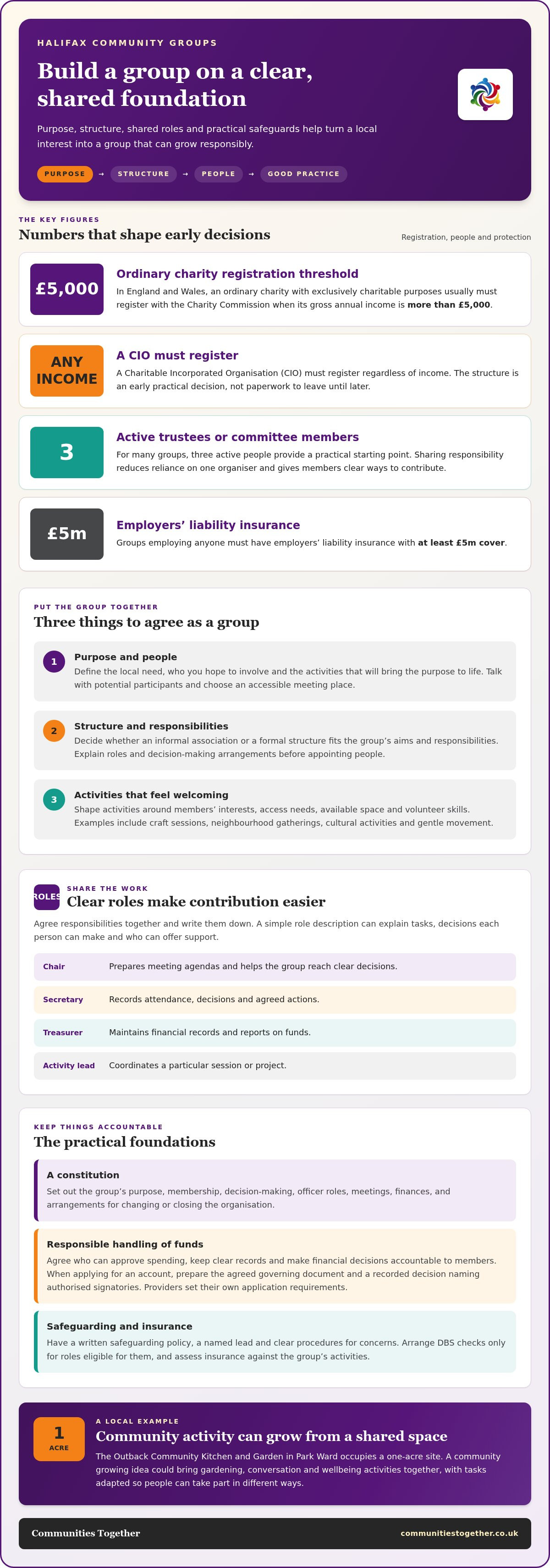
A formal structure isn’t always the first step: to decide how to start a community group in Halifax, define its shared purpose and activities, then choose whether an informal association or a formal structure fits its responsibilities. In England and Wales, an ordinary charity whose purposes are exclusively charitable usually must register with the Charity Commission if its gross annual income is more than £5,000; a Charitable Incorporated Organisation (CIO) must register regardless of income. That makes structure an early practical decision, rather than paperwork to leave until later.
It’s natural to want to bring people together quickly, especially when neighbours share a concern or an interest in culture, creativity or wellbeing. A clear purpose and shared roles give that energy a solid foundation.
This guide explains how to define your group’s aims, choose a structure and identify trustees or committee members to help organise its work. It also covers practical Halifax activity ideas and ways volunteers can turn shared interests into collective action, helping you build a welcoming group grounded in local needs.
Table of Contents
Local community groups and activities
In Halifax, a group can start with a local interest or need and shape activities around the people who want to take part. Craft sessions, neighbourhood gatherings, cultural activities and gentle movement can all help residents meet and contribute. Start by talking with potential participants, finding out what they want to do and choosing an accessible meeting place.
The Hub @ Bull Green in Halifax offers workshops, advice sessions, craft groups and wellbeing activities. This mix shows how a community setting can bring social connection and practical support together. For a local example of people meeting and organising in West Yorkshire, community spaces demonstrate how grassroots efforts thrive across the region.
Situation: People seeking sanctuary may face barriers to forming local connections. Action: A Halifax grassroots initiative brought people together through regular meet-ups, organised by Communities Together and local volunteers. Result: Shared activities can create opportunities for friendship, participation and belonging.
Physical activity can support mental and physical health, confidence, self-esteem and belonging for people who have fled their home countries. A group could begin with a short walk, seated movement or a simple dance session, then ask participants what feels welcoming and manageable. A familiar setting and encouragement from someone trusted can help people feel more confident about taking part.
Plan around the group’s actual capacity. Choose an activity that suits members’ interests, access needs, available space and volunteer skills. A short walk or gentle stretching may be easier to sustain than a complex programme. Community and voluntary groups in Calderdale can also include movement in regular plans, combining it with social time rather than treating it as a separate event.
For example, the Outback Community Kitchen and Garden in Park Ward occupies a one-acre site. A group inspired by community growing could combine shared gardening with conversation and wellbeing activities, adapting tasks so people can participate in different ways. After each session, review attendance and feedback, then adjust the activity, timing or format together.
Groups that handle funds should agree who can approve spending, keep clear records and make financial decisions accountable to members. When applying for an account, prepare the group’s agreed governing document and a recorded decision naming authorised signatories. Account providers set their own application requirements.
Safeguarding begins with a written policy, a named lead and clear procedures for concerns. Arrange appropriate DBS checks only for roles eligible for them, and assess insurance against the group’s activities; groups employing anyone must have employers’ liability insurance with at least £5m cover.
A constitution should set out the group’s purpose, membership, decision-making, officer roles, meetings, finances and arrangements for changing or closing the organisation. Start with a model constitution from a community-sector support organisation, then adapt it collectively. According to the Charity Commission, an ordinary charity whose purposes are exclusively charitable usually must register if its gross annual income is more than £5,000.
Trustees and committee members
A community group needs people to share responsibility, make decisions and keep activities moving. For many groups, three active trustees or committee members provide a practical starting point. In Halifax, these roles might include a treasurer tracking spending, a secretary recording decisions and a chair keeping meetings focused. Shared roles reduce reliance on one organiser and give members clear ways to contribute.
The structure you choose affects what these roles involve. A charity has trustees responsible for its governance, while an unincorporated association may have a committee elected by members. Before appointing anyone, explain the group’s purpose, expected tasks and decision-making arrangements. Make sure everyone understands the time involved and how responsibilities will be shared.
Situation: A Halifax group plans regular cultural activities, but one volunteer is organising everything. Action: The group invites members to take on distinct roles, such as coordinating sessions, keeping accounts and welcoming participants. Result: Responsibilities are shared, decisions are recorded and the group can plan beyond its next activity.
Agree responsibilities together and write them down. A simple role description can set out tasks, decisions each person can make and who can offer support. For example, a treasurer could prepare a financial update for each committee meeting, while activity leads report what participants need. Other volunteers can help with operational tasks, rather than placing every responsibility on trustees or committee members.
Chair: prepares meeting agendas and helps the group reach clear decisions.
Secretary: records attendance, decisions and agreed actions.
Treasurer: maintains financial records and reports on funds.
Activity lead: coordinates a particular session or project.
Set a meeting schedule that suits the group’s workload. A short agenda could cover upcoming activities, participant feedback, spending and outstanding tasks. Share notes afterwards, with a person responsible and a next step for each action. These habits support accountability without making a small group’s administration unnecessarily complex.
Plan for changes in people’s circumstances. Keep role descriptions and important records somewhere shared and accessible, and discuss handovers before someone steps down. If a committee member leaves, the remaining members can review urgent responsibilities and invite another participant to take them on. Clear processes help maintain continuity and keep decisions connected to members’ needs.
Make participation inclusive from the start. Offer different ways to contribute, such as helping at an activity, welcoming newcomers or reviewing plans. Ask members what they feel comfortable doing, and revisit roles as the group develops. Trustees and committee members provide structure, while a wider circle of contributors helps the group stay rooted in its community.
Three active trustees or committee members can be a useful starting point for reviewing how responsibilities are shared. Focus on whether there are enough people to carry out the group’s agreed roles, and revisit the arrangement if activities or members’ availability change.
Volunteering and social connection
Volunteers help turn a shared interest into a regular opportunity to meet, contribute and build relationships. In Calderdale, people may feel more confident trying activities when someone they know invites them and the setting feels familiar. Make welcoming newcomers part of the group’s plan, rather than leaving introductions to chance.
A new Halifax group can find members by sharing a clear invitation through residents’ existing networks, local noticeboards and community contacts. For meeting places, identify accessible community spaces and approach them with your activity, likely attendance, preferred times and practical requirements. Local examples include the Maurice Jagger Centre, 0.2 miles from Halifax town centre, and St Augustine’s Centre, 0.7 miles away.
Situation: A few neighbours want to start a shared activity but don’t know who else might join. Action: They ask trusted contacts to invite people, then hold an introductory gathering in a familiar local setting. Result: Participants can meet organisers, suggest activities and decide whether they want to volunteer or attend.
Make the first invitation specific. Explain what people will do, where the group plans to meet, how often it expects to gather and who can attend. For a craft session, for example, describe the activity and say whether beginners are welcome. Clear details help people decide whether the group suits their interests and circumstances.
Offer different ways to help. One volunteer could welcome attendees, another prepare materials, and someone else share updates with members. Small, defined tasks let people contribute without taking responsibility for running the whole group. Ask volunteers what they enjoy and review roles as the activity develops.
Choose a meeting routine that people can remember. The Hub @ Bull Green is open Monday to Thursday from 9am to 5pm, and on Fridays from 9am to 4pm. These published opening hours offer a practical reference when considering daytime activities nearby, though groups should arrange their own suitable meeting space.
For a wellbeing activity, consider how the format can support conversation as well as participation. A gentle walk, shared craft or informal discussion gives people something to do together, making it easier to arrive without knowing anyone. Invite participants to suggest adjustments, such as a quieter activity or a different meeting format.
After each gathering, ask attendees what helped them feel included and what they would change. Record practical suggestions, then agree one or two actions before the next session. This simple feedback loop helps volunteers improve the welcome, strengthen social connection and shape activities around members’ experience.
Choosing a group's purpose, audience and name
A strong purpose describes the change your group wants to make, not just the activity it plans to run. “Weekly craft sessions” explains what happens, while “helping residents build connections through shared crafts” explains why. If you’re considering how to start a community group in Halifax, begin by identifying a local need, finding out who experiences it and discussing what a group could do together.
Use a short planning exercise with potential members. Ask everyone to complete three prompts: “Our group exists to…”, “We welcome…” and “We will meet to…”. Compare the answers and agree on wording that reflects a shared aim. If participants identify different needs, note them and decide which one the group can realistically focus on first.
Situation: Residents want more opportunities to share cultural skills, but ideas range from cooking to storytelling. Action: They discuss which activity could bring people together and what participants hope to gain. Result: The group can choose a clear starting focus, such as a regular storytelling circle, and return to other ideas later.
Define your audience inclusively and precisely. “Everyone in Halifax” sounds welcoming, but offers little guidance on timing, access or suitable activities. A group might focus on local families, older residents, people interested in a particular craft or neighbours seeking social connection. Keep the invitation open to others if that fits the group’s purpose.
Test the proposed purpose against practical questions before adopting it:
Need: Which local experience or interest will the group address?
Activity: What will members actually do together?
Capacity: Can volunteers sustain the activity with available skills and time?
Outcome: What would participants notice if the group is useful?
Choose a name that helps people understand the group and feel invited to join. Pick words that are easy to say, remember and share on a noticeboard. A name that refers to Halifax and a shared activity, for instance, may be clearer than an abstract phrase. Ask potential members what they think of the name and whether it represents the intended audience.
Before settling on a name, search local listings and online to see how it is already used, and consider whether it could be confused with another group. Keep a second option ready. Record the agreed name, purpose and audience in meeting notes so future members understand the decision and can help keep activities aligned.
For those planning how to start a community group in Halifax, it also helps to distinguish a charitable purpose from the activities a group organises. The Charities Act 2011 sets out 13 statutory charitable purposes; consider whether the group’s aims fit before building plans around that route. A clear purpose helps guide decisions, explain the group to residents and assess whether new activities belong within its shared remit.
Community organising and collective action
Collective action begins when residents move from identifying a shared concern to deciding what they can change together. In Halifax, that could mean making a local activity more accessible, preserving a cultural tradition or creating stronger connections. Build momentum by listening first, agreeing on a specific priority and inviting people affected by it to shape the response.
Turn discussion into a practical organising process. Start with conversations across the neighbourhood, rather than relying only on the views of the first attendees. Note recurring concerns and existing strengths, such as local skills, relationships, meeting places or organisations working on related issues. Then agree on one achievable change, who needs to be involved and what the group will do next.
Listen: collect residents’ experiences through informal conversations or a focused meeting.
Map: note people, skills, organisations and community spaces that could contribute.
Prioritise: choose a shared issue the group can act on with its current capacity.
Agree: assign a lead, a next step and a way to report progress to members.
Situation: Residents find that a local gathering doesn’t reflect the cultural interests of everyone nearby. Action: They speak with those residents, invite them to help shape an activity and agree how to raise the idea with relevant local organisations. Result: The group develops a shared proposal grounded in residents’ experiences, rather than assumptions made on their behalf.
Partnerships work best when everyone understands their role. A residents’ group can bring first-hand knowledge, while a community organisation may help convene discussion or connect people with relevant activities. Set out the shared aim, each partner’s contribution and how decisions will be made. Clear agreements make collaboration easier to sustain and help ensure one voice does not dominate.
Keep collective action manageable. Break a broad concern into a first step, such as gathering residents’ views, inviting an organisation to a discussion or piloting a small activity. Record who will take each action and when the group will review progress. At the next meeting, discuss what happened and decide together whether to continue, adapt or try another approach.
Track progress using evidence members can observe: who took part, what they contributed and what changed after the group acted. For example, a group seeking more inclusive local activities could record suggestions, changes made and participant feedback. Share these updates with residents and partners so they can see how contributions inform decisions and future priorities.
Collective action is not simply a campaign or a meeting; it is a continuing practice of listening, shared decision-making and accountable follow-through. For groups seeking support to strengthen collaboration and local capacity, explore community capacity building.
Communities Together: Community Engagement Programmes
Communities Together supports groups seeking to strengthen participation, local relationships and shared activity through its Community Engagement Programmes. If your group in Halifax would benefit from help bringing residents together, developing partnerships or building its capacity, this could be a practical next step.
Its South Asian Arts and Heritage Activities and Heritage and Cultural Preservation work can support groups developing cultural participation. Wellbeing and Resilience Workshops focus on collective wellbeing. These activities can complement a group’s aims and create opportunities for people to contribute, connect and sustain local initiatives.
To discuss community engagement and possible next steps, visit Communities Together.
Make your next step a shared one
You don’t need to settle every detail before bringing people together. Choose one practical next step, such as inviting Halifax residents to discuss an idea, trying an initial activity or asking a potential partner to help shape it. That first conversation can reveal what matters locally and who wants to contribute.
If you’re considering how to start a community group in Halifax, treat the first gathering as the start of a collaborative process, not a finished plan. Listen to different perspectives, agree on what to try next and keep the group’s purpose in view as it develops. Small, considered actions can give people meaningful ways to participate and strengthen local connections over time.
To develop community participation and shared activity in Halifax, take the next step with Communities Together.
Your idea can grow through the knowledge, commitment and care people bring to it. Start with one conversation and let the community shape what follows.
Frequently Asked Questions
Should our group be incorporated or unincorporated?
An unincorporated association may suit a group seeking a straightforward membership structure and shared rules. Consider an incorporated structure if the group expects to take on formal responsibilities, such as holding assets or entering agreements, and wants its governance arranged accordingly. A Charitable Incorporated Organisation must register with the Charity Commission regardless of income. Compare the group’s planned activities, responsibilities and capacity before deciding.
How do I find out whether a similar community group already exists in Halifax?
Search local listings and social media using the activity, audience and neighbourhood you have in mind. You can also ask community venues and organisations about groups they know. In Halifax, places such as the Maurice Jagger Centre or St Augustine’s Centre may be useful starting points. If you find a group with a similar focus, learn what it offers and where residents still see a need. Collaboration or a distinct activity may serve people better than duplication.



Comments