
Intercultural Dialogue Events in Leeds: Activities and Community
Shared activity, not formal debate alone, is what makes intercultural dialogue tangible. Intercultural dialogue events in Leeds include language exchanges, cultural conversations and creative activities that give people from different backgrounds a reason to meet, listen and learn together. In a city where people represent over 100 nationalities and speak over 175 languages, these gatherings can make cultural difference part of everyday community life.
It’s understandable to seek intercultural dialogue events in Leeds that offer more than a one-off meeting. Trust grows through respectful conversation, shared experiences and opportunities to participate. This article explores activities that bring people together, how they can strengthen relationships between communities, and ways they celebrate culture and heritage. You’ll also find examples of event formats and settings where dialogue can develop naturally, helping you recognise what makes a gathering welcoming and meaningful.
Table of Contents
Intercultural dialogue and discourse
Intercultural dialogue is a shared exchange in which people listen, contribute and learn across cultural differences. In Leeds, this can happen through public talks, language-focused events and discussions about community life. A Leeds Cultural Conversations event on online hate in football, held on 22 May 2025, shows how dialogue can address a specific issue through different perspectives.
Discourse involves more than presenting opinions. It also means considering whose experiences are heard, how ideas are expressed and what participants can learn from one another. Leeds Cultural Conversations has explored subjects ranging from language and literature in a world of data, on 3 April 2019, to Henry Lee and Indo-US trade, on 8 May 2019. These examples show how cultural exchange can connect everyday concerns with history, identity and wider public debate.
UNESCO’s short video introduces the meaning and community principles of intercultural dialogue:
For a listed event, use its event information and follow the stated booking or registration instructions. If the listing gives attendance details without a booking step, use those details to plan your visit.
Access depends on the venue and event format, so check the relevant event and venue information before travelling. For example, the Leeds Cultural Conversations seminar on Sir James Hudson is scheduled at Leeds City Library, LS1 3AB; disabled visitors can use the venue’s access information to plan around their requirements. Public transport planning also depends on the specific venue, so use its named location rather than assuming every event takes place in the same part of Leeds.
Dialogue can be formal, as in a seminar, or centre on everyday concerns, such as online hate in football. In either setting, participate constructively by listening carefully, asking questions that clarify rather than stereotype, and remembering that one person cannot represent an entire culture. These habits help keep discussion open and specific.
Leeds Cultural Conversations’ scheduled seminar, “The Yorkshireman Who Made Italy: Sir James Hudson at Turin, 1852-63”, is listed for 29 October 2026, from 12.00 to 13.00. Its historical focus offers a distinct example of how a local public event can examine relationships between places and cultures. Looking at the subject, format and venue together helps you choose a discussion that suits your interests and access needs.
A Leeds Cultural Conversations event on Vernon Lee's apparitional lesbians and transvestite hauntings took place on 5 February 2020. Its subject points to how cultural discussion can include the ways stories represent gender, identity and the uncanny.
An attentive discussion can make room for differing interpretations without treating any response as definitive. Participants can distinguish what a work depicts from the assumptions they bring to it, and consider how context shapes meaning. They can also examine challenging terminology, explain why it matters and listen when others describe its effects. The aim need not be agreement, but a more precise and respectful exchange. When a topic touches on identity, carefully framed questions help avoid reducing people to labels or treating one cultural perspective as universal.
Activities that bring people from different backgrounds together
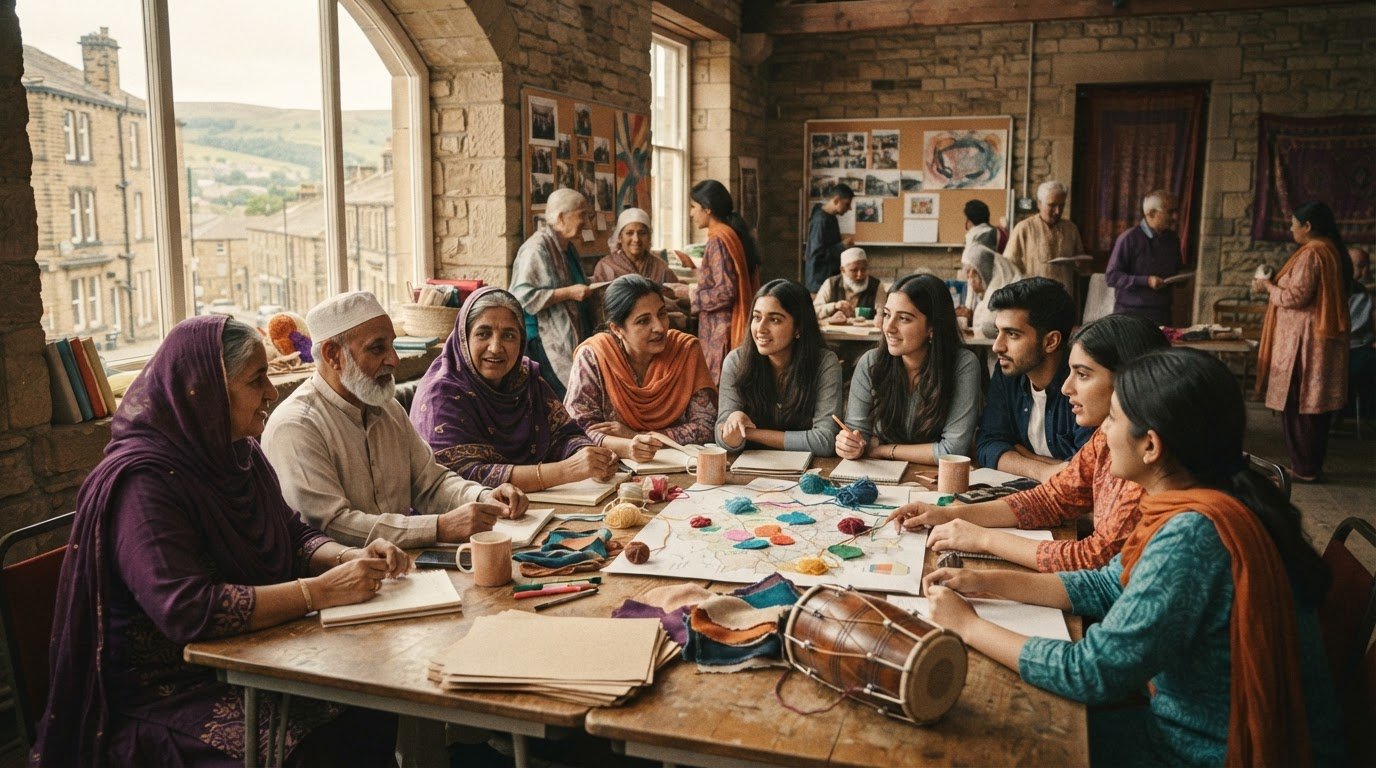
Shared activities offer practical ways to meet, exchange perspectives and take part in community life in Leeds. Language learning, creative workshops and public events each provide a different starting point.
Participation across communities
Taking part across communities means joining an activity with people whose experiences, languages or backgrounds differ from yours. Some events welcome a broad public audience; others focus on particular participants or learning aims. Read the event description to find a suitable fit.
Leeds City of Languages has a workshop with Ukrainian author Kateryna Mikhalitsyna, aimed at pupils aged 7 to 14. That age focus makes it different from a general public discussion, and shows how an event can bring cultural exchange into a particular learning setting. For adults, the online Leeds Language Exchange is free to attend and creates a shared purpose through language practice.
Leeds Language Exchange activities use conversation to make participation active rather than purely observational. At online sessions, participants are asked to spend at least 10 minutes in a breakout room for their native language, helping learners practise with a speaker. This format gives people a clear role: contribute what they know, listen to others and build confidence through reciprocal learning.
Organisations and event programmes offer opportunities to meet across backgrounds, including Leeds City of Languages, Leeds Language Exchange and Leeds Cultural Conversations. Formats range from language learning to public seminars, creating different ways to engage with culture and ideas.
Families can find activities designed for younger participants: the Leeds City of Languages workshop with Kateryna Mikhalitsyna is aimed at pupils aged 7 to 14. Its author-led format gives children a structured way to encounter another language and cultural perspective.
Event locations in Leeds
Events take place in varied settings across Leeds, from online rooms to cafés and public venues. The setting shapes how people meet, whether through a hosted conversation, a workshop or informal language practice.
The Saturday Leeds Language Exchange is listed at World Peace Café, Assembly St, Leeds LS2 7DE. The Thursday Leeds Language Exchange is normally held in the back room of The Griffin at 31 Boar Lane, Leeds LS1 5DA. These named venues help attendees distinguish between sessions and plan around the format and location.
Some activities centre on a shared subject, whilst others make conversation itself the main activity. “Surprise! (it's a poem!)”, a Leeds Cultural Conversations event held on 4 March 2026, used poetry as an entry point. A separate event about stopping looking at museums took place on 22 April 2026, showing how cultural discussion can also examine how people experience public collections.
For a more structured learning experience, Leeds City of Languages’ workshop for pupils aged 7 to 14 connects an author, young participants and language learning. For informal practice, the Leeds Spanish-English Language Exchange runs every Tuesday from 7:00pm to 10:00pm. Comparing the audience, activity and venue helps you choose a format that suits your interests and the way you prefer to participate.
Building trust between communities
Trust develops through repeated contact, fair listening and action that responds to community concerns. Leeds City Council’s six-week social cohesion survey engaged over 1400 residents from across all wards, offering a city-wide view of relationships and local challenges. Its findings show why intercultural dialogue needs both shared experiences and space for difficult conversations.
According to Leeds City Council, 86% of survey respondents felt people in Leeds get on extremely well or well. This positive assessment provides useful context, but it doesn’t mean every resident experiences community relationships in the same way. A dialogue event can create a setting to hear different perspectives, understand where experiences diverge and discuss what would help people feel included.
The survey also found differences between groups: according to Leeds City Council, 89% of White respondents felt positive about how well people get on, compared with 83% of Asian and Asian British respondents. These figures describe survey responses, not the views of every person in either group. They can help organisers consider whose voices are represented and whether event formats make participation comfortable and meaningful.
Trust-building also means acknowledging concerns without allowing them to define whole communities. According to Leeds City Council, 32% of respondents felt racism is an issue, while 24% were concerned about hate crime. A discussion about these topics should make room for lived experience, careful listening and clear ground rules, rather than expecting participants to speak for an entire community.
A constructive conversation can start with a simple practice: listen to understand before responding. Ask questions about what someone has shared, avoid assumptions based on their background, and recognise when an experience is personal rather than representative. In facilitated discussions, these habits keep disagreement focused on ideas and experiences, not stereotypes.
Organisers can build trust by making a gathering’s purpose clear, inviting contributions in different ways and following up on themes raised. A language exchange gives participants a shared task and a chance to contribute knowledge as well as learn. A public discussion about community concerns has a different purpose, making clear facilitation and respectful turn-taking especially important.
Leeds City Council’s survey figures are a starting point for reflection, not a complete account of every neighbourhood. Residents can use them to notice positive relationships as well as concerns that merit attention, then consider whether local events welcome a range of experiences. Trust grows through ongoing listening, learning and relationship-building beyond a single meeting.
These statistics offer a valuable starting point, while the city’s longer history offers context for how relationships develop over time. Leeds' population increased by 4.8% between 2001 and 2011 and by 7.4% between 2011 and 2021. Jewish communities began to appear in Leeds in the 1840s, adding another part of the city’s community history.
The event “History of Dialogue and Community Cohesion in Leeds: A Hindu Perspective” was scheduled in Leeds for 8 February 2010 at 18:00. Additional local initiatives, such as the Communities Together workshops and a Leeds Cultural Conversations event about community resilience in post-war Britain, took place to foster local engagement. Together, these examples reflect continuing attention to intercultural dialogue events Leeds and community resilience.
Celebrating differences
Celebrating cultural difference can begin with a story, an artwork, a shared tradition or a question about identity. Public events in Leeds have explored these themes through community history, storytelling and music, giving audiences different ways to encounter perspectives beyond their own.
One example is “Threads of Labour: Tapestry of an ex-industrial West Yorkshire community”, held on 10 December 2025. Its title connects creative practice with the history of a regional community, showing how heritage can be approached through work and place. For attendees, an event like this can prompt reflection on whose stories shape local memory and how different generations interpret them.
Folktales offer another route into cultural understanding. A Leeds Cultural Conversations event on 12 December 2024 explored folktales, storytelling and the politics of interpretation. That subject invites audiences to consider how stories change through retelling, who gives them meaning and how interpretation can reflect different experiences. Listening to several readings or viewpoints can make discussion richer than treating one version as definitive.
Music can also bring people together around familiar and unfamiliar cultural references. A Leeds Cultural Conversations event about BBC Radio 2 listeners, DJs and music took place on 27 February 2025. Participants can use a topic like this to compare how music is heard, remembered and valued, whilst recognising that people may attach different meanings to the same song or cultural moment.
Events about personal and family histories can widen that exchange. On 24 October 2024, Leeds Cultural Conversations explored women’s post-war holiday albums. Photographs and albums can open discussion about leisure, family life and changing social expectations. Attendees can approach such material by noticing details, asking how experiences differed, and avoiding assumptions that one family’s history represents everyone’s.
Other subjects connect cultural expression with wider questions. “The King’s dinner and the nation’s appetite”, held on 4 March 2020, placed food and national identity in the same conversation. An event exploring ageing, apocalypse and adaptation took place on 21 November 2024. Together, these examples show how culture can be discussed through everyday practices, creative ideas and social change.
To take part thoughtfully, start with the event’s subject and bring curiosity rather than assumptions. Ask what a story, artwork or tradition means to the people sharing it, and listen for differences within communities as well as between them. Leeds events about folktales, family albums and music show that cultural celebration need not reduce people to labels. It can make room for individual voices, varied interpretations and meaningful learning.
Where in Leeds are intercultural dialogue events held?
Events in Leeds take place in public venues, cafés and online, depending on their format. Check the named location to plan your journey, identify the right entrance and decide whether an in-person or online gathering suits you.
Leeds City Library hosts the Leeds Cultural Conversations seminar on Sir James Hudson, scheduled at LS1 3AB. A library setting can suit a structured talk, where attendees gather around a speaker and shared subject. For this seminar, the address provides a practical starting point for planning your visit and locating the venue.
Language exchanges use different settings. The Thursday Leeds Language Exchange is normally held in the back room of The Griffin, at 31 Boar Lane, Leeds LS1 5DA. The Saturday Leeds Language Exchange is listed at World Peace Café, Assembly St, Leeds LS2 7DE. Check the day and venue together, as the two listed sessions have different locations.
Online events offer a way to participate without travelling to a venue. The online Leeds Language Exchange provides a digital setting for language practice, including breakout rooms for conversation. Before joining, review the event instructions and consider the session format, such as taking part in a small-group discussion.
For in-person events, use the venue name and postcode to plan your route through Leeds. The library’s LS1 3AB address, The Griffin’s LS1 5DA address and World Peace Café’s LS2 7DE address distinguish the locations clearly. Allow time to find the correct room, particularly where an event uses a specific area such as The Griffin’s back room.
Access requirements vary between venues and event formats. Review the relevant venue information for details that matter to your visit, such as the entrance and room location. For online participation, read the joining instructions and consider whether the digital format suits the way you prefer to contribute.
When choosing an event, consider the kind of interaction you want. A seminar at Leeds City Library offers a different setting from a language exchange at a café, while an online session centres on digital conversation. Match the subject, format and location to your interests, then use the listing to plan practical details.
Compare the event’s venue, date and format before setting out. The addresses for Leeds City Library, The Griffin and World Peace Café distinguish in-person options, while the online exchange offers a remote alternative. This simple check helps you arrive prepared and focus on participating.
Use the venue name and postcode to plan your journey, and check venue information for details about the entrance and room location. Access requirements vary by venue; the online exchange offers a way to participate without travelling.
Communities Together: Community Engagement Programmes
Communities Together delivers Community Engagement Programmes for groups seeking to build participation, strengthen relationships and support collaboration across communities. Its South Asian Arts and Heritage Activities and Heritage and Cultural Preservation projects help communities share cultural knowledge, recognise local histories and keep traditions visible. Wellbeing and Resilience Workshops offer another way to support community connection in Leeds, Halifax, Huddersfield, Bradford and Wakefield.
These programmes are a useful next step when a group wants to develop engagement beyond attending a single event, or create opportunities for people to learn and contribute together. Work can reflect the community’s interests and priorities, bringing cultural activity, shared learning and relationship-building together.
Make space for the next conversation
Attending intercultural dialogue events in Leeds can be a starting point, not a one-off encounter. Consider what you’d like to carry forward: a new relationship, a shared idea or a better understanding of another person’s perspective. For community groups, the next step could be creating regular opportunities to meet, making participation easier for different voices or developing a shared activity around local priorities.
Small, consistent acts of listening can turn an event’s conversation into lasting community connection. You don’t need every answer before taking part; curiosity, respect and a willingness to learn are a strong foundation. If you’re shaping a community initiative, Communities Together’s engagement programmes and workshops can help you take the next step.
Every meaningful exchange creates room for understanding to grow. Keep the conversation going and help build a more connected Leeds.
Frequently Asked Questions
What kinds of activities are included in Leeds intercultural dialogue events?
Activities can include cultural workshops, performances, creative arts and conversations that encourage people to share perspectives. South Asian arts and culture activities may involve music, dance, visual arts, crafts or storytelling, giving participants different ways to engage with heritage. Some gatherings focus on learning through discussion, while others invite people to take part in a creative activity. Choose a format that feels comfortable and matches your interests.
How do I book or register for intercultural dialogue events in Leeds?
Check the event information and follow its stated booking or registration instructions. If no booking step is listed, use the attendance details to plan your visit.
Comments