
Writing Grant Proposals for Community Arts: 2026 Guide
Updated: Aug 19
A successful community arts proposal is far more than a simple request for financial support; it functions as a strategic social document that demonstrates how creative expression fosters collective resilience, maintains cultural continuity, and strengthens the structural fabric of our local neighbourhoods. You likely understand the frustration of navigating intricate funding landscapes where complex terminology often obscures the path to progress, particularly when you are learning how to write a grant proposal for community arts projects that must measure the intangible benefits of a South Asian heritage project or a local wellbeing workshop.
This guide offers a methodical framework for securing the resources your initiative deserves whilst ensuring you can effectively bridge the gap between creative vision and the rigorous requirements of bodies like the Arts Council or local West Yorkshire authorities. By following this roadmap, you'll discover how to link artistic practice to social wellbeing, gain the clarity needed to articulate your mission to diverse stakeholders, and develop the confidence to secure funding that supports long-term harmony, community capacity building, and personal development within our communities.
Table of Contents
Understanding the Funding Landscape for Community Arts
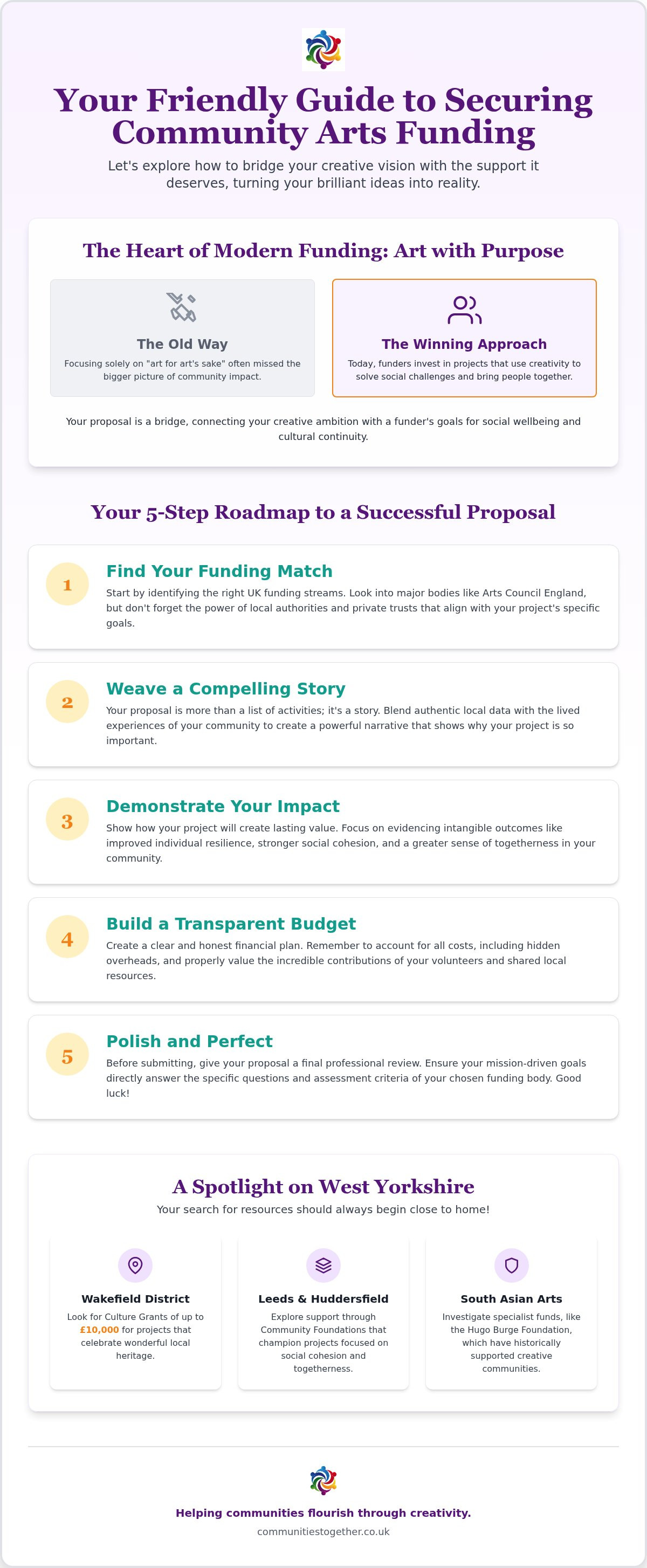
A community arts grant represents a formal agreement between a creative practitioner and a funding body to deliver specific social outcomes through the medium of artistic expression. When you are learning how to write a grant proposal for community arts projects, it's vital to view the document as a bridge between your creative ambition and the funder's strategic goals for social responsibility and cultural continuity. It's about more than the art. It's about the people. In the UK, the landscape is primarily anchored by major institutions such as Arts Council England and the National Lottery Heritage Fund, yet successful applicants often look towards a diverse tapestry of support that includes local authorities and private trusts. Understanding the grant writing process requires you to distinguish between project-specific funding, which supports a defined set of activities, and core organisational funding, which facilitates the internal resilience, stability, and growth of your group.
Mapping Local and National Funding Streams
For those operating within West Yorkshire, the search for resources should begin close to home, as local districts often provide targeted support for grassroots initiatives. In 2026, the Wakefield district is offering Culture Grants of up to £10,000 for projects that celebrate local heritage, whilst organisations in Leeds and Huddersfield can often access support through Community Foundations that prioritise social cohesion. If your work focuses on South Asian arts and heritage activities, you might also explore specialist funds like the Hugo Burge Foundation, which has historically supported creative communities with deadlines extending into July 2026. At Communities Together, we believe that identifying these niche streams is essential for maintaining the cultural fabric of our region.
Defining Your Project’s Social Purpose
Funders are increasingly moving away from supporting art for art's sake, choosing instead to invest in projects that address pressing social challenges such as social isolation, cultural fragmentation, or the erosion of local identity. Your proposal must clearly articulate how a specific creative workshop or exhibition will lead to improved individual wellbeing, collective endurance, and stronger togetherness amongst residents. This focus on holistic health is shared by charitable foundations like Incorporated Earth, which support entities and individuals in improving health, quality of life, and wellbeing. By establishing a vision that links artistic participation to measurable community resilience, you create a compelling narrative that resonates with the earnest, mission-driven priorities of modern stakeholders. You aren't just facilitating a workshop; you are building a foundation for long-term harmony and social responsibility that stakeholders can feel proud to support.
Crafting a Compelling Narrative: The Core Components
When considering how to write a grant proposal for community arts projects, your narrative must transcend a simple description of activities, functioning instead as a structured argument for social investment. The project summary serves as a vital introductory conduit, designed to capture the attention of assessors by distilling complex social ambitions into a concise, evocative statement of intent that highlights the intersection of creative practice and community welfare. To build a robust case, you must distinguish clearly between your broad aims, such as fostering long-term social cohesion, and your specific, measurable objectives, which might include delivering a set number of workshops or engaging a defined demographic of local residents. Whilst international frameworks like those provided by the National Endowment for the Arts offer useful structural benchmarks for project design, your proposal remains most persuasive when it is deeply rooted in the specific socio-economic realities of your target area.
Articulating Community Need in West Yorkshire
Evidence-based writing is the foundation of a successful application, requiring you to move beyond anecdotal claims by integrating local data with the authentic voices of those you serve. In districts like Halifax or Bradford, you might address specific challenges such as the erosion of oral histories or the isolation felt by elderly residents in post-industrial neighbourhoods. By gathering evidence through community consultations, informal workshops, and structured surveys, you can identify the precise gap your project intends to bridge. A strong proposal might state that your initiative provides a vital platform for intergenerational dialogue, thereby reducing social fragmentation and preserving the cultural continuity that defines our regional identity. If you require assistance in gathering this data or refining your project's social vision, our team at Communities Together can support you in building the necessary capacity for collaborative growth.
Designing Inclusive and Participatory Arts Activities
The methodology of your proposal should detail the participant journey, ensuring that your creative process is both transparent to non-artists and deeply inclusive of diverse South Asian traditions. You must demonstrate a high degree of professional literacy by addressing potential barriers to participation, including language differences, transport limitations, or digital exclusion, which can often hinder the reach of community programmes. By organising activities that honour heritage whilst teaching new skills, you facilitate a sense of collective endurance and structural strength within the community. Your description should explain how you will facilitate engagement from the initial outreach phase through to the final celebration of achievements, ensuring that every step of the process contributes to the overarching goal of building a more resilient and harmonious society.
Evidencing Impact: Social Cohesion and Wellbeing Outcomes
Securing funding in the 2026 landscape requires more than a vision; it demands a robust methodology for tracking how your creative interventions lead to tangible shifts in behaviour, attitude, and social connection. When you're refining your approach to how to write a grant proposal for community arts projects, you must demonstrate a sophisticated understanding of how to measure the "intangible" benefits of your work. This involves a balanced integration of quantitative data, such as attendance figures and demographic reach, alongside deep qualitative evidence that captures the personal transformations occurring within your workshops. Using participant testimonials and detailed case studies allows you to present a narrative of change that resonates with the earnest, mission-driven priorities of UK funders who value the human element of social investment.
Evidence of cultural continuity is particularly persuasive when proposing South Asian arts and heritage preservation initiatives. By documenting how traditional practices are being maintained and adapted by younger generations, you prove that your project isn't just a one-off event but a vital contribution to the collective endurance of your community. Whilst a comprehensive grant writing guide for artists can help you structure these arguments, your proposal's strength lies in its ability to show that you're a reliable facilitator of long-term social progress and cultural stability.
Tracking Social Cohesion and Togetherness
In diverse hubs like Leeds and Wakefield, funders are keen to see how creative practice can actively reduce the barriers that exist between different community groups. You should identify specific indicators of success, such as increased social trust or a renewed sense of collective pride in local heritage sites. By showing how your project encourages people from different backgrounds to collaborate on a shared creative goal, you provide evidence of Building Social Cohesion Through Arts in West Yorkshire. This approach turns an abstract concept into a measurable outcome that proves your project's role in strengthening the local social fabric.
Measuring Wellbeing and Resilience
It's vital to incorporate non-clinical wellbeing frameworks into your evaluation to show how participation leads to improved individual resilience and personal development. Instead of relying on medical terminology, focus on documenting the acquisition of transferable skills and the growth of self-confidence amongst your participants. Detailed guidance on this can be found in our Collaborative Wellbeing and Resilience Workshops: A Complete Guide. By tracking these milestones, you demonstrate a principled commitment to the holistic growth of your community, ensuring that your proposal stands out as a methodical and serious request for social investment.
Financial Planning and Collaborative Partnerships
Financial transparency serves as the bedrock of accountability within the grant writing process, ensuring that every pound requested is directly mapped to a specific social outcome or creative milestone. When you're developing your understanding of how to write a grant proposal for community arts projects, it's essential to view the budget as a financial narrative that reinforces your mission, demonstrates operational stability, and proves your commitment to fair practice. A well-constructed budget must account for all direct delivery costs whilst also acknowledging the necessary overheads that sustain the initiative, such as insurance, venue hire, and project management time. By presenting a realistic and thorough financial plan, you reassure funders that their investment will be managed with the high degree of professional literacy and social responsibility that the sector demands. Success requires financial clarity.
Beyond the cash requested, you should clearly value "In-Kind" support to show the full scale of community investment in your vision. This includes calculating the monetary value of volunteer hours, donated equipment, or the use of rent-free community spaces. Documenting these contributions proves that your project has local buy-in and a foundation of togetherness that extends beyond the grant period. To ensure the project leaves a meaningful legacy, your proposal must also outline a sustainability plan that details how the initiative will continue, perhaps through future partnerships or the acquisition of new skills that empower residents to lead their own creative activities.
Constructing a Robust Project Budget
Your budget should prioritise fair pay for artists and facilitators by aligning with established industry standards, such as those set by Artists' Union England or Equity. It's also vital to include inclusive access costs, which might involve budgeting for British Sign Language (BSL) interpreters, translation services for South Asian languages, or crèche facilities to support parents attending workshops. By ensuring a clear link between your proposed activities and your requested expenditure, you demonstrate that your project is both well-planned and deeply considerate of the diverse needs of your West Yorkshire participants. Precision builds donor confidence.
Leveraging Local Partnerships for Capacity Building
Strategic alliances with local schools, libraries, and heritage centres can significantly enhance your project's reach and impact. These collaborations allow for shared resources and collective growth, strengthening the local community infrastructure and creating a more resilient creative ecosystem. You can find more detail on this in our Community Capacity Building in the UK: A 2026 Guide. When partners work together, they weave a stronger social fabric that supports long-term harmony and cultural preservation.
Finalising Your Proposal: The Path to Successful Funding
The final stage of the grant writing journey is perhaps the most critical, as it requires a methodical transition from creative drafting to rigorous quality assurance. When you're refining how to write a grant proposal for community arts projects, you must ensure that your narrative remains consistently professional, earnest, and deeply aligned with the funder's mission-driven priorities. This period of reflection allows you to verify that your statement of intent is supported by a robust internal logic, where every activity is balanced by a corresponding social impact. Seeking external feedback from a peer or a mentor provides an essential academic distance, helping you to identify any areas where your social objectives might be obscured by overly technical language or specialized jargon. Each word should serve the overarching goal of proving your project's value to the social fabric.
If the outcome of your application is not what you hoped for, it's vital to treat the feedback as a constructive tool for collaborative growth rather than a definitive failure. Most major UK funders provide detailed assessment notes that can highlight specific gaps in your evidence of impact or your financial planning. By using this information to refine your approach, you build the structural strength and resilience needed for future success. A principled expert understands that the path to securing resources is often iterative, requiring a steady commitment to the organisation's core values and a willingness to adapt in response to professional critique. Maintaining this earnest perspective ensures that your next submission is even more grounded in the realities of community development.
A Final Checklist for Community Arts Applications
Before you press submit, take a deliberate moment to cross-reference your application against the funder's specific assessment criteria. This thoroughness ensures that your proposal presents as a reliable and stable foundation for social investment, demonstrating that you possess the expertise to manage public funds responsibly.
Supporting Documentation: Confirm that you have attached all required annexes, including up-to-date accounts, safeguarding policies, and the professional CVs of your key creative facilitators.
Financial Accuracy: Verify that your budget balances perfectly and that the narrative provides a clear, transparent justification for every line of expenditure.
Timeline Feasibility: Check that your project timeline is realistic, ensuring it accounts for potential delays in recruitment, participant engagement, or venue availability.
How Communities Together Supports Local Groups
At Communities Together, we act as an authoritative bridge-builder for organisations across West Yorkshire, offering specialised workshops that focus on learning, skills, and personal development for community leaders. Our mission is to empower local groups in Huddersfield and Halifax by facilitating the partnership building and capacity building necessary to navigate the complexities of the public sector. We believe that by weaving together the unique threads of our local social fabric, we can create a more harmonious and resilient region for everyone. If you're seeking to strengthen your next bid or want to develop your team's professional literacy in cultural heritage, we invite you to join our mission to foster collective growth; contact us today for capacity building support.
Empowering Local Creative Initiatives for Long-Term Impact
Mastering how to write a grant proposal for community arts projects is a rewarding journey of professional development that requires you to balance your creative vision with a principled commitment to social accountability, community resilience, and cultural continuity. By aligning your mission with the strategic goals of regional funders, providing robust evidence of social cohesion outcomes, and building transparent financial plans that value every local contribution, you establish a stable foundation for projects that truly resonate with the social fabric. As specialists in South Asian arts and heritage preservation, we're dedicated to supporting local resilience across Yorkshire through expert facilitation in community skills, personal development, and collaborative growth workshops.
We believe that your initiative has the power to foster togetherness, maintain the structural strength of our neighbourhoods, and inspire a lasting sense of collective pride amongst all residents. Our team remains committed to helping you navigate these complex funding streams whilst ensuring your creative voice remains clear, earnest, and impactful for the benefit of the whole community.
We look forward to collaborating with you as you weave your unique creative thread into the vibrant tapestry of our community.
Frequently Asked Questions
What are the most common mistakes in community arts grant proposals?
The most frequent errors involve a lack of alignment between the project's creative vision and the funder's specific social objectives, often resulting in a narrative that fails to prove how the work will facilitate long-term change. When you are learning how to write a grant proposal for community arts projects, it's vital to avoid vague descriptions of artistic practice and instead focus on the methodical delivery of social impact, togetherness, and structural strength within the neighbourhood. Unrealistic budgets that neglect inclusive access costs or fair pay for facilitators also signal a lack of professional literacy to potential stakeholders.
How do I prove that there is a genuine need for an arts project in my local area?
Demonstrating a genuine local need requires the integration of objective local data with the authentic, lived experiences of your community members through structured consultations and neighbourhood surveys. You should identify specific social challenges, such as cultural fragmentation or social isolation in post-industrial districts, and explain how your creative intervention acts as a methodical solution to these issues. This evidence-based approach ensures your proposal is viewed as a serious request for social investment that supports the collective endurance of the local social fabric.
Can an individual artist apply for these grants or must it be a registered charity?
Eligibility varies significantly between funding streams; whilst many private trusts require you to be a registered charity or a Community Interest Company (CIC), several public funds remain open to individual creative practitioners. For example, Arts Council England's National Lottery Project Grants often support individuals who can demonstrate a commitment to community engagement and social responsibility. You must carefully review the specific criteria of each funder to ensure your governance structure aligns with their requirements for accountability and collaborative growth.
What is the difference between an output and an outcome in a grant application?
An output is a quantitative measure of activity, such as the number of workshops delivered, whereas an outcome describes the meaningful change in behaviour, attitude, or social connection that occurs as a result of that activity. For instance, facilitating a series of South Asian heritage sessions is a project output, but the resulting increase in participant resilience and cultural continuity represents the social outcome. Funders in 2026 are increasingly prioritising these long-term outcomes as they seek to build a more harmonious and stable society.
How much detail should I include in the project budget?
Your project budget should be exceptionally detailed, accounting for every pound of expenditure from professional artist fees to "hidden" overheads like insurance and venue hire. It's essential to demonstrate a transparent link between the requested funds and the delivery of your mission-driven goals, including specific allocations for inclusive access such as translation services or crèche facilities. This level of precision reassures governing bodies that you possess the methodical expertise to manage resources with integrity and professional accountability.
What happens if our community project does not meet all the original objectives?
If your project encounters unforeseen challenges that prevent you from meeting every original objective, the most professional course of action is to maintain an open and honest dialogue with your funding officer. Most institutions value the "learning" that emerges from community delivery and are often willing to facilitate a variation in the grant agreement if you can prove a continued commitment to the project's core social purpose. Transparency in the face of difficulty demonstrates a principled approach to project management and builds trust with your partners.
How can I demonstrate that my project will be inclusive of diverse backgrounds?
Inclusivity is demonstrated by proactively identifying and removing the structural barriers that might prevent diverse residents from participating in your creative activities, such as language differences or transport limitations. You should detail a methodology that respects diverse South Asian traditions whilst fostering a sense of collective endurance amongst all participants. Proving that your project is designed to bridge cultural gaps and enhance local social cohesion shows a deep understanding of how to write a grant proposal for community arts projects that serve the whole community.
Are there specific funders who focus on South Asian heritage and arts in the UK?
Yes, several organisations, including the National Lottery Heritage Fund and the Hugo Burge Foundation, have specific priorities related to cultural heritage preservation and South Asian arts. These funders often seek projects that maintain tradition whilst building new skills and community capacity across West Yorkshire's diverse neighbourhoods. When applying to these bodies, it's essential to highlight how your initiative facilitates cultural continuity and strengthens the social threads that bind our local communities together.


Comments