
Understanding Segregation in the UK: Challenges and Pathways to Social Cohesion
Updated: Aug 21
What if the perceived distance between our diverse communities is not an inevitable feature of modern life, but rather a reflection of the missed opportunities we have to engage with one another through shared cultural experiences and heritage? Many residents across West Yorkshire and the wider country feel a quiet anxiety regarding the visible reality of segregation in the uk, observing how different ethnic groups can often live in close proximity yet remain socially distant within their own neighbourhoods. It's understandable to feel a sense of powerlessness when faced with these complex patterns of residential separation, especially when the historical and economic drivers of such divisions seem so deeply entrenched in our urban centres.
This article explores the multifaceted challenges of social cohesion whilst demonstrating how community-led initiatives, particularly those focused on South Asian arts and heritage, are actively building stronger and more inclusive environments. We'll provide a clearer understanding of the current social landscape, offer actionable ideas for fostering local integration, and help you build the confidence to support the vital work of community engagement programmes that are weaving a more resilient social fabric for everyone.
Table of Contents
Defining Segregation and Social Cohesion in the British Context
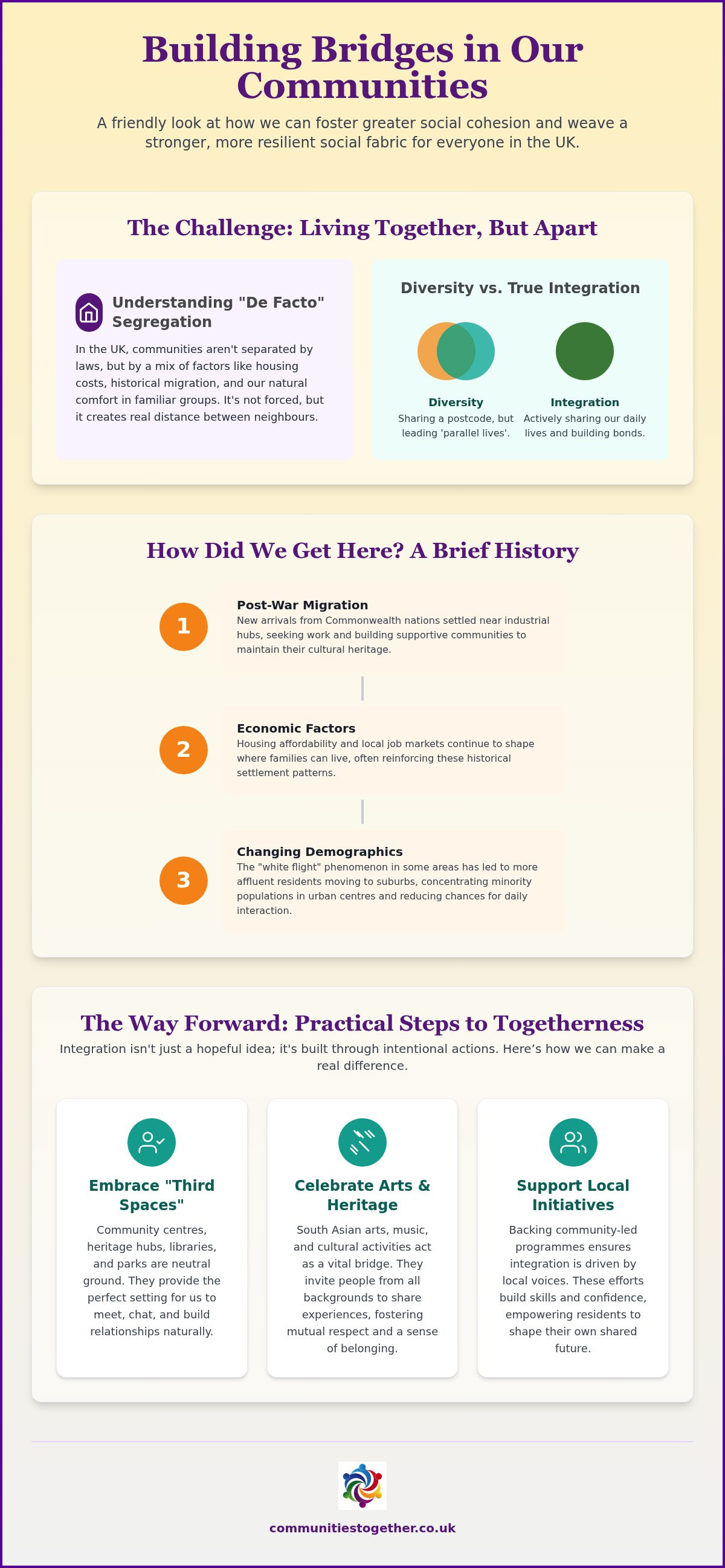
In the British context, segregation is defined as the physical and social separation of individuals or groups based on their ethnic or religious identities. Unlike the forced legal systems seen in other parts of the world's history, segregation in the uk is largely "de facto," meaning it arises from a complex interplay of housing affordability, historical migration patterns, and the natural human tendency to seek comfort amongst those with similar backgrounds. Understanding this distinction is vital because it shifts our focus from dismantling laws to building bridges. Social cohesion acts as the essential counterweight to this separation, representing the active, ongoing process of fostering shared values, mutual trust, and a sense of belonging for all residents. Striking this balance is essential for the future of British community life, as it ensures our neighbourhoods remain stable, harmonious, and capable of withstanding external social pressures.
The Difference Between Diversity and Integration
Living in a diverse neighbourhood is a wonderful start, but it doesn't always guarantee that people from different backgrounds actually talk to each other. In many Northern English towns, we see the phenomenon of "parallel lives," where communities live side-by-side yet move in entirely different social circles, attend different schools, and use different local amenities. True integration requires us to move beyond simply sharing a postcode; it involves the active interweaving of our daily lives through shared activities and mutual support. Social cohesion in a UK community context is the intentional creation of shared bonds through trust, mutual respect, and the collective participation of every resident in the life of their neighbourhood.
How We Measure Social Division Today
We often look at residential patterns and school catchment areas to understand the extent of segregation in the uk. These metrics provide a useful snapshot of where people live and learn, but they're often supplemented by the concept of "social distance," which measures how comfortable different groups feel about interacting with one another in private and public spaces. Whilst statistics from the Office for National Statistics (ONS) offer a structural overview, they only tell half the story. The rest is found in the lived experience of residents, whose daily interactions, or lack thereof, define the true strength of our social fabric. When we measure social distance, we're really looking at the potential for empathy and collaboration across cultural lines, which serves as the foundation for a truly resilient and inclusive society.
The Evolution of Residential and Social Patterns in the UK
The landscape of segregation in the uk today is deeply rooted in the post-war era, when migration from Commonwealth nations began to reshape the urban environments of our northern towns and cities. During this period, the formation of ethnic enclaves was often a practical response to economic necessity, as new arrivals sought housing near industrial hubs and manufacturing centres where employment was readily available. These early settlement patterns were not merely accidental; they were the result of families seeking to establish a sense of belonging, to build social networks of support, and to maintain their cultural heritage in a new environment.
Economic factors continue to play a decisive role in maintaining these patterns, as housing affordability and proximity to specific job markets often dictate where families can afford to settle and grow. We also observe the "white flight" phenomenon in parts of West Yorkshire, where more affluent, predominantly white British residents move to suburban or rural areas, leaving urban centres with concentrated minority populations. This trend often accelerates the process of segregation in the uk by reducing the opportunities for spontaneous, everyday interactions between different social groups. This physical separation is increasingly reinforced by digital echo chambers, where social media algorithms can limit our exposure to different viewpoints, reinforce existing prejudices, and effectively create virtual walls that mirror our physical boundaries.
The Impact of the Industrial Past on Modern Towns
The textile industry in Leeds and Bradford established specific housing patterns that remain visible today, characterised by dense rows of terraced housing built originally to accommodate mill workers. These architectural legacies facilitated community clustering by providing affordable, high-density living spaces where families could support one another through shared labour and proximity. Whilst these areas once functioned as industrial shared spaces where diverse groups interacted daily on the factory floor, the decline of manufacturing has often led to modern residential isolation. Today, without the common ground of the workplace to facilitate interaction, these neighbourhoods risk becoming siloed, making the role of local community hubs even more critical for fostering togetherness.
Why People Choose to Live Amongst Their Own Groups
Choosing to live amongst one's own group is often driven by a natural desire for the comfort of shared language, familiar religious institutions, and cultural amenities that reflect personal traditions. For many minority communities, living in close proximity also provides a vital sense of "safety in numbers," offering protection, psychological security, and a collective voice whilst facing the reality of discrimination. People often seek out neighbourhoods that offer:
Shared linguistic roots and familiar cultural nuances that ease daily communication.
Religious institutions that provide both spiritual guidance and essential social support networks.
Specific grocery shops and community centres that cater to their unique dietary and social needs.
Balancing this legitimate need for cultural preservation with the broader goal of wider integration remains a complex challenge for our society. We believe that supporting heritage and cultural preservation can actually serve as a gateway to broader social interaction, helping to build the confidence needed to engage with the wider community in a meaningful and lasting way.
Beyond Statistics: The Impact of Separation on Community Resilience
When we look beyond the geographical mapping of our towns, it's clear that the true cost of segregation in the uk is measured by the gradual weakening of our social fabric and the reduction of our collective resilience. A neighbourhood's strength isn't just found in its infrastructure, but in the invisible threads of trust and mutual support that connect residents from different backgrounds. When these threads are absent, communities become more vulnerable to external pressures, as the lack of shared purpose makes it harder to organise collective responses to local challenges or economic shifts. This social distance doesn't just create quiet streets; it creates a silence that can be filled by misunderstanding and a sense of disconnection from the wider society.
Social isolation within divided neighbourhoods often leads to a measurable decline in mental health, as residents lack the diverse support networks that provide emotional and practical stability during difficult times. Without regular, meaningful interaction, a vacuum of understanding is created where misconceptions and prejudice can take root, turning the "unknown" into a source of fear rather than a potential for friendship. The economic implications are equally significant, as reduced social networking across ethnic lines limits access to employment opportunities, restricts the flow of skills, and hinders the growth of local businesses that could thrive in a more integrated environment. By addressing the reality of segregation in the uk, we can begin to unlock the hidden potential of our diverse urban centres and build a more prosperous future for everyone.
Erosion of Trust and Shared Identity
The Resilience Gap in Divided Communities
Integrated communities are inherently better equipped to handle social and economic shocks because they possess a rich diversity of perspectives and resources that can be mobilised in times of crisis. Sociologists often distinguish between "bonding social capital," which strengthens ties within a group, and "bridging social capital," which creates vital links between different communities. Through our wellbeing workshops, we actively address these resilience gaps by providing residents with the tools to manage stress whilst building the interpersonal skills needed to reach out across cultural boundaries, ultimately ensuring that no neighbourhood is left to face challenges in isolation.
Practical Strategies for Fostering Integration and Togetherness
We believe that addressing the challenges of segregation in the uk requires more than just top-down policy; it necessitates the practical application of the "Contact Hypothesis," which suggests that meaningful, sustained interaction between diverse groups is the most effective antidote to prejudice and social distance. We facilitate this through the creation and maintenance of "Third Spaces," such as community centres, public parks, and arts hubs, which provide a neutral and welcoming ground for residents to meet outside of their usual social circles. Working together on shared projects, whether it's a community garden or a local history exhibition, allows individuals to focus on common goals, shared achievements, and mutual dependencies, effectively dissolving the barriers that physical separation often creates. Facilitating difficult conversations in a safe and friendly environment is equally crucial, as it allows for the honest expression of concerns whilst maintaining a foundation of respect, empathy, and collective growth.
Using Arts and Heritage as a Universal Language
South Asian arts and heritage serve as a universal language that transcends cultural boundaries, offering an accessible entry point for people of all backgrounds to engage with their neighbours. Our heritage preservation projects have demonstrated significant success in building intercultural pride, particularly in towns like Huddersfield and Halifax. By celebrating these shared stories, we help to create a sense of belonging that values both our unique traditions and our collective future.
Building Capacity in Local Leadership
Empowering diverse community leaders to act as bridge-builders is essential for ensuring that integration efforts are sustainable and locally led. Through inclusive community programmes, we provide the training and support necessary for local voices to lead the way in organising events that encourage genuine cross-cultural friendship. The long-term reduction of segregation in the uk relies on these grassroots efforts to ensure every resident feels empowered to contribute to their neighbourhood.
The Role of Community Engagement in Building a Shared Future
Top-down government policies, whilst often well-intentioned and structurally significant, frequently struggle to achieve a lasting impact because they lack the organic, bottom-up support that can only be generated within the heart of a local neighbourhood. To effectively challenge the patterns of segregation in the uk, we must prioritise initiatives that are deeply rooted in the local context, ensuring that every resident feels a sense of ownership, accountability, and pride in the collective success of their community. Our mission at Communities Together is to act as a methodical facilitator of this harmony, using cultural participation as a primary vehicle for bridging divides, fostering mutual respect, and building a more resilient social fabric. By delivering wellbeing workshops and heritage activities in Leeds, Bradford, and Wakefield, we've seen first-hand how shared experiences can transform social distance into a foundation for long-term collaboration, understanding, and trust.
True social cohesion is not a static state to be reached, but a continuous process of engagement that requires the active participation of residents, local organisations, and public sector partners. When individuals from diverse backgrounds come together to solve local problems or celebrate shared successes, they create a reservoir of social capital that protects the community against future divisions and economic shocks. We invite every resident to consider how they might contribute to this vital work, recognising that the path toward a more integrated society is paved with small, consistent actions that demonstrate a commitment to togetherness and social responsibility.
Our Commitment to West Yorkshire Communities
Our commitment to West Yorkshire is reflected in our community engagement programmes in Huddersfield, which are designed to empower local voices, build the capacity of residents to lead their own integration efforts, and create sustainable networks of support. We place a significant emphasis on South Asian heritage education within local schools, providing young people with the opportunity to explore diverse narratives, celebrate cultural continuity, and develop the empathy required for life in a multi-ethnic society. This educational focus allows us to support individual personal development whilst simultaneously fostering the collective growth of the neighbourhood, ensuring that the next generation is equipped with the skills, confidence, and values needed to maintain a cohesive and welcoming environment for all.
How You Can Contribute to a More Cohesive UK
Cultivating a Shared Path Toward Social Harmony
Addressing the complexities of segregation in the uk requires a measured transition from passive observation to active engagement, acknowledging that the physical and social separation within our towns can be overcome through the intentional creation of shared cultural spaces, the facilitation of intercultural dialogue, and the promotion of mutual understanding. By fostering meaningful interactions and celebrating diverse heritage, we can begin to mend the social fabric and enhance the collective endurance of our neighbourhoods.
Our specialist facilitators in South Asian arts and heritage remain deeply committed to this mission, operating across Huddersfield, Halifax, Leeds, Bradford, and Wakefield to deliver inclusive workshops that build long-term community resilience, support personal development, and strengthen local social networks. We believe that every resident possesses the potential to act as a bridge-builder, contributing to a society where cultural continuity and social harmony are valued in equal measure.
It's through these collaborative efforts that we'll secure a stable and prosperous future for every neighbourhood in West Yorkshire and beyond.
Frequently Asked Questions
Is segregation in the UK getting worse or better?
Recent data suggests that whilst residential segregation in the uk has shown signs of decline in some urban centres, social separation between ethnic groups often remains high. This means that although people live closer together, their daily lives don't necessarily intersect. This highlights the need for active community engagement to bridge the gap between physical proximity and genuine social integration.
How does residential segregation affect school performance in the UK?
Residential separation often mirrors economic disadvantage, which can lead to schools becoming less diverse and having fewer resources to support student development. When children only interact within their own group, they miss out on the diverse social networks and "bridging capital" that are essential for long-term career success and personal growth in a multi-ethnic society.
Can cultural heritage projects really help reduce social isolation?
Cultural heritage projects serve as a powerful tool for reducing isolation by providing a neutral, welcoming environment where residents can explore shared histories and unique traditions. These initiatives help to build the confidence of individuals whilst facilitating meaningful interactions that dissolve the barriers of social distance and foster a lasting sense of belonging within the wider neighbourhood.
What is the difference between integration and assimilation?
Integration is a collaborative, two-way process where both the minority and majority groups adapt to build a shared future whilst respecting cultural differences. In contrast, assimilation requires minority groups to abandon their unique heritage to fit into the dominant culture, a method that often fails to produce the long-term stability and mutual respect found in truly cohesive communities.
How can I get involved in community engagement programmes in West Yorkshire?
It's easy to get involved by reaching out to local facilitators who specialise in building community resilience through inclusive workshops and South Asian arts activities. We offer various programmes across Huddersfield, Halifax, Leeds, Bradford, and Wakefield that are designed to empower residents, build local leadership capacity, and create sustainable pathways for cross-cultural friendship and collective growth.
What role do local councils play in promoting social cohesion?
Local councils play a vital role by providing the funding and infrastructure necessary to maintain "third spaces" like parks, libraries, and community centres. They also act as essential partners for grassroots organisations, ensuring that social cohesion is integrated into urban planning, housing policies, and public service delivery to create a stable foundation for all residents.
Why is South Asian heritage preservation important for all UK citizens?
Preserving South Asian heritage is important because it enriches the collective British identity and provides a bridge for intercultural understanding amongst all residents. When we value and celebrate the history of every group, we build the intercultural literacy needed to navigate a diverse society, effectively reducing the fear of the "other" and strengthening our shared social fabric.
What are the main causes of social division in modern British towns?
The primary causes of social division include economic inequality, the legacy of industrial housing patterns, and the natural human tendency to seek comfort in familiar social circles. These factors often create "parallel lives" where different groups exist in the same town but never share the common ground needed to build trust. This can exacerbate the reality of segregation in the uk if left unaddressed.


Comments