
UK Community Programmes: Reducing Social Isolation Guide
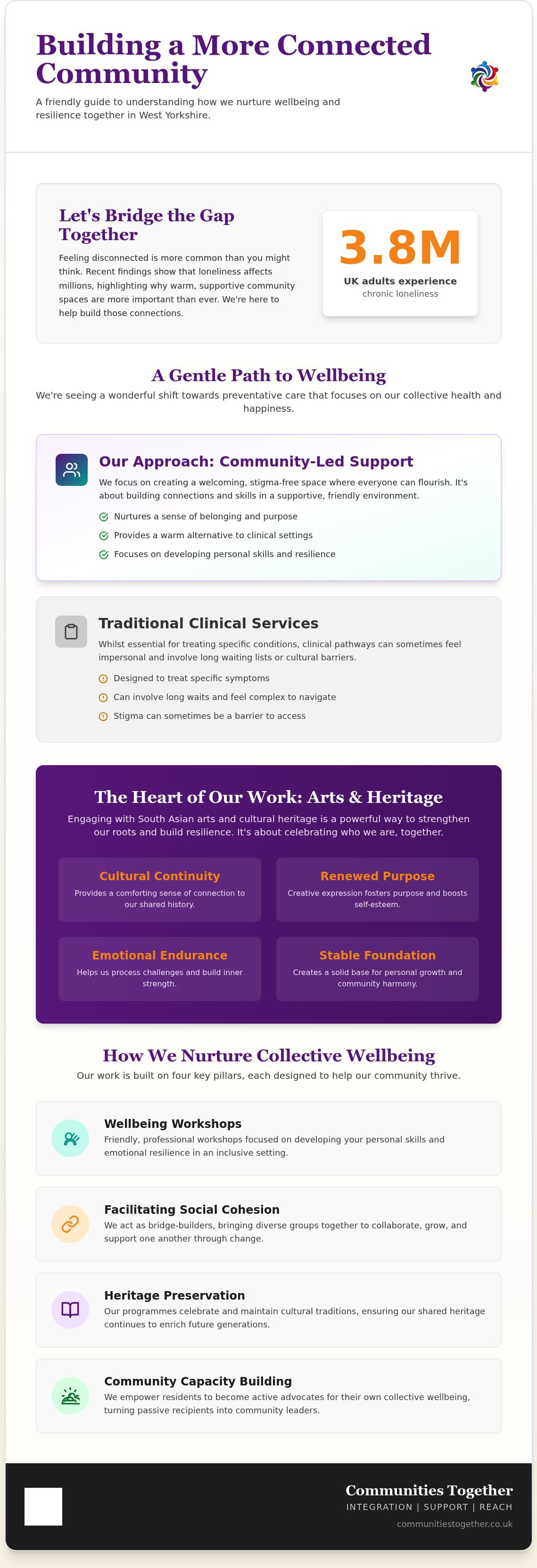
Recent reports from 2026 indicate that approximately 3.8 million adults in the United Kingdom experience chronic loneliness, a figure that underscores the urgent necessity for robust, accessible community programmes to reduce social isolation UK residents can rely upon for meaningful connection and social stability. You might feel that navigating the complex landscape of local charities is a daunting task, especially when urban environments like Leeds or Bradford foster a sense of disconnect rather than the togetherness you seek. It's common to find that language or cultural barriers make traditional mental health services feel distant, leaving you searching for a space that values your heritage whilst supporting your wellbeing.
This guide explores how non-clinical community support, cultural heritage initiatives, and local engagement programmes foster collective resilience by facilitating social cohesion, maintaining cultural continuity, and building individual capacity across West Yorkshire. You'll understand the vital link between cultural participation and mental resilience whilst discovering professional environments where you can develop new skills amongst a supportive, mission-driven community. We'll outline the practical steps to identifying local workshops that offer a stable foundation for growth, ensuring you find a reliable path toward social harmony and personal development.
Table of Contents
Understanding Community Mental Wellbeing Support in the UK
Community mental wellbeing is best understood as a collective state of social health and individual resilience that exists within a neighbourhood, rather than simply the absence of clinical pathology. In 2026, we're witnessing a significant shift across the United Kingdom from traditional clinical treatments toward preventative, community-led interventions that prioritise long-term stability, social harmony, and professional accountability. This shift is evidenced by substantial national investments, such as the £500 million allocated to the 'Youth Matters' strategy, which seeks to refurbish facilities and provide equipment to thousands of organisations to combat isolation at its source. This evolution acknowledges that social cohesion is a critical component in reducing the overall burden on the NHS and local services, as it addresses the root causes of distress before they escalate into medical crises. By establishing non-clinical support as a vital pillar for fostering togetherness and collective endurance, we create a landscape where facilitators work alongside residents to build a more resilient society.
The Difference Between Clinical and Community-Led Support
Whilst clinical care is designed to treat specific symptoms through medical expertise, community-led support focuses on the social determinants of health such as belonging, purpose, and Understanding Social Isolation. Our resilience workshops and engagement programmes are intended to complement traditional medical care by providing a supportive environment where individuals can reconnect with their local fabric without the stigma often associated with clinical settings. In this context, the facilitator acts as an authoritative bridge-builder, creating inclusive spaces that allow for the steady and thorough exploration of personal development. This approach ensures that every participant feels valued as a contributor to the collective whole, facilitating a sense of purpose that clinical settings might not always provide.
Why Social Cohesion Matters for Personal Resilience
Feeling part of a stable community infrastructure is essential for improving long-term mental health outcomes, as it provides a sense of security that individual efforts alone can't achieve. We define social cohesion as the structural strength of a community where diverse groups collaborate for growth, maintain cultural continuity, and facilitate mutual support during periods of social change. Through methodical community capacity building, residents are empowered to take an active role in their local area, transforming from passive recipients of aid into principled advocates for their own collective wellbeing. These community programmes to reduce social isolation UK residents participate in are not merely social gatherings; they're the foundation of a robust, interconnected society that prioritises harmony, shared progress, and the maintenance of cultural heritage for future generations.
The Role of Cultural Heritage and Arts in Strengthening Resilience
South Asian arts and heritage activities act as a cornerstone for individual and collective resilience, providing a vital sense of continuity for those living in the diverse urban centres of West Yorkshire. In cities like Leeds and Bradford, where research into the "urban paradox" reveals that loneliness is often clustered in major hubs despite the high density of people, creative expression offers a structured pathway for community members to process complex social changes and personal challenges. By engaging in these community programmes to reduce social isolation UK, participants find that cultural participation fosters a renewed sense of purpose, directly impacting their self-esteem and emotional endurance whilst building a stable foundation for future growth. These initiatives aren't merely about the final creative output; they're about the methodical process of building togetherness through shared history and artistic practice.
Preserving Traditions as a Protective Mental Health Factor
Cultural identity serves as a protective shield against the stresses of modern life, especially when nurtured through methodical heritage workshops that prioritise stability and social responsibility. These sessions facilitate skills acquisition, personal development, and the maintenance of cultural threads by weaving together the wisdom of the past with the aspirations of the present. Intergenerational learning is particularly significant within South Asian communities, as it ensures that heritage is not merely remembered but lived, creating a sense of belonging that transcends age and social barriers to foster long-term social benefits. This collaborative approach helps maintain the structural strength of the community, ensuring that cultural continuity remains a source of collective endurance for all residents.
Arts for Social Cohesion: Beyond the Creative Canvas
Collaborative art projects serve as a professional conduit for building trust and understanding between different sectors of a local community, transforming individual experiences into a shared narrative of togetherness. These workshops are designed to be absorptive and reassuring, following a deliberate rhythm that allows for steady social delivery, meaningful engagement, and the gradual building of community capacity. This methodology aligns with broader Local Council Loneliness Initiatives, which recognise that place-based funding and cultural education are essential for expanding access to wellbeing across underserved areas. By integrating heritage education with resilience building, we empower residents to contribute to a more harmonious and supportive society. You can explore our upcoming South Asian arts heritage activities to see how we facilitate these vital connections and foster long-term social cohesion.
Community-Led Support vs. Traditional Mental Health Services
While traditional clinical frameworks are essential for crisis intervention, the immediate accessibility of community workshops provides a critical alternative to the often-long waiting lists associated with primary care services. These community programmes to reduce social isolation UK residents access are built upon a foundation of inclusivity, offering a stigma-free environment that differs significantly from the clinical atmosphere of a hospital or surgery. By prioritising social connection, peer-to-peer support, and shared experience, these non-clinical settings facilitate the creation of long-term social networks that sustain individuals far beyond the duration of a specific intervention. This methodical approach to community capacity building empowers you to lead your own journey toward wellbeing, ensuring that resilience is not something done to you, but rather something you cultivate amongst your peers.
Navigating the 2026 Support Landscape in West Yorkshire
In the current landscape of 2026, local charities across Huddersfield, Halifax, and Wakefield are increasingly filling the gaps left by national clinical frameworks by offering bespoke, culturally sensitive support that prioritises the individual's social context. These inclusive programmes provide a stable foundation for the diverse urban populations of our region, facilitating social cohesion, maintaining cultural continuity, and building individual endurance. For those seeking to understand the broader impact of these initiatives, our guide on Strategic Community Engagement Programmes in the UK offers deeper insight into how we weave together the threads of social fabric to create a stronger, more interconnected society. By choosing a local, partnership-led approach, you're engaging with a system that understands the specific nuances of your neighbourhood and heritage.
Addressing the Primary Objection: Is Non-Clinical Support Sufficient?
It's natural to wonder whether a community-led approach can truly address the depth of one's needs, yet it's vital to recognise that whilst clinical care is indispensable for medical crises, community care is what allows you to truly thrive. Wellbeing and resilience workshops act as a preventative measure, stopping the decline in mental health by replacing isolation with active participation, learning, and skill development. We warmly validate your choice to seek support within your community, as this path focuses on your strengths rather than your symptoms, facilitating a sense of agency and collective resilience. By participating in these earnest and mission-driven spaces, you're not just seeking help; you're contributing to a broader movement of social responsibility and shared growth that benefits everyone involved.
Accessing Local Wellbeing and Resilience Workshops
Accessing these workshops involves engaging with a deliberate, steady, and thorough process of self-discovery that's designed to be both absorptive and reassuring for every participant. These community programmes to reduce social isolation UK residents find most effective are those that move at a measured pace, ensuring that every statement of intent is balanced by a tangible statement of impact. By focusing on the integration of learning and skills with emotional resilience, these sessions provide a stable foundation for individuals to build upon, facilitating long-term social benefits rather than short-term excitement. The process of partnership and community capacity building is central to this mission, as it allows local organisations to maintain high-level, professional literacy in social welfare whilst delivering practical applications that meet the unique needs of their specific neighbourhoods. These community programmes to reduce social isolation UK provide a steady pulse of social delivery that feels both grounded and aspirational for all involved.
What Happens During a Typical Resilience Workshop?
Participants can expect a structured yet welcoming environment where the focus remains firmly on inclusive participation, personal growth, and the acquisition of practical life skills. These sessions are meticulously planned to cover core competencies such as personal development, emotional resilience, and inclusive engagement, providing a principled expert's approach to collective growth. You'll find that the environment is designed to be a professional conduit for building meaningful connections, ensuring that you're not just learning in isolation but are part of a collaborative effort to strengthen the local social fabric. For a more comprehensive overview of our session details and methodologies, you can refer to our guide on Collaborative Wellbeing and Resilience Workshops.
Finding Support Near You: A West Yorkshire Focus
Locating inclusive community programmes within Leeds, Bradford, and the surrounding districts of Huddersfield, Halifax, and Wakefield requires an understanding of the local infrastructure that supports diverse backgrounds and heritages. Our presence across these areas ensures that residents have access to authoritative bridge-builders who possess the expertise to weave together the complex threads of social fabric through South Asian arts and heritage preservation. We prioritise stability and social responsibility, providing a reliable path for those navigating the often-overwhelming landscape of local charities and public sector services. Engaging with these local programmes is the first strategic step towards reducing isolation and fostering the collective endurance necessary for a thriving community.
How Communities Together Facilitates Collective Wellbeing
Communities Together acts as a methodical advocate and authoritative bridge-builder for social cohesion across West Yorkshire, ensuring that the complex threads of our social fabric are woven together through professional dedication, earnest partnership, and shared social responsibility. We facilitate collective wellbeing by operating through three core pillars: Community Engagement Programmes, South Asian Arts and Heritage Activities, and Wellbeing and Resilience Workshops. By serving as a professional conduit for collective growth, we help maintain the structural strength of our local areas whilst building community capacity that empowers residents to take an active role in their neighbourhoods. These community programmes to reduce social isolation UK residents can join are designed to foster long-term social benefits, prioritising stability, harmony, and social progress over short-term excitement. We value your contribution. Our work is earnest. Join our next session.
Our Approach to South Asian Arts and Heritage Preservation
Our specific mission involves preserving cultural traditions whilst expanding educational access for all community sectors, ensuring that heritage remains a lived experience rather than a static memory. Through collaborative heritage projects, we facilitate a deep sense of belonging and continuity that helps participants navigate modern social changes with the quiet confidence of a principled expert who understands the value of tradition. These initiatives are not merely about the preservation of the past; they're about building a stable foundation for collective endurance, mutual understanding, and the maintenance of cultural identity between diverse groups. You can find detailed examples of our work in our guide on Cultural Heritage Preservation in the UK, which illustrates how we protect our shared history through methodical advocacy and community-led research. We welcome all participants. Heritage builds shared strength. Together, we preserve history.
Building a Resilient and Inclusive Future Together
We maintain a professional commitment to reducing isolation and enhancing community resilience through structured support that integrates learning, skills, and personal development into a cohesive framework for growth. Our initiatives in Huddersfield and Halifax are designed to be absorptive and reassuring, providing a steady rhythm of social delivery that allows individuals to acquire new competencies whilst building meaningful local connections that sustain them through personal challenges. We invite you to explore partnership opportunities or participate in our workshops to help strengthen the social infrastructure of your local area and foster a sense of togetherness that benefits the entire district. By working together, we can ensure that every resident has the opportunity to contribute to a more harmonious, supportive, and resilient society. Our doors are open. Growth is a journey. We build better futures.
Building Collective Resilience Across West Yorkshire
The transition toward a preventative, community-led model of support represents a significant commitment to fostering social cohesion, maintaining cultural continuity, and building the collective endurance necessary for a thriving society. Our specialist facilitators in South Asian arts and heritage preservation provide the expertise required to weave together the complex threads of our social fabric, ensuring that every participant finds a stable foundation for their personal development journey. By engaging with community programmes to reduce social isolation UK residents across Huddersfield, Halifax, Leeds, Bradford, and Wakefield can achieve measurable local impact through a non-clinical approach that prioritises long-term resilience and social responsibility.
This methodical strategy empowers you to lead your own journey toward wellbeing, facilitating a sense of agency that contributes to the overall structural strength and harmony of our diverse urban environments. We'd love for you to join this mission-driven effort to strengthen our local districts and build a more inclusive, supportive future for everyone.
Frequently Asked Questions
What is the difference between community wellbeing support and clinical therapy?
Community wellbeing support prioritises the social determinants of health such as belonging, purpose, and togetherness, whereas clinical therapy focuses on the medical diagnosis and treatment of specific psychological symptoms. Our non-clinical approach provides a stable foundation for collective resilience, facilitating social cohesion and maintaining cultural continuity within a professional, inclusive environment. This methodology allows you to build individual capacity and develop new skills whilst participating in community programmes to reduce social isolation UK residents find essential for long-term emotional endurance.
How do I find community programmes to reduce social isolation in Leeds or Bradford?
You can identify local initiatives by exploring our dedicated schedule of sessions across West Yorkshire or by contacting regional facilitators who specialise in place-based social delivery. We maintain an active presence in Leeds and Bradford, providing structured support that addresses the specific challenges of urban isolation whilst fostering meaningful connections amongst diverse groups. By engaging with our methodical community capacity building projects, you'll find a reliable path toward togetherness, personal growth, and professional skill development within your immediate neighbourhood.
Are your wellbeing and resilience workshops inclusive of all cultural backgrounds?
Our wellbeing and resilience workshops are deeply inclusive and are specifically designed to welcome individuals from all cultural backgrounds, heritages, and life experiences. We possess a particular expertise in South Asian arts and heritage preservation, ensuring that our programmes provide a warm and reassuring space for those who may face language or cultural barriers elsewhere. This inclusive focus allows us to act as an authoritative bridge-builder, facilitating social harmony and collective resilience across the diverse districts of West Yorkshire.
Can heritage and arts projects really improve my mental wellbeing?
Cultural participation through heritage and arts projects measurably improves mental wellbeing by fostering self-esteem, providing a clear sense of purpose, and maintaining vital cultural identity. These activities allow you to process complex social changes in a supportive group setting, facilitating emotional resilience and building individual capacity through creative expression. By connecting with your shared history, you're not just creating art; you're strengthening the structural threads of your community and enhancing your own collective endurance for the future.
Is there a cost associated with joining your community engagement programmes?
Our community engagement programmes are designed to be accessible and inclusive, prioritising social responsibility and collective growth over commercial gain for all residents of West Yorkshire. We focus on partnership-led community capacity building and sustainable social delivery, ensuring that our workshops remain a stable foundation for personal development and social cohesion. You're encouraged to contact our team directly for specific details regarding upcoming sessions in your district, where we facilitate learning, skills, and personal development in a professional environment.
How can local businesses partner with community wellbeing organisations in West Yorkshire?
Local businesses can partner with us by engaging in collaborative initiatives that focus on community capacity building, social cohesion, and the preservation of cultural heritage. These partnerships act as a professional conduit for collective growth, allowing businesses to contribute to the long-term social benefits and stability of the regions where they operate. By supporting our mission-driven work, your organisation can help maintain the structural strength of West Yorkshire whilst fostering a more resilient and interconnected society for all employees and residents.
What should I do if I am experiencing an immediate mental health crisis?
If you're experiencing an immediate mental health crisis, it's vital that you contact professional clinical services such as the NHS on 111 or emergency services on 999. Our organisation provides non-clinical community support and resilience workshops, which are designed for long-term wellbeing rather than urgent medical intervention or crisis management. We encourage you to seek immediate assistance from qualified medical professionals or dedicated crisis helplines to ensure you receive the appropriate level of clinical care and personal safety.
Do I need a GP referral to join a community resilience workshop at Communities Together?
You don't need a GP referral to participate in our resilience workshops, as we operate as a non-clinical, community-led organisation that's open to all residents seeking social connection. Our programmes are intended to be immediately accessible, providing a stigma-free environment where you can develop personal skills, build emotional resilience, and engage in inclusive participation. This self-referral model ensures that you can take a proactive, strategic step toward reducing isolation whilst contributing to the collective wellbeing of your local neighbourhood and heritage.


Comments