
UK Community Capacity Building Organisations: 2026 Guide
- Qaisar Mahmood
- 3 days ago
- 12 min read
What if the true strength of a West Yorkshire neighbourhood isn't found in its bricks and mortar, but in the invisible threads of skill, confidence, and cultural heritage that bind its residents together? We understand that many local groups face the daunting challenge of fragmented networks and a lack of formal project management expertise, which can make it incredibly difficult to engage diverse or isolated demographics effectively. By partnering with community capacity building organisations UK, your group can begin to bridge these gaps, ensuring that every initiative is grounded in stability, harmony, and a deep sense of social responsibility. These organisations serve as authoritative bridge-builders that provide the necessary training, resources, and strategic guidance to transform a passionate group of volunteers into a resilient, professional, and highly capable collective.
You likely agree that fostering a sense of togetherness requires more than just goodwill; it demands a methodical approach to developing skills, securing sustainable funding, and maintaining cultural continuity across generations. This guide promises to show you how to access the tools needed to empower your local group, helping you foster resilience and achieve long-term social benefits through meaningful partnerships. We will preview the essential landscape of support available in 2026, including specific grant opportunities like the £500,000 Windrush Day Grant Scheme and the UK Fund's large-scale investments, whilst examining how heritage-led engagement can create a more cohesive and inclusive society for everyone.
Table of Contents
What is Community Capacity Building in the UK?
At its heart, community capacity building is the intentional process of developing local skills, confidence, and resources to enable people to take control of their own futures. It moves beyond simply helping individuals; it's about facilitating a transition from personal empowerment to a broader, collective community influence that can shape local policy and social outcomes. For those seeking to understand What is Capacity Building? in a practical sense, it represents the social glue that holds diverse neighbourhoods together, particularly in vibrant urban centres like Leeds, Bradford, and Huddersfield. By working with community capacity building organisations UK, local groups can develop the structural strength required to remain stable, accountable, and effective over the long term. This structural strength refers to the internal robustness of an organisation, encompassing everything from governance and financial management to the ability to maintain consistent community engagement programmes.
The Core Principles of Capacity Building
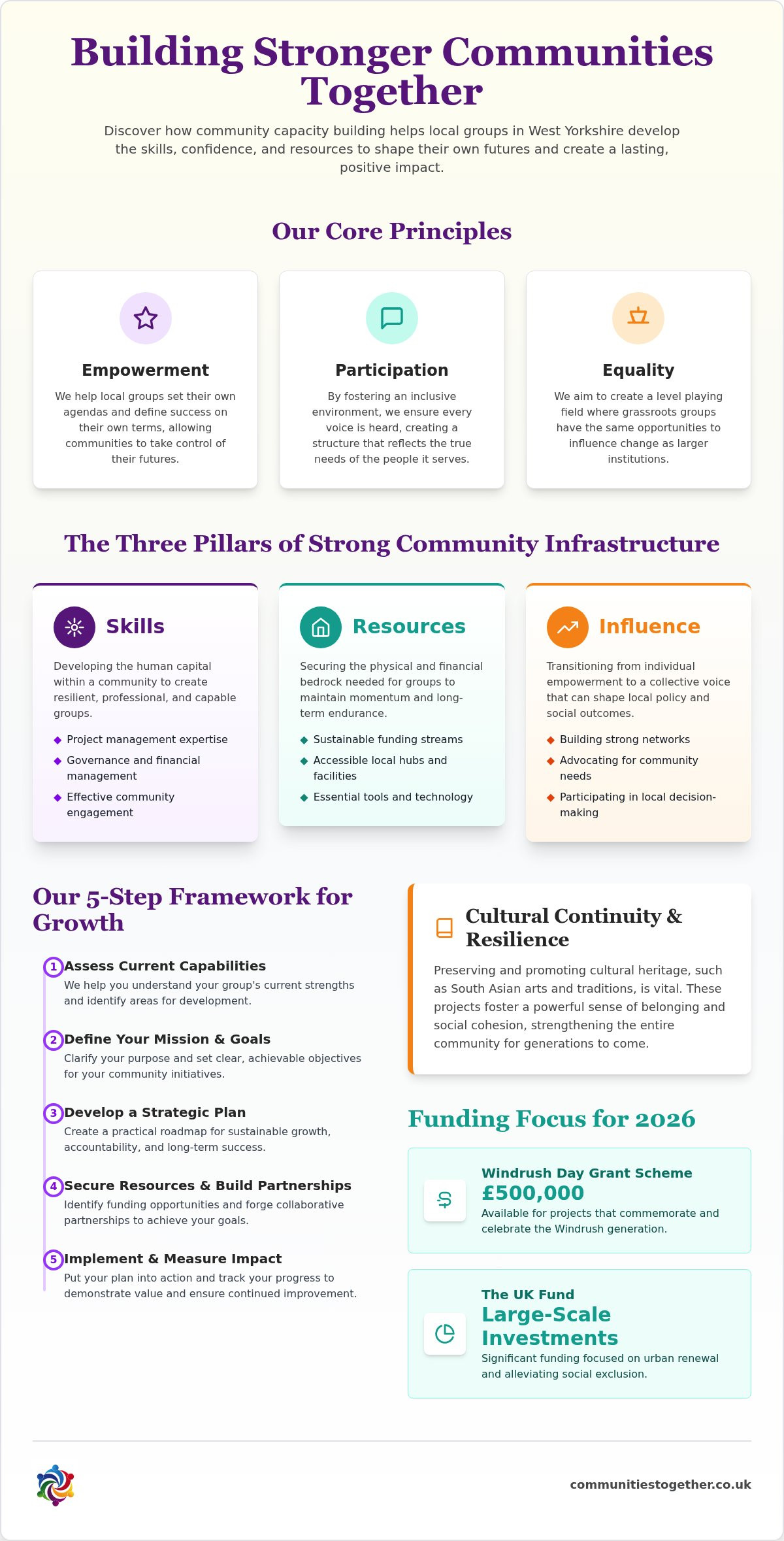
The foundational pillars of this work are rooted in empowerment, participation, and equality. When we prioritise self-determination, we allow local groups to set their own agendas and define success on their own terms rather than following external mandates. This inclusive engagement is especially vital for residents from diverse backgrounds, including those in the South Asian community, as it ensures that heritage and cultural identity are seen as assets rather than barriers. By fostering an environment where every voice is heard, organisations can build a more equitable structure that reflects the true needs of the people it serves. It's about creating a level playing field where grassroots groups have the same opportunities to influence change as larger, more established institutions.
Why Capacity Building Matters in 2026
In 2026, the need for community resilience and social endurance has never been more pronounced. Following the long-term shifts in society, local groups are increasingly called upon to bridge significant gaps in public service delivery, from providing wellbeing support to managing local heritage assets. Capacity building provides the necessary framework for these groups to transition from reactive volunteers to proactive partners in community development. Developing this internal capacity is directly linked to long-term community wellbeing, as it creates a sustainable model where local people have the tools to maintain their own social infrastructure. Through dedicated Partnership and community Capacity Building, groups in West Yorkshire can ensure they possess the skills and resources to thrive amongst changing economic and social landscapes.
The Pillars of Strong Community Infrastructure
Building a robust foundation for local action requires a balanced focus on three primary pillars: skills, resources, and influence. These elements work in tandem to ensure that a group doesn't just exist, but actively thrives and adapts to the evolving needs of its residents. According to official UK guidance, the promotion of these pillars is essential for charitable purposes that seek to alleviate social exclusion and foster urban renewal. For community capacity building organisations UK, the goal is to weave these threads together, creating a tapestry of support that allows grassroots initiatives to move from fragile volunteer efforts to stable, enduring institutions.
Material resources form the physical and financial bedrock of this infrastructure. Without sustainable funding streams and accessible local hubs, even the most passionate groups can struggle to maintain their momentum. Working alongside community capacity building organisations UK helps local groups identify these resource gaps early, allowing them to secure the necessary tools for long-term endurance. However, resources alone aren't enough; effective partnerships between organisations are what truly create a resilient network. By sharing space, knowledge, and funding opportunities, groups across West Yorkshire can build a collective strength that is far greater than the sum of its parts, ensuring that the social fabric remains intact during times of change.
Skills and Personal Development
The human element of infrastructure is perhaps the most vital component of collective growth. When individuals participate in workshops to learn new skills, they don't just gain technical knowledge; they reduce their social isolation, build individual confidence, and develop a sense of agency. You can explore this further in our Skills and Personal Development UK guide, which details how growth in 2026 is being driven by local talent. For emerging leaders, acquiring "engagement skills" is crucial for facilitating difficult conversations and ensuring that every demographic is represented in local decision-making.
Building Influence and Decision-Making Power
A community becomes truly "active" when it possesses the capacity to influence local service delivery and participate meaningfully in democratic processes. Capacity building enables groups to move from being passive recipients of services to being active co-designers of their local environment. This shift is achieved through methodical advocacy, which strengthens community voices and ensures that local authorities are held accountable to the people they serve. By developing this influence, organisations can advocate for cultural preservation and social wellbeing, ensuring that the unique identity of areas like Leeds and Bradford is reflected in every public policy. If you're looking to strengthen your group's foundations, our partnership and community capacity building programmes offer a supportive pathway to achieving these goals.
Integrating Cultural Heritage into Capacity Building
Cultural continuity serves as a vital component of community resilience by providing individuals with a stable sense of identity and belonging amongst the complexities of modern urban life. By integrating tradition into modern frameworks, community capacity building organisations UK empower local groups to use their history as a foundation for future growth, stability, and collective endurance. Cultural participation often acts as an essential entry point for deeper community engagement, allowing residents who might otherwise feel disconnected to find a meaningful pathway into local activism and leadership. This approach is particularly effective in reducing social isolation amongst elderly residents, as it provides a structured environment for sharing wisdom, preserving stories, and maintaining social bonds across generations.
Heritage as a Tool for Social Cohesion
Shared history projects are instrumental in uniting diverse groups across West Yorkshire, creating a common ground where different backgrounds can intersect and harmonise. By focusing on collective narratives, these initiatives foster a sense of togetherness that transcends individual differences, promoting stability and social responsibility in areas like Leeds and Bradford. You can find more detail on this in our guide to Cultural Heritage Preservation in the UK, which examines the long-term benefits of protecting our shared history. South Asian heritage workshops in the region exemplify how methodical community development approaches can turn cultural assets into social capital, building the structural strength needed for communities to advocate for their own interests whilst celebrating their unique identities.
Arts-Based Wellbeing and Resilience
The non-clinical benefits of arts-based community programmes are profound, offering a space for creative expression that builds collective endurance and mental resilience without the formality of traditional medical interventions. These programmes provide a platform for individuals to process their experiences, connect with others, and develop new perspectives on their personal and collective challenges. A "wise facilitator" plays a crucial role here, acting as a professional conduit that guides participants through the creative process to achieve measurable outcomes in wellbeing, confidence, and social responsibility. By facilitating these workshops, community capacity building organisations UK help local groups maintain a healthy and vibrant social fabric that can withstand external pressures and foster a culture of mutual support.
How to Organise a Capacity Building Strategy
To transform a grassroots initiative into a stable and influential entity, groups must adopt a structured approach that prioritises accountability, social responsibility, and long-term growth. This transition is best facilitated by a methodical advocate who understands the complex threads of social fabric and can guide the group through a rigorous internal assessment. By engaging with community capacity building organisations UK, local groups can implement a strategy that moves beyond immediate needs to focus on building structural strength and collective endurance. This process ensures that every statement of intent is balanced by a statement of impact, creating a reliable foundation for future generations to build upon whilst maintaining the cultural continuity of the region. It's a deliberate effort. This ensures long-term stability.
Step 1: Community Asset Mapping
Every successful strategy begins with a thorough audit of existing strengths, rather than focusing solely on deficits. This process involves identifying the triplet of community assets: the specific knowledge and skills of local people, the physical utility of community places, and the enduring value of cultural traditions. By mapping these resources, organisations can establish a firm foundation for future development, ensuring that they're building upon what is already working within the neighbourhood. It's a steady process. This reveals latent potential. This methodical mapping allows for a more absorptive and reassuring transition into formal project management, as it recognises the inherent expertise already present in the social fabric of Leeds, Bradford, and Huddersfield.
Step 2: Identifying Gaps and Training Needs
Once the assets are identified, it's essential to spot weaknesses in the organisational structure or engagement reach that may hinder progress. This involves bridging the gap between the current state of the group and its desired level of influence within the wider social landscape. For a deeper look at this process, you can refer to our detailed resource on Community Capacity Building in the UK. Identifying these gaps allows for the targeted delivery of workshops and development programmes, ensuring that community leaders are equipped with the technical proficiency and engagement skills required for effective advocacy. It's a vital step. This focuses your efforts.
The subsequent phases of the strategy focus on creating a rhythmic pulse of action and assessment. Step 3 involves the development of a Strategic Action Plan that aligns daily activities with the broader mission of social cohesion and resilience. Step 4 emphasises the rigorous monitoring and evaluation of social impact, ensuring that every intervention is accountable to the community it serves whilst providing evidence of success to governing bodies and potential funders. Finally, Step 5 encourages the formation of collaborative partnerships, which allow local groups to scale their impact by weaving their efforts into a larger, more resilient network of support across West Yorkshire. This methodical approach ensures that growth is not just temporary, but sustainable and deeply rooted in the community's core values.
Partnering with Community Capacity Building Organisations
Selecting the right partner is a critical step in ensuring your group's long-term endurance and impact. When exploring community capacity building organisations UK, it's vital to look for a partner that demonstrates deep mission alignment, local expertise, and a genuine sense of earnestness in their approach. For groups operating across West Yorkshire, partnering with an organisation that possesses deep local roots in Leeds, Bradford, or Huddersfield is essential; it ensures that the facilitator understands the unique social fabric and cultural nuances of the area. This local knowledge allows the partner to act as an authoritative bridge-builder, facilitating connections between grassroots groups, governing bodies, and diverse demographics to foster a more resilient and cohesive community. It's about finding a stable foundation that prioritises togetherness, structural strength, and collective endurance.
The Value of Mission-Driven Partnerships
Working with a mission-driven non-profit offers distinct advantages over engaging commercial consultants, as the focus remains steadfastly on long-term harmony and social responsibility rather than short-term excitement. These partnerships are designed to be deeply collaborative, moving at a measured pace that allows every statement of intent to be balanced by a statement of impact. You can learn more about how these relationships function by reading our guide on Strategic Community Engagement Programmes in the UK. By prioritising social welfare and cultural heritage, these partnerships create a stable foundation for others to build upon, ensuring that progress is both principled and sustainable amongst changing social landscapes. It's a methodical way to build trust, facilitate growth, and maintain cultural continuity.
Getting Started with Communities Together
Communities Together acts as a professional conduit for collective growth, offering friendly and expert support for groups across Huddersfield and Halifax. We believe in a principled approach to community development that values tradition and progress in equal measure, providing the technical proficiency and cultural literacy needed to navigate complex social challenges. Whether you're looking to preserve South Asian heritage or develop new skills for local leaders, we're here to facilitate your journey towards structural strength and social cohesion. We invite you to explore our collaborative wellbeing and resilience workshops to see how we can support your group's unique mission whilst fostering a deeper sense of belonging for all residents.
Strengthening the Foundations of Your Local Group
Building a resilient community group is a deliberate and rewarding journey that requires a focus on structural strength, inclusive participation, and cultural continuity. By developing local skills and fostering deep-rooted partnerships, your organisation can transition from a collection of individuals to a stable collective with meaningful influence. Engaging with community capacity building organisations UK provides the methodical guidance needed to navigate this process, ensuring that your efforts lead to long-term social benefits, enhanced togetherness, and sustainable growth. It's a steady path toward collective endurance. This ensures your group remains a reliable pillar of the neighbourhood.
Communities Together serves as a professional conduit for this growth, acting as a wise facilitator for groups across Leeds, Bradford, and Huddersfield. Our mission-driven and earnest approach is backed by specialist facilitators in South Asian heritage and arts who understand how to weave cultural identity into the social fabric. We maintain a proven track record of building social cohesion across West Yorkshire, prioritising stability, harmony, and accountability in every project we support. We're here to help you facilitate lasting change and maintain the unique traditions that make your area thrive.
We look forward to helping you build a stable foundation for collective endurance and progress, ensuring that your community remains vibrant and connected for many years to come.
Frequently Asked Questions
What is the definition of community capacity building in the UK?
Community capacity building in the UK is the intentional process of developing local skills, confidence, and internal resources to empower groups to take control of their own futures. It facilitates a transition from individual empowerment towards a broader collective influence that can shape local social outcomes. By working with community capacity building organisations UK, grassroots initiatives gain the structural strength required to remain stable and effective whilst maintaining their core mission and social responsibility.
How do capacity building organisations support local charities?
These organisations provide a stable foundation for local charities by offering structured training, strategic guidance, and collaborative partnership opportunities. They act as authoritative bridge-builders, helping smaller entities navigate complex governance requirements whilst improving their access to professional networks. In West Yorkshire, community capacity building organisations UK deliver learning and skills development programmes that transform passionate volunteer groups into resilient, methodical advocates capable of delivering long-term social benefits to their local neighbourhoods.
Why is cultural heritage important for community resilience?
Cultural heritage is a vital component of community resilience because it provides residents with a shared sense of identity and a stable foundation for collective growth. By preserving traditions, such as South Asian arts, local groups can foster a deeper sense of belonging and togetherness amongst diverse demographics. This cultural continuity acts as a protective factor, building the internal strength needed to withstand external social pressures whilst ensuring that progress remains principled, inclusive, and grounded in heritage.
Can capacity building help with social isolation in West Yorkshire?
Capacity building plays a significant role in reducing social isolation across West Yorkshire locations like Halifax and Wakefield by creating structured pathways for inclusive engagement. Through wellbeing and resilience workshops, isolated individuals can acquire new skills whilst building meaningful connections with their neighbours. These programmes foster a supportive environment where residents feel valued and heard, effectively weaving the social fabric back together and promoting long-term harmony within diverse urban centres across the region.
What are the 5 core principles of community development?
The core principles of community development focus on empowerment, participation, and equality, alongside self-determination and social justice. These foundational pillars ensure that local groups have the agency to set their own agendas whilst defining success on their own terms. By adhering to these principles, organisations can facilitate a methodical approach to growth that prioritises the needs of the community, ensuring that every initiative is grounded in accountability, stability, and a deep sense of social responsibility.
How can my group access capacity building workshops in Leeds or Bradford?
Groups in Leeds and Bradford can access professional capacity building workshops by partnering with Communities Together, where we offer specialised support in engagement and skills development. We provide a range of wellbeing and resilience workshops designed to strengthen local infrastructure and empower community leaders. By reaching out to our team, your group can begin a collaborative journey that focuses on building structural strength and enhancing your collective impact within the West Yorkshire social landscape.
What is the difference between community engagement and capacity building?
Community engagement refers to the act of involving residents in local activities or decision-making processes to foster participation. Capacity building is the deeper, process-oriented work of developing the internal skills, resources, and governance structures needed to sustain that engagement over the long term. Whilst engagement creates the connection, capacity building provides the structural strength required for a group to remain effective, accountable, and influential amongst changing social or economic landscapes in the United Kingdom.
Are there specific programmes for South Asian heritage in Huddersfield?
Communities Together delivers dedicated South Asian arts and heritage activities specifically tailored for the Huddersfield area to preserve cultural traditions and foster social cohesion. These programmes include heritage preservation projects and creative workshops that allow participants to explore their history whilst building collective resilience. By focusing on cultural participation, we help local groups in Huddersfield maintain their unique identity whilst developing the skills needed to advocate for their community's long-term wellbeing and progress.


Comments