
South Asian Heritage Workshops: A Guide for Schools
What if a heritage workshop became a starting point for sustained learning, rather than a one-off cultural performance? Choosing South Asian heritage workshops for schools can feel challenging when you’re balancing curriculum priorities, pupils’ varied experiences and the need for representation that avoids stereotypes. A thoughtful session creates space for learning, participation and respectful exchange, while recognising the diversity of South Asian histories and communities.
This guide helps you identify themes and activities that connect with pupils’ learning, consider how every child can take part, and ask providers practical questions about their experience, approach and suitability. It also explains how collaboration can make a workshop more meaningful, from shaping aims together to reflecting on what pupils take away. For schools in Huddersfield, Halifax, Leeds, Bradford and Wakefield, Communities Together may be a useful local conversation partner. The organisation delivers South Asian arts and heritage activities, alongside community engagement and cultural preservation work. Check directly which themes, activities and school arrangements are currently available.
Table of Contents
What should South Asian heritage workshops for schools help pupils learn?
How can South Asian heritage workshops make learning active and inclusive?
How should schools assess a South Asian heritage workshop provider?
How can West Yorkshire schools plan a heritage workshop successfully?
How can Communities Together support South Asian heritage learning for schools?
What should South Asian heritage workshops for schools help pupils learn?
A school heritage workshop is facilitated learning that brings cultural knowledge together with creative activity or shared reflection. For South Asian heritage workshops for schools, a clear learning aim helps staff decide what pupils should explore, which activities may support that learning and whether the session suits their age and current priorities.
A special event can introduce a theme and help a school recognise heritage, but it needn’t carry the whole responsibility for learning. A workshop can build on classroom study or prompt further discussion, giving pupils time to encounter context, take part and reflect.
For an example of an educators’ resource in this area, watch this curriculum toolkit run-through:
Which learning aims can a heritage workshop support?
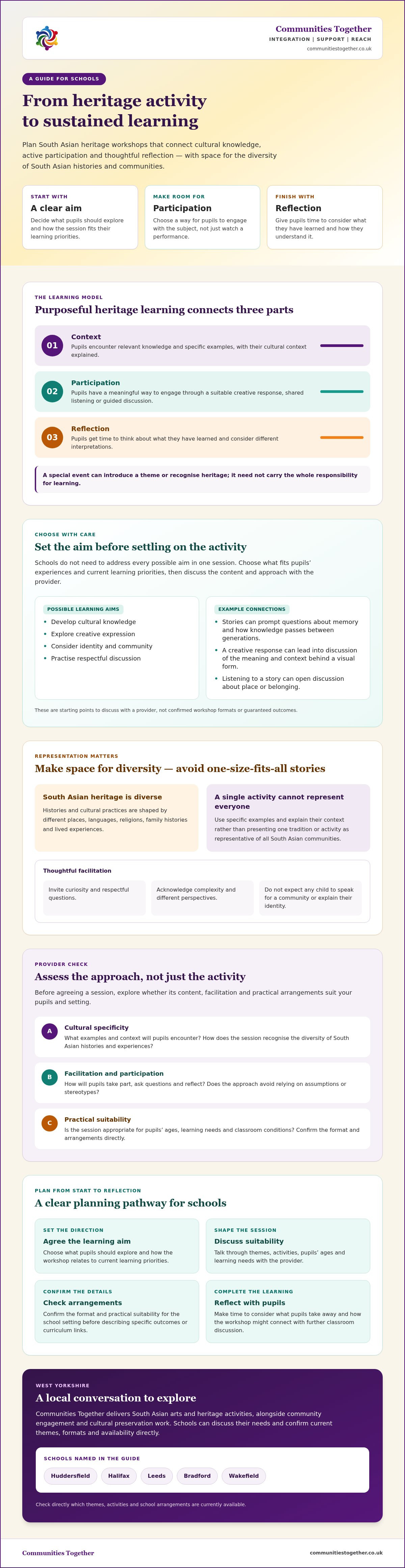
Possible aims include developing cultural knowledge, exploring creative expression, considering identity and practising respectful discussion. Schools don’t need to address all of these at once. Choose aims that reflect pupils’ experiences and current learning priorities, then discuss them with the provider so the session’s content and activities have a clear purpose.
For example, a school might want pupils to explore how heritage is shared across generations, or consider how stories shape understanding of identity and community. These are starting points, not guaranteed outcomes. Confirm any curriculum connections or specific learning outcomes with the school and provider before describing them as part of a session.
Purposeful heritage learning connects context, participation and reflection. Pupils encounter relevant knowledge, have a meaningful way to engage with it and get time to consider what they have learned.
Why represent South Asian heritage with care?
South Asian communities, histories and cultural practices are diverse, shaped by different places, languages, religions, family histories and lived experiences. The broad context of the South Asian diaspora can help staff recognise this range. A workshop should use specific examples and explain their context, rather than present one tradition or activity as representative of everyone.
Invite pupils to approach the subject with curiosity and respect, without expecting any child to speak for a community or explain their identity. Thoughtful facilitation makes room for questions, acknowledges complexity and helps pupils learn from the material without relying on assumptions.
How can South Asian heritage workshops make learning active and inclusive?
Active learning gives pupils ways to engage with heritage, rather than only receiving information. A facilitator might use a creative response, shared listening or guided discussion, depending on the learning aim and their expertise. For example, pupils could respond to a story through drawing, then discuss how stories preserve memories and pass knowledge between generations. Agree the format, content and suitability with the provider rather than assuming them in advance.
Active learning needs cultural context and space for reflection, not activity for its own sake. That balance helps pupils connect what they do or hear with the ideas they are exploring, while allowing time to consider different interpretations.
What activities might schools explore with a provider?
Ask what South Asian arts and heritage activities a provider can offer, and how each could support the agreed learning aim. A making activity, for instance, could prompt discussion about the meaning and context behind a visual form. Listening to a personal or community story could lead into questions about memory, place or belonging. These are examples to discuss, not confirmed workshop formats.
Before settling on an approach, check that it suits pupils’ ages, the intended learning and classroom conditions, including available space, materials and time. Make sure examples are presented with context, rather than suggesting that one art form or tradition speaks for all South Asian communities.
How can teachers support inclusive participation?
Share relevant classroom context and access needs with the facilitator during planning, including what may help pupils feel comfortable taking part. Agree how the teacher and facilitator will introduce the subject, support discussion and respond if questions touch on personal experiences. Clear preparation can help pupils engage without placing responsibility on any child to represent a culture or community.
Participation needn’t mean speaking in front of the whole class. Depending on the activity, pupils might contribute through paired conversation, making, observation, written reflection or listening before choosing whether to share. Offering different ways to engage recognises varied confidence levels and helps keep the learning purposeful. Teachers can reinforce key ideas before and after the session.
Schools considering South Asian heritage workshops for schools can use these questions to shape a constructive planning conversation. Communities Together delivers South Asian arts and heritage activities and community engagement programmes. Schools can explore its heritage work and discuss suitable themes and arrangements directly.
How should schools assess a South Asian heritage workshop provider?
A useful provider comparison looks beyond whether an activity sounds engaging. For South Asian heritage workshops for schools, consider four connected areas: learning aims, cultural specificity, the facilitator’s approach and practical fit for your pupils and setting. Ask how the session was developed, who shaped its content and how relevant context will be introduced. This helps you assess what pupils will encounter as well as how they will take part.
No single cultural activity can represent every South Asian experience. A provider should be able to explain what a particular example relates to, acknowledge diversity and avoid presenting one tradition as universal. A session doesn’t need to cover everything, but its scope should be clear and represented with care.
What questions should schools ask before booking?
Use an initial conversation to understand the session’s educational purpose, cultural approach and delivery requirements. Ask how the proposed content relates to your pupils and stated aims, then clarify practical arrangements before deciding. Specific, open questions can help reveal whether the session is thoughtfully planned or simply built around a broad cultural label.
Learning: What will pupils explore, and how does the session support the school’s stated aims?
Content: Who shaped the material, what context will be provided, and how are different experiences represented?
Facilitation: How can pupils contribute, ask questions and engage with sensitive or unexpected discussion?
Practical fit: What are the age suitability, access considerations, delivery arrangements and responsibilities for the school and provider?
Confirm details directly rather than assuming a format, location or level of adaptation is available. Discuss what the school needs to prepare, what the facilitator will provide and how the session can fit the classroom environment.
How can schools recognise respectful cultural representation?
Look for specific descriptions rather than claims that an activity represents South Asian heritage as a whole. A considered provider can explain the people, place, history or practice being explored and make clear where the session’s focus begins and ends. They should also be ready to discuss how pupils can participate without being expected to speak for a community or share personal experiences.
Ask how the facilitator handles a question based on an assumption, a disagreement or a personal disclosure. A thoughtful answer should explain how discussion can be guided respectfully, without putting an individual pupil on the spot. You might also ask what happens if a conversation moves beyond the planned topic, so staff and facilitator can agree how to respond together.
A well-considered workshop has clear learning aims, specific cultural context, inclusive facilitation and practical arrangements agreed in advance. Use that checklist to compare providers and identify questions to resolve before you book.
How can West Yorkshire schools plan a heritage workshop successfully?
Good planning starts with the pupils and learning purpose, then works through practical arrangements with the provider. Schools in Huddersfield, Halifax, Leeds, Bradford and Wakefield may have different priorities, classroom contexts and access requirements. Treat local knowledge as a starting point for discussion, rather than assuming one plan will suit every school.
Use this sequence to organise the work from first conversation to follow-up:
1. Define the aim. Identify what pupils should explore, such as a particular area of heritage, a creative idea or a question connected to their current learning.
2. Share the pupil context. Discuss age range, prior learning and relevant classroom considerations with the facilitator, without expecting pupils to disclose personal or family histories.
3. Agree a suitable approach. Ask which themes and activities may support the aim, and confirm the proposed approach is age-appropriate and culturally specific.
4. Confirm practical arrangements. Discuss timing, classroom space, materials, access requirements, responsibilities and any preparation needed. Share relevant needs through the school’s usual planning process.
5. Prepare, deliver and reflect. Help pupils approach the session respectfully, support participation on the day, then review what they learned and what questions remain.
What should teachers prepare before the session?
Before the visit or session, agree the learning aims and any relevant prior knowledge with the facilitator. Clarify how the class will be introduced to the subject, how pupils can contribute and what support the teacher should provide. A simple reminder that nobody is expected to speak for a community can help pupils take part with curiosity and respect.
Check arrangements early enough to resolve practical questions together. A classroom with limited space, for instance, may affect which activity is appropriate. Access needs may also shape how pupils engage. Confirm details directly with the provider rather than assuming a particular format or adjustment is available.
How can schools extend learning afterwards?
Keep follow-up proportionate and linked to the agreed aims. A short class discussion, a reflective response or a related classroom activity can help pupils revisit ideas from the session. Invite them to share what they learned, what challenged their thinking and which questions they would like to explore next.
Teachers can also note which parts of the session supported participation and where further context may be useful. This reflection isn’t a claim of measured impact. It’s a practical way to inform future heritage learning decisions and improve planning over time.
How can Communities Together support South Asian heritage learning for schools?
Communities Together delivers South Asian arts and heritage activities, cultural preservation projects and community engagement programmes. Its local coverage includes Huddersfield, Halifax, Leeds, Bradford and Wakefield. The organisation’s work also includes learning opportunities and partnership-building, which may make it a useful local conversation partner for schools considering how heritage learning could connect with pupils and their surroundings.
Explore its South Asian arts and heritage activities as a starting point, then discuss your school’s aims directly. Don’t assume a particular school workshop, topic or delivery arrangement is available. Confirm the current scope, format and availability with the organisation.
What can schools discuss with Communities Together?
Begin with what pupils are learning and what you hope they will explore. Ask whether the organisation’s heritage activities may align with those priorities, which specific themes could be considered and how cultural context might be shared. This helps both sides assess whether there is a suitable basis for planning, without presuming that a particular activity or curriculum link is already in place.
It’s also helpful to discuss age suitability, possible delivery options, accessibility and classroom arrangements. Confirm responsibilities and any preparation needed directly, as these details can depend on the proposed session and school context. Clear questions at this stage help staff make an informed decision before committing to a format.
How can a school begin a local conversation?
Share the school’s location, the intended pupil group and the broad learning purpose. Explain relevant prior learning, practical considerations and the kind of participation you hope to support. These details give the organisation a clearer basis for discussing fit, while leaving room to explore themes and arrangements together.
Schools across West Yorkshire may have different local histories, pupil experiences and learning priorities. An initial conversation is an opportunity to describe your setting rather than assume a standard approach. Ask what can currently be offered, what needs further discussion and whether the proposed scope is appropriate for your pupils.
A careful conversation can help establish whether there is a shared starting point for heritage learning. You don’t need to have every detail settled before making an initial enquiry. Bring your aims and questions, then confirm practical arrangements and availability before planning further.
Build a thoughtful next step for heritage learning
Choosing South Asian heritage workshops for schools begins with a clear learning purpose, thoughtful attention to cultural context and practical planning shaped around your pupils. Activities are most valuable when they support learning through participation and reflection, rather than asking one event to represent the breadth of South Asian histories and experiences.
Start by agreeing what pupils should explore, then speak with a provider about suitable themes, delivery arrangements and access needs. After the session, a short discussion or reflective activity can help pupils share what they learned and identify questions to explore further.
Communities Together delivers South Asian arts and heritage activities, with local coverage including Huddersfield, Halifax, Leeds, Bradford and Wakefield. Schools can discuss their learning aims and local context, then confirm directly whether the organisation’s current activities and arrangements are a good fit.
A considered conversation can be the first step towards meaningful learning that recognises heritage with care and gives every pupil a respectful way to take part.
Frequently Asked Questions
What is a South Asian heritage workshop for schools?
A South Asian heritage workshop for schools is a facilitated learning session that explores cultural knowledge through activities, discussion or reflection. Its focus might relate to history, creative expression, community or identity, depending on the agreed aims and provider’s expertise. A well-planned session gives pupils context for what they encounter and a suitable way to engage, rather than suggesting one activity can represent every South Asian community or experience.
How can schools choose a suitable South Asian heritage workshop?
Choose a workshop by matching its proposed content and approach to your pupils, learning aims and practical needs. Ask what pupils will explore, who shaped the content, how cultural context is explained and how different pupils can participate. Discuss age suitability, accessibility, classroom arrangements and delivery details directly with the provider. Before confirming, check that the proposed session fits your school’s priorities, rather than relying on its title alone.
Can a South Asian heritage workshop support classroom learning?
Yes, a heritage workshop can support classroom learning when its content is connected to a clear aim and pupils have time to reflect. Teachers might link a session to a topic already being explored, then invite pupils to discuss what they learned or what questions remain. Confirm any curriculum connections with the school and provider before presenting them as established. A workshop can complement classroom learning, but specific outcomes shouldn’t be assumed or guaranteed.
How do schools avoid tokenism in cultural heritage workshops?
Schools can reduce tokenism by choosing specific, contextual content rather than treating one activity as representative of all South Asian heritage. Ask who contributed to shaping the material, which community, place or history it relates to, and how its wider context will be explained. Plan respectful ways for pupils to take part, without asking any child to speak for a community. Discuss with the facilitator how questions and unexpected classroom conversations will be handled.
Are South Asian heritage workshops available for schools in West Yorkshire?
Communities Together delivers South Asian arts and heritage activities, and its local coverage includes Huddersfield, Halifax, Leeds, Bradford and Wakefield. This makes the organisation a potential local conversation partner for schools exploring heritage learning. Current school workshop availability, themes, age suitability, formats and delivery arrangements need to be confirmed directly. Share your school’s location and learning aims when making an enquiry, then discuss whether the organisation’s current work is suitable.
What should teachers prepare before a heritage workshop?
Teachers should agree the learning aim and share relevant prior knowledge, pupil context and access needs with the facilitator through the school’s usual planning process. Confirm practical arrangements, including timing, classroom space, materials and each party’s responsibilities. Prepare pupils to approach the subject with curiosity and respect, making clear that no one is expected to represent a culture or share personal experiences. Consider how the class will reflect on the session afterwards.
How much do South Asian heritage workshops for schools cost?
There isn’t a confirmed price for Communities Together’s South Asian heritage activities in the information available here, so contact the organisation for current details rather than relying on a general estimate. When asking providers for a quote, check what the price includes and whether any additional costs, such as travel or materials, apply. Also confirm the proposed session’s format and arrangements so you can compare offers on a like-for-like basis.


Comments