
South Asian Arts Workshops in Leeds: A 2026 Community Heritage Guide
What if the preservation of ancient South Asian traditions in Leeds is not merely an act of historical nostalgia, but rather a vital, strategic mechanism for building the city's future social resilience and collective wellbeing? Many community facilitators and educational leaders recognise that identifying inclusive, high-quality heritage activities can be a complex task, especially when seeking programmes that bridge the gap between cultural expression and measurable social impact. By engaging with the various South Asian arts workshops Leeds provides, residents and institutions are doing more than simply learning a craft; they are actively participating in the delicate process of maintaining cultural continuity, strengthening communal bonds, and facilitating a shared sense of belonging amongst diverse populations.
You'll discover how these workshops foster community resilience whilst preserving vibrant cultural heritage for future generations. This guide provides a comprehensive overview of the available workshop types in 2026, offers practical guidance for schools and community groups looking to integrate these programmes, and explores the profound ways in which traditional arts support local social cohesion and individual development. We'll examine the structural benefits of these initiatives, from the rhythmic precision of Kathak dance to the melodic intricacies of Hindustani music, ensuring you have the knowledge required to facilitate meaningful cultural engagement within your own professional or community sphere.
Table of Contents
The Significance of South Asian Arts Workshops in Leeds
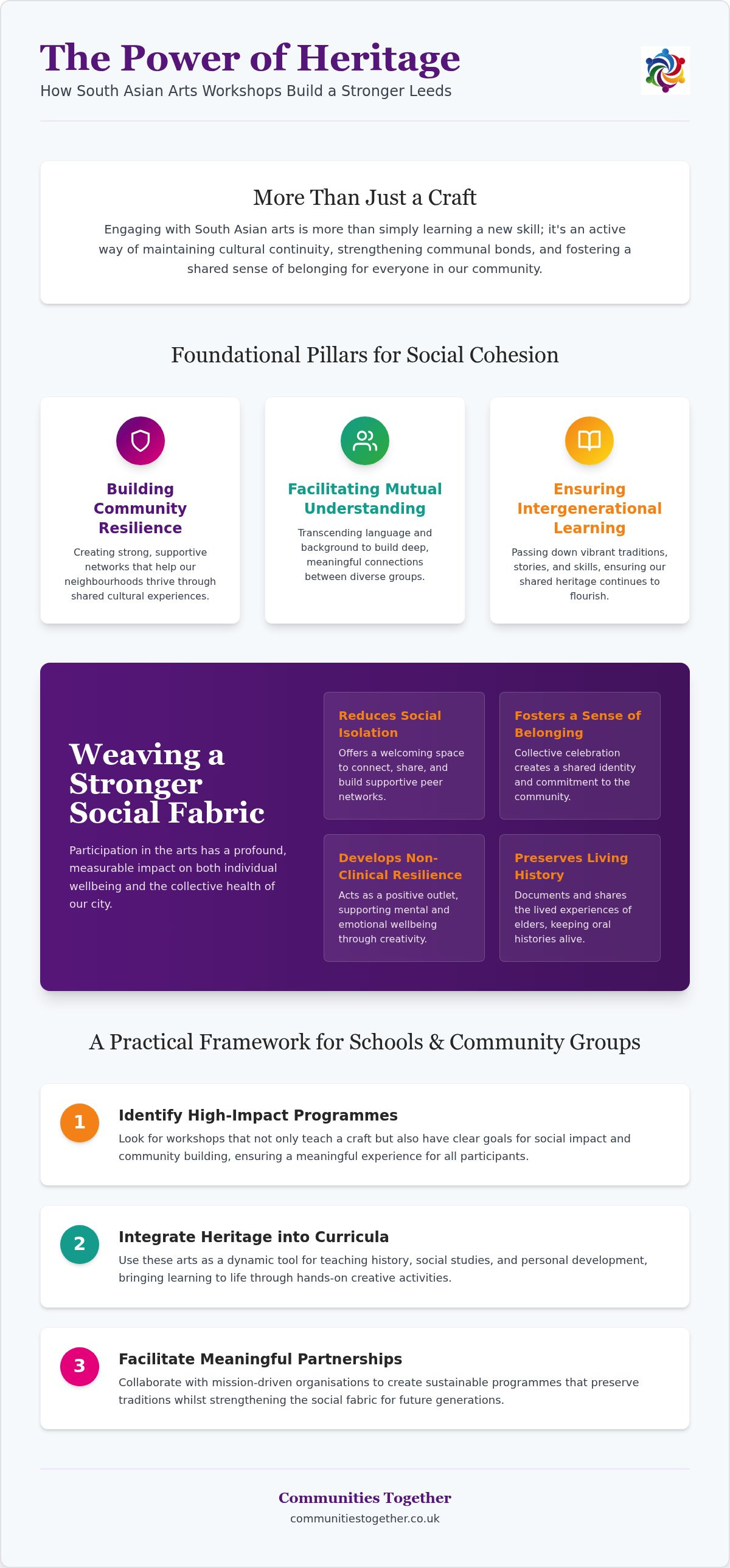
The implementation of South Asian arts workshops Leeds provides a strategic framework for weaving the complex threads of cultural identity into the broader social fabric of West Yorkshire. These initiatives serve as critical conduits for social cohesion, moving beyond mere aesthetic expression to act as foundational pillars for:
Building community resilience and structural harmony.
Facilitating mutual understanding amongst diverse groups.
Maintaining cultural continuity through intergenerational learning.
By providing a platform for the exploration of the historical and cultural context of South Asian arts, these programmes ensure that the rich legacy of the diaspora remains a living component of the city's contemporary identity. It's through this methodical approach that professional facilitators bridge the gap between historical awareness and modern community needs.
Historically, the South Asian contribution to the Leeds cultural landscape has been profound, evolving from early settlement patterns into a robust network of institutions that have shaped the city's unique character. The current transition from static preservation to active community engagement projects signifies a shift towards a more dynamic model of heritage work, where tradition is not simply archived but is actively utilised to build togetherness, facilitate growth, and maintain collective endurance. This evolution directly addresses the difficulties many face when searching for high-quality South Asian arts workshops Leeds that are inclusive for all backgrounds, ensuring that cultural events are inextricably linked to local wellbeing.
To better understand the tangible impact of these cultural expressions on local neighbourhoods, watch this helpful video demonstrating the vibrancy of community-led arts:
Preserving Heritage in a Modern Urban Centre
Leeds has firmly established itself as a premier northern hub for South Asian heritage, providing a stable environment where traditional roots can be celebrated whilst simultaneously adapting to the pressures of a modern urban centre. Ensuring cultural continuity for younger generations is a primary objective; these workshops offer a structured space for youth to explore their lineage through music, dance, and visual arts. In addition to these educational outcomes, community-led heritage projects UK play a vital role in preventing the loss of shared oral histories, documenting the lived experiences of elders to create a comprehensive record of collective adaptation, personal sacrifice, and social contribution. It's an essential process for maintaining the structural strength of our local history.
Fostering Social Cohesion Through Shared Experience
By bringing together residents from diverse backgrounds across Leeds, these workshops facilitate a unique form of dialogue that transcends linguistic barriers to build deep-seated mutual understanding. The impact of inclusive arts is particularly evident in their ability to reduce local social isolation, offering individuals a sense of purpose and a supportive network of peers. This collective cultural celebration creates a profound sense of belonging, transforming individual participation into a shared commitment to the city's social stability, harmony, and long-term prosperity. It's clear that when communities engage in these shared experiences, they don't just learn a skill; they weave themselves more tightly into the communal fabric of the city.
Exploring the Landscape of South Asian Arts Workshops in Leeds
Identifying the right South Asian arts workshops Leeds offers requires a discerning eye for organisers who prioritise long-term social impact, community wellbeing, and cultural authenticity over mere commercial revenue. In the 2026 calendar, several key institutions provide structured environments where heritage education is seamlessly integrated with community togetherness, facilitating a collective space for growth and understanding. These programmes are meticulously designed to ensure cultural continuity, build individual resilience, and maintain the structural integrity of South Asian traditions within the contemporary West Yorkshire context.
Traditional Music and Dance Academies
The preservation of Hindustani music and classical dance forms remains a central focus for established academies, which serve as vital repositories of ancestral knowledge and technical skill. For instance, the SAA-uk Music Summer School, scheduled to take place from August 3rd to August 8th, 2026, at the Sikh Centre and Punjabi School, provides an intensive learning environment that incorporates mindfulness, cultural history, and rigorous technical instruction. Similarly, the Indian Dance Academy, hosted at the Northern School of Contemporary Dance, offers year-long training in Kathak that bridges the gap between physical discipline and emotional expression. These educational spaces, alongside local venues such as Seven Arts, are essential for ensuring that the nuances of these ancient forms are transmitted accurately, respected deeply, and maintained consistently for future generations.
Visual Arts and Craft Heritage Projects
Beyond the performing arts, the visual landscape in Leeds is increasingly focused on documenting the rich history of South Asian communities through textiles, calligraphy, and traditional crafts. These projects often serve as a sophisticated medium for exploring the profound influence of South Asian artists in shaping British culture, providing a tangible link between historical craftsmanship and modern identity. Collaborative mural and exhibition projects in local districts allow residents to contribute to the city's visual narrative, thereby fostering a sense of collective ownership, social pride, and shared heritage. By documenting oral histories through visual media, these workshops ensure that the lived experiences of the diaspora are preserved in a format that is both accessible and enduring.
Contemporary Cultural Identity Workshops
Modern interpretations of heritage are equally vital for maintaining relevance, with many workshops now utilising spoken word and contemporary dance to engage younger, diverse audiences. These programmes are specifically designed to bridge the gap between traditional roots and modern British life, facilitating a safe environment where complex identities can be explored with professional guidance and academic rigour. By participating in these evolving art forms, individuals can develop a stronger sense of self-worth whilst contributing to the broader social cohesion and stability of the city. To explore how your school or organisation can participate in these transformative initiatives, you may wish to learn more about our South Asian arts and heritage activities planned for the 2026 season.
How Cultural Participation Strengthens Community Resilience
The strategic integration of cultural participation into the daily lives of residents serves as a robust framework for enhancing individual wellbeing and collective endurance. By engaging with the diverse range of South Asian arts workshops Leeds facilitates, participants don't just acquire technical proficiencies in music or dance; they build a foundational sense of self-worth that contributes to the city's overall social stability. This process moves beyond the superficial aspects of entertainment to establish arts and heritage activities as effective non-clinical interventions for resilience. It provides a structured environment where individuals can navigate personal challenges through the lens of shared cultural identity.
Collaborative wellbeing workshops UK wide are increasingly recognised for their capacity to foster mental health support by creating spaces where vulnerability is met with professional, earnest facilitation. This methodical approach to community engagement in South Asian arts ensures that every session is balanced by a clear statement of social impact. It prioritises long-term communal health over short-term excitement. By involving local people in the planning and execution of these cultural events, organisations build community capacity. This ensures that the knowledge of how to maintain these traditions remains within the local population.
Wellbeing and Resilience Workshops
Developing personal skills and confidence through South Asian creative practices allows individuals to reclaim their narrative whilst contributing to the broader cultural landscape of West Yorkshire. These workshops provide structured learning opportunities for isolated groups. They ensure that those who may feel excluded from mainstream activities have a dedicated space to grow, learn, and connect. The success of these initiatives relies on a style of facilitation that's both principled and inclusive. This creates a reliable foundation for personal development that feels both grounded and aspirational.
Reducing Social Isolation Through Culture
Targeting support for elderly residents and new arrivals in West Yorkshire is a critical component of maintaining a healthy, cohesive society. Through initiatives like "Chai and Chat" sessions, facilitators create safe spaces for connection. These sessions allow for the sharing of oral histories and the building of intergenerational bonds. The long-term social benefits of consistent cultural participation are measurable. They result in reduced levels of social isolation and an increased sense of belonging amongst participants. By fostering these connections, South Asian arts workshops Leeds help to weave a tighter, more resilient social fabric that can withstand the complexities of modern urban life.
Practical Steps for Schools and Community Groups to Engage
Integrating South Asian arts workshops Leeds provides into the institutional frameworks of our city requires a methodical approach that prioritises educational rigour, community accountability, and long-term social value. For schools and community organisations seeking to facilitate these programmes, the process begins with identifying reputable facilitators who can provide structured learning environments whilst ensuring cultural authenticity. By doing so, leaders can foster a sense of togetherness, enhance individual resilience, and maintain the structural integrity of local heritage within their respective settings. This professional engagement ensures that cultural activities are not merely ornamental but are foundational to the city's social stability and collective growth.
South Asian Heritage Projects for Schools
Educators in Leeds have a unique opportunity to bring history to life by linking local South Asian narratives to broader national curriculum requirements, ensuring that students develop a nuanced understanding of the city's diverse origins. Organising workshops that encourage students to explore their own identities through creative practice allows for the development of skills and personal development UK that are essential for navigating a diverse society. These projects should not be viewed as isolated events but as integral components of a comprehensive educational strategy that values cultural continuity, historical awareness, and the cultivation of mutual respect amongst peers. By facilitating these workshops, schools can bridge the gap between classroom theory and lived experience, creating a more inclusive learning environment for all students.
Building Partnerships for Social Impact
Local businesses and community leaders can play a pivotal role by sponsoring community engagement programmes or partnering with grassroots organisations to facilitate measurable social impact. This collaborative model ensures the sustainability of cultural events whilst providing businesses with a meaningful way to contribute to the city's social stability, harmony, and long-term prosperity. Accessing resources such as the Seasons of Culture 2026 Funding Programme, which offers grants between £3,000 and £15,000 for projects that connect culture with the environment, represents a practical step for groups looking to initiate their own heritage projects. The application deadline for this specific funding is Tuesday, April 21st, 2026, at 12 pm, providing a clear timeframe for strategic planning and partnership development.
Building community capacity involves empowering local leaders to facilitate inclusive engagement programmes that are both mission-driven and professional in their execution. By providing the necessary training and resources, established facilitators can help grassroots groups create sustainable models for cultural events that serve the specific needs of their districts. This methodical transfer of expertise ensures that the knowledge required to maintain and celebrate South Asian heritage is distributed across the city, fostering a more resilient and interconnected social fabric. It's through these principled partnerships that we can ensure tradition and progress are valued in equal measure across West Yorkshire.
Facilitating Collaborative Growth with Communities Together
Communities Together operates as a methodical advocate for the cultural and social health of West Yorkshire, serving as a professional conduit for collective growth and social stability. Our mission-driven approach is rooted in the principled belief that South Asian arts and heritage activities are essential for building togetherness, facilitating growth, and maintaining collective endurance across our diverse districts. By delivering these programmes, we provide a reliable foundation for residents to explore their heritage whilst contributing to the city's social stability, harmony, and long-term prosperity. Our commitment to preserving these vibrant traditions ensures that the cultural fabric of Leeds remains resilient, interconnected, and historically grounded for future generations.
Our Strategic Community Engagement Programmes
We facilitate a range of community engagement programmes UK wide that are specifically designed to address social isolation, promote heritage education, and foster non-clinical wellbeing through the arts. Our ongoing projects across Leeds, Bradford, and Wakefield demonstrate a thoroughness of scale, linking specific creative actions to broader social outcomes such as structural harmony, community capacity building, and individual self-worth. These initiatives provide a structured environment for participants to develop new skills, explore oral histories, and reclaim their cultural narratives within a supportive professional framework that values tradition and progress in equal measure. By acting as a stable foundation for others to build upon, we ensure that the knowledge of how to maintain these traditions is distributed across the region. To learn more about our specific methodologies and current projects, you may visit the Communities Together Homepage.
Join a Movement of Togetherness
Staying updated on the various South Asian arts workshops Leeds hosts throughout the 2026 season is a vital step for those wishing to participate in this deliberate journey towards a more resilient society. We invite Leeds residents, educational leaders, and local businesses to join us in our methodical advocacy for cultural rights, social resilience, and collective wellbeing. By participating in our programmes or forming strategic partnerships, you are actively contributing to the preservation of vibrant traditions and the strengthening of our communal bonds. We remain dedicated to acting as an authoritative bridge-builder and a wise facilitator, ensuring that every individual has the opportunity to engage with their heritage in a way that is both meaningful and professionally facilitated. Together, we can maintain the quiet confidence of an established community whilst striving for a future where every voice is heard, every tradition is cherished, and every resident feels a profound sense of belonging.
Building a Resilient Future Through Cultural Continuity
The strategic implementation of South Asian arts workshops Leeds provides represents a vital investment in our city's social fabric, providing a professional framework where tradition and progress are valued in equal measure. By facilitating these programmes, schools and community leaders don't just celebrate historical legacies; they actively build a more resilient society where individual wellbeing, structural harmony, and collective togetherness are preserved for future generations. This methodical approach ensures that cultural continuity becomes a living component of our modern urban identity, fostering mutual understanding and reducing social isolation across West Yorkshire.
As specialists in South Asian arts and heritage preservation across Leeds and West Yorkshire, we've demonstrated proven success in building community resilience through non-clinical wellbeing workshops that address isolation and facilitate long-term social stability. Our mission-driven initiatives serve as a reliable foundation for partnerships that empower local organisations, build community capacity, and maintain the vibrant traditions that define our shared landscape. We look forward to facilitating your involvement in these essential heritage projects as we work together to strengthen the threads of our communal identity.
We invite you to join this collective journey towards a more interconnected and supportive society where every resident feels a profound sense of belonging.
Frequently Asked Questions
Where can I find a calendar of South Asian arts workshops in Leeds for 2026?
Residents can access a detailed schedule of South Asian arts workshops Leeds offers by visiting the official websites of local organisations such as South Asian Arts-uk. Key events for 2026 include the Music Summer School in August and the Shivir intensive in late July. Both programmes are held at the Sikh Centre in Chapeltown; they provide a structured environment for cultural learning, heritage preservation, and professional artistic development for students of all levels.
Are these cultural heritage workshops in Leeds suitable for families?
Yes, these workshops are specifically designed to be inclusive and intergenerational, facilitating a shared space where families can explore their heritage together. Many organisations offer financial incentives to encourage familial participation, such as the 50% discount for parents learning the same discipline as their child at the Indian Dance Academy. This methodical approach ensures that cultural continuity is maintained whilst strengthening the bonds between different generations within the local community; it's a vital part of our mission.
How do South Asian arts projects help with community wellbeing and resilience?
South Asian arts projects serve as effective non-clinical interventions by providing individuals with a sense of purpose, a supportive social network, and a medium for emotional expression. By participating in these structured activities, residents can develop personal resilience, reduce levels of social isolation, and contribute to the city's overall structural harmony. These programmes are balanced by a clear statement of social impact; they prioritise long-term communal health and collective endurance over short-term entertainment or commercial gain.
Can Leeds schools book South Asian heritage workshops for their students?
Leeds schools can indeed integrate South Asian heritage into their curriculum by booking professional workshops through established facilitators. These programmes are designed to bring history to life for students, linking local diaspora narratives to broader national history projects whilst encouraging youth to explore their own complex identities. By facilitating these educational sessions, schools can build community capacity, promote mutual respect amongst diverse groups, and ensure that cultural traditions remain a living part of the city's future social fabric.
What is South Asian Heritage Month and how is it celebrated in Leeds?
South Asian Heritage Month, which takes place annually from July 18th to August 17th, is celebrated in Leeds through a diverse array of performances, workshops, and community-led exhibitions. The 2026 celebrations are particularly focused on projects that connect culture with the environment, often supported by local funding schemes. These events facilitate a profound sense of belonging, allowing residents to honour their ancestral roots whilst contributing to the city's vibrant, evolving, and inclusive cultural landscape for the benefit of all.
How can I volunteer for heritage preservation projects in West Yorkshire?
Individuals wishing to contribute to heritage preservation projects in West Yorkshire can engage with non-profit organisations that focus on community capacity building and inclusive partnerships. Volunteering opportunities often involve documenting oral histories, assisting in the delivery of community engagement programmes, or supporting the planning of cultural festivals. By offering their time, volunteers help to maintain the structural strength of the local social fabric; they ensure that the rich legacy of the South Asian community is preserved and celebrated.
Do I need to be of South Asian descent to attend these workshops in Leeds?
Participation in these workshops is open to everyone regardless of their cultural or ethnic background, as the primary goal is to foster mutual understanding and social cohesion. These inclusive environments allow individuals from across the city to learn new skills, appreciate the complexities of South Asian traditions, and build lasting connections with their neighbours. This methodical approach to cultural exchange ensures that the city remains a harmonious and welcoming place for all residents, regardless of their personal heritage or history.
What role do non-profits play in supporting South Asian cultural life in Leeds?
Non-profit organisations act as authoritative bridge-builders by facilitating essential funding, managing heritage preservation projects, and providing professional advocacy for cultural rights. They ensure that South Asian arts workshops Leeds provides are accessible to all; they often manage grants like the Seasons of Culture scheme to support grassroots initiatives. By acting as a stable foundation for collective growth, these organisations maintain the city's cultural life, ensuring that tradition and progress are valued in equal measure across West Yorkshire.


Comments