
Mental Wellbeing Courses in Bradford: How to Choose the Right Learning
Updated: Oct 22
The most comprehensive course isn’t automatically the right choice for a Bradford group. A community volunteer hoping to understand how to support someone, a colleague with a defined support responsibility and residents looking for practical ways to build connection may need different kinds of learning. Course titles can overlap, so start by deciding what participants should take away. Choosing mental wellbeing courses Bradford groups can use well means matching the learning to its purpose and the people attending.
It’s understandable to want practical, relevant learning without expecting a workshop to provide clinical care. This guide explains how wellbeing awareness, Mental Health First Aid and resilience learning differ, what community workshops can address, and how to plan for inclusive participation. It also considers how personal development can support stronger local relationships in Bradford and nearby Huddersfield, Halifax, Leeds and Wakefield. The aim is to help you choose learning that fits your group while keeping its role and boundaries clear.
Table of Contents
Bradford Mental Wellbeing Courses: Learning Options
Mental wellbeing learning helps people build understanding, confidence and practical ways to take part in community life. Depending on its purpose, it might introduce ideas for wellbeing, help participants consider when someone may need further support, or explore resilience and connection. A community wellbeing course supports learning and participation. It does not diagnose or treat mental health conditions.
That distinction helps make sense of the different mental wellbeing courses Bradford residents and groups may encounter. General wellbeing awareness can explore everyday influences on wellbeing and supportive relationships. Mental health first aid, by contrast, is structured around responding to mental health concerns in a defined support role. Neither should be assumed to provide clinical care or crisis support.
How does mental wellbeing learning differ from mental health first aid?
Awareness learning is generally broad in scope. It can give participants shared language, encourage reflection on wellbeing and explore how community connection can contribute to a supportive environment. Formal mental health first aid training has a more role-focused purpose: preparing participants to respond when someone is experiencing a mental health concern. The precise content depends on the course.
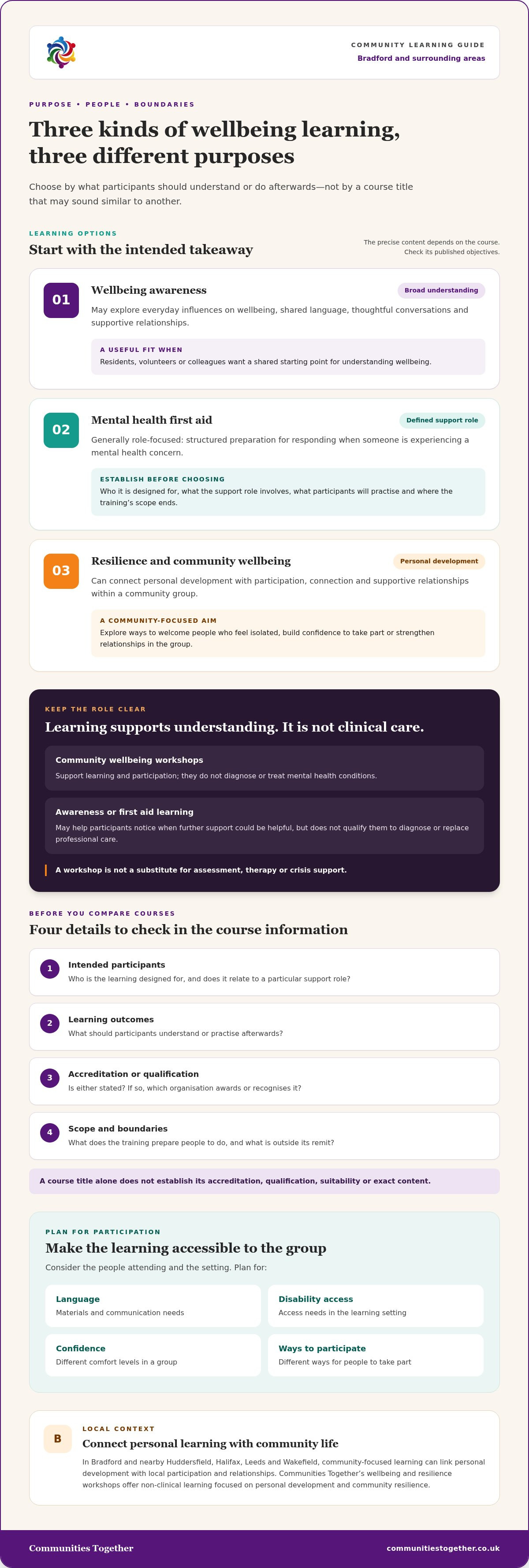
A course title alone doesn’t establish accreditation, qualification or suitability. Read the learning objectives and intended audience: is the aim general understanding, or preparation for a specific support responsibility? This distinction matters because mental health includes emotional, psychological and social dimensions, as outlined in this overview of mental health.
Who might benefit from community wellbeing learning in Bradford?
Residents, volunteers and community groups may value accessible, non-clinical learning when they want to develop shared understanding or create more opportunities for participation and connection. For example, a local group might explore ways to welcome people who feel isolated, help members feel more confident taking part, or strengthen supportive relationships within the group.
Community workshops can also create space to explore resilience and personal development together, with learning shaped around the group’s purpose and context. These are learning aims, not guaranteed individual health outcomes. A workshop isn’t a substitute for assessment, therapy or crisis support; it can build understanding and community capacity alongside appropriate professional support where needed.
In Bradford, community-focused learning can link individual development with the relationships and participation that help groups feel more supportive. Communities Together’s wellbeing and resilience workshops offer non-clinical learning focused on personal development and community resilience, as part of wider community engagement work. Keeping the purpose clear helps participants understand what a workshop can offer and where its boundaries lie.
What Mental Health Awareness and First Aid Courses Typically Aim to Teach
Course titles indicate a general subject, but don’t explain exactly what participants will learn or how they’ll use it. When comparing mental wellbeing courses Bradford groups are considering, focus on the stated objectives, intended audience and course materials. Content varies, so treat descriptions of possible themes as a guide to what to look for, not as a promise of a standard syllabus.
Awareness education can build understanding and supportive communication, while clinical assessment and treatment are the work of qualified health professionals. Learning may help participants notice when someone could benefit from further support, but it doesn’t qualify them to diagnose a condition or replace professional care.
What can an awareness course help participants understand?
Depending on its aims, an awareness course may introduce general concepts relating to wellbeing, encourage thoughtful conversations and help participants understand where someone might seek appropriate support. These themes can give a group a shared starting point, whether its members are residents, volunteers or colleagues. Check the course description to see which topics it actually covers.
Match that description to the needs of the people attending. A session for a community group might prioritise shared understanding and supportive communication, while learning for a workplace or another defined setting may have a different emphasis. Look for clear objectives and accessible materials that explain what participants can expect to explore.
What should readers establish about formal first aid training?
Formal mental health first aid training is generally role-focused. It is intended for people seeking structured preparation to respond to mental health concerns within a defined support context. That differs from broad awareness learning and community workshops centred on resilience or personal development. A course name alone doesn’t establish who it suits, what it covers or whether it leads to a qualification.
Before selecting a course, use its published information to establish:
Intended participants: who the learning is designed for and what support role it relates to.
Learning outcomes: what participants are expected to understand or practise.
Accreditation or qualification: whether either is stated, and which organisation awards or recognises it.
Scope: what the training prepares participants to do and where its boundaries lie.
These checks help match learning to responsibility without assuming that a course provides clinical expertise. Communities Together’s wellbeing and resilience workshops offer a non-clinical route focused on learning, personal development and community resilience, rather than formal first aid training. Groups seeking to build understanding and connection through community wellbeing and resilience learning can consider how that approach fits their aims, while keeping any support responsibilities clear.
How to Compare Mental Wellbeing Course Options in Bradford
A side-by-side comparison can show whether a course’s purpose matches what a group needs. For mental wellbeing courses Bradford residents and organisations are considering, compare the intended participants, learning purpose, delivery context and stated outcomes. The categories below describe broad types of learning, not the syllabus of every local course. Use course information to confirm specific content and accreditation.
Learning option
Intended audience and purpose
Context and outcomes to look for
Awareness session
People seeking broader understanding of wellbeing and supportive communication.
May be delivered in a community or organisational setting; review the stated topics and learning aims.
Formal first aid training
People preparing for a defined support role.
Check the intended role, learning outcomes and any published accreditation or qualification details.
Community wellbeing or resilience workshop
Residents and groups interested in personal development, resilience or connection.
Consider how the activities support participation and shared learning; check the workshop’s stated aims.
Which course type fits a community group’s purpose?
Start with the change the group hopes to support. If members want shared learning, confidence to participate and stronger connections, a non-clinical community wellbeing activity may fit. If people are being given a defined responsibility to respond to mental health concerns, choose training designed for that role.
These formats aren’t interchangeable, and one doesn’t automatically replace another. A community workshop can contribute to resilience and connection without preparing participants for a formal support role. For more on community workshop aims, see this guide to collaborative wellbeing and resilience workshops.
What evidence helps you judge relevance and quality?
Look for information that explains who the course is for, what participants are expected to learn and how the learning will be delivered. If accreditation or a qualification is mentioned, use the provider’s published details rather than inferring it from the title. Clear descriptions make it easier to decide whether the course suits your group.
Also consider whether the information explains boundaries, safeguarding arrangements and routes to further support if someone needs more than educational learning. These details help set realistic expectations and support responsible planning. When comparing courses in Bradford, focus on their stated purpose and specific published information rather than assuming that similar titles mean similar content.
Planning Inclusive Mental Wellbeing Learning for Bradford Communities
Good planning begins with the people who will take part, not with a pre-selected course title. For organisers considering mental wellbeing courses Bradford communities can use, a clear process helps connect the learning aim with participants’ interests, access needs and preferred ways of joining in.
Identify the group: consider who the learning is for and what participants say would be useful.
Clarify the aim: decide whether the priority is shared understanding, confidence, resilience, connection or another community learning goal.
Choose suitable content: select activities and materials that support the aim without expecting a workshop to provide clinical care.
Review access: consider language, disability access, confidence, the setting and different ways to participate.
Accessible delivery gives more people a meaningful opportunity to participate and shape learning around their community. People are better able to contribute when the format and materials are understandable, comfortable and suited to how they prefer to take part.
How can organisers make learning relevant to local participants?
Begin by listening to participants’ interests, existing strengths and preferred ways of learning. Some may welcome open discussion; others may feel more comfortable reflecting individually, working in pairs or contributing through creative activities. Offering different ways to participate can make space for varying confidence levels without asking anyone to disclose personal experiences.
Use clear language and examples that make sense to the group, and consider whether translation or other communication support would help people engage. Culturally responsive planning means inviting participants to shape what feels relevant, rather than assuming Bradford communities share one language, perspective or set of needs. Ask what would make the session welcoming and use the answers to guide practical choices.
How should organisers define boundaries and next steps?
Set expectations before learning begins. Explain that the workshop is educational, describe the topics it will cover and clarify that it isn’t diagnosis, therapy or crisis provision. A respectful environment can help participants feel more comfortable contributing, while clear boundaries avoid pressure to share sensitive experiences. Explain how participants can seek appropriate support if they need help beyond the workshop.
Finally, consider what happens after the learning. If it suits the group’s aims, participants might identify community activities, relationships or opportunities for continued involvement. Keep next steps voluntary and realistic, and use feedback to understand what participants found accessible and relevant. This helps organisers plan responsively instead of assuming one format will work equally well for everyone.
How Communities Together Supports Community Wellbeing Learning in Bradford
Choosing between mental wellbeing courses Bradford offers means considering what participants will learn and how that learning could contribute to relationships and participation in the wider community. Communities Together’s non-clinical wellbeing and resilience workshops sit alongside its community engagement work, linking personal development with the capacity of local groups.
This approach is distinct from clinical treatment and formal Mental Health First Aid training. Its purpose is educational: to create space for learning that supports personal development, resilience and connection, without diagnosing or treating mental health conditions or promising specific outcomes.
What does a community-centred wellbeing workshop focus on?
A community-centred workshop provides structured learning around wellbeing, resilience and personal development, with an emphasis on how participants engage with one another and their community. Collaborative activities give people opportunities to reflect, share perspectives and recognise the strengths within a group. The aim is to link individual learning with participation and community capacity, not to make unsupported claims about health outcomes.
For example, a group might explore what helps people feel welcome and connected in shared activities. The value lies in making room for different experiences and considering how a community can build supportive relationships. These workshops are non-clinical; they don’t replace specialist care or provide diagnosis, therapy or crisis support.
What is a useful next step for Bradford organisations?
For an organisation in Bradford, planning can begin with three questions: who is the group, what does it hope to learn, and what wider community benefit does it want to encourage? A residents’ group may prioritise connection and confidence to participate, while a voluntary organisation may want to build shared understanding and community resilience. These aims help shape learning around the people taking part.
Communities Together brings wellbeing and resilience learning together with community engagement and capacity building. Its workshops are a relevant option for organisations seeking non-clinical learning that considers personal development as well as local relationships. To explore how community wellbeing programmes can support your group’s learning aims, visit the Communities Together website.
Take the Next Step Towards Community Learning
Turn your group’s priorities into a clear learning purpose. Consider what participants want to develop, what would help them feel comfortable taking part and how learning might support connection beyond a single session. This gives your planning a practical foundation and helps reflect the needs of the people the learning is intended to serve.
As you consider mental wellbeing courses Bradford groups can access, keep the purpose of the learning in view. A well-matched community learning opportunity can encourage thoughtful conversations and participation, while appropriate professional support remains important for needs beyond an educational setting.
With a shared purpose and an inclusive approach, your group can take a confident next step towards learning that strengthens connection and supports a more resilient community.
Frequently Asked Questions
What is the difference between mental wellbeing awareness and mental health first aid training?
Mental wellbeing awareness introduces broad themes, while mental health first aid training is intended for people preparing to respond in a defined support role. An awareness session might help a residents’ group discuss supportive communication; role-focused training may suit people with specific responsibilities. Compare the course’s stated aims with what participants need to do instead of relying on a similar-sounding title.
Can a community wellbeing workshop replace mental health treatment?
No. A community wellbeing workshop isn’t a substitute for assessment or treatment from a health professional. It can offer educational activities and shared reflection, but it isn’t designed to diagnose conditions or provide clinical care. Anyone who needs support beyond a learning session should seek appropriate professional help, such as individual counselling and psychotherapy with Therapy Gets It!. Organisers can explain this boundary beforehand so participants understand the workshop’s role.
How do I choose a mental wellbeing course in Bradford for my organisation?
Choose according to your organisation’s purpose and participants’ needs. A community group hoping to encourage connection may value shared learning, while an organisation assigning a support role may need training designed for that responsibility. Compare the intended audience, learning outcomes, delivery approach and any stated qualification. This helps you select from mental wellbeing courses Bradford organisations are considering without assuming the most advanced-sounding option is the best fit.
Are mental health awareness courses in Bradford accredited?
A course title such as “mental health awareness” doesn’t establish accreditation or a qualification. Check the published course information for the awarding or accrediting organisation and the specific qualification, if one is stated. Don’t infer accreditation from the title. This is particularly useful when your organisation needs evidence of learning for a particular role or development plan.
Who can benefit from non-clinical wellbeing and resilience workshops?
Residents, volunteers and community groups may find these workshops useful when they want to build shared understanding, personal skills or stronger connections. A local group, for example, might explore ways to help new members feel welcome and take part. The learning can support community participation, but it can’t promise a particular health outcome or replace specialist care. Suitability depends on the group’s interests and the workshop’s stated aims.
Where can I find mental wellbeing learning in Bradford District?
Start with learning opportunities that clearly describe their audience, aims and location. Communities Together provides community wellbeing and resilience learning in Bradford, Huddersfield, Halifax, Leeds and Wakefield. Explore the Communities Together offer and consider your group’s purpose and preferred learning format when planning a session.
What should a mental wellbeing course description include?
A helpful description identifies who the course is for, what participants are expected to learn, how sessions are delivered and whether a qualification or accreditation is included. It should also explain the course’s boundaries and how participants can find appropriate further support if needed. These details help an organisation assess suitability, plan participation and set realistic expectations.
To plan non-clinical wellbeing and resilience learning for your community group in Bradford, Huddersfield, Halifax, Leeds or Wakefield, explore Communities Together’s community wellbeing programmes.


Comments