
Charity governance training in Halifax: cost and content
For charity governance training in Halifax, the fee is only one part of the decision. Course format, duration and depth of content all affect what trustees and charity teams learn. Compare the cost with what the training covers and the practical value it offers, rather than weighing fees without clear details.
It is reasonable to want clarity on both price and content before setting aside time and resources. This guide explains what can affect training costs and how sessions may cover governance frameworks, trustee responsibilities, board development and good practice, helping you assess which format suits your organisation.
You’ll also find an overview of the Charity Governance Code 2025, including its seven elements, and the kinds of practical discussion that can help boards strengthen oversight, decision-making and collective responsibility. The aim is to give you a clear basis for considering training that supports sound governance and the charity’s wider work in its community.
Table of Contents
Workshop 1: An introduction to the Charity Governance Code (CGC): Why is it so important?
The Charity Governance Code offers trustees a framework for sound oversight and decision-making. Training can connect its principles with practical topics such as financial scrutiny, board development and risk awareness.
Financial governance for trustees
Financial governance training helps trustees understand budgets, financial reports and the questions that support responsible oversight. For example, a board can consider whether spending serves its charitable purpose and whether the financial information available supports timely decisions.
The Charity Governance Code 2025 workshop covers the Code’s seven elements, including its approach to sound governance. A useful course applies those elements to financial decisions, rather than treating accounts as a task only for the treasurer. This can help trustees recognise concerns such as unclear reporting or weak financial controls.
Trustee development planning
Development planning helps identify the skills trustees, staff and volunteers need in their roles. A charity might review its board objectives, identify gaps in financial or safeguarding knowledge, then arrange learning around those priorities.
Training can also support recruitment and retention by making expectations clearer for new and existing board members. A Charity Governance Code workshop gives a board a shared framework for discussing responsibilities and development. For Halifax charities, compare the course content and format with the board’s actual learning needs, rather than assuming governance standards differ between nearby towns.
Trustee induction and training resources
A structured induction can introduce a new charity trustee to the organisation’s purpose, finances, decision-making and conflicts of interest. The Charity Commission provides five-minute guides covering trustee purpose, finance, conflicts, decisions, support and safeguarding.
These guides offer concise learning resources; facilitated training can then give trustees space to apply guidance to board scenarios. For introductory learning, distinguish self-guided resources from courses, and check what each course includes before booking. Halifax options include online and in-person formats, including an online Essential Charity Governance course scheduled for 11 February 2027, from 09:30 to 16:30.
Training on trustee legal responsibilities
The Charity Commission provides guidance on what trustees in England and Wales need to know and do. Training can help trustees put those responsibilities into practice, for example by recording decisions and managing conflicts of interest.
The Charity Commission is the named organisation providing trustee guidance; structured course options include Essential Charity Governance and Charity Governance Code workshops. The available facts identify no trainer for the Code workshop. For Essential Charity Governance, D’Arcy Myers has more than three decades of experience working across the UK and internationally.
To book board training, select a format, identify the board’s learning priorities and follow the course provider’s registration process. In-person Essential Charity Governance is scheduled for 23 November 2026, from 10:30 AM to 4:30 PM, and provides six hours of CPD. Training can help trustees consider risks involving finances, conflicts, decisions and safeguarding, supporting more informed oversight.
Recruiting, retaining and motivating board members
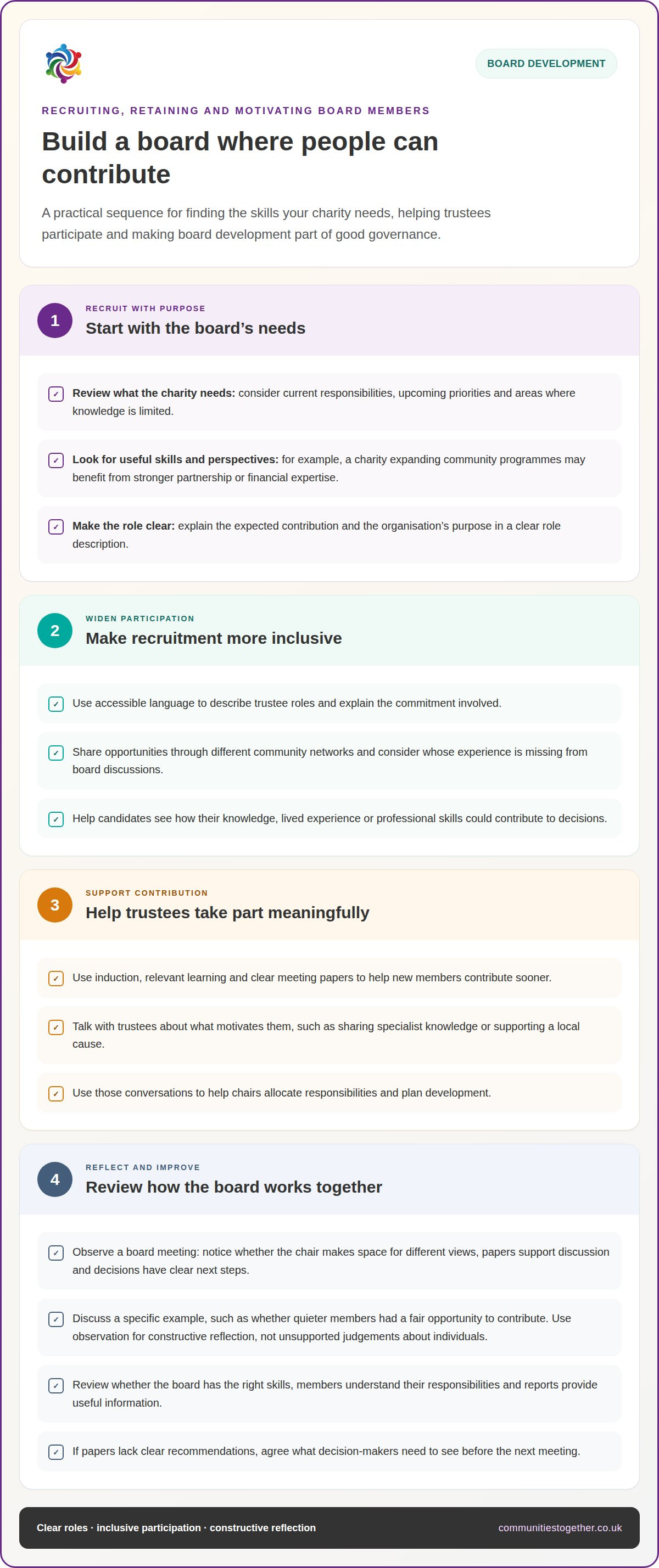
Effective board recruitment starts with identifying the skills and perspectives the charity needs. Review current responsibilities, upcoming priorities and areas where knowledge is limited. For example, a charity expanding community programmes may benefit from stronger partnership or financial expertise. A clear role description helps prospective trustees understand the contribution expected and the organisation’s purpose.
Inclusive recruitment means widening how roles are shared and considering whose experience is missing from board discussions. Use accessible language to describe trustee roles, explain the expected commitment and invite interest through different community networks. This makes recruitment more transparent and helps candidates see how their knowledge, lived experience or professional skills could contribute to decisions.
Retention depends partly on whether trustees can participate meaningfully and understand their impact. Induction, relevant learning and clear meeting papers can help new members contribute sooner. A board can also discuss what motivates each trustee, such as sharing specialist knowledge or supporting a local cause. These conversations help chairs allocate responsibilities and plan development.
Observing a board meeting is one practical way to assess how participation works. An observer can note whether the chair makes space for different views, whether papers support discussion and whether decisions have clear next steps. The board can then discuss a specific example, such as whether quieter members had a fair opportunity to contribute. Observation should support constructive reflection, not become an unsupported judgement about individuals.
Board effectiveness concerns how well the group fulfils its purpose through oversight, discussion and decisions. A review can consider whether the board has the right skills, whether members understand their responsibilities and whether reports provide useful information. If papers lack clear recommendations, for example, the board can agree what decision-makers need to see before the next meeting.
Performance discussions make development more focused. Assess each trustee’s contribution against agreed objectives for the next year, then identify skill gaps or development opportunities. The discussion can also cover attendance, preparation and how members work together. Clear objectives connect individual contribution with board priorities, while regular feedback helps trustees understand where their knowledge is supporting the charity’s work.
For charities in Halifax, a course on diverse board recruitment can help structure discussion about access, skills and retention. Boards seeking wider staff and volunteer development can also explore learning and skills development as part of strengthening participation and organisational capacity.
Charity governance frameworks and legal obligations
For charities in Halifax, the Charity Governance Code offers a structured way to consider board practice. The refreshed Code retains seven core principles, providing a framework for reviewing governance across the organisation. Training can make those principles practical by connecting them with board papers, discussions and recorded decisions. For example, trustees can review whether a recent decision was clearly explained and linked to the charity’s purpose.
The Code supports reflection, while the Charity Commission explains what trustees in England and Wales need to know and do. A useful course helps participants understand how to use each resource. Trustees can bring a realistic scenario, identify the relevant governance question and discuss what information would support a responsible decision. This helps distinguish broad good practice from guidance on trustee responsibilities.
A training session can help a board work through questions such as:
Does the decision-making record explain the board’s reasoning?
Do trustees receive reporting that supports meaningful oversight?
Are conflicts of interest considered during relevant discussions?
Can individuals explain how a decision supports the charity’s purpose?
These prompts turn a framework into a shared approach to discussion and give trustees a practical route from identifying an issue to recording how it was considered. For example, a board reviewing a new fundraising activity could discuss its purpose, the information available and how to document its decision. Training should connect the exercise with the Charity Governance Code’s principles and Charity Commission guidance.
Learning about legal responsibilities is most useful when it addresses decisions trustees actually make. A course can use board scenarios to explore what information participants need, how responsibilities are understood and when a question needs further consideration. The Charity Commission’s guidance is a reference point for trustees in England and Wales, keeping discussion relevant to the jurisdiction applying to Halifax charities.
Governance frameworks also help boards consider how charitable giving is overseen and explained. Trustees can practise reviewing a funding decision, asking whether its purpose is clear and whether the board’s reasoning is recorded. These examples support consistent reporting and give new and experienced members a shared vocabulary. A workshop on the Code can connect principles, responsibilities and everyday decisions without treating the framework as a substitute for Charity Commission guidance.
The practical outcome for a board is a repeatable approach: identify the issue, consult relevant guidance or a framework, discuss the evidence and record the decision. Applying this sequence to a real example helps trustees see how governance principles guide their work across the charity sector.
Governance best practice
Good governance becomes meaningful when a board applies agreed principles to everyday decisions. A charity can use a programme review, for example, to consider whether its purpose, finances and reporting align. Training can help trustees make that connection, identify gaps and agree practical improvements instead of treating governance as paperwork.
The Good Governance online course covers the Code of Good Governance, charity finances, annual reporting and financial systems. These topics connect oversight with the information boards use to guide their work. Trustees can review a sample annual report, assess whether it explains progress clearly, then identify the financial information that supports decisions about a programme.
A useful learning session can turn these themes into a repeatable review. For instance, the board might consider:
Whether reporting explains progress against the charity’s purpose.
Whether financial systems support clear and timely oversight.
Whether a programme’s aims and use of resources are understood.
Which actions should be recorded after a board discussion.
These prompts help trustees connect financial information with the social outcomes they seek. They also provide a shared way to discuss evidence, responsibility and follow-up. A course is more relevant when its examples reflect the charity’s work, such as reviewing how a community programme’s costs and intended outcomes are reported.
Governance needs can vary by organisational structure. For community interest companies, Chapter Nine of the guidance focuses on corporate governance. A training discussion can start with that chapter, then consider how the organisation documents decisions, responsibilities and oversight. This helps participants distinguish guidance for their structure from broader charity governance frameworks.
Succession planning is another practical aspect of good governance. A session can cover future planning and assess how prepared a group is for succession. Boards can discuss which roles need continuity, where knowledge sits and how a transition might affect current priorities. If one person holds essential organisational knowledge, for example, the board can consider how to share and document it.
To make training useful after the session, link each discussion to an agreed action. A board could assign responsibility for improving a report, reviewing a financial process or documenting succession priorities. Trustees can revisit the action at a later meeting and assess what has changed. This simple cycle turns learning into board practice, supports accountability and keeps governance connected to the charity’s work.
For Halifax charities, suitable training reflects the organisation’s structure and learning priorities. A course on finances and reporting may suit a board reviewing its systems, while succession planning may be more relevant during a leadership transition. Matching the content to a real governance task helps trustees apply what they learn to decisions and programmes.
What charity governance training is available in Halifax, West Yorkshire?
Charities in Halifax can consider online courses, in-person training and shorter workshop formats. The best fit depends on whether trustees need a broad introduction or focused learning on the Charity Governance Code. Course duration, delivery format and the board’s priorities all help shape the decision.
Charity Governance Essentials is scheduled for Thursday 3 December 2026, from 09:30 to 15:45. The course contributes six hours towards continuing professional development. Its timetable can suit trustees seeking structured learning across a working day, with time to explore governance responsibilities and apply ideas to their board’s work.
For a shorter option, Charity Governance Code workshops can be delivered as individual sessions lasting 1.5 hours. They can also be combined into a three-hour session. This format may suit boards that want to focus discussion on the Code without setting aside a full day. Each session should connect the framework with practical board decisions.
Online training lets trustees join without travelling to a venue. In-person courses provide a shared learning environment for board members attending together. When choosing a format for a Halifax charity, consider:
Whether trustees need an introductory course or a specific Code workshop.
How much time the board can allocate to learning.
Whether participants prefer to join remotely or together in person.
How the course’s content relates to current governance priorities.
These factors clarify what a course fee covers. Costs depend on format, duration and content, so compare them with the board’s learning needs. A shorter workshop may focus on a specific topic, while a full-day course allows broader study. Request a quote from the course provider for the fee.
Before booking, identify the board’s main learning need, choose a suitable course format and follow the provider’s registration process. Trustees seeking a shared introduction might choose a broad course, while a board reviewing its use of the Code may prefer a focused workshop. Clear objectives help participants apply what they learn after the session.
For Halifax charities, online and in-person course formats are available, as are shorter Charity Governance Code workshops. Listed dates and times help with planning trustee diaries. A board can use these details to choose relevant content, consider attendance and arrange participation around other commitments.
Communities Together
Communities Together supports charities seeking to strengthen community participation alongside governance learning. Its Community Engagement Programmes and partnership and community capacity building help local groups develop collaborative approaches, build relationships and support shared priorities. This work complements trustee training by connecting effective decision-making with the communities a charity serves.
Turn to Communities Together when your organisation wants to build community connections or develop its capacity for partnership working. Its work also includes South Asian arts and heritage activities, wellbeing and resilience workshops, and heritage and cultural preservation, supporting community life through a range of engagement.
Take your next step towards stronger community impact
Governance learning helps trustees connect careful oversight with the needs and aspirations of the people their charity serves. If your organisation is considering charity governance training in Halifax, identify how board learning can support its wider community purpose, alongside clear decisions and accountable practice.
Communities Together offers a complementary way to strengthen that community focus through Community Engagement Programmes, South Asian Arts and Heritage Activities, and Wellbeing and Resilience Workshops. These activities support participation, cultural connection and collective wellbeing, helping organisations consider how community relationships contribute to their aims. Start a conversation with Communities Together about the priorities your organisation wants to develop and the people it hopes to involve.
With a thoughtful approach to governance and community connection, your organisation can build a stronger foundation for its future work.
Frequently Asked Questions
How much does it cost?
There is no single fee for charity governance training; providers set their own charges. Before budgeting, identify whether the course is for one trustee or the whole board and whether travel or access arrangements affect the total. Ask for the current fee and details of what it covers, then compare the cost with your charity’s learning needs.
Who is it for?
Charity governance training can benefit new and experienced trustees, board chairs and staff who support governance or reporting. A new trustee might need an introduction to board processes, while an established member may want focused learning on a particular responsibility. Volunteers involved in governance-related work can also benefit when the course matches their role and the decisions they help prepare.
Are there free or subsidised charity governance courses in Halifax?
Free learning resources include the Charity Commission’s short trustee guides, which can support independent learning or an induction discussion. Registered charities can request a discount on some course fees. For a Halifax charity, ask the course provider about concessions before booking and consider whether free resources meet the board’s learning needs.
How much does charity governance training cost in Halifax?
Fees for Halifax charities depend on the course provider and what the booking includes. A board arranging training can clarify whether the quoted amount covers every participant, course materials and any applicable discount. Registered charities can request a discount on the course fee. Use the provider’s current quote to plan the budget, rather than relying on a general estimate.
What are the legal duties and responsibilities of charity trustees in England and Wales?
Trustees are responsible for understanding and carrying out the duties attached to their role. The Charity Commission explains what trustees in England and Wales need to know and do. Start by reading relevant guidance alongside your charity’s governing document, then use training to discuss how those responsibilities apply to your board’s decisions and circumstances.
How does charity governance training in Halifax compare with courses in nearby towns?
Compare courses by format and content, and choose one that fits your board’s learning needs. Governance standards do not differ simply because a course is in a nearby town.


Comments