
Grant writing workshops in Huddersfield with free and low-cost options
Funding may support creative development, but it should not be assumed to cover the cost of a grant-writing course.
It’s understandable to look for practical help with an application without taking on unnecessary expense. In this guide to grant writing workshops in Huddersfield, you’ll learn what funding might apply, what to consider when comparing free and low-cost learning options, and how to assess whether a tutor’s experience is relevant to your project.
We’ll distinguish general writing groups from sessions focused on funding applications, so you can identify support that fits your next step. The aim is to help you make an informed choice and explain your project, its community value and intended outcomes clearly.
Table of Contents
Authors and tutors leading workshops
Huddersfield has writing communities, but a writing group and a grant-writing tutor serve different purposes. Yorkshire Writers Lunch meets weekly on Tuesdays from 12pm at Cafe Society in Huddersfield. It is a mixed-ability group where members discuss writing, collaborate and take turns contributing to a weekly blog. That format can help an author develop ideas and share work, but it isn’t described as grant-writing instruction.
For a funding application, a tutor’s relevant experience matters more than a writing title alone. An author may be skilled at shaping a compelling narrative, while a grant specialist may know how to respond to funders’ criteria, present a project budget and describe intended outcomes. These are different strengths. A useful session connects writing craft with the practical demands of your application.
Huddersfield Authors Circle meets on the second and fourth Wednesday of each month from 7pm to 9pm on Zoom. Its regular schedule may help writers maintain a routine and exchange feedback, though the meeting details don’t identify it as a grant-writing workshop. Shelley Art Group meets on Tuesday evenings from 8pm to 10pm at Shelley Village Hall, and holds a yearly exhibition, usually in March. These examples show why it’s worth distinguishing creative community activity from targeted funding guidance.
Look for evidence that the tutor teaches the stages you need help with. This may include developing a clear project rationale, matching activities to a funder’s aims or explaining outcomes to assessors. Ask whether the session includes worked examples or feedback on draft material. A university or arts background can provide useful context, but does not by itself show that someone teaches grant applications.
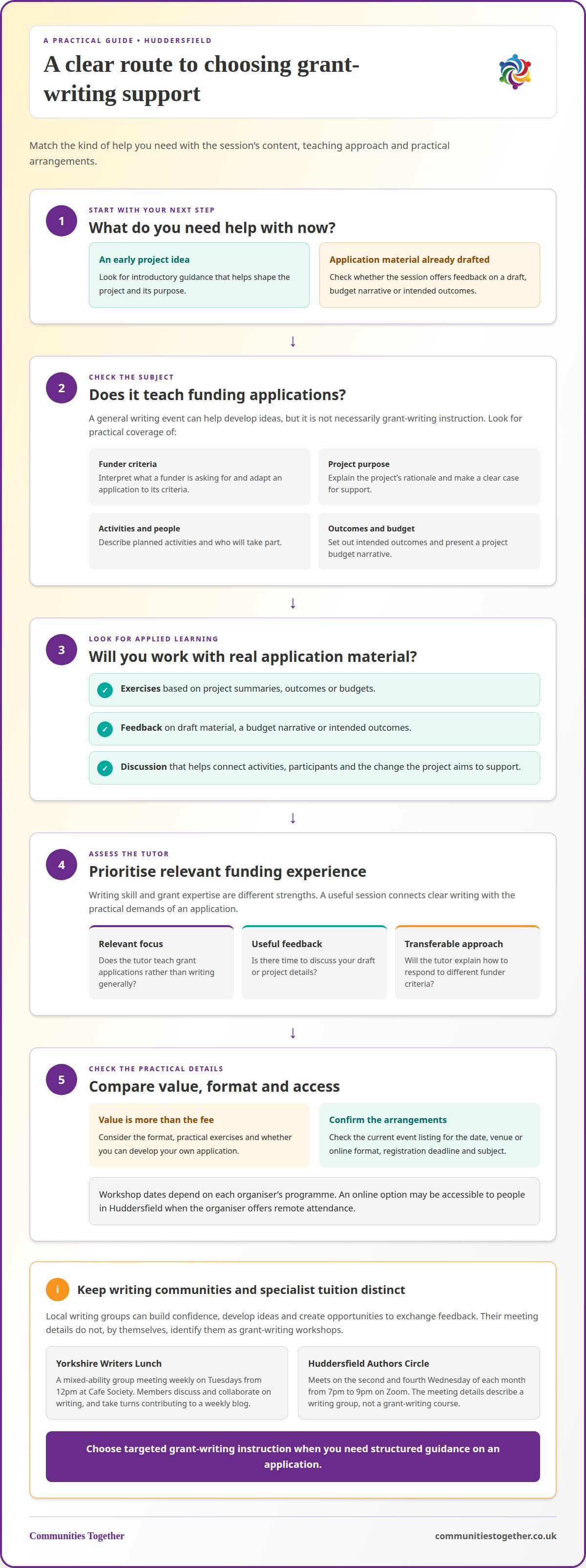
Use these practical checks to assess the workshop leader’s fit:
Relevant focus: Does the session cover grant applications, rather than writing generally?
Applied learning: Will you practise turning a project idea into a concise case for support?
Feedback: Is there time to discuss a draft, budget narrative or intended outcomes?
Transferable approach: Will the tutor explain how to adapt an application to different funder criteria?
For example, a community arts project may need to explain who will take part, what activities are planned and what change the project aims to support. A tutor should help clarify those links without overstating the results. In Huddersfield, writing groups can help build confidence and connection; choose grant-focused instruction when you need structured application guidance.
Choosing a writing workshop
Workshop dates depend on each organiser’s programme, so look for a current event listing before planning to attend. Check the date, location or online format, registration deadline and subject. A general creative-writing event may help develop ideas, but it will not necessarily teach funding applications.
People preparing applications for community, creative or charitable projects may benefit from practical grant-writing instruction. It can be useful whether you are developing a project as an individual or contributing to an organisation’s funding bid. Check the session description for its intended participants and any entry requirements, particularly if it focuses on a specific funding scheme.
Useful topics include interpreting a funder’s criteria, describing a project’s purpose and setting out planned activities. Stronger sessions also cover explaining intended outcomes, making a clear case for support and presenting a project budget narrative. For example, a community arts proposal needs to link its activities to the people involved and the change it aims to achieve.
Online sessions can be accessible to people in Huddersfield when the organiser offers remote attendance. Huddersfield Authors Circle meets on Zoom, although it is a writing group rather than a grant-writing course. For funding-focused instruction, check whether the session includes live discussion, individual feedback or practical exercises instead of relying on the word “workshop” alone.
Before choosing, compare the session content with the task you need to complete. A useful description should make the format and learning outcomes clear. Consider these points:
Application stage: Choose introductory guidance for an early idea, or draft feedback when you have application material.
Funder relevance: Look for teaching on criteria and evidence, rather than generic advice about persuasive writing.
Practical work: Check whether the session includes exercises based on project summaries, outcomes or budgets.
Access: Confirm the date, venue or online arrangements and registration process in the event information.
To book, follow the registration instructions from the workshop organiser. This may involve completing an online form or reserving a place through an event listing. Read the details for any preparation required, keep your confirmation, and note the session time, access arrangements and materials to bring.
If your project also aims to build confidence and collective resilience, community wellbeing and resilience work may complement your development plans, while remaining distinct from specialist grant-writing tuition.
Dates depend on each organiser’s programme. Check current event listings for session dates, formats and registration details.
Free and low-cost workshops
Free and low-cost learning can help writers build application skills without committing to a longer course. In Huddersfield, distinguish grant-writing tuition from general writing activities before treating an event as suitable. Yorkshire Writers Lunch meets weekly on Tuesdays from 12pm at Cafe Society, but its activities centre on discussion, collaboration and a weekly blog. That may support writing practice, rather than provide targeted funding guidance.
Start by defining the help you need. If you are shaping an early idea, a free introductory session may offer enough structure to clarify its purpose. If you are preparing an application, a low-cost workshop with draft feedback may be more useful. Compare the learning activity with your task, not just the event title. A creative-writing session, for example, may not cover funder criteria or application budgets.
Check what the advertised fee includes before deciding whether an option is genuinely economical. Look for the session length, teaching format, exercises and feedback arrangements. A short talk may explain application terminology, while a practical workshop may help participants develop a project summary or outcomes statement. Include any extra materials or follow-up support in your comparison. Do not assume that a “free” listing means every part of participation has no cost.
Funding for creative development is another possibility, but it does not automatically cover workshop attendance. This grant opportunity supports creative development; read its published aims and eligible-cost rules before treating it as a way to pay for a course. Its suitability depends on the applicant’s creative development plans, not simply a preference for training.
Use a simple comparison before reserving a place:
Purpose: Does the session teach grant applications, or general writing?
Practice: Will you work on a project summary, outcomes or budget explanation?
Access: Are the date, venue or online arrangements practical for you?
Overall value: Does the fee cover useful teaching and feedback for your current stage?
For example, a community group with a clear project idea may benefit more from feedback on its case for support than from a broad writing session. Writers still developing an idea may first use peer discussion to test its purpose and audience. Choose support that addresses the next specific task, then use what you learn to strengthen the project rationale, activities and intended outcomes.
Tutor experience
A tutor’s established reputation can be useful, but it does not automatically demonstrate grant-writing expertise. Look for experience that matches the work you need to do. A creative-writing author may strengthen your narrative, while a funding practitioner may be better placed to explain application criteria, evidence and budgets. The right tutor connects clear writing with the practical requirements of a funding bid.
Assess experience through the examples a tutor uses. Can they explain how a community project’s activities relate to its aims and intended outcomes? Can they show how to make a case for support specific, coherent and proportionate? A session should help you understand the reasoning behind these choices, rather than offer only general advice to “write persuasively”.
Huddersfield has an example of an arts organisation with a documented funding award. This demonstrates funding support for that organisation, not an individual tutor’s teaching experience. Treat an organisation’s award history and a tutor’s application expertise as separate evidence when assessing a workshop.
Ask what the tutor will teach and how participants will practise. A useful exercise might turn a broad idea, such as a local arts activity, into a project summary with defined participants, activities and intended outcomes. The tutor should explain how each part supports the case for funding. Feedback is most useful when it identifies unclear reasoning and suggests a practical revision.
Use these indicators to consider a tutor’s fit:
Relevant practice: Their examples relate to grant applications or funded projects.
Clear teaching: They explain funder criteria, project rationale and outcomes in accessible terms.
Applied feedback: Participants can discuss or improve a real project example.
Responsible claims: They distinguish intended benefits from results that cannot yet be evidenced.
Experience should also match the funder and applicant. A tutor familiar with arts funding may offer relevant insight for a creative project, while a community organisation may need guidance that gives equal attention to participation, delivery and local benefit. Ask how the workshop adapts examples for different purposes instead of assuming one application model fits every project.
Finally, consider whether the tutor makes complex tasks easier to repeat independently. After a session, you should be better equipped to interpret criteria, organise evidence and revise your own draft. That practical outcome matters more than a prestigious title alone. A clear teaching approach, relevant examples and constructive feedback are stronger reasons to choose a workshop leader.
Which organisations run grant writing workshops in Huddersfield?
Huddersfield has named writing and arts organisations, but their activities should not be mistaken for grant-application tuition. Yorkshire Writers Lunch is a mixed-ability group where members discuss writing, collaborate and contribute to a weekly blog. Huddersfield Authors Circle meets on the second and fourth Wednesday of each month from 7pm to 9pm on Zoom. These provide writing-focused settings, rather than identified grant-writing instruction.
Shelley Art Group offers another example of local creative activity. It meets on Tuesday evenings from 8pm to 10pm at Shelley Village Hall and holds a yearly exhibition, usually in March. An exhibition can help artists share work, while a regular group can support creative practice. Neither activity, by itself, establishes that the group teaches funding applications.
Grist planned a new anthology in 2022, student work placements within its publishing team for around a dozen students, and monthly open mic nights in Huddersfield. Those plans concern publishing and literary activity, not a stated programme of grant-writing workshops. The distinction matters when looking for specialist application support.
Huddersfield Literature Festival is another relevant arts organisation. Its 2025 event ran from 8 to 18 May and received an Arts Council England grant. This is a concrete example of funding supporting a local cultural event, but it does not make the festival a grant-writing tutor. For applicants, it illustrates the difference between an organisation receiving funding and one teaching others how to apply.
Use an organisation’s published event description to identify what it offers. Look for direct reference to funding applications, practical exercises, draft feedback or funder requirements. If the listing describes a writing group, exhibition, festival or publishing activity, treat it as creative development or community activity unless grant-writing instruction is explicitly included. This helps you avoid booking an event for a different purpose.
For a project in Huddersfield, identify the support you need before choosing an organisation. A writer developing a manuscript may value a literary group; an applicant preparing a funding bid needs instruction tied to applications. A clear event description should state its subject, format and intended participants. Use those details to decide whether the activity matches your next practical step.
Writing communities: Yorkshire Writers Lunch and Huddersfield Authors Circle focus on writing and peer exchange.
Creative activity: Shelley Art Group and Huddersfield Literature Festival provide arts-related examples.
Funding distinction: Grist and the festival illustrate funded cultural work, not necessarily grant-writing teaching.
None of the named organisations is identified as running grant-writing workshops; their activities are described as writing, arts, publishing or festival programmes rather than application instruction.
Communities Together: Wellbeing and Resilience Workshops
Communities Together offers Wellbeing and Resilience Workshops for groups seeking to strengthen wellbeing and resilience alongside their community work. These workshops complement, rather than replace, grant-writing tuition. They may suit groups whose plans involve supporting people, building confidence or sustaining collective activity.
For projects rooted in community participation, Communities Together’s Community Engagement Programmes and South Asian Arts and Heritage Activities can help establish context for the work’s purpose. Heritage and Cultural Preservation projects may also be relevant when a project focuses on safeguarding cultural knowledge. These activities can help groups clarify the community value they want to describe in a funding application.
If your next step is support with community wellbeing or resilience, contact Communities Together to discuss your needs.
Turn a strong idea into a shared next step
Your next step is to connect the project’s purpose with the people it is intended to serve. A clear funding case begins before the form: it grows from listening, shared priorities and an honest account of what activities can achieve. As you develop your plans in Huddersfield, Halifax, Leeds, Bradford or Wakefield, consider how Community Engagement Programmes, South Asian Arts and Heritage Activities, and Wellbeing and Resilience Workshops can support participation and collective wellbeing.
Keep the application focused on the funder’s aims, grounding each statement in your project’s real activities and intended outcomes. If you are still shaping the work, discuss its community purpose with the people involved before refining the proposal. Grant writing workshops in Huddersfield can help strengthen your writing; a community-focused approach helps keep the project meaningful and collaborative.
With a thoughtful process and a clear shared purpose, your next application can express the value of the work with confidence.
Frequently Asked Questions
Is funding available to complete the courses?
Funding may support creative development, but it does not automatically cover the cost of attending a course. For example, an application for a community arts project should explain how the proposed learning contributes to the project’s aims, rather than assume training fees are eligible. Read the funder’s criteria and eligible-cost rules carefully, and distinguish course costs from the activities and outcomes your project is designed to deliver.
Are there grant writing workshops in Huddersfield?
Grant-writing workshops in Huddersfield differ from local writing groups and arts activities, which may focus on creative practice and peer exchange. Look for an event description that specifically includes funding applications, funder criteria or practical work on application sections. This distinction helps you choose a session suited to a funding bid, rather than a general writing meet-up.
What grant writing workshops are available near Huddersfield?
Options include in-person sessions in Huddersfield and online workshops open to participants in the area. The local examples discussed in this guide include writing groups and arts activities, rather than a named grant-writing course. For any event, its stated content can show whether it covers application writing, budget explanations or outcomes. Online delivery may widen your choices beyond events held locally.
How much do grant writing workshops in Huddersfield cost?
Workshop fees depend on the organiser, session format and teaching included. A short group session and a workshop with individual draft feedback may offer different levels of support. Compare the full arrangements, including materials, travel or online access costs, rather than judging by the headline fee alone. If a session is advertised as free, check what participation includes before making plans.
Are there free grant writing workshops in Huddersfield?
Free sessions may be available through community learning or funded programmes, depending on the organiser and event. Check whether the session specifically teaches grant applications, as free writing groups may focus on creative practice instead. A useful free workshop sets out its subject and format clearly, so you can tell whether it will help with your funding application.
Comments