
Local charity support in Huddersfield through volunteering and donations
Local charity support in Huddersfield can take the form of volunteering, donations and partnerships, as well as help to access community activities and social centres. Platform 1 is open from 09:30 to 15:30 on Monday, Wednesday, Thursday and Friday. The right starting point depends on whether you want to give your time or resources, work with a local organisation, or find support for yourself or someone else.
Wanting to make a difference is a good start, but it can be difficult to know what support would help most or where to find welcoming activities. This guide explains practical ways to contribute, the kinds of help local charities provide and how to access support, including when a referral may be needed.
You’ll also find examples of local activities and organisations in Huddersfield, helping you consider options that suit your circumstances and interests. Whether you want to volunteer, develop a community partnership, donate or take part in activities, the information ahead will help you plan your next step.
Table of Contents
Volunteering, partnerships and donations
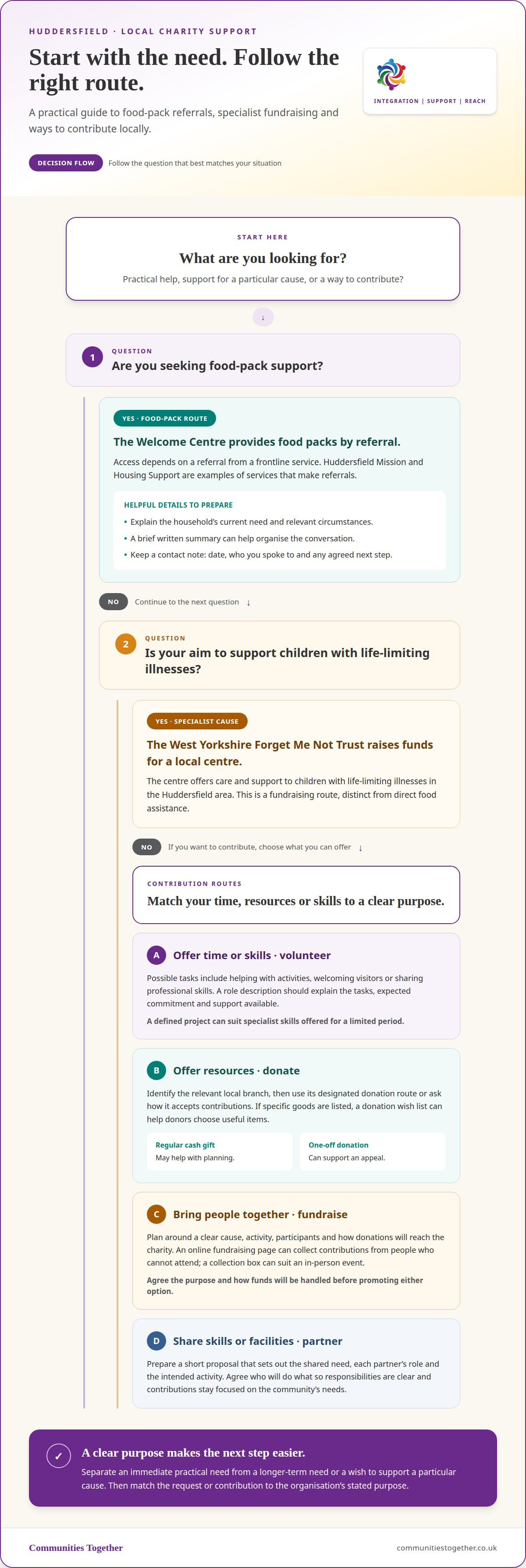
Local charity support Huddersfield residents can take part in includes volunteering, fundraising and practical partnerships. Volunteering contributes time and skills, while donations help charities resource their work. A partnership can connect a community group with people, knowledge or facilities to support a shared project. Start by deciding what you can offer and which local need you want to address.
When considering volunteering, think about the tasks you can sustain, such as helping with activities, welcoming visitors or sharing professional skills. A role description should set out the tasks, expected commitment and support available, helping both sides decide whether it is a good fit. If you can offer specialist skills for a limited period, ask about contributing to a defined project.
Fundraising can bring neighbours or colleagues together around a clear purpose. A simple plan should identify the cause, activity, participants and how donations will reach the charity. An online fundraising page can collect contributions from people who cannot attend, while a collection box can suit an in-person event. Agree the purpose and how funds will be handled before promoting either option.
Donating to a local branch can support work rooted in a particular community. Identify the relevant branch, then use its designated donation route or ask how it accepts contributions. If a charity lists specific goods it needs, a donation wish list helps donors choose useful items rather than unsuitable stock. A regular cash gift may help with planning, while a one-off donation can support an appeal.
A community partnership works best when everyone understands their contribution. Prepare a short proposal outlining the shared need, each partner’s role and the intended activity. A project brief can clarify responsibilities and keep the work aligned. For example, a group might identify a local priority, bring together people with relevant skills and agree how those skills will support the activity.
Sustainable local charity support Huddersfield residents can offer depends on matching time, resources and skills to a clear purpose. A community group might coordinate volunteers, share knowledge or organise an activity with a charity. Before starting, agree on the aim and who will do what. This gives partners a practical basis for working together and keeps contributions focused on the community’s needs.
What local charities provide support in Huddersfield?
Charities in Huddersfield address different needs, so begin by identifying the kind of help required. The Welcome Centre, for example, provides food packs to people referred by frontline services. The West Yorkshire Forget Me Not Trust has a different focus: it raises funds for a centre offering care and support to children with life-limiting illnesses in the Huddersfield area. These examples show why it is important to understand each organisation’s purpose.
Access to the Welcome Centre’s food-pack support depends on a referral from a frontline service. Huddersfield Mission and Housing Support are examples of services that make referrals. If food is an immediate concern, contact a frontline service involved in your support and explain what you need. A brief written summary can help organise the conversation. Include essential details, such as the household’s current need and relevant circumstances, and leave out unrelated information.
The West Yorkshire Forget Me Not Trust supports a specialist cause by raising funds for a centre that serves children with life-limiting illnesses. This is different from direct food assistance: its fundraising contributes to care and support for children and their families. If you want to contribute, first consider whether your priority is supporting this cause or finding help with an immediate practical need. That distinction can guide your next step.
A simple needs list can make it easier to explain what support you are seeking. Separate an immediate concern, such as food, from a longer-term need or a wish to support a particular cause. For example, someone seeking food-pack assistance can explain their need to a frontline service. Someone who wants to support children’s care can look at the Trust’s fundraising role. These are different routes, not one service for every need.
Before contacting an organisation, note its name, purpose and the help you need. A contact log can keep track of conversations with services such as Huddersfield Mission or Housing Support, especially when a referral is involved. Record the date, who you spoke to and any agreed next step. This can reduce repeated explanations and help you follow the referral route discussed.
These local examples also clarify what charity support can mean: practical provision through a referral, or fundraising for specialist care. The Welcome Centre and the West Yorkshire Forget Me Not Trust have distinct roles, so match your request or contribution to the organisation’s stated purpose. For a broader view of community activity, explore community support and activities.
Which charities in Huddersfield support families, children and young people?
Two local examples have different areas of focus. The West Yorkshire Forget Me Not Trust raises funds for a centre providing care and support to children with life-limiting illnesses in the Huddersfield area. Fresh Futures has run a Safety Rangers event attended by Year 5 children. These examples help distinguish specialist support from organised activities for school-age children.
For a family seeking support related to a child’s life-limiting illness, the West Yorkshire Forget Me Not Trust is relevant because its fundraising supports a centre that provides care and support for children. This describes the Trust’s focus, not every service offered by the centre. A useful first step is to clarify whether you want information about support or want to contribute to the Trust’s fundraising.
Fresh Futures offers a different point of reference for children and young people. Its Safety Rangers event was attended by Year 5 children, making it an example of an organised activity involving school-age pupils. The event illustrates a route through a structured activity, rather than the specialist care focus associated with the Forget Me Not Trust. Consider the child’s age and the kind of activity or support being sought.
A simple needs map can help families organise their options. Write down who needs support, the main concern and whether the need is practical, specialist or activity-based. For example, a child with a life-limiting illness fits the Forget Me Not Trust’s area of focus. For an enquiry about a school-age activity, Fresh Futures’ Safety Rangers event is a relevant example.
Keep a short enquiry note for each organisation. Include its name, why you are contacting it and the question you need answered. For the West Yorkshire Forget Me Not Trust, you might ask about the centre supported through its fundraising. For Fresh Futures, you could ask about the type of activity represented by Safety Rangers. Clear notes help distinguish different organisations and their purposes.
These examples do not cover every source of family support in Huddersfield. They show why it matters to match a need to a charity’s stated focus. Families can start with a specific concern, such as specialist care for a child or participation in an organised activity, then use the relevant organisation’s focus to shape their next enquiry.
In 2025, 384 Year 5 children attended a Fresh Futures Safety Rangers event. This gives families a clearer sense of the scale of that particular activity, while keeping the example tied to school-age children. It may help when deciding whether an organised activity is the kind of option to ask about.
Attendance at the event alone does not explain what participants did or establish what other support Fresh Futures provides. Families can use the event as a starting point for a focused enquiry: ask what the activity involved and whether similar opportunities suit the child’s needs. Keeping those questions separate from enquiries about specialist care can make it easier to compare options and decide which organisation to contact first.
Accessing charity support and referrals in Huddersfield
To access local charity support in Huddersfield, start by identifying the immediate need and finding a service that addresses it. Kirklees Council’s Local Welfare Provision team runs a non-cash scheme, according to the council. It can provide support such as food parcels, furniture and debt advice. This is a route to practical help, not a cash payment. A short summary of your needs can help explain what support you are seeking and why.
Referral requirements vary by service. The Welcome Centre’s food-pack support, for example, uses referrals from frontline services, including Huddersfield Mission and Housing Support. Not every charity requires a referral. For a referral-based service, explain your need to a relevant frontline service and ask about the next step. For other support, follow the organisation’s stated access route.
Before speaking with a service, prepare a simple contact record. Note the organisation’s name, the support you need and any referral already discussed. Use a contact log to record who you spoke to and what action was agreed. Keep the notes factual and brief. For example, record whether your next step is an enquiry to Kirklees Council or a conversation with a frontline service.
For more immediate mental health support in Kirklees, contact the 24-hour Single Point of Access Team on 01924 316830. It operates 24 hours a day. This gives people a named route when urgent support is needed. For non-urgent practical needs, the Local Welfare Provision scheme covers a different set of support, including furniture and debt advice.
A folder, on paper or digitally, can keep relevant correspondence together. Store referral details, contact notes and information from services. This is useful when several organisations are involved because it helps distinguish each service’s role. A referral relates to the specific support being sought and does not automatically apply to another organisation.
For local charity support in Huddersfield, a shared needs summary can help someone supporting a family member communicate consistently. Include the main concern, the organisation contacted and the agreed next action. For instance, record an enquiry about furniture through Kirklees Council’s scheme separately from any charity referral. Clear notes can make it easier to follow the route through local support.
What are the opening hours and contact details of support charities in Huddersfield?
Opening times vary across Huddersfield services, so plan around the organisation you intend to visit. The Mission is open Monday to Thursday, from 9 am to 3 pm. Carers Count is open Monday to Friday, from 9 am to 5 pm. Platform 1 opens Monday, Wednesday, Thursday and Friday, from 09:30 to 15:30. These schedules can help you choose a suitable day and time.
For immediate mental health support in Kirklees, the Single Point of Access Team can be contacted on 01924 316830. It operates 24 hours a day. This is a phone contact, unlike the opening-hour details for The Mission, Carers Count and Platform 1. Keep the number accessible if you may need this support, and use the appropriate service for the concern you have.
A simple opening-hours table can help you compare the options. Record the organisation, days open and daily hours in one place. For example, note that Carers Count is open on Fridays, while Platform 1 is not. This makes it easier to plan around a weekday commitment, arrange travel and avoid relying on a centre being open every day.
The Mission: Monday to Thursday, 9 am to 3 pm.
Carers Count: Monday to Friday, 9 am to 5 pm.
Platform 1: Monday, Wednesday, Thursday and Friday, 09:30 to 15:30.
Single Point of Access Team: 01924 316830, available 24 hours a day.
A calendar reminder is useful for keeping track of a planned visit or call. Add the organisation’s name and its opening window, such as The Mission’s weekday hours. A contact log can record the date of an enquiry and any agreed next step. These tools help keep details for Carers Count, Platform 1 and other services distinct, especially when you are arranging support for someone else.
Before setting out, use the relevant opening hours to choose a time within the stated schedule. For example, a Friday visit to Platform 1 fits between 09:30 and 15:30, while a Tuesday visit does not fall within its listed opening days. If you need urgent mental health support, the 24-hour phone route is separate from centre opening times.
Communities Together
Communities Together helps local groups build connections through community engagement and partnership working. If you are looking beyond a specific charity service, its programmes can support shared activities, participation and community capacity building.
South Asian arts and heritage activities, heritage and cultural preservation projects, and wellbeing and resilience workshops create opportunities for people to connect, learn and contribute. These programmes can suit groups seeking to strengthen relationships or develop activities rooted in local interests. They complement practical support, but do not replace specialist charity services or urgent mental health support.
If you are developing a community idea or want to bring people together, contact Communities Together to discuss your plans.
Turn a local interest into shared action
If you are considering local charity support in Huddersfield, think beyond a one-off contribution and consider how participation can continue over time. Shared activities can bring residents together, create opportunities to contribute and help local groups build connections around common interests.
Communities Together supports this kind of community building through Community Engagement Programmes, South Asian Arts and Heritage Activities, and Wellbeing and Resilience Workshops. These give people and groups opportunities for participation, cultural connection and collective wellbeing. Start with the community idea or shared interest you want to develop.
Thoughtful contributions can strengthen the relationships that sustain a connected community. Your next step can begin with a conversation about what people can build together.
Frequently Asked Questions
Where can older people, disabled people and carers find charity support in Huddersfield?
Carers Count is a named Huddersfield point of contact for carers. For older and disabled people seeking community participation, community engagement activities and wellbeing workshops can offer a route into group activities. These are community activities, not specialist care. First identify whether the priority is practical help, social connection or a carer-specific issue. This helps direct an enquiry to an organisation whose work fits the need.
How can people volunteer or donate to charities in Huddersfield?
Decide whether you can offer time, a particular skill, a donation or help with fundraising, then approach a charity whose purpose fits. For volunteering, describe the contribution you can sustain and the tasks you could take on. For a donation, use the charity’s designated route and name the local branch if you want your gift to support it. A group can also coordinate a shared fundraising effort for a chosen cause.



Comments