
Effective community outreach Halifax: examples of partnerships and trust
The strongest outreach is shaped with the people it aims to reach, not simply delivered to them. Effective community outreach in Halifax brings residents and local organisations together to build trust, understand different experiences and create activities around local priorities. Clear, accessible communication matters too: people need to understand and be able to respond to an invitation before they can take part.
Partnerships, consultation and community-led events make outreach more relevant when they respond to people’s needs and sustain relationships over time. Make space for local knowledge, adapt when feedback identifies barriers, and build inclusion into the work from the start.
This article explores outreach through partnerships, trust-building, consultation, community-led events and inclusive campaigns. It covers how these approaches can support participation and local connections, with practical principles for applying them in Halifax.
Table of Contents
Partnerships with community organisations and advocacy groups
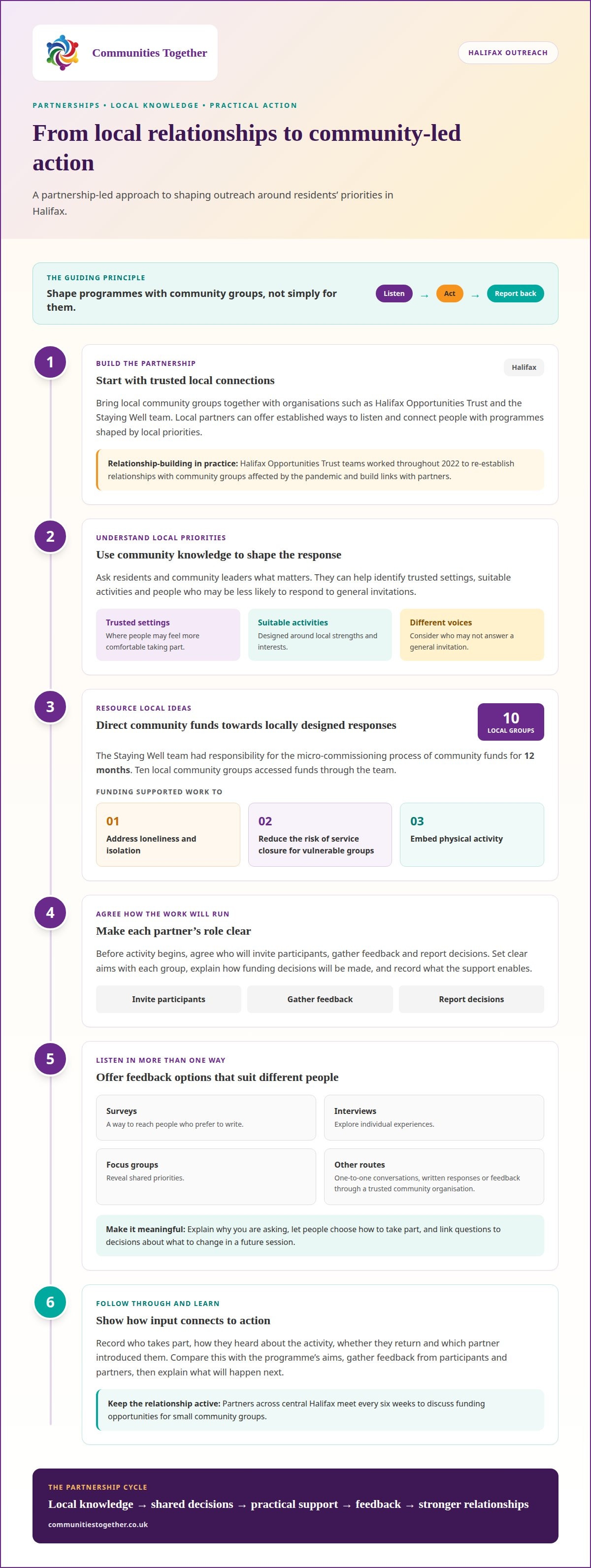
In Halifax, outreach can involve local community groups, Halifax Opportunities Trust and the Staying Well team. Partnerships can connect people with programmes shaped by local priorities and offer established ways to listen to residents.
Situation: Small community groups may understand local needs but have limited capacity to deliver activities. Action: Micro-commissioning can direct community funds towards locally designed responses. The Staying Well team had been responsible for the micro-commissioning process of community funds for twelve months. Ten local community groups accessed funds through the team to address loneliness and isolation, reduce the risk of service closure for vulnerable groups, and embed physical activity. Result: Funding supported work led by groups with direct knowledge of their communities. For a similar approach, agree clear aims with each group, explain how funding decisions will be made, and record what the support enables.
Situation: A programme planned without local input may miss people’s priorities or existing strengths. Action: Halifax Opportunities Trust teams worked throughout 2022 to re-establish relationships with community groups affected by the pandemic and build links with partners. Community leaders can help identify trusted settings, suitable activities and individuals who are less likely to respond to general invitations. Result: Those relationships offer a practical starting point for co-design, rather than assuming one message or activity will suit every group.
To measure participation, record who takes part, how they heard about the activity, whether they return and which partner introduced them. Compare these records with the programme’s aims, then gather feedback from participants and partners. Surveys can reach people who prefer to write; interviews explore individual experiences, and focus groups can reveal shared priorities. Link questions to decisions, such as what to change in a future session. That way, feedback informs action rather than being collected and set aside.
Group discussions do not work for everyone. Offer alternatives such as a one-to-one conversation, a written response or feedback through a trusted community organisation. Explain why you are asking, let people choose how to participate, and tell them how their input will shape the next step. These options can help people with limited time, confidence or technology access, and those who prefer a private conversation, contribute on their own terms.
Partnerships work best when every organisation understands its role. Agree who will invite participants, gather feedback and report decisions. For effective community outreach in Halifax, following through builds accountability and connects local knowledge to practical action.
Local groups, community leaders and organisations can broaden outreach, build trust and share valuable insight into community needs. They can also work together to shape programmes, events and services around local priorities and values. Partners across central Halifax meet every six weeks to discuss funding opportunities for small community groups.
Ask residents what they need, then shape support, grants and programmes around their challenges, values and interests. Taking time to build relationships and show commitment to people’s goals can strengthen community connections. Local neighbourhood policing teams and community safety partnerships are committed to engaging with residents through regular local surveys to better understand community needs and values.
Building trust and meaningful relationships
Trust grows through consistent action, not a single consultation or public meeting. Clear, inclusive communication and a willingness to learn can help build trust in community engagement. Use them as a practical test: can people understand the purpose, take part in a suitable way and see what happened next?
Situation: Residents may hesitate to share concerns if they do not know how their contributions will be used. Action: Before inviting participation, explain the decision under consideration, who will review contributions and when an update will follow. Use plain language and provide an accessible way to respond. Result: People can make an informed choice about taking part, and clear expectations help prevent consultation from seeming to promise a particular outcome.
Make listening active. At a local meeting, a facilitator can invite participants to describe their priorities in their own words, summarise what they hear and ask whether the summary is accurate. Offer a private conversation or written response to anyone who would rather not speak in a group. These steps help distinguish a genuine concern from an assumption made on someone else’s behalf.
Situation: A one-off event can create connections, but it may not show whether an organisation will respond over time. Action: Assign a named contact, record commitments and share progress through the same channels used for invitations. If a suggestion cannot be adopted, explain why and identify any alternative action. Result: Participants can see how their input influenced decisions, even when the final choice differs from their preference.
Consistency also means adapting when feedback reveals a barrier. If residents say a meeting time conflicts with caring responsibilities, offer another way to contribute. If the purpose is unclear, improve the invitation before sending it again. At each stage, ask who has not been heard, what could make participation difficult and how the next contact can address that gap. A commitment to inclusion becomes credible through these practical choices.
For community groups seeking to strengthen shared planning and relationships, partnership and community capacity building can support more collaborative ways of working. Used well, that process helps partners establish clear roles, maintain active connections and keep accountability visible to the people involved.
Build lasting relationships by creating genuine connections grounded in trust and mutual understanding. Be present, listen actively and show empathy. Being present means making room for concerns without rushing to defend a decision or steer the conversation towards a preferred answer. Active listening includes checking what remains unclear, confirming that you have understood and responding with care. Mutual understanding grows when people can explain their perspectives and receive an honest response, even when views differ.
Community outreach is an ongoing process that calls for flexibility, openness to feedback and a willingness to learn. Use feedback to reconsider how you make contact, whether the invitation is clear and what would make participation easier. Show that you have heard people by making a suitable adjustment or explaining why change is not possible. Returning to the conversation helps maintain relationships beyond a single activity. Over time, a steady presence, empathy and a readiness to adapt can make collaboration more meaningful and help people approach shared work with confidence.
Community and stakeholder consultation methods
Good consultation starts with a decision, not a generic request for views. In Halifax, identify the issue, who is affected and what can still change. A housing proposal, for example, may affect residents, local organisations and nearby service providers in different ways. Explain who will make the decision, which options are under consideration and how contributions will inform the outcome. This helps people focus on useful detail and understand why their involvement matters.
The Halifax Board of Police Commissioners requests at least one Community Roundtable on Policing per year. A roundtable brings stakeholders together to discuss a shared subject. Its value depends on preparation: explain the purpose, invite people with different experiences and offer ways to contribute beyond speaking in public. Record concerns, areas of agreement and unanswered questions, then report how they informed the next step.
Choose each consultation method for a clear purpose. A survey can gather views from a wide group, while interviews let people explain individual experiences in depth. Focus groups help participants discuss shared issues and differences. For example, a service redesign could begin with a survey, followed by interviews to explore responses that need more context. A later group discussion could test proposed changes before decisions are finalised.
Taking part should not depend on attending a meeting. Offer a written response, an individual conversation or a phone discussion for people who cannot join a group. If you use digital forms, provide a non-digital option too. A community centre or trusted local organisation can be a suitable place to share information and gather views. State the closing date and contact details clearly so people know how to contribute.
Check that questions are accessible and relevant to the people being consulted. Replace specialist terms with everyday language, explain how responses will be used and let participants skip questions they find uncomfortable. For discussions about mental wellbeing, for example, ask about access to community support without inviting people to share private details. This keeps consultation focused on service needs rather than individual diagnoses.
Close the loop after collecting feedback. Summarise what participants raised, explain which suggestions influenced the decision and give reasons when a proposal cannot proceed. A short update shared through the original invitation channels helps people see how their contributions connect to the outcome. Record participation by method and group, then use any gaps to improve the next consultation. This makes the process more accountable and useful.
Community engagement events led by marginalised voices
An event led by community members gives people with direct experience influence over its purpose, format and follow-up. In Halifax, organisers can ask trusted local groups which voices are missing, then invite those people to set priorities. The goal is shared leadership, not just attendance. Agree who makes decisions, how contributions will shape the event and how organisers will report back.
People can be missed because of language barriers, limited technology access, lack of time, complicated applications or restrictive eligibility criteria. These barriers may overlap, so an online invitation alone may not reach everyone. Ask local organisations which formats and communication channels work for their communities.
Situation: A public meeting may attract people who already feel confident speaking in a group, while others remain unheard. Action: Invite community representatives to plan a smaller discussion, choose its location and agree ground rules. Offer private ways to contribute, such as a written response or one-to-one conversation. Result: Participants can shape the agenda and take part in ways that suit their circumstances, rather than having to adapt to one meeting format.
Situation: An event about cultural heritage can feel extractive when organisers decide what should be shared. Action: Ask participants which knowledge, traditions or skills they want represented, and let them choose how to present them. Local residents might lead a storytelling session, demonstration or discussion, with organisers supporting access and practical arrangements. Result: The event reflects participants’ priorities and recognises their expertise, rather than treating lived experience as something to collect.
Funding can affect who has the time and capacity to lead. Before planning, identify practical needs such as materials, travel arrangements, interpretation or event coordination. Clarify roles and decisions, and involve community representatives in deciding how available resources support the event’s purpose. This helps prevent leadership from depending only on people able to contribute unpaid time.
Keep the setting and programme flexible. A quiet space, clear schedule and option to leave and return can make participation easier. Share information in accessible language and through channels chosen with local participants. If an activity does not suit the group, change it before the event rather than expecting attendees to adapt.
Afterwards, ask the people who led and attended what worked, what felt uncomfortable and what should change. Record practical outcomes, including who helped shape the programme and which suggestions informed follow-up. Share a concise update with participants and partners. This closes the loop and gives the next Halifax event a stronger foundation in community direction.
Inclusive community outreach campaigns
Reach Halifax residents through a mix of online messages and face-to-face contact. Share clear posts through community groups and place printed invitations in familiar local settings. Pair each digital channel with an in-person option, such as a staffed information point or a conversation through a trusted organisation. This gives residents different ways to hear about an initiative and take part.
Successful examples in Halifax and Calderdale include community groups receiving support through the Staying Well team. Ten local groups accessed funds to address loneliness and isolation, reduce the risk of service closure for vulnerable groups, and embed physical activity. This shows how locally delivered activity can connect outreach with practical community priorities.
Start a campaign by identifying who it aims to reach and what those residents need to know or do. For a community activity, explain its purpose, who can participate, how to take part and whom to contact. Use short sentences, clear headings and an invitation that describes the activity accurately. Ask a local group to review the message before sharing it, so it can flag unfamiliar wording or assumptions.
Then make it easier to respond. Simplify application forms, offer flexible ways to participate and translate messages where appropriate. A long online form may discourage someone with limited time or digital access; a short paper form or in-person conversation offers another route. For mental health-related community initiatives, describe the activity and available support without inviting people to disclose private health information publicly.
Choose communication channels with residents instead of relying only on the platforms an organisation already uses. A local group may know which noticeboards, community settings or online spaces people trust. Give each partner a message they can share, with the same key details in every format. Include an offline contact option alongside any digital sign-up, so people can ask questions without completing an online process.
Assess a campaign by recording how people heard about it, which participation routes they used and where responses came from. Compare these patterns with the groups the initiative aimed to reach. If one channel draws little engagement, ask community partners what may be getting in the way, then adjust the message or format. Tell participants about the changes so they can see feedback leading to action.
Inclusive outreach works best when residents can shape both the invitation and the activity. Involve them from planning through follow-up, and use their feedback to guide adjustments. This helps organisations in Halifax make participation more accessible and keep local priorities central.
Communities Together: Community Engagement Programmes
Communities Together helps local groups turn outreach priorities into shared activity through its Community Engagement Programmes. These can support partners who want to build participation, develop community capacity or create opportunities shaped by local interests.
Depending on community aims, South Asian Arts and Heritage Activities can encourage cultural participation, while Wellbeing and Resilience Workshops create opportunities for learning and connection. Heritage and Cultural Preservation projects can help communities sustain and share cultural knowledge. Choose an approach that fits the people involved and the purpose of the work.
For a conversation about community engagement, contact Communities Together.
Turn shared priorities into sustained action
The next step is to choose a community priority and agree how residents will help shape the work. For effective community outreach in Halifax, build participation into the plan from the start: clarify the purpose, invite contributions through accessible channels and decide how you will share progress. A focused beginning gives local partners room to learn, adapt and build towards lasting collaboration.
Communities Together supports organisations developing community-led activity and stronger local connections. Start with a conversation about the people you hope to engage and the change you want to work towards.
With a clear purpose and community voices at the centre, your next initiative can grow from a strong foundation.
Frequently Asked Questions
How can local organisations partner with Halifax Council, schools, health services and community groups?
Start with a shared local priority and a clear proposal for how each organisation could contribute. A school, for example, might share an invitation with families, while a community group advises on suitable activities and a health service identifies relevant wellbeing themes. Agree responsibilities, communication routes and intended outcomes before activity begins. A short planning meeting can help partners identify overlap, avoid duplicated work and decide how to review progress together.
Which Halifax communities and groups are underserved by current outreach?
The material highlights marginalised voices, vulnerable groups and people less likely to respond to general invitations. Outreach may also miss people with limited time, confidence or technology access, and those who prefer private ways to contribute.



Comments