
Community leadership training for Halifax community members
Community leadership grows through shared practice, not simply by holding a formal role. A community leadership programme in Halifax can help people build the confidence and skills to bring residents together, strengthen local groups and contribute to decisions that affect their communities. Learning focuses on turning local knowledge and relationships into collective action.
It’s reasonable to want clear answers before committing your time: what the sessions cover, whether the programme is intended for you, and how taking part works in practice. This guide explains what community leadership training can involve, who may be able to participate and the areas a programme serves, alongside delivery arrangements, travel support and participants’ feedback.
You’ll also find guidance on choosing a programme and how structured learning can support people at different stages of community involvement. Use these considerations to judge how training might fit your experience, responsibilities and aspirations for your community.
Table of Contents
What is Community Leadership Training?
Community leadership training develops skills for bringing residents together, supporting local organisations and shaping community projects. In Halifax, the organisation delivering each programme sets its focus; this may be a voluntary or community-sector body, a public-sector partner or a learning provider.
Voluntary and Community Sector Leadership
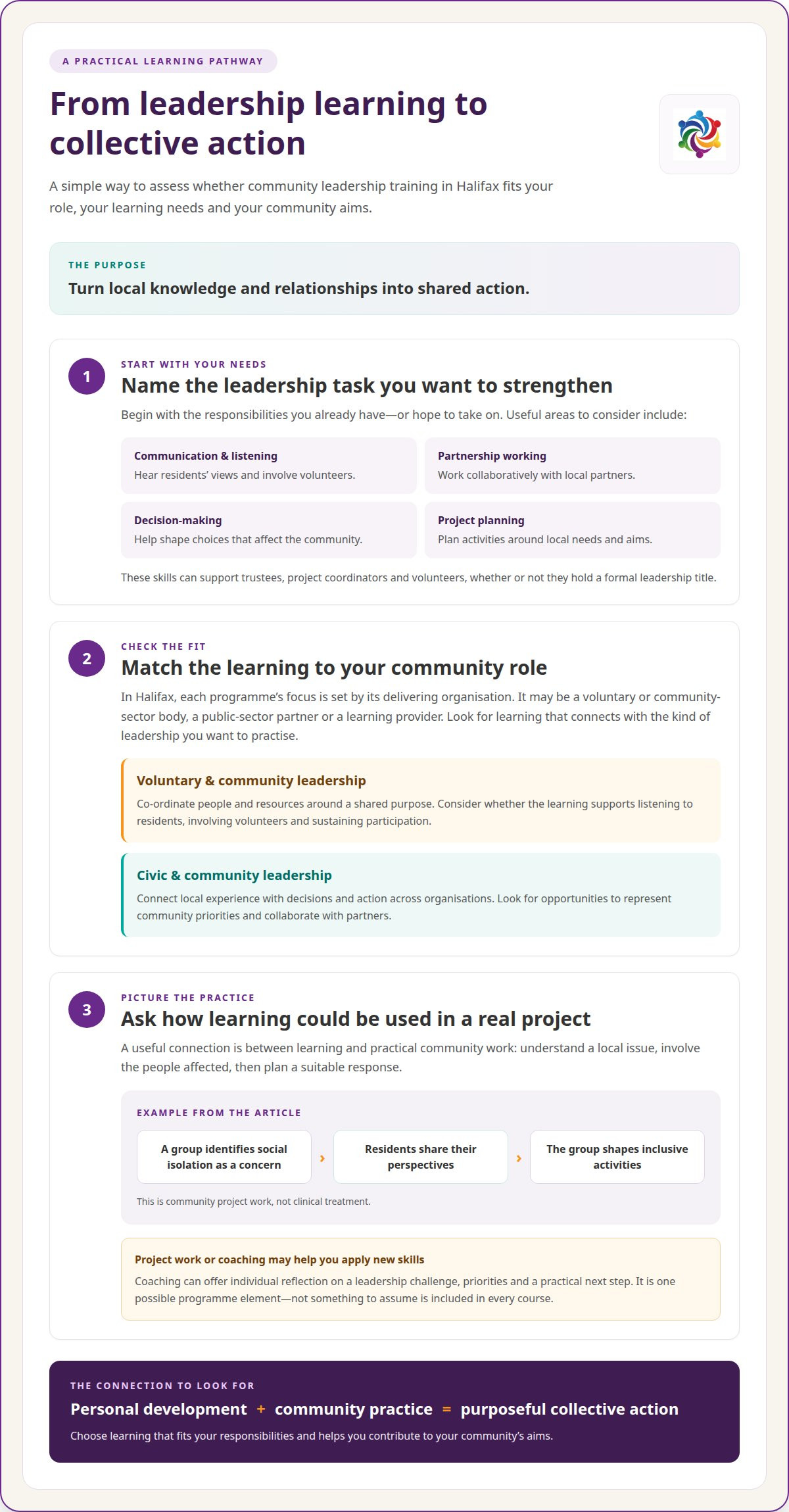
In voluntary and community organisations, leadership often means coordinating people and resources around a shared purpose. Useful skills include communication, partnership working, decision-making and project planning. Look for learning that connects with practical responsibilities, such as listening to residents, involving volunteers and sustaining participation. These skills can help trustees, project coordinators and volunteers contribute, whether or not they hold a formal leadership title.
Civic and Community Leadership
Civic and community leadership connects local experience with decisions and action across organisations. Useful learning explores how to listen to residents, represent community priorities and collaborate with partners. For example, a group identifying barriers to participation could bring residents and local organisations together to agree practical steps. Consider whether a programme builds collaboration and collective influence as well as individual confidence and communication.
A Diploma in Community Development Practice offers a structured way to study community development methods and knowledge. The qualification title alone does not explain its format or assessment. Consider how the learning relates to practical tasks such as understanding local needs, facilitating participation and planning activities. For Halifax learners, the key question is whether the course fits their role and community aims.
Project development can connect leadership learning with community wellbeing when groups identify an issue, involve affected residents and plan a suitable response. For example, a local group concerned about social isolation could gather residents’ perspectives before shaping inclusive activities. This is community project work, not clinical treatment. Training can help participants consider who should contribute, what local knowledge can inform decisions and how partners can support the work.
Leadership development and coaching can add individual reflection to group learning. A coach can help someone consider a leadership challenge, clarify priorities and identify a practical next step. Coaching is one possible programme element, not a feature to assume in every Halifax course. Its value depends on whether individual reflection supports the participant’s development needs and community responsibilities.
To assess a course, identify the leadership tasks you want to strengthen, compare the learning with voluntary or civic practice, and consider how project work or coaching could help you apply new skills. For instance, a volunteer hoping to involve more residents could prioritise facilitation and communication. This links personal development with purposeful action by community organisations.
Participant feedback
Participants gave the programme an average score of 9/10 for its content and subject matter. This figure offers a useful indication of how learners rated those elements, rather than a complete measure of every part of their experience. It does not, by itself, show how participants rated session arrangements, coaching or the practical application of learning. Keeping those distinctions clear helps readers interpret feedback accurately.
Content ratings can help prospective learners consider whether sessions address relevant leadership needs. For example, a participant hoping to strengthen partnership working may value learning that examines collaboration, communication and shared decision-making. The 9/10 average relates to content and subject matter, so it is most useful when read in that context. It should not be treated as a rating for every programme feature or as evidence of a specific community outcome.
Feedback is most useful when it answers practical questions: what participants found valuable, which topics applied to their roles and whether sessions helped them identify next steps. Someone coordinating a voluntary group, for example, may want learning they can use to involve residents or work with partners. These are ways to assess relevance, not claims about individual participants’ experiences.
Content: Does the subject matter connect with the leadership responsibilities learners bring?
Application: Can participants identify a practical way to use an idea in their organisation or community?
Experience: Does feedback describe the sessions and support, rather than only the topics?
A strong average score can be encouraging, but it cannot answer every question a prospective participant may have. Separate the considerations: assess the reported content rating, then consider whether the programme’s format and activities suit your circumstances. Someone seeking structured reflection may value the chance to discuss a current challenge, while a project lead may prioritise tools for planning and collaboration.
Feedback also has limits as a guide to future results. A 9/10 average describes participants’ ratings of content and subject matter; it does not guarantee that every learner will have the same experience or achieve identical outcomes. Individual roles, learning priorities and opportunities to practise skills can shape what someone takes away. Treat the score as one reference point, alongside the programme’s stated focus and your own development aims.
For groups seeking to translate learning into shared local activity, community engagement programmes offer a related route for supporting participation and collaboration.
Programme eligibility and geographic reach
In Halifax, community leadership training and community development learning may be available through different organisers, each with its own eligibility criteria. Halifax is part of Calderdale, so compare local and wider-area programmes by their intended participants, catchment and delivery arrangements.
Programme Eligibility
Eligibility depends on each programme’s purpose, rather than on one standard rule. An organiser might design learning for voluntary groups, emerging community leaders or people already coordinating local projects. A programme focused on strengthening community organisations, for example, may suit a volunteer trustee, while another may prioritise people leading a specific initiative. Look for the intended audience and any stated role or experience criteria.
Practical fit matters as much as formal eligibility. A resident hoping to contribute to local decisions may need a different learning focus from a project coordinator seeking partnership skills. Consider how the programme describes its audience, the activities participants undertake and whether group learning reflects their responsibilities. These details help distinguish leadership development from a course focused mainly on a professional qualification or technical subject.
Geographic Reach
Geographic reach describes where a programme recruits participants or supports community activity. A Halifax-based course may focus on Calderdale, while a regional programme may include people from several local authority areas. This can shape peer learning: participants from nearby communities may discuss shared local challenges, while a wider group can bring different approaches to partnership and participation.
To compare geographic reach, identify the stated catchment, session locations and whether the learning is intended for a particular community or sector. A programme supporting voluntary organisations across a wider area, for instance, may welcome participants whose work connects several neighbourhoods. A locally focused initiative may prioritise people developing projects in a defined community. The organiser’s remit determines which applies.
For someone in Halifax, comparing a Calderdale option with one serving a wider area means weighing the programme’s purpose against the community where its learning will be used. A broader catchment can create opportunities to exchange experience across organisations; a local focus can keep discussion close to neighbourhood priorities. Neither is automatically more suitable. The key question is whether the programme’s reach matches participants’ responsibilities and intended project.
Before choosing, make three practical checks: match the eligibility criteria to your role, compare the geographic remit with your community work, and consider whether the programme addresses your development needs. Someone helping a neighbourhood group build partnerships, for example, should look for learning relevant to collaboration rather than assume every leadership course covers the same challenges. This makes the difference between local and regional provision clearer.
Programme schedule and travel support
Schedules and travel arrangements depend on the organiser, cohort and delivery location. For people in Halifax, consider how often sessions take place, their start and finish times, breaks and the journey involved. These details affect whether training fits alongside work, caring responsibilities and existing community commitments.
A previous Community Leadership Programme format included seven in-person programme days: five intensive training and connection-building days, alongside a one-day group Mentoring Marathon. This example shows how a course can combine learning formats rather than rely on weekly sessions alone. It describes a past delivery model, not a timetable for a Halifax programme, so use it to understand possible formats rather than local dates.
For travel planning, consider the whole journey, not just the session time. A Halifax participant travelling after work, for example, needs to account for the trip to the venue, the session and the return journey. The location and frequency of in-person activities shape the commitment. If a programme combines formats, each type of session may involve a different travel pattern.
Travel support is separate from scheduling, and arrangements depend on the programme and journey involved, including where sessions take place and how often participants attend. A course with several in-person days, for example, creates a different travel requirement from one with fewer, longer gatherings. Understanding these practical factors helps participants assess the commitment without assuming that arrangements for one cohort apply to another.
When comparing options, set out the schedule clearly: session dates, start and finish times, delivery method, breaks and travel needs. This makes differences easier to see. A weekly evening course may fit around daytime responsibilities, while intensive days may require cover for other commitments. These are planning considerations, not details of a particular Halifax timetable.
Travel affects participation beyond the journey itself. Someone coordinating shared transport or caring arrangements, for instance, benefits from having session dates early enough to plan. Regular attendance can help learners build relationships with peers and develop skills across connected sessions. The organiser’s schedule and each participant’s circumstances determine what planning is needed.
Read a published timetable as part of the learning offer, not as an administrative extra. In Halifax, compare how the format supports your learning aims with the time and travel it requires. Considering both can help you choose a realistic way to participate and make good use of the training.
Annual delivery and cohort history
For people considering community leadership learning in Halifax, a programme’s cohort history can help explain how it is organised over time. It may run as a one-off course or return with new groups, and each approach offers different kinds of continuity. Repeated cohorts can create opportunities for learning across successive groups, while a single course may focus on a particular development need or community project.
Consider what each cohort aims to achieve, who it is designed for and how the learning connects with local work. Community priorities can differ between neighbourhoods and organisations in Halifax, Huddersfield, Leeds, Bradford and Wakefield. A useful programme makes its purpose clear, so participants can judge whether the learning relates to the people and projects they support.
Cohort history can also indicate whether learning continues beyond scheduled sessions. Some programmes may connect past participants through a peer network, shared activity or further development opportunities. These features are not automatic parts of every course. Consider whether continued contact would help you collaborate with others or whether your immediate priority is focused learning for a current role.
When reviewing a programme’s record, distinguish delivery history from evidence of impact. The number of previous cohorts alone does not explain what participants learned or how their communities benefited. More useful details include the programme’s aims, the experience it draws on and how participants can apply what they learn. A local group developing a community activity, for example, may need support that connects leadership ideas with practical planning.
How often a programme runs can affect when someone has a chance to participate. A programme that returns periodically may have defined application windows, while another may organise learning around a specific project. In either case, the current cohort’s dates and requirements matter for planning. People balancing community responsibilities with work or caring commitments can use this information to see how participation fits their routine.
For a Halifax group exploring leadership development, use cohort information to understand a programme’s continuity, audience and connection with local priorities. Then compare these features with the work your organisation or community hopes to advance. This keeps the decision grounded in practical aims rather than relying on programme history alone. If the priority is wider community participation, engagement activity may be a useful next step alongside individual learning.
Communities Together: Community Engagement Programmes
Communities Together supports groups in Halifax and across Huddersfield, Leeds, Bradford and Wakefield through Community Engagement Programmes. These offer a practical next step when your focus is bringing people together, strengthening relationships and supporting community cohesion, rather than joining a formal leadership course.
Depending on your group’s aims, South Asian Arts and Heritage Activities, Wellbeing and Resilience Workshops, and Heritage and Cultural Preservation projects can create opportunities for connection and shared learning. These activities can complement community development by encouraging participation through cultural knowledge, wellbeing and local relationships.
If your group in Halifax is shaping an engagement activity or exploring ways to strengthen community connections, contact Communities Together to discuss your aims.
Put your next community step into motion
If a community leadership programme in Halifax is your next step, begin by identifying the contribution you want to make. You might bring people into a local conversation, build stronger connections between groups or develop an idea with a clear community purpose. A specific aim can help you decide which learning and support will be most useful.
You don’t need to resolve every detail before taking action. Start with the community priority that matters most, consider who should help shape the response and think about what would make participation meaningful. Then explore a suitable way to build shared understanding and turn intentions into practical activity.
For support with community-led work, get in touch with Communities Together to discuss your aims and the next step that fits.
Your experience and local knowledge are valuable foundations for positive change. Build on them, one purposeful step at a time.
Frequently Asked Questions
How do I access the training?
Access usually begins through the organisation running the programme, which sets its application process and intake dates. First decide whether you want structured leadership learning or support for a community activity, then follow the relevant organiser’s published process. In Halifax, Communities Together’s community engagement, learning, skills and personal development activities may suit people looking to build participation or develop local initiatives, even if they are not seeking a formal course.
What will participants learn?
Participants can develop practical ways to involve residents, communicate community priorities and work constructively with partner organisations. Someone supporting a local group, for example, could practise turning residents’ ideas into a clear project purpose, then identify who needs to contribute. Learning may also encourage reflection on leadership responsibilities and how decisions affect participation. Topics depend on programme design, so the most useful course connects activities with the participant’s community role.
What are the benefits of attending the training?
Training can give participants space to build confidence, reflect on their approach and practise skills alongside people working on community issues. A volunteer coordinating a neighbourhood activity, for instance, could use learning to clarify roles and make collaboration easier. Peer discussion can introduce different responses to shared challenges. Benefits depend on how learners apply ideas in their own settings and the opportunities available to put them into practice.
What have participants said about the programme?
Participants gave the programme an average score of 9/10 for its content and subject matter. That rating offers a helpful indication of how learners assessed the programme’s learning content, but it does not describe every aspect of participation. Someone considering a course can use the score alongside its stated subject matter and their own priorities. For example, a learner focused on partnership working will want to see whether the topics relate to that goal.
Who is the training aimed at?
Community leadership training can suit people contributing to voluntary, community or social enterprise work, whether they lead a group or support its activities. A volunteer organising a neighbourhood project, a trustee shaping an organisation’s direction or a resident bringing local perspectives to a partnership may each have different learning needs. The best fit depends on the programme’s purpose and whether its intended audience reflects the participant’s responsibilities.
Who is eligible to apply for a Halifax community leadership programme?
The organisation running each programme sets its eligibility criteria, so there is no single rule for every opportunity in Halifax. Organisers may define participation by a person’s community role, area of work or the programme’s aims. Someone involved in a local group may be among the intended participants for a community leadership programme in Halifax, but the stated application criteria determine eligibility. The programme’s remit and requirements are decisive.
What topics and skills do Halifax community leadership programmes cover?
Topics can include community participation, communication, collaborative working and planning local activity. The balance varies: one course may focus on developing a project, while another emphasises working across organisations or representing community perspectives. To assess relevance, connect a current responsibility with a learning need. Someone bringing residents together might prioritise facilitation, while a project organiser may focus on planning and partnership.
How long are the programmes, and when do they run?
Programme length and timing depend on the organiser and format. Some learning takes place in regular sessions; other programmes use concentrated training days. For participants in Halifax, the practical commitment includes travel, preparation and time to apply learning between sessions. If you balance community work with employment, study or caring responsibilities, compare the timetable with your routine to judge whether the format is manageable.



Comments