
Intercultural Understanding: Building Meaningful Connections in Our Communities
What if the most effective way to address rising social polarisation in our urban centres is not through separate cultural celebrations, but through the deliberate, methodical practice of intercultural dialogue? It's widely understood that the benefits of cultural diversity in communities are vast, yet many practitioners find it difficult to engage diverse groups in a single programme whilst navigating the complex fears of cultural appropriation. We recognise the earnest desire of local leaders to build bridges in a way that is both inclusive and accountable, ensuring that every resident feels a sense of belonging, purpose, and security within the social fabric of West Yorkshire. This article promises to reveal how intercultural dialogue and shared heritage activities can transform local social cohesion, facilitate deeper understanding, and foster lasting community resilience across Huddersfield, Halifax, Leeds, Bradford, and Wakefield. We'll provide a clear framework for facilitating these vital conversations, offer practical ideas for heritage-based community workshops, and demonstrate how South Asian arts can serve as a powerful vehicle for building trust, strengthening partnerships, and achieving long-term social stability.
Table of Contents
What is Interculturalism? Defining the Path to Social Cohesion
The Pillars of Intercultural Dialogue: Trust, Reflection, and Identity
Intercultural vs. Multicultural: A Strategic Framework for Communities
Practical Strategies for Fostering Intercultural Understanding in West Yorkshire
Bridging the Divide: South Asian Arts and Heritage as Intercultural Tools
What is Interculturalism? Defining the Path to Social Cohesion
Interculturalism is far more than a passive state of coexistence; it represents a dynamic, active process of interaction where individuals from diverse backgrounds engage in meaningful dialogue to build a stronger collective identity. While we often celebrate the visible benefits of cultural diversity in communities, such as varied cuisines or vibrant festivals, the true potential for social stability lies in the deeper appreciation of cultural nuances and the recognition of shared social identities. This approach prioritises mutual respect and accountability, ensuring that every resident in our region feels seen, heard, and valued as a contributing member of society. We don't just live side-by-side; we actively shape each other's experiences through purposeful engagement.
The Difference Between Multicultural and Intercultural
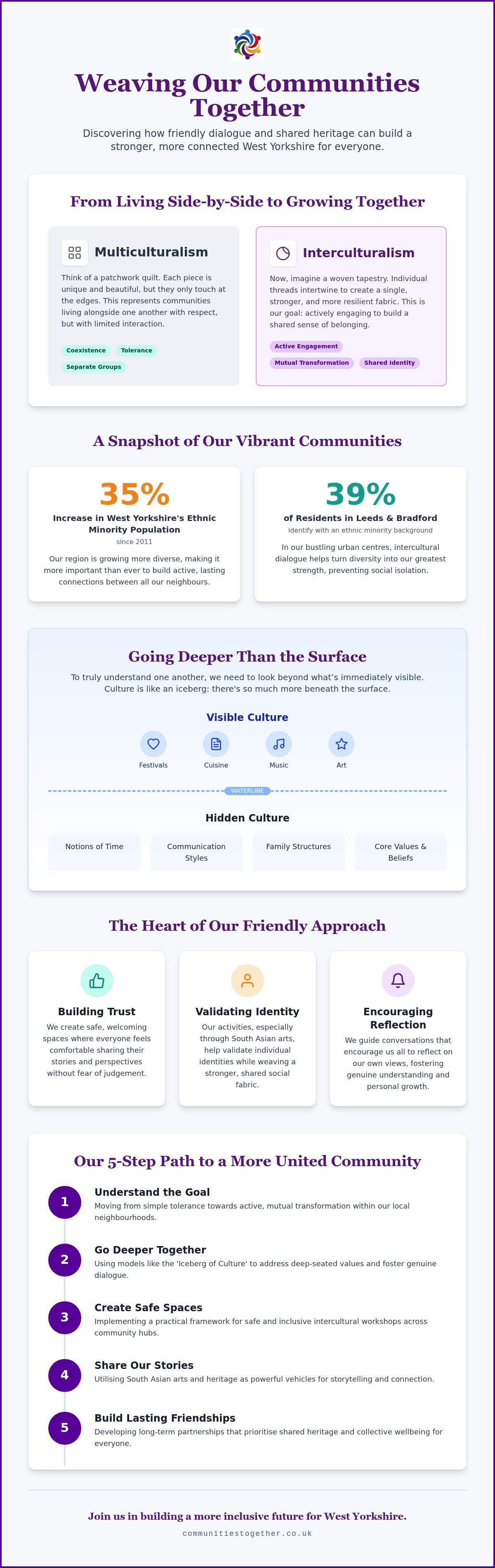
To understand this shift, we can visualise multiculturalism as a patchwork quilt where each piece of fabric is beautiful and distinct but remains separate, touching only at the edges. In contrast, Interculturalism functions like a tapestry where individual threads are intricately woven together to create a fabric of greater structural strength and resilience. This distinction is fundamental to the design of social cohesion programmes in West Yorkshire, as it moves us away from separate silos toward shared bridges of understanding. By focusing on mutual transformation rather than just tolerance, we can facilitate environments where traditions are preserved whilst new, collective stories are written together.
Why Intercultural Understanding Matters in 2026
With the ethnic minority population in West Yorkshire increasing by 35% since 2011, the need for robust social frameworks has never been more pressing. In urban centres like Leeds and Bradford, where 39% of the population identifies with an ethnic minority background, social isolation can take root if we fail to build active connections between disparate groups. Intercultural dialogue acts as a vital mechanism to reduce prejudice, dismantle stereotypes, and build the collective community resilience necessary to face future challenges.
Interculturalism is a principled commitment to achieving shared growth through the deliberate and continuous exchange of cultural heritage, values, and perspectives. By investing in these connections, we ensure the benefits of cultural diversity in communities translate into tangible social harmony and long-term stability for every household. Methodical participation in initiatives like the West Yorkshire Community Leaders Programme provides the necessary foundation for this ongoing work, helping to weave a more inclusive future for everyone.
The Pillars of Intercultural Dialogue: Trust, Reflection, and Identity
Building meaningful connections across West Yorkshire requires a methodical approach that prioritises trust, self-reflection, and the active formation of shared identities amongst residents. While we often focus on the immediate benefits of cultural diversity in communities, such as the introduction of new perspectives and the enrichment of local life, these outcomes are only achievable when we commit to the hard work of deep, sustained dialogue. This process involves moving beyond polite conversation to address the structural and emotional barriers that can lead to social polarisation in our urban centres.
Recognising the Iceberg of Culture
We often perceive culture through its most visible manifestations, such as the vibrant South Asian food festivals, traditional dress, or colourful celebrations frequently seen in Huddersfield and Halifax. However, these represent only the surface of a much larger structure. Beneath the waterline lie the deep-seated values that govern notions of time, family structures, and communication styles, all of which are essential components in Understanding Culture and Diversity within our local context. Communities Together utilise this structural understanding to design inclusive engagement programmes that facilitate deeper dialogue, address underlying tensions, and maintain social harmony by acknowledging these often-unseen cultural drivers.
Developing a Culture-Reflexive Perspective
True intercultural dialogue isn't just about learning about our neighbours; it's about looking inward to recognise how our own backgrounds influence our interactions. By using tools like the social identity wheel, participants in our sessions can map their own experiences, identify their personal biases, and understand how their perspective shapes their worldview. This process of developing a culture-reflexive perspective is vital for fostering empathy and realising the full benefits of cultural diversity in communities. When we understand ourselves, we're better equipped to listen to others without judgement, ensuring that our interactions are grounded in mutual respect rather than assumption.
Navigating disagreements amongst diverse groups requires a commitment to active listening, which involves hearing the underlying values and intentions behind a person's words. When residents from different backgrounds collaborate on local projects, they begin to form a shared "third space" identity that transcends individual differences and builds a sense of collective belonging. This collaborative participation ensures the benefits of cultural diversity in communities are felt through increased social resilience and a stronger, more inclusive local fabric. To explore how these concepts are applied in practice, you might consider participating in our wellbeing and resilience workshops, which are designed to support personal and community growth through methodical engagement.
Intercultural vs. Multicultural: A Strategic Framework for Communities
Choosing a strategic framework for community development requires a clear understanding of how different models impact social stability and growth. While multiculturalism has historically focused on the peaceful coexistence of distinct groups, it often stops at the level of tolerance, which can leave communities vulnerable to fragmentation. In contrast, interculturalism seeks mutual transformation through active engagement, ensuring that the benefits of cultural diversity in communities are fully realised through shared participation and collective resilience. This shift is essential for community capacity building, as it moves beyond simply living alongside one another to building a unified, interactive neighbourhood.
Tolerance vs. Mutual Transformation
Tolerance serves as a baseline for any civil society, yet it's often insufficient for building the deep-seated trust required to weather social challenges. Intercultural projects challenge this passivity by encouraging participants to learn, adapt, and change together through shared experiences. For instance, a collaborative South Asian arts project in Huddersfield or Halifax doesn't just showcase heritage; it invites residents from all backgrounds to co-create, share stories, and redefine their local identity. This process of Understanding Culture and Diversity ensures that every participant is transformed by the encounter. This leads to a profound sense of togetherness. It transcends mere superficial acceptance.
Strengthening Local Infrastructure Through Interaction
Building a robust community infrastructure requires more than just physical centres; it demands the creation of durable social networks that can facilitate ongoing cooperation. Intercultural dialogue builds this capacity by fostering collaborative partnerships between local community groups, faith organisations, and public bodies. By prioritising interaction, we can bridge the gaps between diverse groups in Wakefield and surrounding areas, creating a sustainable foundation for future development. These inclusive programmes ensure that the benefits of cultural diversity in communities are not just theoretical concepts but are woven into the very fabric of how we organise, support, and sustain our local neighbourhoods. This methodical approach to engagement leads to increased social resilience, improved wellbeing, and a stronger sense of shared purpose for all residents. We're committed to facilitating these connections to ensure a legacy of stability and harmony for every community member.
Practical Strategies for Fostering Intercultural Understanding in West Yorkshire
Implementing a methodical framework for interaction is essential to move from theoretical concepts to a lived reality where every resident feels a sense of belonging, purpose, and security. We recommend a structured five-step process for initiating change: identifying neutral ground, recruiting diverse representation, establishing shared values, facilitating structured dialogue, and committing to collaborative action. By following this sequence, community leaders can ensure that the benefits of cultural diversity in communities are harnessed effectively to build trust, reduce prejudice, and mitigate social polarisation in our urban centres. Neutral ground is particularly vital across West Yorkshire, as it provides a space free from historical baggage where residents from Leeds, Bradford, and Huddersfield can meet as equals. This foundational work requires leaders to invest in their own skills and personal development, perhaps by engaging with the West Yorkshire Community Leaders Programme before its 30 June 2026 application deadline to ensure they possess the expertise to weave complex social threads together.
Creating Inclusive Spaces for Dialogue
Identifying and addressing the psychological barriers to participation is as important as overcoming physical hurdles in areas like Wakefield and Halifax. We must recognise that residents may feel hesitant due to language barriers, fear of cultural appropriation, or previous negative experiences in formal civic spaces that didn't feel inclusive. Facilitators should employ techniques that warmly encourage quiet voices to be heard, using small-group breakouts, visual aids, and non-verbal storytelling methods to ensure that every participant feels their contribution is significant. Integrating wellbeing and resilience workshops into these efforts helps to create a supportive environment where participants feel psychologically safe, valued, and ready to engage in the deep reflection necessary for intercultural understanding.
Leveraging Shared Projects for Collective Growth
Working toward a common, tangible goal is one of the most effective ways to naturally break down cultural silos and foster a sense of collective belonging amongst residents. Practical projects like community gardens in Leeds, local history trails in Halifax, or shared murals in Bradford provide visible outcomes that everyone can take pride in, maintain, and enjoy. These activities shift the focus from individual differences to collective achievement, demonstrating the practical benefits of cultural diversity in communities through improved local amenities, enhanced social bonds, and increased community pride. Shared learning activities allow participants to validate their own identities whilst finding common ground, ensuring that the social fabric of our region remains strong, durable, and resilient for future generations.
Bridging the Divide: South Asian Arts and Heritage as Intercultural Tools
South Asian arts and heritage serve as a profoundly vibrant medium for storytelling, offering a shared experience that transcends linguistic barriers and facilitates a deeper, more visceral form of intercultural understanding. By positioning these creative expressions at the heart of community life, we can effectively demonstrate the benefits of cultural diversity in communities through increased social participation, the validation of diverse personal narratives, and the creation of a more inclusive local identity. In cities like Huddersfield and Leeds, where the South Asian population contributes significantly to the local economy and social life, these artistic endeavours provide a necessary bridge between different generations and cultural backgrounds. They allow for a methodical exploration of identity that strengthens the social fabric, maintains cultural continuity, and facilitates long-term stability across our entire region, especially as we build upon the lasting cultural legacy of Bradford's UK City of Culture 2025.
The Power of Creative Participation
Workshops focused on traditional South Asian dance or visual arts foster a unique form of non-verbal understanding that is particularly effective in West Yorkshire's diverse districts. Through movement, rhythm, and colour, participants engage in a universal language that bypasses the limitations of formal speech, allowing for a shared emotional resonance that builds trust, fosters empathy, and encourages mutual respect amongst residents. This creative engagement acts as a powerful conduit for collective growth, enabling residents to celebrate their own traditions whilst simultaneously learning from the heritage of others in a safe, supportive, and inclusive environment. Active cultural participation expands educational access for all residents by providing informal learning environments that are both inclusive and intellectually enriching, ensuring that knowledge is shared across all social boundaries to foster a more resilient society.
Heritage Preservation as a Tool for Resilience
The preservation of local history through community-led heritage projects plays a critical role in reducing social isolation and building collective community resilience. By documenting the specific stories and contributions of South Asian communities in Yorkshire, we enrich the collective memory of our region, ensuring that the threads of cultural continuity are woven into the broader narrative of local life and history. These projects empower individuals by giving a formal voice to their experiences, validating their presence, and facilitating a sense of enduring belonging that is essential for maintaining social stability and harmony. This methodical approach to protecting our shared history ensures that the benefits of cultural diversity in communities are preserved for future generations, creating a legacy of harmony, understanding, and mutual transformation. We warmly invite you to join our local intercultural initiatives to share your heritage, build new connections, and contribute your unique story to the ongoing tapestry of West Yorkshire.
Weaving a Resilient and Inclusive Future for West Yorkshire
Building a unified future requires more than just the passive acknowledgement of our neighbours; it demands a principled commitment to active interaction, mutual transformation, and the continuous cultivation of trust. By moving beyond multicultural silos towards an intercultural framework, we ensure that the benefits of cultural diversity in communities translate into tangible social resilience, improved wellbeing, and a more durable community infrastructure. We're proud to act as specialists in South Asian arts and heritage preservation, delivering impactful community engagement across the vibrant districts of Leeds, Bradford, and Huddersfield to maintain stability and harmony.
As a mission-driven non-profit dedicated to social cohesion and inclusive growth, we remain committed to facilitating these vital connections and supporting local leaders in weaving together the complex threads of our social fabric. Through the methodical preservation of our shared history and the celebration of creative participation, we can transform our local neighbourhoods into spaces of profound belonging where cultural continuity becomes the foundation for collective strength.
We warmly invite you to join us in this ongoing work to ensure a legacy of understanding, respect, and shared prosperity for every resident in our region.
Frequently Asked Questions
What is the primary difference between intercultural and multicultural approaches?
An intercultural approach focuses on active interaction and shared growth rather than just the peaceful coexistence of separate cultural groups. While multiculturalism often emphasises tolerance between distinct communities, interculturalism encourages residents to engage in purposeful dialogue and collaborative projects that lead to mutual transformation. This dynamic process ensures that the benefits of cultural diversity in communities are realised through the creation of shared spaces where new, collective identities are formed across Leeds and Bradford.
How can intercultural dialogue help reduce social isolation in my local area?
Intercultural dialogue reduces social isolation by creating structured opportunities for residents from disparate backgrounds to meet, share stories, and build lasting friendships. By facilitating safe environments for interaction in local community centres, we help individuals overcome the psychological barriers of loneliness and mistrust. These meaningful connections foster a sense of belonging and collective security, ensuring that every participant feels valued as an integral part of the social fabric in Huddersfield and Wakefield.
What are some practical examples of intercultural activities for community groups?
Practical intercultural activities include collaborative projects that require diverse groups to work towards a common, tangible goal. Examples often involve creating community gardens, developing local history trails, or co-designing public murals that reflect shared heritage. These initiatives naturally break down cultural silos by prioritising collective achievement and mutual support, allowing residents to learn new skills whilst building the social resilience necessary for a harmonious and inclusive neighbourhood environment across West Yorkshire.
Can South Asian arts and heritage projects be inclusive for those from other backgrounds?
South Asian arts and heritage projects are designed to be deeply inclusive by using universal mediums like dance, music, and visual storytelling to invite participation from all backgrounds. These activities serve as a vibrant bridge for intercultural exchange, allowing residents to validate their own identities whilst finding common ground with others. By engaging with these traditions in Huddersfield or Leeds, participants experience the benefits of cultural diversity in communities through shared creative expression and non-verbal understanding.
Why is self-reflection important for intercultural understanding?
Self-reflection is vital because it allows individuals to recognise their own cultural biases and understand how their background influences their perceptions of others. By engaging in a culture-reflexive process, residents can develop the empathy and self-awareness needed for genuine dialogue. This internal work is a necessary foundation for building trust and ensuring that intercultural interactions are grounded in mutual respect, accountability, and a sincere desire for collective growth within our diverse local districts.
How do Communities Together support intercultural cohesion in West Yorkshire?
Communities Together support cohesion by delivering methodical engagement programmes, South Asian heritage projects, and wellbeing workshops across West Yorkshire. We act as a professional bridge-builder, facilitating dialogue between diverse groups and building the capacity of local organisations to maintain social stability. Our mission-driven approach prioritises long-term social benefits by providing the tools, expertise, and safe spaces required for residents in Halifax and Wakefield to thrive together in harmony and security.
What role does wellbeing play in fostering intercultural dialogue?
Wellbeing is a fundamental component of intercultural dialogue because it ensures that participants feel psychologically safe, supported, and ready to engage in deep reflection. Our resilience workshops provide the emotional foundation necessary for residents to navigate difficult conversations and build trust across cultural divides. By prioritising the mental and emotional health of our community members, we facilitate a more absorptive and reassuring environment where meaningful social connections can take root and flourish for the long term.
How can I get involved in local heritage and cultural preservation projects?
You can get involved by reaching out to our team to learn about upcoming community engagement programmes or heritage preservation initiatives in your local area. We warmly welcome residents to participate in our workshops, contribute to local history projects, or join the West Yorkshire Community Leaders Programme. By visiting our website, you'll discover numerous opportunities to share your skills, develop your personal leadership, and help build a more inclusive future for everyone in our region.


Comments