
How to Launch Oral History Projects in Wakefield: A Comprehensive 2026 Guide
A community’s history can disappear one conversation at a time. For groups planning oral history projects Wakefield, the challenge is not only to record memories before they’re lost. It is also to create a process that respects each storyteller and preserves their contribution for the future.
It’s understandable to feel unsure where to begin when consent, data protection, recording equipment and archiving all seem to demand specialist knowledge. A clear plan helps local organisations bring generations and cultures together, capture stories with care and decide how an archive can be shared appropriately.
This guide covers how to define a project, invite and interview contributors, make informed decisions about consent and recording, and plan for long-term preservation. It also considers how community-led heritage work can strengthen connections across Wakefield through partnerships and workshops. Communities Together specialises in South Asian arts and heritage, community engagement and cultural preservation, helping groups build capacity and make space for diverse voices in shared local history.
Table of Contents
Understanding the Significance of Oral History in Wakefield
Oral history is the planned collection of people’s first-hand accounts, usually through recorded interviews that can be preserved and, where appropriate, shared. These accounts add lived detail to written records: how work felt, how neighbourhoods changed and what people remember about everyday life. For an introduction to oral history methods and their role in historical research, see Understanding Oral History.
Wakefield’s industrial and multicultural heritage offers many possible starting points for oral history projects Wakefield. Stories connected with textile mills, coal mining, the city centre and local markets can illuminate how livelihoods and public spaces have changed. First-hand accounts of post-war migration can also document experiences that have shaped modern communities. Together, these perspectives can add depth to the historical record and make room for voices that formal archives may not capture in the same way.
Preserving Wakefield’s Industrial and Social Heritage
A project could focus on a particular workplace, street, market or community. Invite contributors to describe changes they witnessed and the relationships that shaped local life. Rather than treating industrial history as a list of dates and developments, interviews can record how people experienced changes in work, family routines and neighbourhood identity. Migration stories can add another perspective, showing how people made homes, maintained cultural connections and contributed to shared community life.
These accounts don’t replace archival documents. They enrich them by adding personal context, raising questions and sometimes differing from established narratives. Careful documentation allows those differences to be preserved rather than smoothed away.
The Emotional Impact of Shared Storytelling
Being listened to with patience and respect can help older residents feel recognised and connected, particularly when opportunities for social participation are limited. A shared-history project can also bring younger people into conversation with elders, giving them a chance to hear how family and community experiences connect with wider local change. This exchange can support belonging and resilience without assuming that participants share the same memories or interpretations.
For diverse neighbourhoods, the process matters as much as the finished recordings. Offering different, comfortable ways to contribute can build trust, encourage participation and create a fuller account of Wakefield’s shared heritage. Communities Together focuses on community engagement and South Asian heritage, including in Wakefield, and offers heritage and resilience workshops that can help groups create space for shared learning and cultural preservation.
Planning Oral History Projects Wakefield Groups Can Deliver
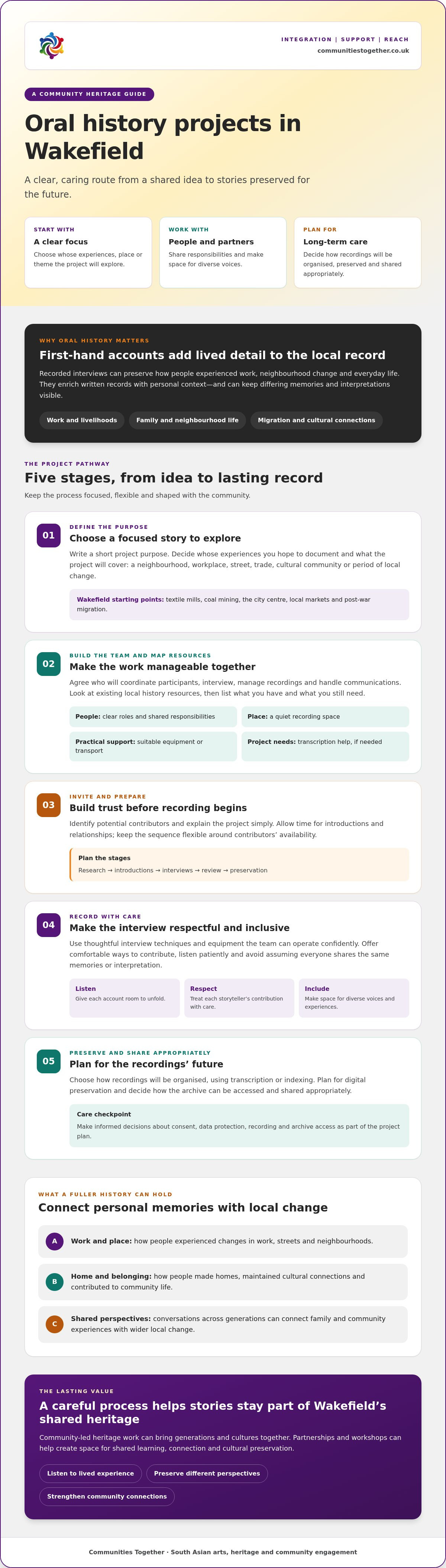
A durable project starts with a clear purpose shaped with the community, not a large collection of interviews without a shared direction. Decide whose experiences you hope to document and what the project will make possible: a record of a street, a trade, a cultural group or a period of local change. A focused scope makes it easier to identify narrators, prepare relevant questions and explain the project simply.
Use local history resources to inform your scope. Wakefield Council local archives can help you explore existing documents and identify gaps that personal testimony might illuminate. Then form a team and assign responsibilities, such as coordinating participants, interviewing, managing recordings and handling communications. Agreeing roles early helps volunteers work consistently and reduces the risk of overlooking essential tasks.
Set the scope: Write a short project purpose and identify the people, place or theme it will cover.
Map resources: List what you have and what you need, such as a quiet recording space, suitable equipment, transport support or transcription help.
Plan the sequence: Allow time for research, introductions, interviews, review and preservation. Leave flexibility for contributors’ availability and for building relationships.
For budgeting, separate essential costs from optional improvements. Check what equipment or accessible community spaces partners may be able to contribute. Wakefield Council’s 2026 Culture Grants include support for cultural and heritage activity. Check the current criteria and application timetable before including a grant in your plans. If your group would benefit from support developing its heritage activities, Communities Together’s partnership and community capacity building work may be relevant. Explore its community engagement and heritage work.
Identifying Your Community Narrators
Start with trusted connectors, such as local groups, cultural organisations, community workers and residents who can introduce the project in a familiar, respectful way. An informal discussion or coffee morning gives people a chance to hear the purpose, ask questions and decide whether they want to take part. Don’t rely on just one contact or network. Consider whose perspectives may be missing across ages, backgrounds and experiences, and make your approach accessible to them.
Ethics, Consent and GDPR Compliance
Before recording, explain in plain language what taking part involves, how audio or video will be stored, who may access it and whether it could be shared publicly. Use written participation and permissions documents that reflect those choices, and give people time to ask questions before agreeing. A signature is not a substitute for ongoing communication. Check that contributors understand each proposed use of their story.
Keep contact details and permissions organised separately from working audio files, and limit access to people who need it. Agree how files will be named, backed up and reviewed. For data protection questions or archival requirements, seek guidance from an appropriate specialist or repository before collecting personal information. Clear planning builds trust and gives the project a stronger foundation for preserving stories responsibly.
Best Practices for Conducting Inclusive Oral History Interviews
In oral history projects Wakefield, a strong interview is more than a clear recording. It depends on trust, careful listening and a method that respects each narrator’s preferences, language and experience. The Oral History Society’s practical guidance for oral history projects is a useful reference for preparing to interview ethically and thoughtfully.
Create a comfortable interview environment
Choose a quiet, familiar place where the narrator feels at ease, such as a private room at home or a suitable community centre space. Before recording, listen for traffic, heating systems, conversations and other background noise. Switch off what you can and place the microphone close enough to capture speech clearly without making the set-up feel intrusive. A pre-interview without recording gives you both a chance to build rapport, talk through the project and agree what the narrator would like to discuss.
Use equipment the team can operate confidently. A reliable audio recorder and an external microphone may capture clearer speech than a device placed across the room. Test the set-up beforehand and listen back briefly to check the sound. Video can add visual context, but it changes the interview experience and creates more material to manage. Use it only if it serves the project and suits the narrator’s wishes.
Ask open questions and listen actively
Begin with straightforward prompts about a person’s background before moving to memories and reflections. “What do you remember about a typical day at work?” invites a fuller account than a question that can be answered with yes or no. Follow the narrator’s lead, allow pauses and use gentle prompts about sensory details, such as the sounds of a workplace, the smell of a familiar meal or the colours of a market. These details can help bring a memory to life without directing the answer.
Take particular care with sensitive experiences. Explain that the narrator can decline a question, pause or end the interview. Don’t press for detail if they seem uncomfortable. Interviewers should listen with empathy while recognising the limits of their role. Oral history is not clinical support.
Make the process culturally responsive
Don’t assume that people from the same community share a language, customs or preferences. Ask each narrator how they would like to take part, whether they would prefer to speak in another language, and whether an interpreter or trusted support person would help them feel comfortable. For South Asian elders and other under-represented groups, trusted community connections can support introductions, but the narrator should remain central to decisions about their story. Respectful, adaptable interviews help create an archive that reflects varied voices rather than a single account of Wakefield’s past.
Preserving and Sharing Wakefield’s Diverse Cultural Narratives
Recording an interview is only the beginning. For oral history projects Wakefield, preservation also means making stories findable, maintaining dependable copies and agreeing how each account may be shared. Plan for these tasks from the outset. Consult the West Yorkshire Archive Service about its role as a regional repository and its current requirements before preparing material for deposit.
Make recordings easier to discover
Transcription and indexing serve different purposes. A transcript records the interview’s spoken words and can help readers search for names or themes, but it takes time to prepare and review. An index is a structured guide to the recording that notes subjects and where they appear. It can be a practical alternative when a full transcript isn’t possible. Whichever approach you choose, check names, place references and translated terms carefully, and make the relationship between each recording and its notes clear.
Keep an unedited preservation copy and a separate working copy, use file formats recommended by your chosen archive, and maintain organised backups. Ask the repository about preferred formats rather than assuming a particular file type will suit its systems. Record permissions and sharing conditions alongside the archive information so future users can understand what may be accessed or reused.
Share stories with communities
Public sharing can bring history into everyday community life rather than leaving it accessible only in a digital catalogue. Options include a listening event at a local library or community centre, a school resource built around local accounts, or a carefully selected audio excerpt for a heritage podcast or social media. Before sharing, check that the proposed use matches the narrator’s agreement. Invite contributors and community partners to review how their stories are presented.
Consider accessibility at every stage. Translate key summaries where this would help Wakefield’s linguistic communities engage with the material, and ask speakers or community organisations to review translations for meaning and tone. For physical exhibitions, consider clear text, readable presentation, accessible routes and alternatives for people who cannot listen to audio. A digital project home should include useful descriptions and contact information, with a plan for maintaining and updating it.
Preservation is strongest when communities stay involved after the interviews are complete. Contributors can help shape exhibitions, identify missing context and guide how stories are shared. Ongoing participation turns an archive into a living resource, connecting personal memories with Wakefield’s wider cultural heritage.
Facilitating Community Heritage with Communities Together
Oral history work can strengthen community engagement when residents help shape what is recorded, how it is interpreted and where it is shared. Communities Together works across West Yorkshire, including Wakefield, with a focus on community engagement, South Asian heritage and cultural preservation. Its partnership and community capacity building work can help local groups develop heritage activities that reflect their priorities and support participation from people who may otherwise feel overlooked.
For groups developing oral history projects Wakefield, this means linking the practical work of gathering stories with wider aims: creating opportunities for people to meet, supporting shared learning and building relationships across neighbourhoods. Heritage workshops can offer a welcoming starting point, particularly when a group wants to explore how personal memories connect with cultural traditions and local change.
South Asian arts and heritage specialism
Communities Together specialises in South Asian arts and heritage preservation. Its cultural activities give communities opportunities to share knowledge and maintain connections with their heritage. A workshop might invite participants to discuss traditions, memories and how these have been passed between generations. This can help younger people learn from elders while recognising that each person’s experience is distinct. The approach can complement oral history interviews by making space for dialogue before, during or after stories are recorded.
Shape activities with participants rather than making assumptions about what a community values. Making room for different languages, experiences and ways of taking part can help a project feel more welcoming and produce a fuller account of local life.
Building partnerships and lasting capacity
Long-term heritage work depends on more than collecting testimony. Local groups may need to develop volunteer skills, share responsibilities and build relationships with organisations that can contribute knowledge or help reach new participants. Communities Together supports partnership and community capacity building, alongside learning, skills and personal development. Its wellbeing and resilience workshops can connect cultural preservation with opportunities for people to participate, develop skills and build community resilience through shared history.
As you plan, consider which skills volunteers want to develop, which local partners could help broaden participation and how the group can continue its work after an initial activity ends. Communities Together’s cultural participation work aims to reduce social isolation, a relevant consideration for groups seeking to engage diverse or isolated residents. The aim is to support communities to lead and sustain their own heritage activity while strengthening connections across West Yorkshire.
To explore whether its community engagement programmes could support your heritage project, visit community engagement programmes UK.
Help Wakefield’s Stories Shape a Stronger Shared Heritage
Lasting oral history projects Wakefield begin with a clear purpose, respectful conversations and a plan to preserve and share stories responsibly. By involving contributors in decisions and making room for different experiences, community groups can create a richer record of local life while building connections between generations and neighbourhoods.
Communities Together works in Wakefield and across West Yorkshire, including Huddersfield, Halifax, Leeds and Bradford, with a specialism in South Asian heritage preservation and community engagement. Its cultural participation, wellbeing and resilience workshops can connect shared history with wider aims for community cohesion, resilience and belonging. Through thoughtful partnerships and opportunities for volunteers to develop their skills, heritage work can continue to benefit communities beyond the first interviews.
Frequently Asked Questions
What is an oral history project, and how does it differ from a standard interview?
An oral history project is a planned process for recording, preserving and interpreting people’s first-hand accounts of the past. Unlike a standard interview conducted for a single article or research question, it follows a clear theme and considers how recordings will be documented, stored and shared. The narrator’s perspective is central, and their testimony can enrich the historical record alongside other evidence.
Do I need expensive equipment to start an oral history project in Wakefield?
No. You can start without buying specialist equipment. A smartphone or basic digital recorder may be sufficient if it captures clear speech, so test the device in the intended setting before interviewing. Prioritise a quiet space and a reliable way to keep a copy of the recording. Ask local partners whether equipment is available to borrow, and check archive preferences before choosing formats for long-term preservation.
How do we ensure our heritage project is inclusive of Wakefield’s diverse populations?
Involve community members in shaping the project instead of deciding on their behalf which stories matter. For oral history projects Wakefield groups develop, trusted local organisations and community connectors can help make introductions. Flexible ways to participate, language support and accessible meeting spaces can reduce barriers. Consider whose experiences may be missing, invite feedback as the work develops and avoid treating any community as having a single shared perspective.
What are the legal requirements for recording and storing personal stories?
Requirements depend on what personal information you collect, how you use recordings and whether you plan to share them publicly. Check current Information Commissioner’s Office guidance or seek advice from a suitable data protection professional. Before recording, explain the project’s purpose, intended access and storage arrangements, and document participants’ permissions. Keep personal details appropriately secure and confirm that planned uses are covered by the permissions you have obtained.
Can oral history projects help with community wellbeing and social isolation?
They can create opportunities for people to meet, share experiences and feel that their contribution is valued, which may support connection and belonging. Communities Together offers cultural participation activities, wellbeing workshops and resilience workshops that address community needs. Outcomes vary, so a heritage project shouldn’t be presented as clinical treatment or a guaranteed solution. Consider how inclusive participation can complement wider community activity.
Where can we archive our completed oral history recordings in West Yorkshire?
The West Yorkshire Archive Service is the designated repository for archival material in the region and has an office in Wakefield. Contact the service before preparing a deposit to ask about its current requirements, including preferred file formats, accompanying information, access arrangements and any restrictions. Early discussion can help your group organise recordings consistently and clarify whether the material is suitable for deposit, rather than leaving these decisions until the project is complete.
How can Communities Together help our group launch a heritage project?
Communities Together offers community engagement programmes, South Asian arts and heritage activities, resilience workshops and community capacity building. These can help groups bring people together around cultural preservation, shared learning and local participation. Its work includes Wakefield and other West Yorkshire communities, including Huddersfield, Halifax, Leeds and Bradford. To learn more about its relevant activities, visit Communities Together.
Is there funding available for community-led heritage projects in Wakefield?
Wakefield Council’s 2026 Culture Grants include Small Grants of up to £1,500 for community groups, charities and other voluntary, community and social enterprises. The listed deadline for Culture Grants Small, Round 5, is Monday 9 November 2026. Eligibility and application details can change, so check the Council’s current guidance before planning your project budget or relying on a grant award.
To explore community engagement, South Asian heritage and cultural preservation support for your project in Wakefield, Huddersfield, Halifax, Leeds, Bradford or across West Yorkshire, contact Communities Together.
Comments