
Exploring the Benefits of Cultural Heritage Workshops in Schools: A Guide to Social Cohesion and Learning
A classroom is far more than a simple setting for academic instruction; it's the vital foundation where our future society is carefully woven together through shared understanding, mutual respect, and a deep appreciation for our collective history. You've likely noticed how challenging it can be to maintain social harmony within diverse student bodies, especially whilst navigating the new Ofsted framework's emphasis on inclusion and the essential need for authentic cultural capital. By exploring the benefits of cultural heritage workshops in schools, educators can find meaningful ways to bridge these social divides, ensuring every child feels seen, valued, and empowered to contribute to their community's story.
This guide offers a comprehensive look at how structured heritage activities, specifically those highlighting South Asian traditions and arts, serve to enhance student empathy, strengthen academic engagement, and foster long-term community resilience. We'll discuss practical methods for implementing these high-quality, curriculum-aligned programmes to create a supportive environment where self-esteem flourishes and school-wide cohesion becomes a measurable reality. From meeting statutory local history requirements to building the social infrastructure necessary for a thriving modern Britain, we'll show you how these workshops facilitate lasting stability, harmony, and togetherness for everyone involved.
Table of Contents
Defining Cultural Heritage Workshops within the British Curriculum
Cultural heritage workshops are structured, immersive experiences that go beyond the simple recitation of historical dates to explore the living traditions, shared values, and collective memories that define our local communities. In the vibrant towns of Huddersfield, Halifax, and Wakefield, these sessions provide a vital bridge between past and present, helping students to understand the intricate social fabric that binds us together through shared stories, common goals, and mutual understanding. By engaging with the benefits of cultural heritage workshops in schools, educators can facilitate a classroom environment where students don't just observe history from a distance but actively participate in the preservation of their local identity, ensuring that the threads of our collective endurance remain strong for future generations.
The Role of Heritage in Modern Education
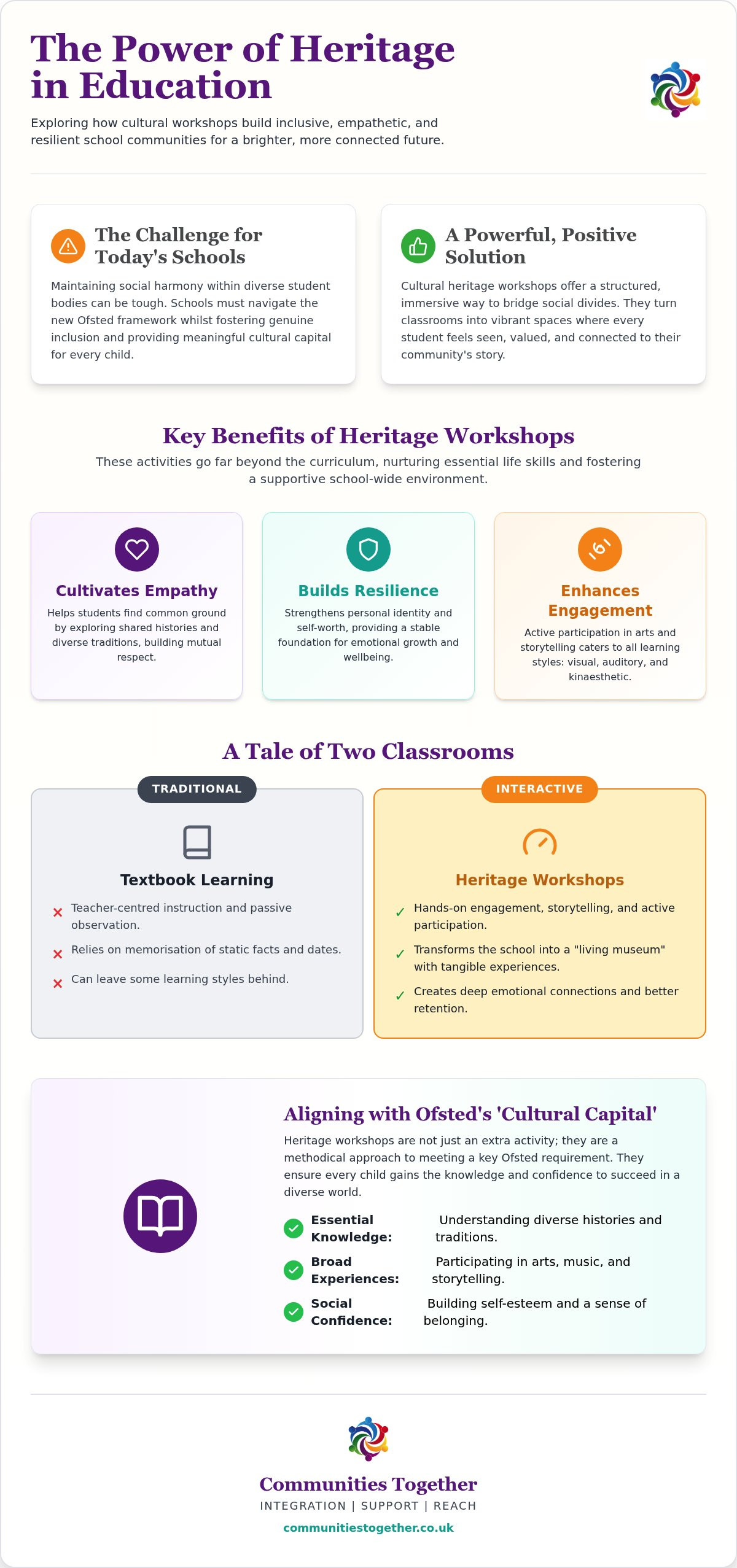
Modern schooling requires a thoughtful shift from the study of static facts toward the deep exploration of lived experiences and cultural continuity. Integrating these workshops into the PSHE and Citizenship curriculum allows pupils to investigate how diverse backgrounds, particularly South Asian heritage, contribute to the structural strength and richness of our contemporary society. This methodical approach aligns directly with the current Ofsted requirement for "Cultural Capital," which seeks to ensure that every child gains the essential knowledge, broad experiences, and social confidence needed to succeed in a diverse world. By representing these varied histories, schools can foster a genuine sense of togetherness, promote cultural continuity, and maintain a steady pulse of inclusive learning that resonates throughout the entire school community.
Interactive vs. Passive Learning Models
Whilst Traditional education often relies on teacher-centered instruction and the memorisation of textbook content, interactive models prioritise hands-on engagement, oral histories, and community storytelling. We've found that active participation in South Asian arts leads to significantly better retention and emotional connection because it transforms the school hall into a "living museum" where history becomes a tangible, felt experience for every student involved. By moving away from passive observation, schools can build inclusive community infrastructure through Learning, Skills and Personal Development partnerships, creating a learning environment that is both absorptive and reassuring. This transition from being a spectator to becoming a participant helps to facilitate personal growth, strengthen community resilience, and ensure that the benefits of cultural heritage workshops in schools are felt by students with all learning styles, whether they are visual, auditory, or kinaesthetic learners.
Cultivating Empathy and Identity through Heritage Education
Exploring one's own heritage acts as a powerful catalyst for strengthening personal resilience, enhancing individual self-worth, and establishing a robust sense of identity within the complex environment of a modern classroom. When students engage with the benefits of cultural heritage workshops in schools, they begin to understand their unique place within a much broader historical narrative, a process that helps to reduce social isolation by revealing the profound common ground found in shared histories and collective memories. This methodical approach allows us to serve as a principled advocate and a "wise facilitator," guiding young people to appreciate cultures different from their own whilst building a deep sense of belonging for students from migrant or minority backgrounds who may feel underrepresented in traditional curricula.
Building Emotional Resilience in the Classroom
Cultural continuity is inextricably linked to mental wellbeing, providing students with a stable foundation that supports their emotional growth, structural strength, and long-term academic success. By utilising heritage workshops as a non-clinical intervention, schools can help alleviate student anxiety and encourage a spirit of "collective endurance" through the powerful storytelling of historical resilience and the preservation of traditional wisdom. Research regarding the Benefits of Heritage for Young People highlights how "place attachment" and cultural engagement are vital for developing a positive self-image and a secure sense of identity. These structured sessions allow students to process complex emotions through the lens of tradition, ensuring that their journey toward adulthood is grounded in an inclusive community framework that values their heritage.
Fostering Social Cohesion Amongst Diverse Groups
Collaborative South Asian arts projects serve as a professional conduit for breaking down social barriers and uniting diverse student populations through shared creative expression and mutual respect. In vibrant communities across Leeds and Bradford, we've observed how these initiatives bring together students from varying backgrounds to work toward a common goal, fostering a sense of long-term social harmony that is most effective when introduced during early-years education. By facilitating these interactions, we help schools maintain a steady pulse of community harmony, ensuring that every child feels they are a valued part of the local social fabric whilst experiencing the tangible benefits of cultural heritage workshops in schools. If you're interested in strengthening your school's inclusive atmosphere, our Wellbeing and Resilience Workshops offer a methodical way to integrate these essential social benefits into your daily learning environment.
Comparing Traditional Learning with Interactive Heritage Workshops
Whilst standard textbook lessons provide a necessary foundation for historical knowledge, they often lack the immersive depth required to truly resonate with a diverse student body. By prioritising the benefits of cultural heritage workshops in schools, educators can transition from a passive observation of the past to an active, felt engagement with living traditions that cater to visual, auditory, and kinaesthetic learning styles simultaneously. This methodical shift ensures that every child, regardless of their preferred educational approach, finds a point of entry into the subject matter, thereby facilitating a more comprehensive understanding of our shared social fabric and promoting collective endurance.
Academic Outcomes and Skill Development
Engaging with cultural artefacts and oral histories allows students to develop high-level critical thinking skills whilst improving their literacy and communication through the art of heritage-based storytelling. These activities are designed to align seamlessly with our Learning, Skills and Personal Development framework, which seeks to build community capacity by equipping young people with the analytical tools needed to navigate a complex society. Key developmental outcomes include:
The refinement of interpretive skills through the analysis of traditional textiles, music, and physical artefacts.
Increased confidence in verbal communication during collaborative storytelling and community history sessions.
A deeper understanding of cause and effect by linking historical migrations to modern local demographics.
By linking historical narratives to modern-day social consequences, schools can achieve measurable impacts on student engagement, self-esteem, and structural strength within the classroom environment.
The Facilitator Advantage
Partnering with specialised community organisations like Communities Together allows schools to access "real-world" expertise and authentic South Asian cultural knowledge that might otherwise be unavailable within the standard teaching staff. This collaborative approach significantly relieves the administrative and research burden on teachers whilst ensuring that the preservation of traditions is handled with the professional literacy and earnestness it deserves. Acting as a principled expert and a methodical advocate, an external facilitator brings a unique rhythm to the school day, providing a stable foundation for students to explore complex social concepts in a reassuring and inclusive manner.
When evaluating the investment required for these programmes, it's essential to look beyond the immediate one-off activity costs to the long-term dividends of community harmony, reduced social isolation, and enhanced student empathy. A thorough cost-benefit analysis reveals that the benefits of cultural heritage workshops in schools extend far into the future, creating a more resilient and cohesive school population that is better prepared for the challenges of adult life in a multicultural Britain. By investing in these structured experiences today, schools are effectively facilitating the long-term stability and togetherness of their local Yorkshire communities, ensuring that the social pulse of the region remains healthy and vibrant.
Strategic Implementation: Integrating Workshops into Yorkshire Schools
Integrating these programmes into the local educational landscape requires a methodical approach that respects the unique demographics of each district whilst ensuring that the benefits of cultural heritage workshops in schools are realised by every participant. In towns like Huddersfield, Halifax, and Wakefield, we start by identifying the specific cultural needs of the student body, facilitating a dialogue between school leaders and community representatives, and ensuring that the activities resonate with local lived experiences. To successfully organise a workshop, schools typically follow a structured path of consultation, curriculum alignment, and delivery, which ultimately builds community capacity and strengthens the social fabric of the entire institution.
Measuring the success of these interventions is vital for maintaining accountability and demonstrating long-term impact to governors and parents alike. We use a combination of student feedback, qualitative observations of classroom harmony, and specific social cohesion metrics to evaluate how these sessions improve empathy and collective endurance amongst diverse groups. Engaging parents in these heritage projects further extends the reach of the learning, turning the school into a professional conduit for broader community togetherness and mutual respect.
Tailoring Content to Local Demographics
The rich South Asian heritage of Bradford and Leeds offers a wonderful opportunity to adapt workshop content so that it reflects the specific ancestral journeys and traditions of the local population. By collaborating with local history societies and heritage centres, we ensure that our South Asian Arts and Heritage Activities provide an authentic representation of the region's history, promoting cultural continuity and inclusive engagement for all students. This tailored approach allows schools to move beyond generic education, creating a learning environment that feels both deeply personal and globally relevant for every child involved.
Best Practices for School Leaders
To maximise the impact of these programmes, school leaders can consider scheduling workshops to coincide with South Asian Heritage Month, ensuring that the activities are part of a wider, sustained celebration of diversity. Creating lasting legacy projects, such as school heritage murals or digital archives, helps to maintain the pulse of cultural awareness long after the workshop has finished. By linking these school-based initiatives to Community Capacity Building in the UK, headteachers can ensure their projects contribute to the broader strengthening of local social infrastructure and community resilience.
Collaborative Growth: How Communities Together Facilitates School Heritage Projects
Communities Together operates with the quiet confidence of an established facilitator, prioritising stability and social responsibility whilst delivering our methodical approach to South Asian arts and heritage activities. We believe that by building inclusive community infrastructure through dedicated school partnerships, we can provide a stable foundation for students to explore their identities and the histories of those around them. This collaborative growth is designed to empower young people, transforming them from passive learners into active custodians of their own cultural history who understand the importance of tradition and progress in equal measure. By inviting schools across West Yorkshire to join our mission, we facilitate a rhythmic pulse of community harmony that ensures the long-term social benefits of our work are felt throughout Huddersfield, Halifax, and beyond.
Our commitment to social responsibility drives us to act as a professional conduit for collective growth, ensuring that every interaction within the school environment is handled with the earnestness and professional literacy our partners expect. We understand that schools are the heart of our towns, and by strengthening the bonds between students, families, and local history, we help to maintain a resilient social fabric that can endure for generations. This methodical advocacy for cultural continuity ensures that the benefits of cultural heritage workshops in schools are not just temporary experiences but lasting contributions to the community's structural strength.
Our Specialist Heritage Programmes
Our South Asian heritage and cultural preservation projects are carefully designed to integrate Wellbeing and Resilience Workshops into every school session, ensuring that the academic exploration of history is balanced by a deep commitment to student mental health. We've seen wonderful success in the Huddersfield and Halifax districts, where our programmes have helped schools maintain a steady flow of inclusive learning that resonates with students from all backgrounds. These case studies demonstrate how the benefits of cultural heritage workshops in schools extend beyond the classroom, creating a measurable impact on school community harmony and providing students with the collective endurance needed to thrive in a diverse society.
Next Steps for Your School
Initiating a partnership with us is a straightforward process designed to foster long-term community engagement and provide your students with high-quality, curriculum-aligned cultural activities. We remain deeply committed to professional, earnest, and friendly facilitation, acting as a methodical advocate for both the school's educational goals and the community's social welfare. If you're looking to strengthen the social fabric of your institution, we encourage you to explore our Bradford South Asian Heritage Projects for Schools to see how we can tailor our expertise to meet your specific needs. By working together, we can ensure that our collective efforts continue to facilitate lasting togetherness and structural strength across our local Yorkshire communities.
Building a Legacy of Social Harmony and Inclusive Learning
The benefits of cultural heritage workshops in schools extend far beyond the classroom, facilitating a profound sense of togetherness and structural strength within our local Yorkshire communities. By moving from passive observation to active participation, students develop the emotional resilience, the cultural literacy, and the social confidence needed to navigate a diverse society with mutual respect. These structured programmes don't just meet Ofsted's inclusion standards; they empower the next generation to become methodical advocates for their own heritage whilst fostering a steady pulse of harmony across the entire school environment.
As specialist facilitators with deep expertise in South Asian heritage, we're proud to be trusted by schools across Leeds, Bradford, and Huddersfield to deliver mission-driven engagement that builds capacity, preserves tradition, and creates a lasting legacy. We understand the unique social fabric of West Yorkshire and work tirelessly to ensure our partnerships provide a stable foundation for collective growth and togetherness. Our earnest approach ensures that every child feels represented and every community feels supported.
We look forward to working alongside you to create a vibrant, inclusive space where every child's story is valued and every tradition is preserved for the future success of our shared community.
Frequently Asked Questions
What are the main benefits of cultural heritage workshops for primary school students?
Main benefits include improved student empathy, enhanced self-esteem, and deeper academic engagement through interactive learning. These workshops facilitate a sense of togetherness by exploring shared traditions, helping children build personal resilience, and fostering a deep appreciation for the social fabric of their local community. By engaging with the benefits of cultural heritage workshops in schools, primary pupils develop essential life skills, improve their communication through storytelling, and establish a stable foundation for lifelong learning and personal development.
How do heritage workshops help schools meet Ofsted requirements for cultural capital?
Heritage education directly supports schools in meeting the Ofsted "Cultural Capital" requirement by providing students with the essential knowledge and diverse experiences needed to succeed as well-rounded citizens. These structured activities expand a pupil's understanding of the world, promote inclusive engagement, and ensure that every child has access to high-quality cultural participation. By facilitating these sessions, schools demonstrate a commitment to building community capacity and maintaining a steady pulse of social responsibility within the modern British curriculum.
Can cultural heritage workshops help reduce social isolation in diverse schools?
Cultural heritage workshops are a powerful tool for reducing social isolation by helping students find common ground in their shared histories and collective memories. By facilitating collaborative South Asian arts projects, schools can break down social barriers, promote community harmony, and strengthen the structural bonds between diverse student groups. This methodical approach ensures that students from all backgrounds feel seen and valued, thereby fostering a reassuring environment of stability, togetherness, and mutual respect in the classroom.
How do you ensure heritage workshops are inclusive for students from all backgrounds?
We ensure inclusivity by tailoring every session to reflect the specific demographics and lived experiences of the local area, such as the vibrant South Asian communities in Bradford and Leeds. Our "wise facilitator" approach prioritises the representation of diverse backgrounds, ensuring that every student's heritage is treated with professional literacy and earnestness. By maintaining a friendly, welcoming environment, we facilitate a rhythmic flow of togetherness that encourages all pupils to become active custodians of their shared history.
What specific activities are included in a South Asian arts and heritage workshop?
Immersive activities such as traditional textile analysis, community storytelling through oral histories, and hands-on creative preservation projects form the core of our South Asian arts workshops. Students engage in the study of cultural artefacts, participate in collaborative music sessions, and explore the history of migration within West Yorkshire. These methodical exercises are designed to enhance learning, skills, and personal development whilst ensuring the authentic preservation of traditions, fostering a deeper understanding of the collective endurance that defines our region.
Are heritage workshops suitable for secondary schools and FE colleges?
Older students in secondary schools and FE colleges across Huddersfield and Halifax benefit from programmes that are meticulously adapted to meet their complex developmental needs. These advanced sessions focus on building community resilience, developing critical thinking skills through the lens of heritage, and preparing young adults for active citizenship. By exploring the benefits of cultural heritage workshops in schools at this level, we help students navigate complex social concepts whilst strengthening their personal identity and sense of belonging.
How can a school in West Yorkshire partner with Communities Together for a project?
Schools in West Yorkshire can initiate a partnership by contacting Communities Together to discuss a bespoke project tailored to their specific student demographic and curriculum goals. We offer a methodical consultation process to ensure every programme builds community capacity, facilitates social cohesion, and delivers a measurable impact on school harmony. Whether you're based in Wakefield, Bradford, Leeds, Huddersfield, or Halifax, our mission-driven team is ready to act as a stable foundation for your school's cultural initiatives.


Comments