
Effective Community Partnership Building: A Strategic How-To Guide for 2026
What if the most resilient tool for social change in West Yorkshire isn't a new grant or a fresh mandate, but the quiet, deliberate architecture of how we choose to work together? Effective community partnership building often feels like a delicate balancing act between meeting urgent local needs, respecting cultural heritage, and maintaining the structural integrity required for long-term sustainability. It's understandable if you feel the weight of resource scarcity or the persistent frustration that arises when goals between partners don't quite align, especially when you're striving to engage diverse or isolated demographics across Leeds and Bradford. We're here to help you move past these hurdles by sharing a professional framework designed to establish, nurture, and sustain the meaningful connections that drive social cohesion throughout our districts. In the following sections, we'll provide a clear roadmap for partnership development that increases your capacity to deliver impactful cultural activities, wellbeing programmes, and heritage projects. This guide serves as a steady foundation for your efforts, helping you to facilitate growth, build resilience, and maintain harmony within the vibrant communities you serve.
Table of Contents
The Strategic Importance of Community Partnership Building in West Yorkshire
Identifying Synergetic Partners: A Framework for Collective Impact
Designing a Collaborative Infrastructure: Formal vs Informal Models
A Step-by-Step Guide to Implementation and Sustaining Momentum
Strengthening Regional Resilience through Communities Together
The Strategic Importance of Community Partnership Building in West Yorkshire
In the current climate of West Yorkshire, establishing a professional foundation for collective growth is no longer a luxury but a strategic necessity for regional resilience. As we move through 2026, the landscape of social unity in Huddersfield, Halifax, and Leeds has become increasingly complex, necessitating a more methodical approach to community partnership building that prioritises stability and social responsibility. By fostering these deep-rooted connections, organisations can effectively address the persistent challenges of social isolation amongst our diverse populations, ensuring that every individual feels a sense of belonging and cultural continuity. This collaborative spirit isn't just about sharing space; it's about weaving together the unique strengths of various groups to create a social fabric that is both durable and inclusive.
To better understand this concept, watch this helpful video:
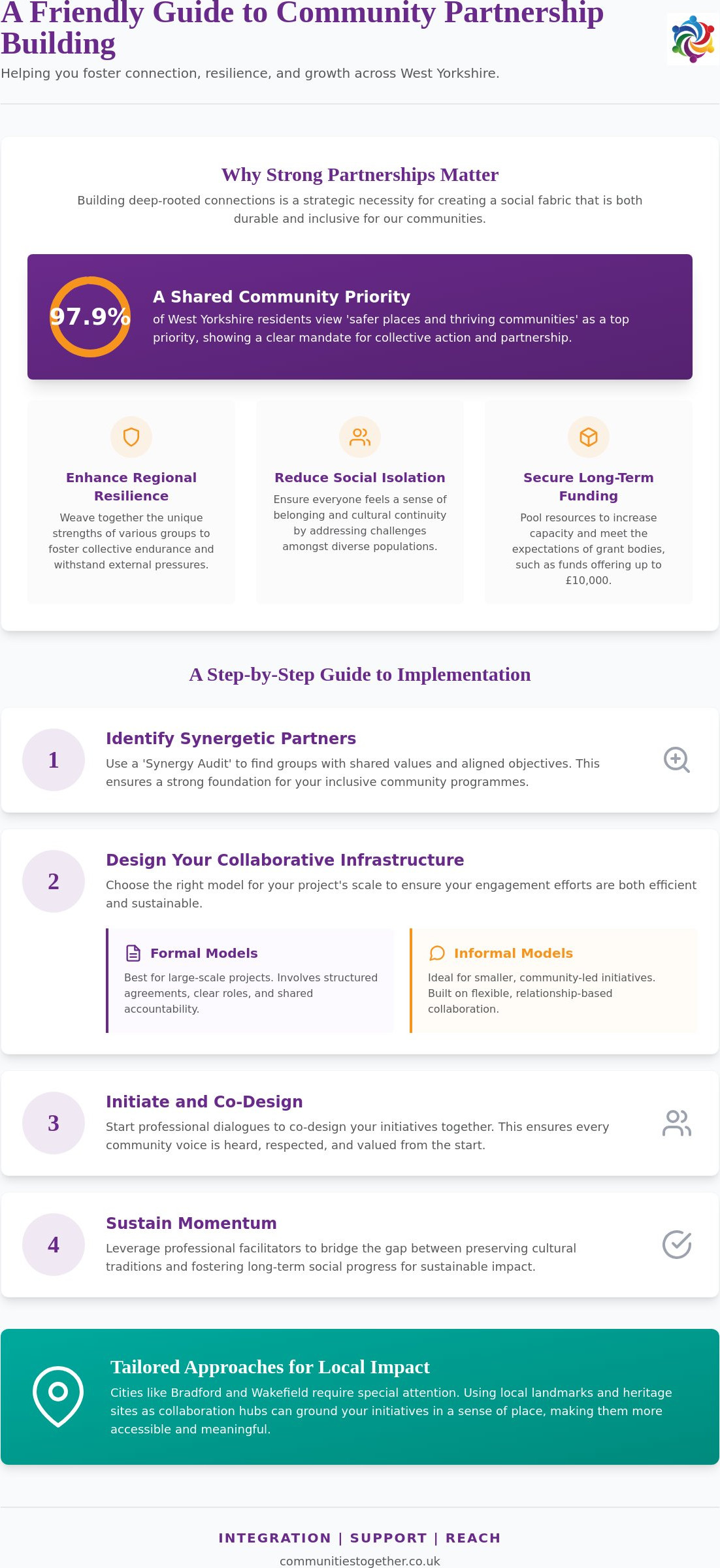
Collaborative efforts are particularly essential for securing long-term funding and sustainability, as grant bodies increasingly look for evidence of structural strength and shared accountability. For instance, the Mayor's Safer Communities Fund, which offers grants of up to £10,000, explicitly rewards projects that align with the West Yorkshire Police and Crime Plan 2024–2028. This plan reflects a significant local consensus; a 2024 survey indicated that 97.9% of West Yorkshire residents view 'safer places and thriving communities' as a top priority. Partnerships provide the necessary scale to meet these expectations, allowing small groups to pool resources and increase their capacity to deliver vital cultural and wellbeing programmes.
Defining Success in the Modern Non-Profit Landscape
Success in the current non-profit sector requires us to move beyond transactional networking toward achieving deep-rooted social impact through shared values and mutual support. This process involves integrating community organizing principles with a commitment to cultural heritage preservation, creating a robust community infrastructure that can withstand external pressures. When we facilitate these connections, we foster a sense of collective endurance that allows partners to achieve broader social outcomes whilst maintaining their unique individual group identities and traditions.
Local Context: Why Bradford and Wakefield Require Tailored Approaches
Cities like Bradford and Wakefield, with their high levels of cultural diversity, demand tailored approaches to community partnership building that respect local nuances and historical contexts. Using local landmarks and heritage sites as collaboration hubs can ground these initiatives in a sense of place, making them more accessible to isolated demographics. If you're interested in exploring how these local dynamics influence wider trends, you can Learn about community cohesion initiatives UK to see how social unity is being navigated across the country. By focusing on these specific regional needs, we ensure that our partnership strategies are both inclusive and effective in driving meaningful social change.
Identifying Synergetic Partners: A Framework for Collective Impact
Selecting the right collaborators is a process of social architecture that demands a structured evaluation of shared intent. We suggest using a 'Synergy Audit' to assess whether a potential partner's long-term objectives truly align with your commitment to inclusive community programmes. This methodical approach helps you prioritise groups that enhance your capacity to deliver wellbeing and resilience workshops, ensuring that the partnership provides tangible benefits to the residents of West Yorkshire. It's about looking for those who don't just share a postcode, but who share a vision for a more cohesive and supportive society.
Strategic community partnership building thrives when we move beyond surface-level introductions to explore the deeper motivations of our colleagues. Following practical guidelines for developing a community partnership can provide a stable framework for these initial assessments. By being intentional from the very start, you can avoid the common pitfalls of goal misalignment and resource friction. If you're looking for support in this area, exploring partnership and community capacity building can help you find the right path forward.
The Three Pillars of Partner Alignment
To ensure a partnership is sustainable, we focus on three essential pillars. First is Mission Alignment, where we confirm a shared vision for community development and social change. Second is Resource Complementarity; this involves balancing your strengths, such as expertise in heritage preservation, with a partner's skills in areas like digital literacy or vocational training. Finally, Cultural Competency is paramount. It's vital to select partners who respect and celebrate South Asian arts and traditions. In Leeds, for example, where 19.2% of new mental health service registrations in 2024 came from ethnically diverse users, having partners who understand these specific cultural nuances is essential for delivering effective, inclusive support.
Mapping the Local Ecosystem in West Yorkshire
Finding the right fit often requires a deep dive into the local landscape of Huddersfield and Halifax. You can use local directories and public sector registers to find niche organisations that might otherwise be overlooked. Engaging with stakeholders from social enterprise circles often reveals hidden opportunities for collaboration that bridge existing gaps in service delivery. By mapping out who is doing what, you can identify exactly where a new partnership could provide the most value. This proactive approach ensures that your collective efforts are focused where they're needed most, fostering a sense of togetherness and structural strength across the district.
Designing a Collaborative Infrastructure: Formal vs Informal Models
Determining the appropriate level of formality for your project is a critical step in the journey of community partnership building, as it ensures that the structural strength of your collaboration matches the scale of your social ambitions. Whilst some initiatives thrive on the energy of loose, informal networks, others require the steadying influence of formal governance to maintain momentum over several years. By carefully considering the duration and complexity of your goals, you can build a collaborative infrastructure that fosters accountability, transparency, and mutual respect amongst all participants. This thoughtful alignment between your methods and your mission is what allows a partnership to move from a simple idea to a lasting social legacy.
Structuring your governance effectively is about more than just oversight; it is an act of principled advocacy that ensures every partner feels valued and heard. Whether you are facilitating a small group in Huddersfield or a large consortium in Wakefield, your governance model should act as a stable conduit for collective growth. This involves setting up clear channels for communication, establishing fair decision-making processes, and ensuring that financial accountability is shared transparently. Such a methodical approach not only protects the interests of individual organisations but also strengthens the overall impact of your community partnership building efforts, creating a reliable foundation for future regional resilience.
Informal Collaborations: Flexibility and Grassroots Reach
Light-touch partnerships are often the best choice for time-sensitive local events, such as a community arts festival or a one-off wellbeing workshop, where the primary focus is on rapid-response engagement. These models allow you to maintain momentum without being weighed down by heavy administrative processes, making them ideal for testing new ideas or reaching isolated demographics in Leeds and Bradford. You can explore more about Strengthening community organisations through resilient infrastructure to see how these flexible foundations support broader growth. By keeping things simple, you can react quickly to local needs whilst staying true to your core values.
Formal Partnerships: Stability for Multi-Year Programmes
For large-scale social cohesion programmes or complex heritage and cultural projects, establishing a formal Memorandum of Understanding (MOU) is essential for providing long-term stability and professional precision. These legal frameworks allow you to define roles, responsibilities, and financial contributions with absolute clarity, which helps in managing shared risks whilst maximising collective social dividends. When partners understand exactly what is expected of them, it builds a foundation of trust that is vital for the success of multi-year initiatives across the West Yorkshire Combined Authority districts. This formalised approach ensures that your shared vision remains steady, even as individual teams or funding cycles change.
A Step-by-Step Guide to Implementation and Sustaining Momentum
Moving from a shared vision to a tangible reality requires a series of methodical steps that transform warm intentions into a durable social infrastructure. We've found that initiating the dialogue with a friendly, professional proposal is the most effective way to approach potential partners, as it clearly outlines the mutual benefits of togetherness whilst respecting each organisation's unique identity. Co-designing the programme from the outset ensures that all voices are heard during the planning phase, which fosters a deep sense of ownership and accountability amongst everyone involved. This inclusive start is the bedrock of any successful journey in community partnership building, allowing for the creation of initiatives that are both culturally sensitive and structurally sound.
Phase 1: Discovery and Initial Engagement
We believe that starting with a clear sense of purpose is vital, so we suggest crafting a compelling narrative that highlights how collective action can solve the persistent challenges of resource scarcity and social isolation. Organising introductory workshops allows you to build trust and personal rapport, creating a safe space where partners can share their expertise and aspirations without hesitation. Establishing a shared vocabulary for community learning and development ensures that everyone is on the same page, which is essential for maintaining clarity as the project grows. These early conversations are where the threads of social fabric are first woven together, creating the foundation for collective endurance.
Phase 2: Operationalising the Partnership
Operationalising the partnership involves turning these collaborative feelings into concrete plans by setting SMART objectives for collective wellbeing and resilience outcomes. This phase often includes developing a shared calendar of South Asian arts and heritage activities to ensure that cultural preservation remains a central focus of your joint efforts throughout West Yorkshire. For those seeking more detailed strategies on how to support these efforts, our Comprehensive guide to community capacity building UK offers a deep dive into strengthening local infrastructure. By aligning your daily actions with your long-term social goals, you ensure that the partnership remains focused and productive.
Phase 3: Long-term Stewardship and Growth
Finally, we focus on the long-term stewardship of the relationship by conducting regular 'health checks' to ensure the collaboration remains synergetic and that any misalignment of goals is addressed with professional kindness. Celebrating collective achievements is a wonderful way to foster a sense of pride and continuity, helping to keep the energy high as you scale successful models from Huddersfield to broader regions like Leeds and Bradford. Monitoring and evaluation are not merely administrative requirements; they are a way to honour the progress you've made together whilst identifying areas for further growth. This methodical approach to community partnership building ensures that your shared vision for social cohesion remains grounded in measurable impact and lasting regional resilience.
Strengthening Regional Resilience through Communities Together
Communities Together acts as a professional conduit for collaborative growth across West Yorkshire, providing the necessary infrastructure and expertise to facilitate meaningful connections that endure. Our commitment to preserving cultural traditions whilst fostering modern social progress allows us to serve as a stable foundation for local groups, ensuring that every effort in community partnership building is rooted in both tradition and innovation. By accessing our specialised knowledge in South Asian heritage preservation and our proven wellbeing workshops, your organisation can gain the structural strength required to tackle complex social challenges with confidence and grace. We're here to help you navigate the intricate threads of our social fabric, weaving together diverse perspectives to create a more resilient and harmonious future for Huddersfield, Leeds, and Bradford.
As an authoritative bridge-builder, we understand that the most successful collaborations are those that balance formal institutional weight with a warm, inclusive spirit. We've spent years refining our approach to ensure that every partner, regardless of their size, feels supported and valued throughout the entire process of engagement. This focus on mutual respect and shared accountability is what allows us to facilitate programmes that don't just meet immediate needs but also build long-term capacity within the community. We're dedicated to acting as a reliable foundation, offering the expertise needed to weave together the complex threads of our regional social fabric into a stronger, more unified whole.
Our Role as a Wise Facilitator
We take pride in providing a structural foundation that smaller community groups can build upon, offering a reliable framework that balances formal accountability with inclusive, warm engagement. Our work involves facilitating learning, skills, and personal development opportunities for all, which empowers individuals and organisations to contribute more effectively to their local districts. By ensuring every partnership contributes to a broader narrative of interconnectedness, we help our collaborators achieve measurable social impacts whilst maintaining their unique cultural identities. This methodical approach to facilitation ensures that social responsibility remains at the heart of every project, fostering a sense of togetherness that transcends geographical boundaries and promotes collective endurance.
Get Involved: Your Next Steps Toward Collaboration
If you're ready to enhance your organisation's capacity to deliver impactful programmes, we invite you to register your interest in our community engagement programmes today. We regularly host partnership-building workshops in Halifax and Huddersfield, where you can meet like-minded professionals, share your vision for social change, and begin co-designing initiatives that benefit our region's diverse populations. These sessions are designed to be absorptive and reassuring, providing a space where you can explore new possibilities for collaboration in a supportive, friendly environment. We'd be delighted to welcome you into our growing network of partners as we work together to strengthen the social fabric of West Yorkshire, building a legacy of harmony and progress for everyone.
Building a Legacy of Social Unity in West Yorkshire
We've explored how a methodical approach to identifying synergetic partners and designing a robust collaborative infrastructure can transform local initiatives into sustainable social forces. By prioritising cultural competency and co-designing your projects from the outset, you ensure that every voice in our diverse districts is heard and valued. Successful community partnership building is ultimately about creating a stable foundation for collective growth that respects our shared heritage whilst embracing future progress. As specialists in South Asian arts and heritage preservation, we're dedicated to capacity building in West Yorkshire and act as professional facilitators of social cohesion.
We look forward to supporting your journey as we work together to weave a stronger, more resilient social fabric for our communities. Your commitment to collaboration is the first step toward a brighter, more unified future for everyone.
Frequently Asked Questions
What are the first steps in community partnership building for a small organisation?
The first step in community partnership building is to clearly define your own core values and mission before seeking collaborators who share those same long-term objectives. Once you've identified potential partners, we suggest organising an informal introductory workshop to build personal rapport and trust. This allows you to explore mutual benefits without the pressure of formal agreements, creating a steady foundation for future collective growth and regional resilience across West Yorkshire.
How can we ensure our partnership is truly inclusive of diverse cultural backgrounds?
True inclusivity begins with the principle of co-design, ensuring that representatives from diverse cultural backgrounds are active participants during the planning phase. Prioritising cultural competency involves selecting partners who genuinely respect and celebrate South Asian arts and traditions, rather than treating them as an afterthought. By weaving these diverse perspectives into the structural fabric of your programme, you foster a sense of togetherness that effectively addresses social isolation amongst isolated demographics.
What should be included in a formal community partnership agreement or MOU?
A formal Memorandum of Understanding should clearly define the roles, responsibilities, and financial contributions of each partner with professional precision. It's essential to include a shared governance structure that ensures accountability, transparency, and mutual respect throughout the project's duration. By outlining how you'll manage shared risks and resolve potential disagreements, you provide the stability required for multi-year social cohesion programmes to succeed and deliver their intended social dividends.
How do we measure the social impact of our collaborative community programmes?
You can measure social impact by setting SMART objectives that align with specific collective wellbeing and resilience outcomes from the very start of your collaboration. Monitoring success involves a combination of quantitative data, such as participation rates, and qualitative feedback that captures the narrative of interconnectedness within the community. These evaluations help you honour the progress you've made together whilst identifying areas where your partnership can grow to achieve even deeper social impact.
What happens if our organisational goals begin to diverge from our partner's?
If goals begin to diverge, it's vital to conduct a professional 'health check' to identify the root cause of the misalignment and explore whether the partnership can be realigned. Open, earnest dialogue allows you to address these challenges with professional kindness, prioritising the long-term social benefits for the community over individual organisational interests. In some cases, a graceful and structured exit may be the most responsible way to maintain harmony and preserve your professional reputation.
Can community partnerships help with securing government or lottery funding in 2026?
Collaborative efforts are highly effective for securing funding in 2026, as grant bodies like the Mayor's Safer Communities Fund often prioritise projects that demonstrate structural strength. For example, the current round of applications for grants up to £10,000 closes on 3rd July 2026, with another round opening on 9th November 2026. These funds require projects to support the West Yorkshire Police and Crime Plan 2024–2028, making community partnership building a strategic advantage for any bid.
How does South Asian heritage preservation specifically contribute to social cohesion?
Preserving South Asian heritage acts as a powerful catalyst for social cohesion by providing a shared sense of cultural continuity and pride that bridges generational and social divides. When communities celebrate their traditions together, it builds structural strength and collective endurance, creating a more resilient social fabric. These activities facilitate learning and personal development, helping to reduce social isolation and foster a deeper narrative of togetherness across districts like Leeds, Bradford, and Huddersfield.
Are there specific partnership opportunities available in Leeds or Bradford?
There are numerous opportunities for collaboration within the West Yorkshire Combined Authority districts, particularly for groups focused on cultural preservation and wellbeing. You can find niche organisations through local directories or by engaging with social enterprise circles in urban centres like Leeds and Bradford. We also encourage you to join our network at Communities Together, where we act as a professional conduit for collaborative growth and facilitate partnership-building workshops throughout the year.


Comments