
Cultural Engagement Programmes: A Strategic Guide for West Yorkshire Communities
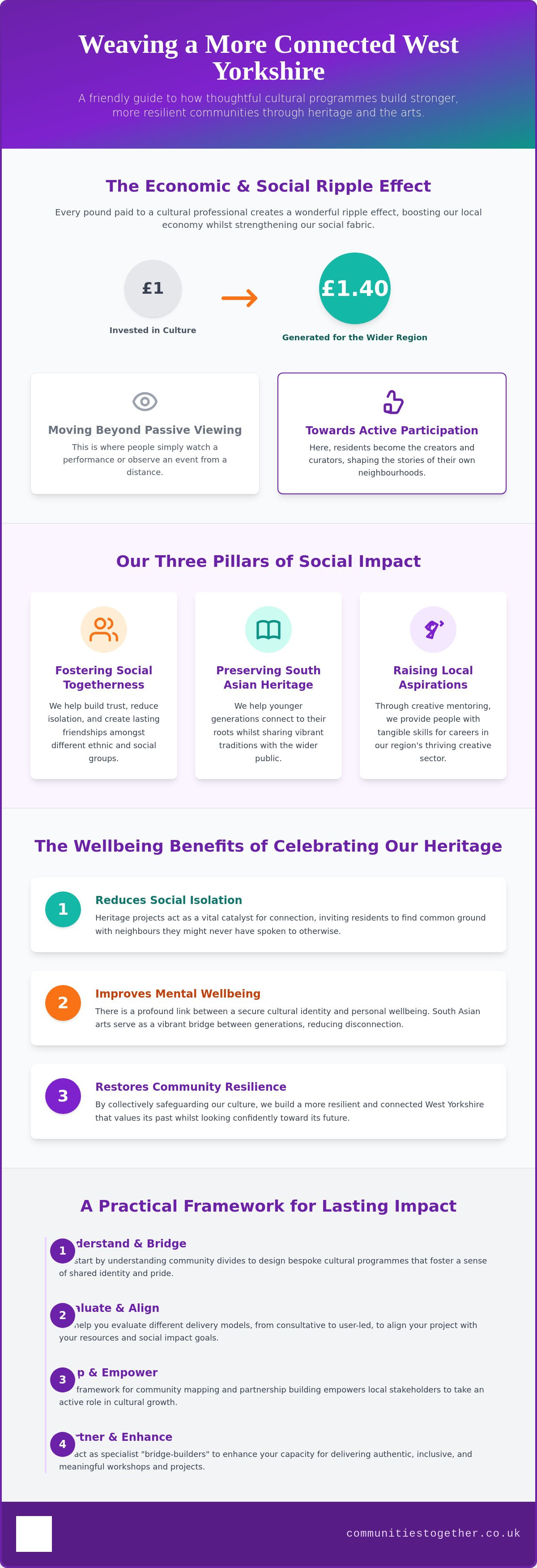
In West Yorkshire, every £1 paid to a cultural professional generates an additional £1.40 for the wider regional economy, yet the most profound impact of our creative sector is often found in the strengthened social fabric and the quiet restoration of community pride. You likely recognise that whilst a single festival or workshop can spark temporary interest, the persistent challenge of addressing fragmented community relations and ensuring the authentic preservation of South Asian heritage requires a more methodical, sustained approach to partnership and capacity building.
This article serves as a strategic resource to help you design, evaluate, and implement impactful cultural engagement programmes that foster genuine social cohesion, celebrate our rich local history, and deliver measurable wellbeing outcomes across our diverse districts. We shall examine the essential frameworks for building community resilience, the methods for reducing social isolation through inclusive arts practices, and the ways in which we can collectively safeguard the cultural continuity of our region for future generations. It's our hope that these insights provide a stable foundation for your upcoming projects as we work together to weave a more connected and harmonious society.
Table of Contents
Understanding Cultural Engagement Programmes in West Yorkshire
We often think of culture as something we observe from a distance, yet true cultural engagement is a deeply collaborative journey where organisations and residents work side-by-side to shape the stories of their own neighbourhoods. In West Yorkshire, where the creative industries contribute £2 billion to our regional economy, these initiatives represent far more than simple entertainment. They are structured cultural engagement programmes designed to move beyond passive "cultural consumption," where people simply watch a performance, and into the space of active "cultural participation," where residents become the creators and curators of their own local identity. This shift ensures that art isn't just something that happens to a community, but something that grows from within it.
The diverse makeup of our region means that a one-size-fits-all strategy rarely succeeds. In cities like Leeds and Bradford, heritage serves as a vital bridge that helps us build a shared sense of place. By focusing on what makes each community unique, we can foster stronger community cohesion, ensuring that every voice is heard, every tradition is respected, and every resident feels a genuine sense of belonging. This methodical approach to building social fabric is at the heart of what we do at Communities Together, where we act as a professional conduit for collective growth and cultural continuity.
The Core Objectives of Inclusive Cultural Activity
When we design inclusive activities, we focus on three pillars of social impact that ensure long-term stability and harmony:
Fostering social togetherness amongst different ethnic and social groups to build trust, reduce isolation, and create lasting friendships.
Preserving South Asian arts and heritage so that younger generations remain connected to their roots whilst sharing their vibrant traditions with the wider public.
Raising local aspirations through creative mentoring and skills development, which provides people with tangible expertise for their future careers in our region's thriving creative sector.
Why Local Context Matters in Huddersfield and Halifax
Every town has its own pulse. In Huddersfield and Halifax, "place-based" engagement means respecting the specific history of the Victorian mills, the bustling markets, and the local landmarks that residents hold dear. Effective cultural engagement programmes must address very practical barriers, such as transport links or language differences, to ensure that town centres and community hubs truly become inclusive spaces for everyone. By revitalising these shared areas through culture, we don't just host events; we build a more resilient and connected West Yorkshire that values its past whilst looking confidently toward its future.
The Benefits of Heritage-Led Social Cohesion Initiatives
Heritage is far more than a collection of static dates or dusty archives; it's a living resource that we can use to build a more resilient and connected West Yorkshire. In urban areas like Wakefield, heritage-led projects act as a vital catalyst for reducing social isolation by inviting residents to step out of their private spheres and into shared public narratives. When people engage with the history of their own streets, they often find common ground with neighbours they might never have spoken to otherwise. This process is a cornerstone of effective cultural engagement programmes, which aim to transform individual experiences into a collective sense of pride and belonging.
The principles of creating such inclusive spaces are also highly relevant within professional organisations; to explore the strategic frameworks that support this, learn more about Culture Of Belonging Global INC. and their expertise in building high-performance cultures.
There's a profound and documented link between a secure sense of cultural identity and individual mental wellbeing. South Asian arts activities, for instance, serve as a vibrant bridge between generations, allowing elders to pass down the intricacies of traditional crafts, music, or storytelling to younger people who might otherwise feel disconnected from their roots. This intergenerational dialogue doesn't just preserve the past; it strengthens the emotional health of the present. The "ripple effect" of these interactions often extends into the wider family unit, as the confidence gained through community resilience workshops helps families navigate modern social challenges with a renewed sense of togetherness and purpose.
Strengthening Social Bonds Through Shared History
By using oral history and local archives, we can connect residents with the hidden stories of their neighbours, creating a tapestry of shared experience that transcends individual backgrounds. Communal storytelling is a powerful tool for breaking down cultural misconceptions, as it replaces abstract stereotypes with the authentic, human voices of the people who live next door. This collaborative approach builds "community capital" through arts commissions that require residents to work together toward a common goal. This alignment with Arts Council England's Let's Create strategy ensures that West Yorkshire's local voices remain at the heart of our national cultural development, fostering a society where everyone's story is valued.
Wellbeing and Resilience: Beyond the Arts
Structured workshops often provide essential non-clinical interventions for social isolation, offering a safe space for individuals to reconnect with their community whilst learning new traditional skills. Developing personal resilience is a core outcome of these sessions, as the act of mastering a new craft or participating in a group project builds a sense of agency and achievement. We believe in measuring the success of cultural engagement programmes not just by attendance numbers, but by the qualitative impact on happiness and the long-term strength of social ties. If you're looking to foster these outcomes in your own area, our wellbeing and resilience workshops offer a methodical and supportive way to begin this transformative work.
Selecting the Right Model: A Comparison Framework
Choosing the structural foundation for your project is a critical step that determines the depth of community ownership and the longevity of the results achieved. We find that cultural engagement programmes generally fall into three distinct categories: Consultative, Collaborative, or User-Led. Each model carries its own set of resource requirements, from the lighter administrative touch of a survey to the intensive, long-term investment needed for co-produced heritage activities. For South Asian heritage projects specifically, a collaborative approach often proves most effective, as it allows for a professional exchange of expertise whilst ensuring that local residents remain the primary guardians of their own cultural narratives.
Drawing inspiration from the British Council's cultural engagement approach, we can see that the most successful initiatives are those that prioritise mutual benefit and long-term partnership over short-term outputs. Capacity building is the invisible engine of these models; it involves providing the training, mentoring, and organisational support necessary for residents to eventually lead these initiatives themselves. By embedding partnership and community capacity building into the very fabric of the programme, we ensure that the skills developed remain within the neighbourhood long after the initial funding has concluded.
Consultation vs. Co-Creation
Whilst simple consultation is a useful tool for gathering initial feedback, it can sometimes lead to "participation fatigue," particularly in areas like Bradford where communities have been frequently researched without seeing tangible change. Co-creation, where residents lead the design from the outset, offers a more rewarding path. It ensures the project remains relevant to the community's daily lives and fosters a deeper sense of accountability amongst all partners involved. This model requires more time and emotional investment, but the resulting social cohesion is significantly more robust.
Evaluating Programme Accessibility and Inclusion
To ensure your programme is truly inclusive, we recommend a methodical approach to accessibility that considers more than just physical entry. You might consider the following checklist for your local arts projects:
Are materials available in relevant community languages to ensure everyone can participate?
Does the venue choice respect cultural sensitivities and provide a safe, neutral space for all groups?
Have you considered environmental sustainability to ensure the project respects the local landscape?
Are the timings of the sessions inclusive of different religious observances or family commitments?
By addressing these barriers early, we create a welcoming environment that encourages diverse participation and supports the successful preservation of our shared local heritage.
For those requiring expert support in these areas, IntegraSense provides specialist consultancy in accessibility, communication, and governance to help organisations embed these principles into their professional practice.
Template: Designing Your Cultural Engagement Programme
Moving from a strategic vision to a tangible community project requires a methodical, step-by-step approach that ensures every action is rooted in local reality. Whilst the theoretical benefits of social cohesion are clear, the successful implementation of cultural engagement programmes depends on a structured delivery framework that balances professional oversight with genuine community warmth. We've developed this five-step template to help you navigate the complexities of local delivery, ensuring that your project remains inclusive, sustainable, and deeply impactful for all residents involved.
Step 1: Community Mapping – Begin by identifying the unique assets and specific needs in areas like Huddersfield, looking beyond physical buildings to the "invisible" networks of local leaders and cultural practitioners.
Step 2: Partnership Building – Recruit a diverse range of stakeholders, including local business owners and community groups, to ensure the project has a broad foundation of support and expertise.
Step 3: Programme Design – Select activities that authentically honour South Asian heritage, ensuring that the creative content reflects the lived experiences and traditions of the participants.
Step 4: Delivery and Facilitation – Implement your workshops with a friendly, inclusive tone that encourages participation whilst maintaining the professional rhythm necessary for long-term success.
Step 5: Impact Measurement – Use the Wellbeing Through Arts and Heritage framework to track your progress, focusing on qualitative stories of change as much as quantitative attendance data.
Phase 1: Planning and Partnership
Success in the planning phase often relies on your ability to identify "gatekeepers" within diverse communities, such as religious leaders or respected elders, who can act as a trusted bridge between your organisation and local residents. It's vital to develop a shared vision that aligns with local authority strategies, such as the West Yorkshire Combined Authority’s focus on inclusive growth and skills development. By working together on collaborative grant applications, you can secure the necessary resources whilst demonstrating a unified commitment to the region's cultural future. If you're ready to begin this journey, our team provides expert partnership and community capacity building to help your project thrive.
Phase 2: Execution and Evaluation
During the delivery phase, maintaining a consistent and earnest professional rhythm is essential for building trust and ensuring that participants feel valued and secure. We recommend collecting stories and data whilst the programme is active, as these real-time insights allow you to adjust your approach to meet the evolving needs of the group. Finally, every project should include a "legacy plan" that outlines how the activities or the newly formed social bonds will continue beyond the initial funding period. This ensures that the structural strength you've built remains a permanent part of the local social fabric, providing a stable foundation for future growth and cultural continuity.
Partnering for Success: Communities Together in West Yorkshire
At Communities Together, we pride ourselves on acting as the specialist bridge-builder for West Yorkshire, weaving together the diverse threads of our regional identity to create a more resilient, inclusive, and harmonious society. Our cultural engagement programmes are uniquely positioned at the intersection of heritage preservation and social welfare, offering a sophisticated blend of South Asian arts expertise and a dedicated wellbeing focus that addresses the specific needs of our local neighbourhoods. We don't simply host events; we facilitate a methodical process of partnership and community capacity building that empowers local groups to take ownership of their cultural assets, ensuring that the benefits of our collaboration remain embedded within the community, foster long-term stability, and support collective growth long after our direct involvement has concluded.
We invite local leaders, stakeholders, and community advocates to join us in this mission of cultural continuity. By combining our professional expertise in heritage preservation with your local knowledge, we can design initiatives that not only celebrate our shared history but also provide the structural strength needed to navigate modern social challenges. It's our firm belief that through earnest collaboration and a shared commitment to social responsibility, we can build a West Yorkshire where every resident feels a deep sense of belonging and every tradition is given the space to flourish.
Our Approach to Social Cohesion
We facilitate inclusive engagement across Leeds, Bradford, and the wider region by creating safe, welcoming spaces where residents can explore their shared history whilst building new, lasting social bonds. Our facilitation style is intentionally professional yet friendly, ensuring that every participant feels respected, heard, and valued within the group setting. We believe that by providing a stable foundation for collaboration, we can help local organisations overcome fragmented community relations, reduce social isolation, and achieve lasting community cohesion. If you're interested in exploring how we can support your specific goals, we'd be delighted to offer a partnership consultation to discuss your vision for local growth and heritage preservation.
Case Studies of Resilience and Growth
Our work in Halifax and Wakefield has demonstrated the transformative power of heritage-led initiatives, where we've used local archives, oral histories, and traditional crafts to reconnect isolated individuals with their community's past and present. The impact of our skills development workshops extends far beyond the creative output, as participants frequently report a significant reduction in social isolation, an improvement in mental wellbeing, and a renewed sense of personal aspiration. By measuring these qualitative shifts in happiness and community capital, we provide a clear framework for success that demonstrates the tangible, life-changing value of cultural engagement programmes in our urban centres. We remain deeply committed to this work and look forward to partnering with more local groups to ensure our region's heritage continues to inspire and unite us all.
Building a Resilient Cultural Legacy for West Yorkshire
The journey towards a more connected West Yorkshire begins with a commitment to methodical co-creation, a respect for local history, and a dedication to long-term community resilience. We've seen how moving from passive observation to active participation allows residents to reclaim their narratives, strengthen their social bonds, and improve their collective wellbeing through structured cultural engagement programmes. By focusing on capacity building, intergenerational dialogue, and inclusive facilitation, we ensure that the vibrant traditions of our region are not only preserved but celebrated as a stable foundation for future growth.
As specialists in South Asian arts and heritage preservation with a proven track record in Huddersfield, Leeds, and Bradford, we're ready to act as your professional conduit for social cohesion. We invite you to Discover our Cultural Engagement Programmes and partner with us today to begin building a more inclusive and harmonious society for everyone. It's our shared responsibility to facilitate a legacy of togetherness that supports our communities for generations to come, and we look forward to embarking on this meaningful journey with you.
Frequently Asked Questions
What exactly is a cultural engagement programme?
A cultural engagement programme is a structured framework that facilitates active collaboration between organisations and local residents to co-create meaningful artistic or heritage-based experiences. Unlike passive consumption, where people simply watch a performance, these initiatives prioritise participation to ensure community members are the primary architects of their own cultural narratives. This methodical approach helps build social capital by inviting diverse groups to share traditions, develop new skills, and foster a collective sense of pride within their own neighbourhoods.
How do cultural programmes improve social cohesion in diverse areas like Bradford?
Cultural programmes improve social cohesion by providing safe, neutral spaces where residents from different backgrounds can connect through shared creative goals and mutual respect. In diverse urban centres like Bradford, these initiatives help break down social barriers by replacing abstract misconceptions with authentic human interactions and communal storytelling. By focusing on shared heritage and collective aspirations, these projects weave a stronger social fabric that reduces isolation and promotes genuine understanding amongst all community members.
Can arts and heritage activities really help with mental wellbeing?
Arts and heritage activities provide powerful non-clinical interventions that significantly enhance individual mental wellbeing by reducing social isolation and building personal resilience. Engaging with cultural traditions or learning a new craft fosters a sense of agency and achievement, which helps participants navigate modern stresses with greater confidence. These workshops create a supportive environment where residents can reconnect with their identity, share their experiences, and find a renewed sense of purpose and belonging.
What are the first steps to starting a community heritage project in Leeds?
The first steps to starting a community heritage project in Leeds involve conducting thorough community mapping to identify local assets and engaging with trusted leaders within the neighbourhood. You'll need to build a diverse partnership of residents, local businesses, and stakeholders who share a unified vision for preserving your area's unique history. Establishing these foundational relationships ensures that your project is rooted in local needs and has the structural support required for long-term sustainability and success.
How do you measure the success of a cultural engagement initiative?
We measure the success of a cultural engagement initiative by evaluating both quantitative data, such as attendance and demographic reach, and qualitative stories of personal and social change. Using a structured framework allows us to track improvements in community resilience, reductions in social isolation, and the successful preservation of local heritage. This methodical evaluation ensures that our cultural engagement programmes remain accountable to their social mission whilst providing clear evidence of their positive impact on regional togetherness.
Are these programmes suitable for schools and youth groups in West Yorkshire?
These programmes are exceptionally well-suited for schools and youth groups, as they provide vital opportunities for intergenerational dialogue and the development of creative skills. By engaging with South Asian arts and heritage activities, young people in West Yorkshire can connect with their roots whilst building the confidence and expertise needed for future careers in the creative sector. These initiatives help raise aspirations and ensure that the next generation remains an active part of our region's cultural continuity.
How can my organisation partner with Communities Together for a local project?
Your organisation can partner with us by reaching out for an initial partnership consultation to discuss your specific goals for community growth and cultural preservation. We act as a professional bridge-builder, providing the expertise in South Asian arts and community capacity building needed to make your project a success. Whether you're a local authority, a charity, or a community group, we're here to provide the stable foundation and methodical support required for impactful collaborative work.


Comments