
Community Cohesion Service Providers in the UK: A Guide to Strategic Partnerships
Updated: Aug 17
What if the most effective way to heal the fractures of urban isolation was not found within a legislative chamber, but rather through the shared preservation of a community’s heritage and the collective expression of its arts? Whilst the English Devolution and Community Empowerment Act 2026 provides a necessary framework for local governance, many local authorities and public sector bodies continue to struggle with the practicalities of reducing social disconnection and measuring the tangible impact of their integration efforts. Identifying the right community cohesion service providers UK is often the difference between a fleeting initiative and a sustainable legacy of togetherness, structural strength, and mutual understanding.
This guide explores how specialist partners facilitate social integration through arts, heritage, and resilience programmes to build stronger, more inclusive local communities. We will examine the strategic benefits of these partnerships, the role of cultural continuity in fostering collective endurance, and the methodical approaches required to meet Public Sector Equality Duties whilst achieving a measurable sense of pride in place. By aligning with experts who understand the delicate threads of the social fabric, organisations can move beyond short-term interventions to create lasting harmony, stability, and social responsibility.
Table of Contents
What are Community Cohesion Service Providers in the UK?
Community cohesion service providers UK are specialist organisations, typically operating within the voluntary, community, and social enterprise (VCSE) sector, that design and deliver targeted programmes to strengthen social bonds, foster mutual respect, and encourage a sense of belonging amongst diverse populations. These facilitators act as a vital bridge between high-level government policy and the nuanced reality of local neighbourhoods, ensuring that the abstract concept of community cohesion is translated into practical, ground-level action that addresses the specific needs of residents. By focusing on the intentional cultivation of shared values and social responsibility, these providers help local authorities move beyond mere compliance with the Public Sector Equality Duty towards the creation of a truly integrated society.
To gain a deeper understanding of how these initiatives function within a global and local context, watch this overview:
In the 2026 landscape, the transition from 'policy' to 'practice' has become increasingly complex, particularly following the English Devolution and Community Empowerment Act 2026 which places greater responsibility on local councils to manage social harmony. Service providers facilitate this transition by managing complex heritage or arts-based engagement, reducing isolation through bespoke workshops, and building the internal capacity of local groups to lead their own development. This methodical approach ensures that interventions aren't merely reactive but are instead grounded in long-term stability and cultural continuity.
The Evolving Landscape of Social Cohesion
Recent shifts in the sector have seen a move towards prioritising 'bonding social capital', a concept that emphasises the internal strength of community groups as a foundation for wider social integration. The foundational 2025 'State of Us' report highlighted that social tensions often stem from unresolved grievances and a lack of shared spaces, prompting a shift in how service delivery models are structured. Professional facilitators are now considered essential for navigating these complex social tensions, as they possess the professional literacy and academic distance required to mediate between stakeholders, partners, and governing bodies whilst maintaining local accountability.
This professional capacity can be further enhanced through specialised development; for instance, Buddhi & SAMA provides coaching pillars focused on personal and corporate growth that help leaders navigate complex social environments with greater clarity and resilience.
Key Pillars of Effective Cohesion Services
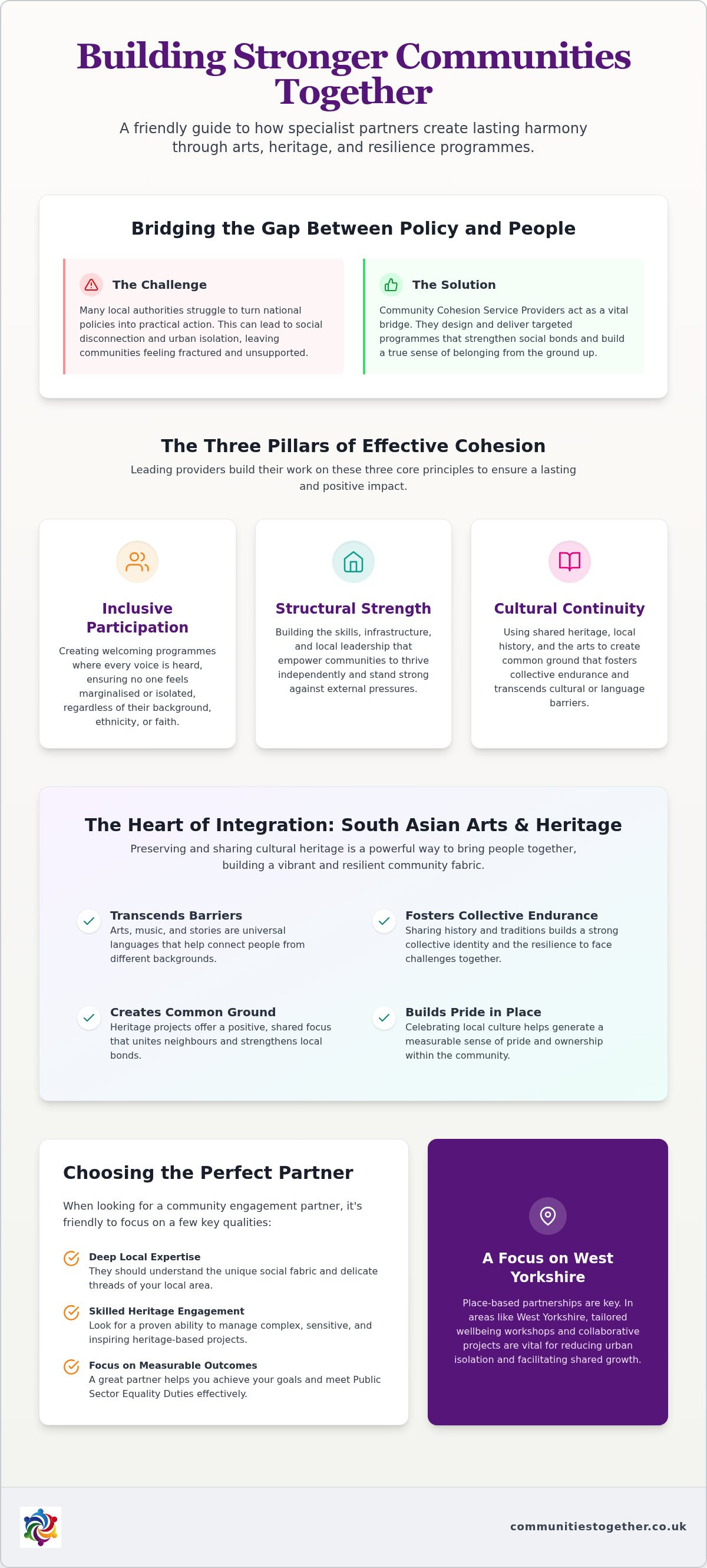
Leading community cohesion service providers UK anchor their work in three primary pillars to ensure comprehensive social delivery and measurable impact:
Inclusive participation: Implementing programmes that ensure all voices are heard regardless of background, ethnicity, or faith to reduce the risks of marginalisation and isolation.
Structural strength: Building the underlying infrastructure, skills, and local leadership that allow communities to thrive independently and resist external pressures.
Cultural continuity: Utilising South Asian arts, local history, and shared heritage to create a sense of common ground that transcends language barriers and fosters collective endurance.
The Essential Frameworks Used by Leading Service Providers
Leading community cohesion service providers UK employ methodical frameworks that align immediate community needs with the broader objectives outlined in the UK Government's Cohesion Strategy. This alignment ensures that public participation isn't a performative exercise but a foundational component of long-term strategic delivery, allowing for the creation of social value that is both sustainable and accountable. By integrating diverse local voices into the planning phase, providers can design interventions that achieve measurable social impact, moving beyond anecdotal success to documented improvements in togetherness, structural strength, and collective endurance. These frameworks are designed to be absorptive and reassuring, providing a stable foundation upon which local authorities can build inclusive programmes that effectively reduce isolation and foster a sense of shared identity.
Community Engagement and Infrastructure
Designing programmes that foster inclusive engagement requires a deep understanding of local networks and the physical or social barriers that often impede meaningful interaction in densely populated urban centres. Effective community infrastructure building involves creating stable environments where individuals from diverse backgrounds can collaborate on shared projects, share resources, and develop mutual respect through practical cooperation. This process of capacity building empowers local groups to lead their own cohesion initiatives, facilitating a shift from dependency on external facilitators to a model of self-sustaining community growth. By nurturing local leadership and transferring essential skills, service providers ensure that the threads of the social fabric are woven tightly enough to withstand future pressures and social tensions.
Wellbeing and Resilience as Cohesion Tools
The delivery of wellbeing and resilience workshops serves as a vital non-clinical intervention for reducing social isolation and improving individual health, which in turn supports broader community harmony and stability. When individuals possess the psychological tools to manage stress and uncertainty, they're more likely to engage positively with their neighbours and participate in wider social activities that build bonding social capital. Acquiring new skills through learning and personal development programmes provides a clear pathway to increased social participation, allowing residents to contribute their unique talents to the collective strength of their district. Organisations seeking to implement these methodical approaches can benefit from the expertise of a wise facilitator to ensure that every workshop is balanced by a clear statement of long-term social impact.
Leveraging South Asian Arts and Heritage for Social Integration
The unique power of South Asian arts lies in their inherent ability to transcend linguistic and cultural boundaries, providing a sensory and emotional language that fosters immediate connection amongst residents who might otherwise remain socially distant. Professional community cohesion service providers UK recognise that heritage preservation is not merely an act of looking backwards but a forward-facing strategy for expanding educational access, promoting mutual understanding, and building a robust sense of identity amongst all citizens. By facilitating projects that focus on shared cultural memory and tradition, these providers create a stable foundation for togetherness that respects individual history whilst weaving it into the broader narrative of the local district.
South Asian Arts and Heritage Preservation
Providing high-quality arts activities that celebrate and preserve specific cultural traditions allows for the creation of inclusive spaces where shared history becomes a practical tool for community resilience and structural strength. The implementation of community-led heritage projects plays a significant role in urban renewal, transforming neglected spaces into vibrant centres of cultural continuity that reflect the diverse identities of modern Britain. Engaging schools and youth groups in South Asian cultural participation ensures that these traditions are not lost, whilst simultaneously providing young people with the skills, confidence, and historical literacy required to navigate their own complex identities within a multicultural society. This methodical approach to preservation ensures that every resident, regardless of their background, can find points of connection and common ground through the exploration of shared heritage.
Arts for Social Cohesion: Impact and Evidence
Creative workshops provide a structured yet flexible environment where dialogue amongst different groups can occur naturally, often breaking down long-standing social barriers through the simple act of collective creation and mutual discovery. Heritage serves as a potent bridge for intergenerational engagement, allowing elders to share their narratives with younger generations, thereby building social capital and reducing the isolation often felt by older residents in rapidly changing urban areas. Arts activities act as a catalyst for local togetherness by providing a neutral ground where shared participation dissolves social distance and fosters a collective sense of belonging. By documenting the outcomes of these creative interventions, service providers can demonstrate a measurable reduction in social isolation and a significant improvement in the overall harmony and stability of the local community.
Best Practices for Selecting a Community Engagement Partner
Selecting the most suitable community cohesion service providers UK is a strategic undertaking that requires a methodical evaluation of a potential partner’s local knowledge, their established presence within specific districts, and their nuanced understanding of the social tensions unique to each neighbourhood. A reliable facilitator doesn't merely implement a set of pre-defined activities; they act as a stable foundation for collective growth by designing inclusive community engagement programmes that are tailored to the specific demographic and cultural needs of the area. Stakeholders should prioritise providers who offer a holistic approach, integrating South Asian arts and heritage activities with non-clinical wellbeing workshops and skills development to ensure that every intervention contributes to the long-term structural strength and collective endurance of the community. This comprehensive strategy ensures that the facilitator can manage the complex threads of the social fabric whilst maintaining a high degree of professional accountability to local authorities and governing bodies. Choosing correctly ensures stability.
Criteria for Professional Community Partners
A professional partner must provide clear evidence of a mission-driven and earnest commitment to social impact, demonstrating that their core values align with the principles of togetherness and cultural continuity. This includes an assessment of their ability to manage complex heritage and cultural preservation projects, which often require a high level of professional literacy in social welfare terminology and a deep respect for traditional practices. Methodical advocates in this field possess the expertise to weave together various strands of community life, facilitating growth through partnership building and the transfer of skills. They act as a professional conduit for progress.
Ensuring Inclusive and Friendly Engagement
Whilst maintaining a formal institutional voice in strategy, effective community cohesion service providers UK adopt a friendly, approachable tone during ground-level delivery to engage isolated groups. Avoiding clinical phrasing in favour of supportive and personable communication allows facilitators to build trust and maintain a positive connection, particularly during sensitive discussions regarding identity. This inclusive style is crucial for reducing social distance and fostering a sense of common ground amongst residents from diverse backgrounds. It creates a rhythmic pulse of professional promise and social delivery. Trust is essential.
Strategic Partnerships for Cohesive Communities in West Yorkshire
In the diverse and historically rich landscape of West Yorkshire, the role of community cohesion service providers UK is particularly significant, as the region’s urban centres require a nuanced understanding of historical social tensions, contemporary demographic shifts, and the evolving needs of local residents. Establishing strategic partnerships in districts such as Huddersfield, Halifax, Leeds, Bradford, and Wakefield allows for the delivery of place-based interventions that respect the specific cultural heritage of each area whilst fostering a unified sense of regional identity. By acting as a professional conduit for collective growth, these providers facilitate the building of social capital through shared participation, ensuring that local authorities can meet their statutory duties whilst creating tangible improvements in community harmony, structural strength, and mutual understanding. This methodical approach to partnership ensures that every intervention is balanced by a clear statement of long-term social impact.
Focusing on Huddersfield, Leeds, and Bradford
Understanding the unique demographic and cultural landscape of West Yorkshire is essential for designing programmes that resonate with residents and address the root causes of urban isolation and social disconnection. In urban centres like Wakefield and Halifax, building resilience amongst diverse groups requires a methodical approach that combines non-clinical wellbeing workshops with structured opportunities for cross-cultural dialogue and collective problem-solving. Local heritage projects serve as a vital tool for revitalising community pride in these specific areas, as they allow residents to reclaim their shared history, celebrate cultural continuity, and develop a stronger sense of belonging within their immediate neighbourhood. This process of cultural preservation creates a stable foundation for togetherness, ensuring that the progress made is both inclusive and sustainable for future generations who will inherit these strengthened social networks.
Working with Communities Together
Communities Together remains deeply committed to facilitating collaborative growth through the delivery of structured programmes that prioritise inclusive engagement, methodical capacity building, and the preservation of South Asian arts and heritage. Our approach focuses on empowering individuals through targeted skills and personal development, providing the tools necessary for residents to lead their own cohesion initiatives and contribute to the collective endurance of their district. By positioning ourselves as a wise facilitator for local authorities and governing bodies, we ensure that every partnership is grounded in professional accountability, earnest intent, and a shared mission to reduce isolation across West Yorkshire. We invite stakeholders, partners, and community leaders to contact us to discuss their community's unique needs and goals, beginning a collaborative journey towards a more cohesive, resilient, and harmonious society built upon a foundation of mutual respect.
Building Sustainable Harmony Through Strategic Collaboration
Effective integration requires stability. The pursuit of social harmony and structural strength within our urban centres necessitates a shift from transient interventions to the establishment of methodical partnerships that prioritise the long-term wellbeing of all residents. By integrating South Asian arts and heritage with dedicated wellbeing workshops, local authorities can facilitate a sense of cultural continuity that transcends isolation, fosters mutual respect, and builds collective endurance. Identifying established community cohesion service providers UK remains the most effective pathway for the delivery of tailored programmes across districts like Huddersfield, Leeds, and Bradford. This strategic alignment ensures that every resident possesses the necessary skills and historical literacy required to contribute to a more inclusive society.
It's through a commitment to accountability and professional facilitation that we can weave together the complex threads of our social fabric. We look forward to facilitating your community’s journey towards a more cohesive future built upon togetherness and shared responsibility.
Frequently Asked Questions
What exactly do community cohesion service providers do?
Community cohesion service providers UK facilitate social integration by designing structured programmes that strengthen social bonds, foster mutual respect, and encourage a sense of belonging amongst diverse populations. These specialist organisations bridge the gap between high-level government policy and ground-level delivery, ensuring that abstract concepts of togetherness are translated into practical, measurable actions that address the specific needs of local neighbourhoods whilst maintaining professional accountability to governing bodies.
How can South Asian arts contribute to social cohesion in the UK?
South Asian arts contribute to social cohesion by providing a sensory and emotional language that transcends linguistic barriers, allowing residents to connect through shared creative expression and mutual discovery. By facilitating high-quality arts activities, providers celebrate cultural continuity and preserve traditions, which in turn expands educational access, promotes mutual understanding, and builds a robust sense of identity amongst all citizens within a multicultural district.
Is there funding available for community engagement programmes in West Yorkshire?
Funding for community engagement programmes in West Yorkshire is currently available through several national and regional streams, including the £1.7 million Common Ground Award and the Know Your Neighbourhood Fund, which was extended until March 2026. Local authorities and VCSE organisations can also access the Common Ground Resilience Fund, which provides up to £5 million for interventions that bring people from different backgrounds together to foster harmony.
How do service providers measure the success of cohesion initiatives?
Success is typically measured through a combination of quantitative participation data, qualitative social impact reports, and longitudinal assessments of social capital growth within a specific area. Service providers track the reduction in social isolation, the increase in cross-cultural dialogue, and the strengthening of local networks, ensuring that every initiative is balanced by a clear statement of impact that meets Public Sector Equality Duties effectively.
Can heritage projects really help reduce social isolation?
What is the difference between community engagement and community capacity building?
Community engagement focuses on the immediate participation of residents in social activities, whilst community capacity building involves the long-term process of empowering local groups to lead their own initiatives and manage their own infrastructure. Engagement creates the initial connection, whereas capacity building transfers essential skills, nurtures local leadership, and builds the structural strength required for a community to thrive independently and resist future social pressures.
Why is a friendly approach important for community cohesion services?
A friendly, approachable delivery style is essential for community cohesion service providers UK because it lowers psychological barriers, builds trust, and encourages participation amongst the most isolated or marginalised groups. Whilst strategy remains formal and professional, ground-level communication must be supportive and personable to maintain a positive connection during sensitive discussions, ensuring that residents feel valued and safe within the collaborative environment.
How do I choose the right community resilience workshop for my local area?
Choosing the right community resilience workshop requires an evaluation of the provider's local knowledge, their presence in specific West Yorkshire districts, and their ability to offer a holistic approach. Effective workshops should integrate non-clinical wellbeing interventions with practical skills development, ensuring that the programme addresses both individual resilience and the wider structural strength of the neighbourhood to foster long-term stability and harmony.


Comments