
Collaborative Wellbeing and Resilience Workshops: A Complete Guide for UK Communities
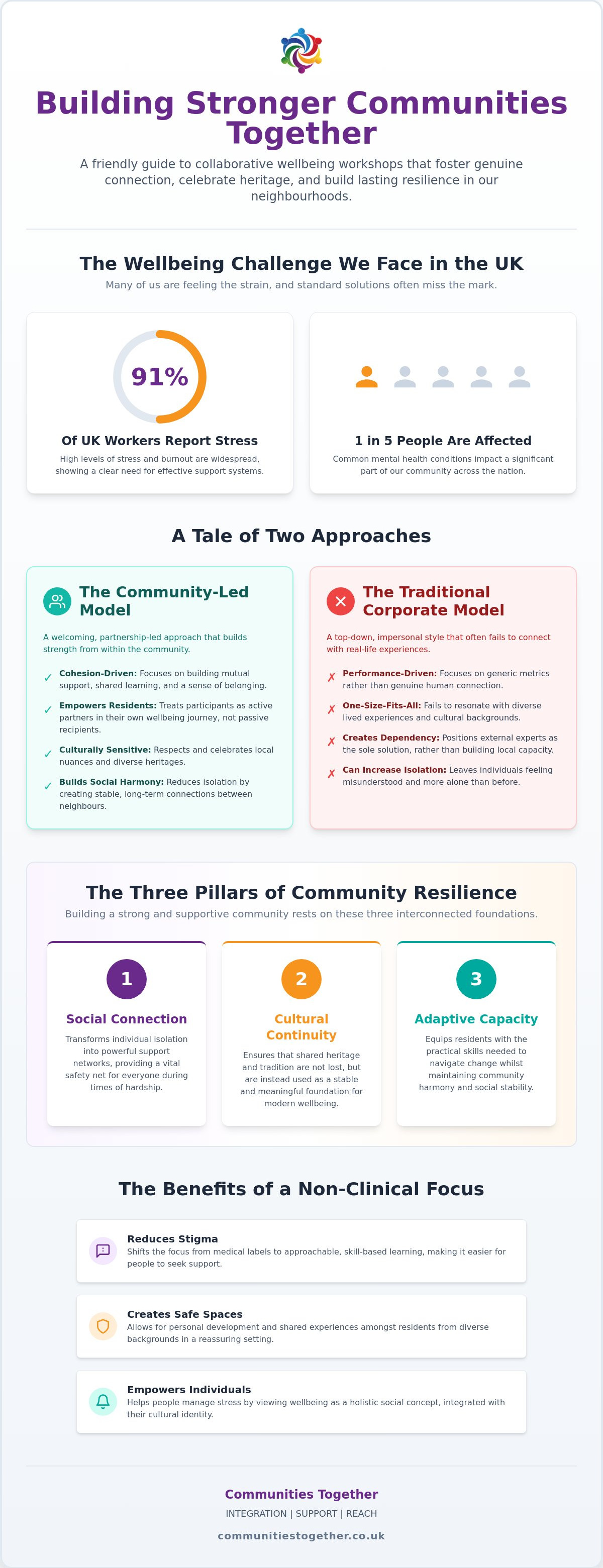
With 91% of UK workers reporting high levels of stress and burnout whilst one in five people across the nation are now affected by common mental health conditions, the necessity for robust, localised support has never been more pressing. You likely recognise that a standard corporate seminar often fails to resonate with the lived experiences of our diverse residents, frequently leaving them feeling more isolated than before they entered the room. This guide will show you how to identify and facilitate collaborative wellbeing workshops UK partners provide that actually bridge social divides, celebrate local heritage, and equip individuals with the practical tools they need to manage stress effectively.
By prioritising inclusive engagement and cultural continuity, you can move beyond reactive interventions to create a stable foundation for collective endurance, structural strength, and social harmony. We'll examine the essential criteria for selecting culturally sensitive facilitators, the methodology for building social cohesion through group activities, and the long-term benefits of integrating personal development with community preservation to ensure your next initiative delivers a measurable, positive impact on the social fabric of your neighbourhood.
Table of Contents
Understanding Collaborative Wellbeing and Resilience Workshops
Collaborative wellbeing is best understood as a purposeful partnership where facilitators and community members work side-by-side to co-create sustainable solutions for local challenges. Unlike clinical mental health treatments that focus on individual diagnosis and medical intervention, these workshops prioritise the collective strength of the group to foster mutual support, shared learning, and a sense of belonging. When you participate in collaborative wellbeing workshops UK organisations facilitate, you aren't just a passive recipient of information; you're an active contributor to a larger narrative of togetherness and collective endurance.
In vibrant, urban areas such as Leeds and Bradford, where the social fabric is often woven from a rich tapestry of diverse cultures, these collaborative models prove exceptionally effective at reducing social isolation. By moving away from a clinical, top-down approach, we can facilitate spaces that respect local nuances whilst building the structural strength necessary for communities to thrive together. This process involves building, facilitating, and maintaining connections that allow residents to feel seen, heard, and valued within their own neighbourhoods.
To help you visualise how these supportive environments operate in practice, please watch this short overview:
The Core Pillars of Community Resilience
Building Community resilience requires a methodical focus on three interconnected areas. First, social connection transforms individual isolation into collective support networks that provide a safety net during times of hardship. Second, cultural continuity ensures that heritage and tradition aren't lost but rather used as a stable foundation for modern wellbeing. Finally, adaptive capacity gives residents the practical skills to navigate change whilst maintaining community harmony, stability, and social responsibility.
Why Non-Clinical Interventions Matter
Non-clinical interventions are vital because they help reduce the stigma often associated with mental health by focusing on approachable, skill-based learning rather than medical labels. These workshops create safe spaces for personal development amongst residents from diverse backgrounds, allowing for the seamless integration of learning and skills with emotional health. By viewing wellbeing as a holistic social concept, we can empower individuals to manage stress whilst celebrating the cultural heritage that makes their local area unique. You can explore how these principles are applied through our dedicated Community Engagement Programmes which focus on long-term social impact.
Key Features to Look for in a Collaborative Wellbeing Provider
Selecting the right partner for your community project requires a methodical evaluation of their core values and delivery methods. When you research collaborative wellbeing workshops UK options, prioritise those who demonstrate a principled expertise in social welfare rather than just commercial wellness. A reliable provider acts as an authoritative bridge-builder, facilitating sessions that are absorptive and reassuring for participants from all walks of life. You should look for evidence of a partnership-led approach that empowers local groups to take ownership of their progress whilst maintaining a supportive environment, rather than a model that creates dependency on outside experts.
Cultural Sensitivity and Inclusivity
Cultural sensitivity isn't merely a checkbox; it's the heartbeat of effective community engagement. In areas like Bradford and Leeds, integrating South Asian arts and heritage activities allows for a deeper level of connection that transcends standard clinical models. This approach aligns perfectly with the Community Resilience Development Framework, which encourages the use of local assets and knowledge to strengthen the social fabric. By respecting cultural nuances and tradition, facilitators can create a safe space for collective growth. This ensures that the benefits of the workshop are inclusive, reaching those who might otherwise feel alienated amongst mainstream services.
Skills and Personal Development Integration
True resilience is built when emotional support is paired with practical development. You should seek out workshops that include learning, skills, and personal development as core components of their curriculum. There's a direct link between the confidence gained from mastering a new craft or technique and the ability to manage life's stresses with quiet confidence. These skills provide a sense of achievement that reinforces personal resilience and encourages long-term social responsibility. The structured acquisition of new abilities acts as a vital catalyst for community empowerment by turning shared interests into collective strengths.
If you're looking to build these lasting connections in your area, exploring our Partnership and community Capacity Building initiatives can provide a stable foundation for growth.
Comparing Community-Led vs. Corporate Wellbeing Models
When you explore the landscape of professional support, you'll quickly notice a fundamental divide between performance-driven corporate models and the cohesion-driven approach of community-led initiatives. Corporate wellbeing often treats the individual as a unit of productivity, focusing on stress management as a tool for workforce stability, sickness reduction, and efficiency. In contrast, collaborative wellbeing workshops UK communities truly benefit from are those that view wellbeing as a shared social asset. These programmes prioritise building, facilitating, and maintaining a sense of togetherness that allows residents to thrive within their own neighbourhoods rather than just surviving their working week.
This focus on helping individuals thrive is shared by specialists globally; for example, you can learn more about Thrive Teen Therapy Alberta and their educational resources on how neurodevelopmental conditions like ADHD affect the brain.
A one-size-fits-all corporate workshop can often feel clinical or entirely irrelevant to local residents because it fails to account for the complex threads of social fabric that define our daily lives. Instead of delivering a generic set of slides, community-led models embrace an earnest and mission-driven emotional style that respects the unique cultural continuity of the area. This ensures that every session feels grounded and aspirational, providing a stable foundation for collective growth rather than a temporary fix for individual burnout.
Purpose vs. Productivity
Whilst corporate sessions are frequently designed to maintain a change-ready workforce, community workshops focus on social responsibility and the long-term health of our society. We see ourselves as wise facilitators who bridge the gap between these two worlds, ensuring that the quiet confidence of an established programme is accessible to everyone. By prioritising the health of the social fabric over simple productivity metrics, these workshops help residents develop the structural strength needed to face life's challenges with resilience and grace. It's about creating a professional conduit for growth that values tradition and progress in equal measure.
Evaluating Impact and Accountability
Measuring the success of a resilience programme in a non-profit context requires a methodical shift in perspective. Instead of looking for a financial Return on Investment (ROI), we look for reduced social isolation, increased community engagement, and improved social cohesion amongst participants. We rely heavily on qualitative feedback from residents in towns like Huddersfield or Halifax to gauge our real-world impact. This accountability ensures the provider remains deeply connected to the people they serve, aligning with the principles of the UK Government's Community Resilience Framework. By focusing on these human-centric outcomes, we can ensure that our Wellbeing and Resilience Workshops deliver lasting benefits that strengthen the entire community.
How to Organise Effective Collaborative Workshops in Yorkshire
Organising successful collaborative wellbeing workshops UK residents feel truly connected to requires a methodical understanding of the specific socio-economic and cultural dynamics within West Yorkshire. Whether you are operating in Leeds, Bradford, or Wakefield, the first step involves identifying the specific needs of your local group by listening to their concerns, respecting their lived experiences, and acknowledging the unique challenges they face. By facilitating a process where residents are co-creators rather than just participants, you can ensure that the resulting programme provides a stable foundation for collective growth and social responsibility.
Finding accessible local centres and venues is equally vital, as these spaces must foster a welcoming and friendly atmosphere that encourages open participation amongst diverse groups. You should look for locations that are already trusted by the community, ensuring that the environment feels safe, inclusive, and culturally familiar. Strategies for engaging isolated community members often rely on inclusive invitations that clearly state the workshop's goals whilst avoiding clinical jargon that might feel alienating or intimidating to those seeking support.
Engaging Diverse Communities
Building trust requires earnest and transparent communication about what the workshop aims to achieve for the neighbourhood. In areas with significant South Asian populations, using South Asian cultural activities as a hook can be an exceptionally effective way to bridge the gap between individual isolation and collective engagement. This approach ensures the workshop format remains flexible enough to accommodate different levels of literacy or experience, allowing every participant to contribute to the community's structural strength and cultural continuity. By celebrating local heritage, you create a professional conduit for personal development that feels both grounded and aspirational.
Logistics and Partnership Building
Leveraging local partnerships across West Yorkshire is a methodical way to secure essential funding, share specialist resources, and access appropriate venue spaces. A steady and thorough planning phase is necessary to ensure that every aspect of the delivery is inclusive, from the timing of the sessions to the physical accessibility of the building. Local collaboration significantly reduces the logistical burden on small community groups by providing a stable framework for resource sharing and venue access. This shared infrastructure allows you to focus on the mission-driven work of building resilience and facilitating togetherness.
If you're ready to start building a stronger social fabric in your area, you can learn more about how we facilitate these connections through our dedicated Wellbeing and Resilience Workshops.
Strengthening Community Resilience with Communities Together
Communities Together operates as a dedicated facilitator across the Yorkshire region, delivering mission-driven initiatives that foster long-term social cohesion and personal resilience. Our collaborative wellbeing workshops UK teams deliver are specifically designed to meet the needs of diverse populations by integrating South Asian arts and heritage activities into the learning process. This creates an absorptive and reassuring experience where participants can explore their own cultural continuity whilst developing the practical skills necessary to manage the pressures of modern life. By building, facilitating, and maintaining these safe spaces, we help residents move from a state of isolation towards a future of collective endurance and structural strength.
Our commitment to reducing social isolation is rooted in the belief that structured learning and personal development are essential catalysts for community empowerment. We don't simply provide temporary relief; instead, we offer a stable foundation for growth by equipping individuals with tangible abilities that reinforce their self-esteem and social responsibility. Through our partnership and community capacity building efforts, we ensure that every group we work with is better prepared to face future challenges with quiet confidence and a shared sense of purpose. Every session we lead is an invitation to celebrate the unique heritage that makes our local neighbourhoods so vibrant.
A Professional Bridge-Builder for Your Community
We adopt a methodical approach to facilitating togetherness, acting as an authoritative bridge-builder between institutional goals and the lived experiences of local residents. In towns like Huddersfield and Halifax, our engagement programmes have successfully bridged social divides by providing a professional conduit for collective growth that respects both tradition and progress. For instance, by facilitating workshops that combine heritage preservation with resilience training, we've seen residents develop stronger support networks that continue to thrive long after our formal sessions have concluded. These efforts empower individuals whilst simultaneously strengthening the broader community infrastructure, ensuring that social harmony is maintained through active participation and mutual respect.
Taking the Next Step for Your Local Group
Identifying your community's specific needs for resilience and cultural preservation is the first step towards creating a more inclusive and supportive environment. Whether your group requires help with managing stress, building new skills, or preserving vital heritage traditions, we're here to act as a methodical advocate for your residents' wellbeing. Beginning a collaborative partnership with us is a straightforward process designed to be as welcoming and supportive as possible for local organisers. We invite you to discover how our collaborative workshops can support your community and help us build a future where every resident feels a deep sense of belonging and togetherness.
Empowering Your Community Through Shared Growth
Building a resilient neighbourhood is a methodical journey that relies on co-creating solutions, celebrating cultural continuity, and fostering genuine social connection. By choosing non-clinical interventions that respect local heritage, you ensure that every resident feels valued whilst developing the practical skills needed to navigate life's challenges. These collaborative wellbeing workshops UK communities need most are those that transform individual isolation into collective strength, particularly in urban areas where the social fabric requires careful nurturing.
As specialists deeply rooted in West Yorkshire, we're here to act as your authoritative bridge-builder, integrating South Asian arts and heritage to create an absorptive learning experience for all. We're committed to building community capacity and fostering long-term harmony through inclusive resilience building. We invite you to Enquire about our Collaborative Wellbeing Workshops to begin this transformative process for your local group. Let's work together to create a stable foundation for togetherness where every resident can thrive with quiet confidence and shared pride.
Frequently Asked Questions
What exactly is a collaborative wellbeing workshop?
A collaborative wellbeing workshop is a structured partnership where facilitators and residents co-create solutions to improve collective endurance and togetherness. These sessions move away from top-down teaching; instead, they empower participants to share their lived experiences and build support networks that strengthen the local social fabric. By participating in collaborative wellbeing workshops UK residents can actively contribute to a shared narrative of growth whilst developing practical skills for managing daily stress.
How do resilience workshops help in reducing social isolation?
Resilience workshops reduce social isolation by creating safe, inclusive spaces where individuals from diverse backgrounds can connect through shared learning and mutual support. These programmes facilitate the transition from individual isolation to collective support networks, providing a stable foundation for residents to feel seen and heard within their neighbourhoods. This process of building and maintaining social connections is essential for fostering long-term community harmony and structural strength across West Yorkshire.
Are these workshops suitable for diverse groups in Bradford and Leeds?
These workshops are specifically designed to meet the needs of the diverse populations found in Bradford, Leeds, and the wider West Yorkshire region. We prioritise cultural sensitivity and inclusivity, ensuring that every session respects the varied traditions and languages amongst our participants. By facilitating collaborative wellbeing workshops UK partners can trust, we provide a professional conduit for personal development that resonates with residents from all walks of life.
Can South Asian arts really improve mental wellbeing?
South Asian arts and heritage activities serve as a vital bridge to wellbeing by providing a non-clinical, culturally familiar medium for expression and connection. Integrating these traditions into our workshops ensures cultural continuity, which provides a reassuring and stable foundation for individuals to explore their resilience. This methodical blending of heritage with wellbeing helps participants manage stress whilst celebrating the rich cultural tapestry that defines their personal and collective identities.
How do I fund a community wellbeing programme in West Yorkshire?
Funding for community wellbeing programmes in West Yorkshire can often be secured through a combination of local government grants, social impact funds, and partnership-led resource sharing. We act as a methodical advocate for local groups, helping them identify appropriate funding streams and build the necessary community infrastructure to support long-term initiatives. Collaborating with established organisations can also reduce the logistical burden, making it easier to facilitate impactful programmes in areas like Wakefield or Halifax.
What is the difference between a resilience workshop and clinical therapy?
A resilience workshop focuses on group-based, non-clinical interventions and skill-building, whereas clinical therapy is a medicalised process aimed at individual diagnosis and treatment. For those who require more tailored support, such as relationship counselling or therapy for teenagers, a professional practitioner like Tracy Kimberg can provide the individualised care that complements community-based resilience building. Our workshops prioritise collective growth and the acquisition of practical tools for managing life's pressures within a supportive community setting. This earnest, mission-driven approach allows for personal development and the strengthening of the social fabric without the stigma often associated with clinical mental health treatments.
How long do these community engagement programmes typically last?
The duration of our community engagement programmes is flexible, ranging from intensive one-day sessions to multi-week programmes designed for deeper capacity building. We work methodically with local partners to determine the most effective pace for achieving sustainable social impact and long-term cohesion. Whether it's a short-term project or a longer structured programme, our focus remains on providing a steady and thorough experience that delivers measurable benefits to society.
Do you offer workshops specifically for South Asian heritage preservation?
We provide dedicated South Asian Arts and Heritage Activities that focus on cultural preservation whilst simultaneously fostering personal development and community togetherness. These workshops are designed to maintain the threads of tradition amongst younger generations and ensure that local history remains a vibrant part of the community's identity. By integrating learning and skills with heritage work, we facilitate a unique and absorptive experience that strengthens the cultural continuity of the region.


Comments