
Collaborative funding in Halifax: guide for local groups
What if the strongest funding application begins before anyone opens the form? In Halifax, a shared purpose and clear community benefit give partners a stronger starting point than simply combining logos or resources. That’s the principle behind collaborative funding applications Halifax organisations can shape together, with local priorities guiding the project from the outset.
Groups often see the value of working together but may be unsure which fund fits, whether partners are eligible, how to agree aims and responsibilities, or who will coordinate the work. A clear process can help answer those questions before drafting begins. This guide takes you from listening to community priorities and identifying a suitable opportunity through to agreeing roles, planning activities and describing intended outcomes. It also shows how inclusive engagement and partnership capacity building can strengthen work beyond one funding round. Always use the funder’s current guidance for eligibility and application requirements.
Table of Contents
Collaborative funding applications in Halifax: start with a shared local need
Here, Halifax means Halifax in Calderdale, West Yorkshire. A collaborative funding application is a proposal in which two or more partners jointly plan, deliver or support a project, with agreed responsibilities and intended outcomes. A strong application explains why these partners are working together and how their combined contributions respond to a community priority.
Funders need to see a clear link between the need, the proposed activities and the change the project aims to support. Listing participating organisations, or having several groups submit the same idea, does not demonstrate collaboration by itself. A genuine partnership brings distinct knowledge, relationships or delivery capacity to a shared plan. It also explains who will do what, how decisions will be made and how the partners will review progress.
For a helpful introduction to funding proposal basics, you can watch this video:
In brief: Collaborative funding applications bring partners together to plan, deliver or support a project around a shared community need. They set out a common purpose, defined contributions and intended outcomes that partners can work towards together.
How can Halifax groups identify a shared community priority?
Start by listening to people affected by the issue. Use inclusive engagement to understand their experiences, priorities and existing strengths, then compare what you learn with partners’ knowledge of local provision and community assets. This helps distinguish a shared priority from an organisational preference and gives the proposal a clear local foundation.
For example, if conversations point to a need for more opportunities to connect across generations, partners can explore whether their relationships, skills and activities could contribute to a joint response. The Collective Impact model offers one framework for thinking about how partners can align their work around a shared social outcome.
When does a joint application make sense?
Collaboration is most useful when each partner contributes something distinct, such as trusted community relationships, relevant experience or the capacity to deliver part of the project. If one organisation is well placed to coordinate, a lead-organisation arrangement with clearly described partner roles can make accountability easier to follow. The collaborative funding applications Halifax groups develop should reflect how the work will actually happen, rather than adding partners simply to make the proposal appear more substantial.
Thoughtful engagement helps partners shape a project around community priorities before they settle on activities. For practical ideas, see this community engagement programme guide.
How to develop a collaborative funding application in Halifax, step by step
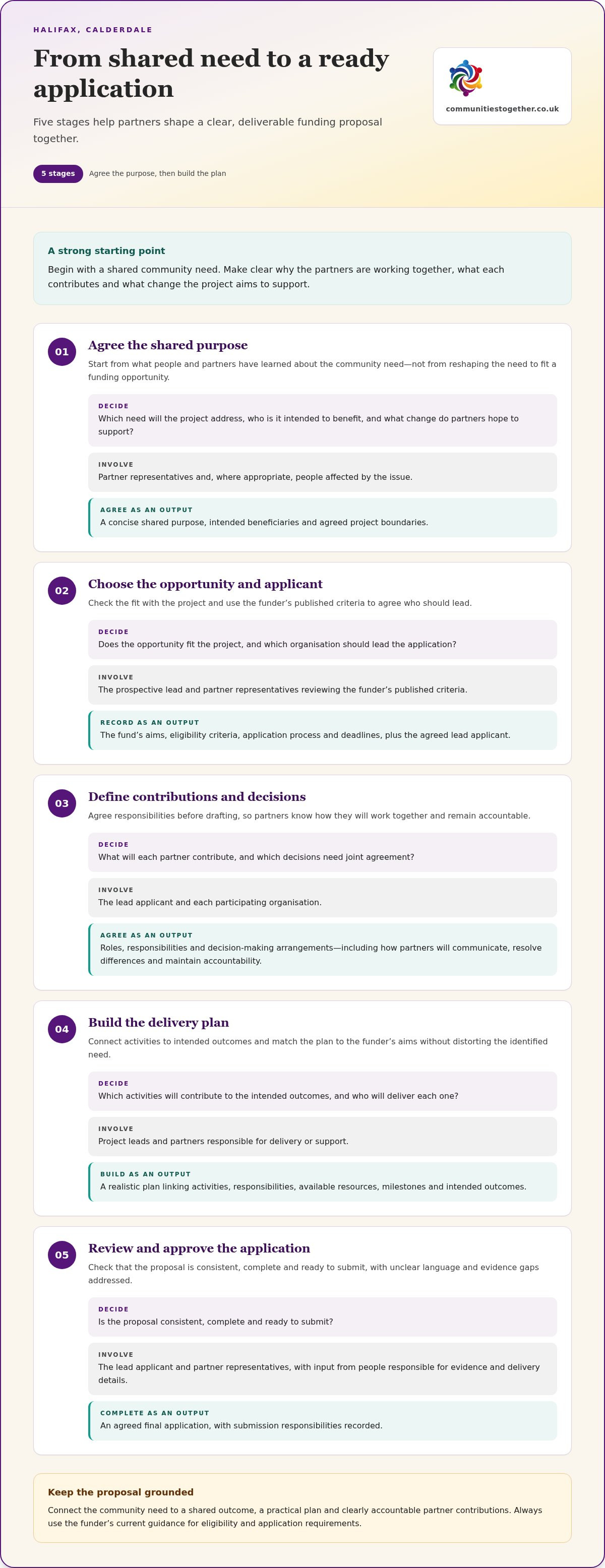
A shared purpose gives the partnership a foundation; a structured process turns that purpose into a clear, deliverable proposal. These five stages can help Halifax groups move from early agreement to a considered final review. At each stage, record the decision and agreed output so everyone can work from the same plan.
1. Agree the shared purpose.Decision: Which community need will the project address, who is it intended to benefit, and what change do partners hope to support? People involved: Partner representatives and, where appropriate, people affected by the issue. Output: A concise shared purpose, intended beneficiaries and agreed project boundaries. Ground the need in what people and partners have learned, rather than reshaping it to fit a funding opportunity.
2. Choose the right funding opportunity and applicant.Decision: Does the opportunity fit the project, and which organisation should lead the application? People involved: The prospective lead and partner representatives who review the funder’s published criteria. Output: A record of the fund’s aims, eligibility criteria, application process and deadlines, plus the agreed lead applicant. Use the funder’s current guidance, as requirements and dates can change.
3. Define contributions and decision-making.Decision: What will each partner contribute, and which decisions need joint agreement? People involved: The lead applicant and each participating organisation. Output: A clear allocation of roles, responsibilities and decision-making arrangements, including how partners will communicate, resolve differences and maintain accountability. Agree this before drafting to avoid uncertainty later.
4. Build the delivery plan.Decision: Which activities will contribute to the intended outcomes, and who will deliver each one? People involved: Project leads and partners responsible for delivery or support. Output: A realistic plan connecting activities, responsibilities, available resources, milestones and intended outcomes. Match the plan to the funder’s published aims without distorting the identified need to make it appear more suitable.
5. Review and approve the application.Decision: Is the proposal consistent, complete and ready to submit? People involved: The lead applicant and partner representatives, with input from people responsible for evidence and delivery details. Output: An agreed final application, with gaps in evidence or unclear language addressed and submission responsibilities recorded.
A coherent partnership application connects an evidenced community need to a shared outcome, a practical plan and clearly accountable partner contributions. This process can help your group develop a proposal that is collaborative and manageable. Communities Together’s community engagement and capacity building work supports inclusive engagement and stronger partnerships.
Which collaboration model suits your Halifax funding application?
There is no single structure that works for every project. Choose a model based on what partners will contribute, how decisions need to be made and what the funder’s current guidance says about applications and accountability. Collaboration can involve extra coordination, but clear responsibilities help reduce duplicated work and uncertainty.
Lead applicant or jointly managed partnership: what’s the difference?
A lead applicant can provide a clear coordination point, organise communication and make responsibilities visible, while partners contribute their experience, local relationships or specific activities. A jointly governed arrangement shares more decision-making, so partners need to agree how decisions will be reached and record who is responsible for each part. Neither model is automatically preferable. The structure should fit the project and the funder’s guidance.
How can partners decide whether the collaboration is workable?
Look beyond the number of organisations involved. Each partner should have a meaningful contribution linked to the shared outcome. The group should also consider whether it has the capacity to communicate, make decisions and maintain continuity throughout the project. Collaborative funding applications Halifax groups develop are more credible when the proposed structure reflects these practical realities instead of creating extra layers without a clear purpose.
Before settling on a model, discuss who needs to be involved in decisions, how often partners will share progress and what happens if plans change. A short written record of roles and agreed processes can prevent repeated conversations and help everyone understand their part. Communities Together supports partnership capacity building as part of its work with local communities. Find out more at Communities Together.
Prepare a clear, evidence-led Halifax funding application
A clear application makes it easy to follow the route from the community need to the work partners propose and the difference they hope to support. For collaborative funding applications Halifax groups are preparing, evidence should support that story without overstating what is known or promising results no project can guarantee. Keep the information relevant to the funder’s published application guidance and use the current criteria to decide what to include.
Before submission, check that your application:
Describes the identified community need and how partners understand it.
Sets out clear aims that respond to that need.
Links planned activities to those aims.
Names each partner’s specific, realistic role.
Defines intended outcomes and how progress will be monitored.
Includes relevant supporting evidence requested or encouraged by the funder.
What evidence can partners bring together?
Use appropriate community consultation, partners’ relevant experience and existing local information that relates to the proposed work. Feedback gathered through engagement, for example, can help explain why an activity matters, while an organisation’s experience can show how it is positioned to contribute. Distinguish verified information from assumptions and be candid about gaps rather than presenting an estimate as fact.
Local evidence, named partner responsibilities and realistic ways to monitor progress help explain why a project is relevant, how it will be delivered and what change it intends to support. Describe how activities will be reviewed, such as by recording participation or gathering feedback where appropriate. Avoid implying that a particular outcome is guaranteed.
How can groups keep a joint application coherent?
Prepare one shared project summary and use it as a reference when partners draft or review different sections. Check that every section supports the same purpose, that activities match the stated need and that partner contributions are consistent throughout. For instance, a partner described as leading an activity in one section should not appear as a supporting partner elsewhere without explanation.
Before submission, review the application together for accessible language, inclusion, clarity and funder-specific requirements. Confirm that the evidence supports the claims, the proposed activities are realistic and intended benefits are described consistently. A careful shared review can catch gaps that individual contributors may miss.
Build lasting community partnerships alongside funding in Halifax
A funding application can be one step in a longer process of building community capacity, rather than the sole reason partners come together. The relationships developed while listening, planning and sharing responsibility can continue to support local work after a project ends. Partners can learn from one another and respond more confidently to community priorities.
How can collaboration strengthen local capacity over time?
Make shared learning part of the partnership from the outset. Partners can reflect on what they hear from community members, share practical knowledge and introduce one another to relationships that support future activity. Keep involving people affected by the work. Their perspectives can help activities reflect local priorities and cultural context rather than relying on assumptions made during planning.
Communities Together works across Halifax and neighbouring West Yorkshire locations, including Huddersfield, Leeds, Bradford and Wakefield. Its work includes community engagement and partnership capacity building, alongside South Asian arts and heritage activities, wellbeing and resilience workshops, and learning and skills development. These programmes help local groups build relationships and develop locally grounded activities. For groups shaping collaborative funding applications Halifax projects, this longer-term perspective keeps partnership development in view alongside the immediate proposal.
What is a useful next step for Halifax community groups?
Start with a practical conversation between partners. Describe the shared outcome in plain language, identify the contributions and relationships already in place, and note what the group still needs to learn. Keep listening as the plan develops. Community members’ priorities can help clarify which activities are relevant, who should participate and how partners can make the work accessible and inclusive.
Partnerships grow through consistent, respectful engagement, not just a successful application. Sharing insight and learning as the work progresses can strengthen groups’ ability to plan together and sustain community-led activity beyond one funded project.
Explore community engagement and partnership programmes with Communities Together.
Take your Halifax partnership from shared purpose to lasting impact
Strong collaborative funding applications Halifax groups develop start with a locally understood need, then connect it to a shared outcome, clear partner contributions and a practical plan. Choosing a structure that suits the project makes responsibilities easier to follow, while relevant evidence helps explain how activities are intended to support change.
Keep the partnership’s value in view beyond the application itself. Listening to community members as plans develop, sharing learning between organisations and agreeing how to work together can strengthen local capacity beyond one funding round.
Communities Together delivers community engagement and partnership capacity-building programmes in Halifax and across West Yorkshire, including Huddersfield, Leeds, Bradford and Wakefield. Its programmes support organisations to develop inclusive, locally grounded community work.
With a shared purpose and a thoughtful approach, your partners can build a stronger foundation for meaningful community work, whatever the next step brings.
Frequently Asked Questions
How do collaborative funding applications work in Halifax?
Collaborative funding applications bring organisations together to plan or deliver a project around a shared community outcome. Here, Halifax refers to Halifax in Calderdale, West Yorkshire. Partners agree the need they want to address, who the project is intended to benefit, what each organisation will contribute and how they will work together. One organisation may lead the application, or partners may share decisions, depending on the project and the funder’s current guidance.
Can small community groups apply for funding with a partner?
Small community groups may be able to apply with a partner, but eligibility depends on the funder and opportunity. Read the latest published criteria for who can apply, whether a lead organisation is required and what information partners need to provide. A partnership can bring together complementary community relationships, experience or delivery capacity, provided each organisation has a clear and meaningful role in the proposed work.
What makes a collaborative funding application strong?
A strong application connects a clearly described community need to relevant activities, defined partner contributions and realistic intended outcomes. It uses appropriate evidence, such as community consultation, organisational experience or relevant local information, and distinguishes verified facts from assumptions. The proposal should also reflect the funder’s published aims and requirements. For collaborative funding applications Halifax groups prepare, consistency between the project summary, delivery plan and partner roles makes the shared purpose easier to understand.
How should partners divide roles in a funding application?
Divide roles according to each organisation’s contribution and capacity, then describe them consistently in the application. For example, one partner might coordinate communication, while others contribute community insight, lead specific activities or support participation. Agree who makes key decisions, how partners will share updates and how they will address differences. A written record of responsibilities can help prevent duplicated work and make accountability clearer for partners and the funder.
Where can Halifax organisations find community funding opportunities?
Start with published funding pages from relevant local authorities, charitable trusts, foundations and public bodies, then read the current guidance for each opportunity. Local networks can also help groups hear about funding programmes, but verify eligibility, dates and application requirements in the funder’s own information. Halifax organisations should focus on opportunities relevant to their community, activities and intended outcomes, rather than relying on deadlines or details from an older funding round.
Do collaborative funding applications take longer than applying alone?
They can take additional time to coordinate, particularly while partners agree aims, responsibilities and decision-making, but the difference depends on the project and how prepared the group is. Setting shared expectations early, appointing a lead where useful and keeping one agreed project summary can reduce repeated discussions. Allow time for partners to review the application together, and use the funder’s current deadline and process to plan submission.
What should happen if a funding application is unsuccessful?
First, review any feedback the funder provides and identify whether the application needs clearer evidence, a more suitable structure or a stronger connection between activities and outcomes. Discuss the learning with partners and, where appropriate, revisit the plan with community members. An unsuccessful decision does not remove the value of the relationships or shared insight developed during preparation. Use those foundations to refine the project or consider another opportunity whose published criteria fit.



Comments