
Arts for Social Cohesion UK: 2026 Trends and Strategic Community Impact
Imagine walking through your local neighbourhood and feeling a genuine sense of connection with everyone you meet, as if the very streets were designed to bring people together. We all know that life in our busy urban centres can sometimes feel a bit isolating, and it's heartening to see so many of us looking for ways to mend fragile community relations and build something truly lasting. If you've been searching for a way to make arts for social cohesion UK feel less like a temporary project and more like a permanent, welcoming part of your local area, we're so glad you've found us.
Discover how creative initiatives and heritage projects are transforming our social fabric and building resilient, supportive communities across the UK in 2026. In the following sections, we'll explore the latest trends in community engagement, provide a clear and helpful framework for implementing your own cohesion programmes, and look at how establishing sustainable local partnerships can help us all grow together. We're here to help you understand the beautiful ways that art and heritage can act as a bridge, ensuring that every person in our community feels seen, heard, and deeply valued.
Table of Contents
Understanding the Landscape of Arts for Social Cohesion in the UK
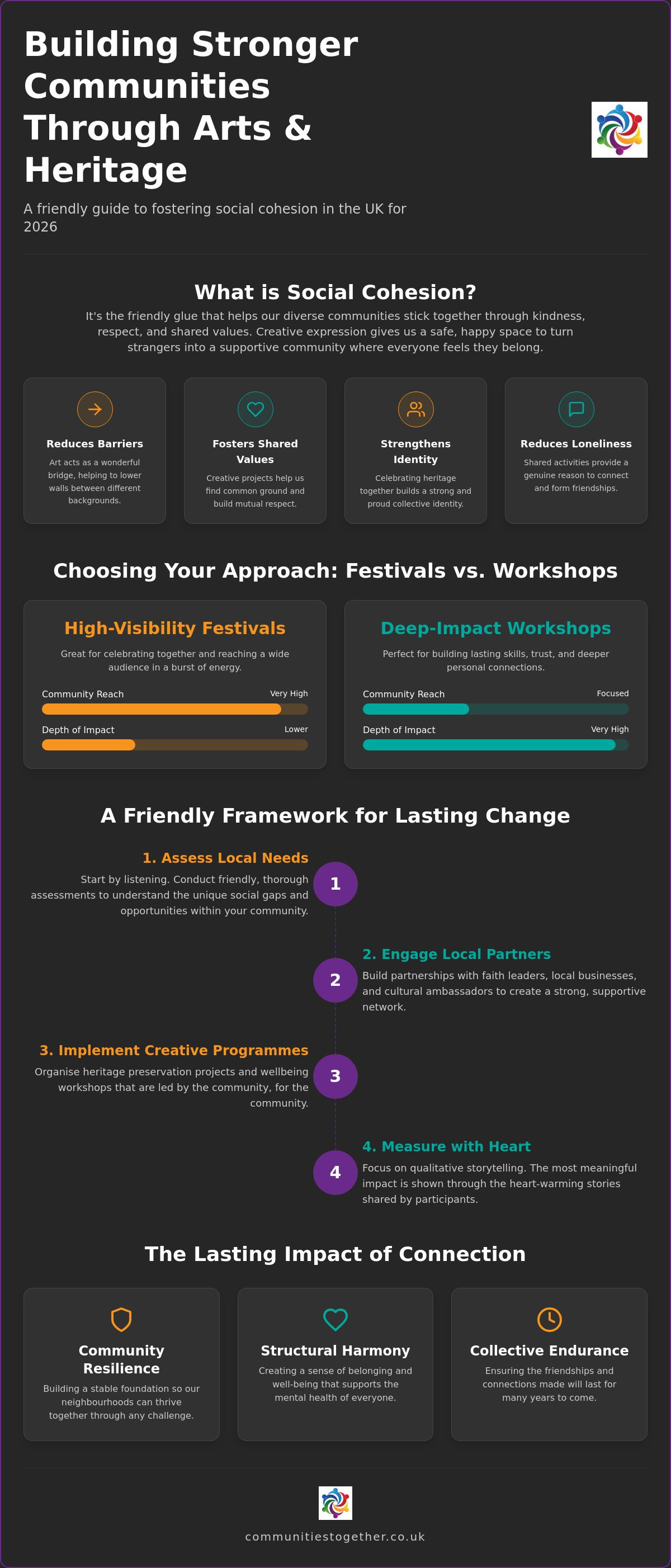
Social cohesion is essentially the friendly glue that helps our diverse UK communities stick together through kindness, mutual respect, and shared values. In 2026, finding thoughtful ways to use arts for social cohesion UK has become a wonderful way to build warmer, more welcoming neighbourhoods for everyone to enjoy. When we explore the history of Understanding Community Art, we can see that creative projects are so much more than just a hobby; they're a natural way to lower the walls between different backgrounds and help us see the beauty in our differences. Creative expression gives us a safe, happy space to talk and share, making it much easier to turn a group of strangers into a supportive community where everyone feels they belong.
In our fast-moving world, art helps us feel a lot less lonely by giving us a genuine reason to get together and create something special. We've found that 2026 is the perfect time to let communities lead the way, ensuring that every local voice is heard and every person feels included in the cultural life of their town. By moving away from stiff, top-down approaches and towards these friendly, community-led frameworks, we can make our busy urban centres feel much more like home. Cultural participation isn't just about the end result; it's about the lovely friendships and the sense of security that grow when we spend time being creative together.
To better understand this concept, watch this helpful video:
The Evolution of Community Engagement
It's so encouraging to see how we're moving from just watching art to actually getting stuck in and taking care of our local heritage together. In vibrant spots like Huddersfield and Halifax, local councils are now seeing that art is a fantastic tool for helping us all stay well and connected. Instead of relying only on clinical services, we're finding that these creative workshops are a brilliant, non-clinical way to support our mental wellbeing and help us feel more resilient. At Communities Together, we're passionate about using South Asian arts and heritage to help people find that sense of togetherness and lasting friendship that keeps our communities strong.
Measuring the Impact of Creative Cohesion
We know these projects are working when we see the smiles, the growing trust, and that lovely feeling of truly belonging to a place. Whilst numbers are always helpful, we’re finding that the most meaningful way to show impact is through the heart-warming stories shared by the people involved. Qualitative storytelling is becoming a respected way to prove how much these projects matter, showing the real-life magic of how art can mend a social gap, brighten someone’s day, and strengthen the very foundation of our local neighbourhoods. In the context of 2026 UK community development, social cohesion is the warm and intentional way we build trust and friendship through shared creative activities that help everyone feel right at home.
Key Trends Shaping Community Cohesion Through Arts in 2026
In 2026, the strategic focus of arts for social cohesion UK has evolved significantly towards a model of hyper-localism that prioritises the unique cultural needs of specific districts like Huddersfield and Halifax. This shift is mirrored in the independent review of Arts Council England, which underscores how arts help to engender our sense of place and identity whilst strengthening the social fabric of our neighbourhoods. By moving away from generic, large-scale spectacles and towards sustained, district-level engagement, facilitators can address local grievances, foster a more confident sense of belonging, and strengthen the structural harmony of our communities. This approach aligns with the government's 2026 Social Cohesion Action Plan, which emphasises the importance of everyday interactions in shared community spaces to build trust and civic participation.
Digital-physical hybridity is now a primary tool for expanding educational access, particularly for South Asian heritage projects that seek to connect historical narratives with modern community life. By integrating virtual archives with physical skill-sharing sessions, we can bridge the gap between youth and elders, ensuring that intergenerational storytelling remains a vibrant part of our collective cultural continuity. Additionally, environmental cohesion has emerged as a vital trend, where sustainable practices are linked with community arts to reinforce local identity and shared responsibility for our common surroundings. These initiatives don't just create art; they build the capacity for collective endurance and provide a reliable foundation for future growth.
South Asian Arts as a Bridge
South Asian arts and heritage activities serve as a powerful bridge, providing a shared language that facilitates mutual understanding amongst diverse social groups in West Yorkshire. The preservation of traditional music, dance, and visual arts ensures that cultural identity is maintained whilst simultaneously opening doors for dialogue, collaboration, and shared learning. South Asian Heritage Month now acts as a professional catalyst, sparking year-round community engagement programmes that move beyond seasonal celebration to achieve long-term social integration and togetherness. If you're looking to implement such initiatives in your local area, our Community Engagement Programmes provide a methodical framework for building these essential connections.
Resilience and Wellbeing Workshops
The trend of "wellbeing-first" programme design has seen the integration of personal development with creative practice to enhance both individual and collective resilience. By offering Wellbeing and Resilience Workshops, organisations can provide non-clinical interventions that reduce social isolation, improve mental health, and build the local capacity necessary for communities to thrive. These sessions focus on skills-based learning within a supportive environment, ensuring that every participant gains the tools needed to contribute to a more stable and harmonious society. This methodical approach to wellbeing demonstrates a high degree of professional literacy in social welfare, prioritising the long-term health of our community infrastructure over short-term excitement.
Comparing Collaborative Models: Heritage, Workshops, and Festivals
Selecting the most appropriate delivery model is a critical step for organisers seeking to maximise the impact of arts for social cohesion UK within their specific districts. Whilst high-visibility festivals offer a vibrant spectacle that encourages immediate social mixing, it's often the quieter, long-term workshop series that provide the necessary depth for building resilient communities and establishing a permanent sense of belonging. Heritage preservation projects serve as a vital anchor in this process, allowing residents to explore shared histories to foster cultural continuity, strengthen local identity, and create a stable foundation for future collaboration. By developing sustainable local partnerships between non-profits and community groups, we can ensure that these initiatives aren't just temporary events but rather a permanent part of the social infrastructure that supports togetherness and collective endurance.
The decision to implement a specific model should always be guided by the unique social challenges of a local district, whether that involves addressing urban isolation or repairing fragile community relations. A methodical advocate for social harmony understands that different outcomes require different approaches. For instance, a heritage project might focus on cultural continuity and structural strength, whilst a skills-based workshop prioritises individual growth and community capacity. By aligning the chosen model with the specific needs of the population, facilitators can provide a reliable foundation for growth that respects both tradition and progress in equal measure.
The Festival Model vs. Persistent Engagement
Outdoor festivals in cities like Leeds and Bradford are fantastic for creating a sense of immediate excitement and visibility, yet they often lack the sustained contact required to dismantle deep-seated social barriers. In contrast, multi-week Community Engagement Programmes facilitate a slower, more deliberate process of trust-building that allows participants to move beyond surface-level interactions. This balanced strategy is essential because it combines the broad reach of public events with the intensive impact of persistent engagement, ensuring that every member of the community feels seen, heard, and valued. It's about using the energy of the festival to draw people in, whilst providing structured pathways for them to remain connected through ongoing creative practice and shared learning.
Capacity Building and Skills Development
A truly effective cohesion strategy must also focus on partnership and community capacity building by equipping local leaders with the skills they need to facilitate their own initiatives. Through Learning, Skills and Personal Development workshops, we can bridge the gap between cultural heritage education and practical life skills, which in turn boosts participant confidence and encourages active civic participation. By teaching these engagement skills, we ensure the longevity of our cohesion efforts, allowing the community to maintain its own structural harmony and collective endurance long after the initial facilitator has stepped back. This methodical approach transforms participants from passive beneficiaries into active architects of their own social fabric, creating a pulse of professional promise and social delivery that feels both grounded and aspirational.
Strategic Implementation: Building Cohesion in West Yorkshire Communities
The successful implementation of arts for social cohesion UK requires a principled and methodical approach that begins with a comprehensive local needs assessment in districts like Wakefield or Huddersfield to identify specific social gaps. By identifying and engaging key stakeholders, such as faith leaders, local businesses, and cultural ambassadors, we can build a stable foundation for projects that are both representative and sustainable. Designing inclusive programmes that prioritise accessibility and represent the diversity of the local population ensures that every resident feels a sense of ownership, trust, and belonging within their neighbourhood. To maintain this momentum, we must establish clear feedback loops that allow our initiatives to remain responsive to evolving community needs whilst ensuring that every statement of intent is balanced by a measurable statement of impact.
Securing long-term sustainability for these efforts is achieved through collaborative partnerships and dedicated capacity-building workshops that empower residents to lead their own cultural journeys. This strategic delivery of arts for social cohesion UK doesn't just create temporary excitement; it facilitates a permanent shift in how communities interact, share resources, and support one another through periods of change. By focusing on the structural strength of our local networks, we can provide a reliable conduit for collective growth that benefits the entire social fabric of West Yorkshire.
Localised Engagement in Bradford and Leeds
Navigating the unique cultural landscapes of major urban centres like Bradford and Leeds requires a deep understanding of the complex threads that connect diverse neighbourhoods. We've found that utilising South Asian heritage projects for schools is an exceptionally effective way to foster early-years social cohesion by teaching children the value of cultural continuity and mutual respect. These initiatives are particularly vital for addressing the specific challenges of social isolation in densely populated, diverse neighbourhoods where shared creative spaces can bridge the gap between isolated individuals and the wider community. By creating these points of connection, we help to weave a more resilient and inclusive social tapestry that can withstand the pressures of urban life.
Building Partnerships for Resilience
We believe that true resilience is built through the empowerment of local groups, allowing them to facilitate their own growth through shared resources and collective expertise. The role of a wise facilitator is essential in this process, as it involves managing complex community dynamics and potential tensions with a steady, professional hand to ensure that every voice is heard. To establish a community heritage project, one must first conduct a thorough local needs assessment, then identify and secure key stakeholders, and finally design an inclusive programme that prioritises accessibility whilst maintaining clear feedback loops for continuous improvement. If you're ready to strengthen your local area, our focus on Partnership and community Capacity Building provides the professional expertise needed to weave these threads together for a more harmonious future.
Strengthening Local Resilience with Communities Together
We're so proud to be your friendly partners in West Yorkshire, helping to make our neighbourhoods places where everyone feels a warm sense of belonging. We believe that arts for social cohesion UK works best when it's built on kindness and a genuine desire to see our communities thrive together. We’re here to offer a supportive hand and share our love for bringing people closer, creating happy spaces where everyone feels welcome and valued. By focusing on the heart-warming benefits of being creative, we can help turn a busy town into a close-knit community where no one has to feel isolated or alone.
Our approach to South Asian arts and heritage preservation is all about togetherness, using these beautiful traditions as a friendly way to spark conversations and build lasting friendships. We've seen how these creative moments can truly brighten someone's day and provide a steady foundation for a more inclusive future. We’d love to invite you to collaborate with us as we work side-by-side to make our community infrastructure even more welcoming for everyone. Our wellbeing and resilience workshops are a lovely example of how arts for social cohesion UK can offer measurable benefits, helping individuals find their confidence whilst making our whole community feel a lot more connected and supported.
Our Heritage and Cultural Preservation Projects
We're deeply committed to taking care of precious cultural traditions whilst making sure that everyone has a wonderful opportunity to learn and grow. Our heritage and cultural preservation projects are all about sharing the joy of these traditions to help people in Huddersfield and beyond find common ground and grow together. It's so heart-warming to see how a shared craft or a story can turn a group of strangers into a supportive circle of friends. If you'd like to see how we can bring this magic to your area, please Learn more about our Community Engagement Programmes and join us in making our towns even friendlier places to live.
Facilitating Collaborative Growth
We also love helping our local residents gain the confidence and skills they need to lead their own wonderful community projects. By offering a steady, supportive foundation for new partnerships, we can help your neighbourhood become even more resilient and harmonious for the long term. It’s all about giving you the tools to keep that community spirit going, ensuring that our towns are places where everyone can flourish and feel right at home. We'd love for you to Explore our South Asian Arts and Heritage activities and see how we can start building a brighter, more connected future together.
Building a Resilient Future Through Creative Collaboration
The landscape of arts for social cohesion UK in 2026 reflects a sophisticated move toward hyper-localism, the adoption of digital-physical hybridity, and a principled focus on long-term capacity building that transcends the temporary impact of large-scale spectacles. By prioritising the deep, methodical work of heritage preservation and skills-based workshops, we can facilitate cultural continuity, foster a lasting sense of belonging, and strengthen the structural harmony of our diverse neighbourhoods. This shift ensures that creative initiatives serve as a reliable foundation for togetherness, allowing us to maintain social responsibility whilst building a more inclusive social fabric that supports everyone.
Communities Together acts as an established facilitator and a trusted partner for West Yorkshire local authorities, specialising in South Asian heritage preservation whilst remaining deeply dedicated to building community capacity and resilience across our districts. We possess the professional expertise to act as a methodical advocate for your area, weaving together the threads of tradition and progress to achieve measurable social benefits and collective growth. We invite you to partner with Communities Together to strengthen your local community and embark on a collaborative journey toward a more harmonious future. Together, we'll ensure that our collective endurance remains a source of shared strength and pride for generations to come.
Frequently Asked Questions
How do arts contribute to social cohesion in the UK?
Arts provide a neutral platform for shared experiences, fostering trust and breaking down social barriers by inviting people from diverse backgrounds to collaborate on creative projects. This process-oriented approach encourages mutual respect and togetherness, which are essential for a stable and harmonious society. By facilitating dialogue through creativity, these initiatives help build a collective identity that strengthens the social fabric of our neighbourhoods.
What are the most effective arts for social cohesion programmes?
The most effective initiatives are those that prioritise long-term, deep-impact engagement over short-term spectacle. Programmes that combine heritage preservation with skills-based learning, such as multi-week workshops, tend to create more lasting relationships and deeper trust. By focusing on consistent participation, these projects build a reliable foundation for community resilience and collective endurance within local districts across the country.
How can South Asian heritage projects improve community relations in West Yorkshire?
South Asian heritage projects act as a bridge by sharing cultural traditions that promote mutual understanding and respect amongst all residents. In areas like Halifax and Wakefield, these activities provide a dedicated space for people to explore shared histories whilst celebrating cultural diversity. This methodical preservation of heritage ensures cultural continuity and strengthens the bonds between different ethnic and social groups throughout the region.
What role do local councils play in funding arts for social cohesion?
Local councils act as vital facilitators by providing strategic direction and financial support for community-led cultural projects that meet local needs. They often align funding with broader social welfare objectives, such as the government's 2026 Social Cohesion Action Plan. By investing in arts for social cohesion UK, councils help to establish sustainable local partnerships that enhance community harmony and long-term resilience.
Can creative workshops really reduce social isolation in urban areas?
Yes, creative workshops offer non-clinical interventions that significantly reduce feelings of loneliness by providing regular social contact and a sense of shared purpose. These sessions create a warm, supportive environment where individuals can develop new skills whilst building meaningful connections with their neighbours. This methodical approach to wellbeing helps to maintain a healthy, inclusive community infrastructure in even the most densely populated urban centres.
How do you measure the success of a community engagement programme?
Success is measured through a combination of qualitative storytelling and key indicators such as increased interpersonal trust, an improved sense of belonging, and higher levels of civic participation. We also evaluate the strength of local community infrastructure and the longevity of established partnerships. These metrics demonstrate the professional promise and actual social delivery of a project over an extended period of time.
What are the emerging trends in UK community arts for 2026?
Key trends for 2026 include a significant shift toward hyper-localism, digital-physical hybridity, and a renewed focus on environmental cohesion within neighbourhoods. There's also a growing emphasis on intergenerational storytelling and "wellbeing-first" programme design. These trends reflect a more sophisticated understanding of how arts for social cohesion UK can address modern social challenges whilst respecting and preserving local identity.
How can local groups in Huddersfield or Leeds start a cohesion project?
Groups should begin by conducting a thorough local needs assessment to identify specific social gaps and potential community partners. Engaging with local stakeholders, such as faith leaders and cultural ambassadors, is a crucial next step for building a stable foundation for any project. By designing inclusive programmes that prioritise accessibility, organisations can facilitate collaborative growth and ensure long-term community resilience from the very start.


Comments