
Strategic Third Sector Partners for Local Authorities
Updated: 3 days ago
What if the most resilient solutions for mending a fragmented community are not found within the confines of a council chamber, but through the enduring, quiet work of heritage preservation and cultural participation? Many local authorities recognise that whilst statutory services provide a vital safety net, the true strength of a neighbourhood often lies in its informal networks, its shared histories, and its collective sense of belonging. Finding the right third sector delivery partners for local authorities UK is essential for bridging the gap between high-level policy and the nuanced reality of grassroots engagement, especially when you're faced with the difficulty of measuring social value or reaching isolated groups.
We understand that you're seeking more than just a service provider; you're looking for a methodical advocate who can help build robust partnership frameworks, facilitate meaningful cultural continuity, and deliver measurable improvements in social cohesion. This article provides a comprehensive guide on how to identify, procure, and collaborate with high-impact partners to ensure the successful delivery of wellbeing workshops, heritage programmes, and community engagement initiatives. We'll explore how a strategic approach to third sector collaboration can foster structural strength, promote togetherness, and create a stable foundation for long-term social prosperity across your district.
Table of Contents
The Role of Third Sector Delivery Partners in UK Local Government
Identifying Strategic Partners for Community Engagement and Capacity Building
Matching Heritage and Wellbeing Projects to Local Authority Outcomes
Navigating Procurement for Local Authorities in West Yorkshire
Communities Together: A Strategic Partner for Northern Local Authorities
The Role of Third Sector Delivery Partners in UK Local Government
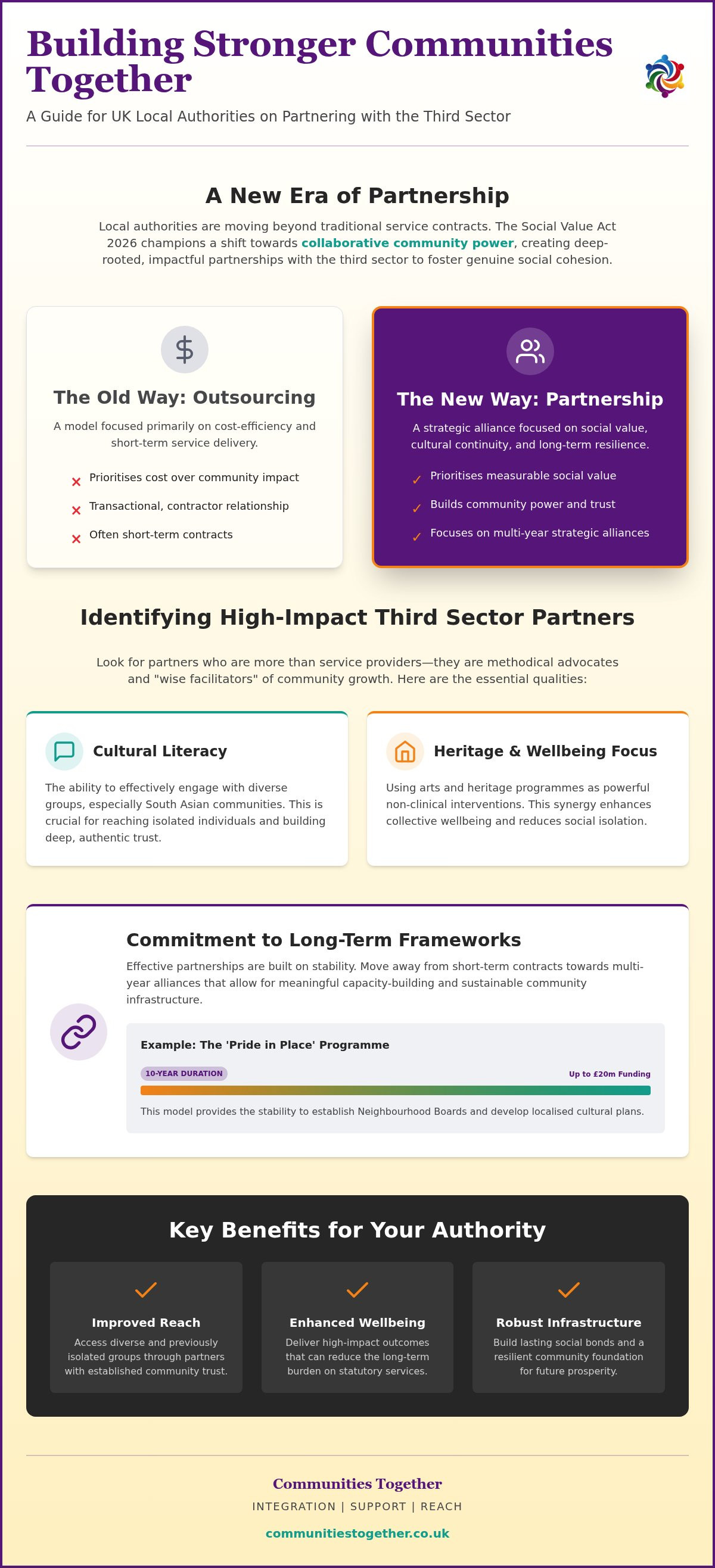
Public service delivery is undergoing a profound transformation. Under the framework of the Social Value Act 2026, the definition of a delivery partner has evolved from a mere contractor to a strategic ally. Local councils are moving away from traditional outsourcing models that often prioritise cost over community impact; instead, they're embracing a model of collaborative community power. This approach recognises that the voluntary sector in the UK possesses the unique agility to address complex social needs. By engaging third sector delivery partners for local authorities UK, councils can foster a sense of togetherness, ensure cultural continuity, and build long-term structural strength within their districts.
To better understand how these procurement frameworks operate in practice, watch this helpful video:
Understanding the 2026 Partnership Landscape
Devolution deals in Northern England, particularly across West Yorkshire, are fundamentally reshaping how we think about community engagement. We're seeing a decisive move towards multi-year strategic alliances that provide the stability needed for meaningful progress. These partnerships focus on building social infrastructure, enhancing community resilience, and facilitating sustainable capacity building. It's about moving beyond short-term contracts to create a steady pulse of professional promise and social delivery. For instance, the Pride in Place programme provides up to £20 million per area over a 10-year period, which allows for:
The establishment of Neighbourhood Boards to oversee community engagement.
The development of localised plans that reflect specific cultural heritage.
The creation of enduring social bonds that withstand economic shifts.
The Social Value Imperative for Local Councils
Procurement is no longer just about the bottom line. It's about integrating social, economic, and environmental benefits into every decision. Third sector partners offer significant "added value" through their established local trust and deep-rooted networks. They act as a professional conduit for collective growth, balancing fiscal responsibility with the need for high-impact community outcomes. This allows authorities to maintain institutional accountability whilst tapping into the earnest, mission-driven energy of local experts who understand the intricate threads of the social fabric. By prioritising third sector delivery partners for local authorities UK, councils can achieve:
Improved reach into diverse or isolated groups through cultural literacy.
Enhanced wellbeing outcomes that reduce the burden on statutory services.
A more robust community infrastructure that supports collective endurance.
Identifying Strategic Partners for Community Engagement and Capacity Building
Selecting the right third sector delivery partners for local authorities UK requires a methodical approach that balances professional rigour with deep community empathy. It's not enough to simply deliver a service. You need to find organisations that act as authoritative bridge-builders, possessing the expertise to weave together complex social threads whilst maintaining the high standards of governance, safeguarding, and financial transparency expected by public bodies. When non-profit organisations are delivering public services, their ability to demonstrate institutional accountability provides the stable foundation necessary for collective growth and long-term structural strength.
The Importance of Cultural and Heritage Literacy
Generic engagement programmes often fail to reach isolated groups because they lack the necessary cultural and heritage literacy to build authentic trust. In regions such as Leeds, Bradford, and Huddersfield, successful partnerships thrive when the delivery partner has deep-rooted connections and understands the nuances of South Asian arts and heritage. This cultural continuity is essential for fostering togetherness, ensuring that participation feels relevant and respectful of tradition. It's about creating a space where every community member feels seen and heard.
Capacity Building as a Core Delivery Requirement
A strategic partnership should focus on empowering the wider community infrastructure rather than just meeting immediate targets. This involves facilitating growth amongst smaller, local groups to ensure that the resilience and skills developed during a project remain within the neighbourhood. You can explore this methodology further in our guide to Strategic Community Engagement Programmes. By prioritising capacity building, local authorities can foster collaborative growth that outlasts any single funding cycle. If you're looking for a methodical advocate to help strengthen your local networks, partnering with a specialist facilitator can help you achieve these enduring social benefits.
To ensure your chosen partner can facilitate long-term community infrastructure growth, consider these essential evaluation criteria:
Proven Cultural Literacy: Evidence of successful engagement with diverse South Asian communities through heritage-led activities.
Infrastructure Focus: A clear, documented methodology for facilitating capacity building amongst local community groups.
Professional Standards: Robust safeguarding policies, clear governance structures, and transparent financial reporting.
Regional Presence: Established networks and local knowledge within West Yorkshire, specifically in areas like Halifax and Wakefield.
Matching Heritage and Wellbeing Projects to Local Authority Outcomes
We've seen that effective collaboration between local government and specialist organisations allows for the seamless alignment of community needs with statutory goals. Strategic third sector delivery partners for local authorities UK play a pivotal role in this process by translating high-level policy into tangible, heritage-led interventions to address social isolation, foster a shared sense of belonging, and build the structural strength necessary for communities to thrive. By focusing on South Asian heritage preservation, these partnerships help maintain cultural continuity whilst ensuring that the social fabric of our urban centres remains resilient and inclusive. It's about more than just meeting targets; it's about creating a steady pulse of social delivery that residents can truly feel in their daily lives.
Heritage Projects as Tools for Social Cohesion
Preserving cultural traditions whilst expanding educational access is a fundamental strategy for building social cohesion in diverse areas like Huddersfield and Halifax. Heritage workshops designed for schools in Wakefield and Bradford provide an inclusive platform where children of all backgrounds can explore shared histories, learn new skills, and develop a deeper respect for their neighbours' traditions. These initiatives act as a stable foundation for future harmony by ensuring that cultural knowledge isn't lost but instead becomes a bridge for togetherness. For a more detailed exploration of how these programmes protect our shared history, you can read about Cultural Heritage Preservation in the UK.
Wellbeing and Resilience Through Creative Engagement
The synergy between arts participation and community resilience workshops offers a non-clinical route to improving public health whilst reducing the strain on local authority budgets. By facilitating learning and skills development through creative engagement, third sector delivery partners for local authorities UK help residents build individual resilience, gain confidence, and establish supportive social networks. These workshops are designed to be absorptive and reassuring, providing a safe space for personal growth and collective endurance. You can learn more about how these programmes are structured by visiting our guide on Collaborative Wellbeing and Resilience Workshops. Success is measured through a variety of metrics, including social cohesion indices and personal resilience scores, ensuring that every intervention delivers a professional promise of social delivery that's both grounded and aspirational.
Navigating Procurement for Local Authorities in West Yorkshire
It's encouraging to see how procurement in West Yorkshire is shifting towards a more integrated and relational model that prioritises long-term social impact over mere transactional efficiency. Local councils are increasingly looking for third sector delivery partners for local authorities UK who can act as authoritative bridge-builders, bridging the distance between civic policy and the specific needs of diverse neighbourhoods. This methodical approach ensures that every commissioned programme contributes to the district's structural strength, facilitates cultural continuity, and promotes a sense of collective endurance amongst residents in Huddersfield, Halifax, and Leeds. By adopting this model, authorities can maintain institutional accountability whilst ensuring that their investments foster genuine togetherness, social responsibility, and community-led growth. This focus on ethical leadership and integrity is at the heart of the work done by Unashamedly Ethical NPC.
The Commissioning Roadmap for 2026
The most successful partnerships often begin long before a formal tender is issued, as pre-procurement engagement allows councils to build meaningful relationships with potential delivery partners. This collaborative phase is essential for designing inclusive specifications that allow for creative community solutions rather than rigid, output-only frameworks that often fail to address complex social needs. Monitoring and evaluation must move beyond simple metrics to capture qualitative social impact, using robust impact reporting and social value tracking to demonstrate how projects strengthen the social fabric over time. By establishing these frameworks early, local authorities can create a stable foundation for others to build upon, ensuring that every pound spent contributes to the resilience, health, and harmony of the region whilst maintaining a clear audit trail of impact.
Localised Engagement Strategies
Effective delivery requires a deep understanding of the unique demographic profiles across West Yorkshire's districts. The needs of a community in Wakefield may differ significantly from those in the urban centres of Bradford or Leeds. Addressing the specific requirements of isolated groups requires a strategy that integrates personal development workshops, heritage activities, and wellbeing initiatives into broader council strategies. This ensures that engagement isn't a standalone event but a process-oriented method that maintains community infrastructure whilst facilitating the learning, skills, and personal development necessary for long-term resilience. By tailoring these programmes to the specific cultural threads of each area, local authorities can ensure their community engagement initiatives remain both grounded in local tradition and aspirational in their social goals. It's through this principled expertise that we can weave together the complex strands of society to create a more harmonious future.
Communities Together: A Strategic Partner for Northern Local Authorities
Communities Together operates with the quiet confidence of an established facilitator, positioning itself as a stable foundation for public bodies seeking reliable third sector delivery partners for local authorities UK. We act as an authoritative bridge-builder between institutional policy and the nuanced reality of community life, specialising in South Asian arts, heritage, and community capacity building to foster togetherness and social responsibility. Our work across Huddersfield, Halifax, Leeds, Bradford, and Wakefield is underpinned by a deep sense of purpose and accountability, ensuring that every project we deliver contributes to the long-term structural strength, social harmony, and collective endurance of the region.
Our Proven Methodology for Inclusive Growth
Our "Wise Facilitator" approach is a methodical process designed to achieve cultural continuity, individual resilience, and measurable social impact. By integrating heritage and cultural preservation into the heart of our delivery, we provide a stable platform for residents to reconnect with their shared history whilst developing the personal resilience necessary for modern urban life. We focus on facilitating community engagement programmes to achieve social cohesion, structural strength, and cultural continuity. You can explore our specific framework for growth in our comprehensive guide to Skills and Personal Development UK, which details how we facilitate learning to empower both local groups and individuals.
Partnering for a Cohesive Future
As we look towards the 2026 and 2027 project cycles, we invite local government stakeholders to begin a collaborative dialogue regarding our current wellbeing and resilience workshops. Our team is dedicated to building, facilitating, and maintaining partnerships that align with the strategic goals of Northern local authorities, providing a professional promise of social delivery that's both grounded in tradition and aspirational in its reach. We understand the complex threads of the social fabric and possess the expertise to weave them together through South Asian arts activities, heritage preservation, and capacity-building initiatives. We welcome enquiries from governing bodies seeking a principled expert to help navigate the complexities of social welfare and cultural heritage.
To discuss how we can support your specific district outcomes or to learn more about our non-clinical wellbeing interventions, please contact our professional team for strategic partnership enquiries.
Fostering Sustainable Social Cohesion through Strategic Collaboration
The path towards creating resilient, harmonious neighbourhoods depends on the ability to bridge high-level civic policy with the authentic, lived experiences of local residents. We've explored how identifying the right third sector delivery partners for local authorities UK involves more than just evaluating service outputs; it's about finding an authoritative bridge-builder who can facilitate cultural continuity, foster togetherness, and build the structural strength necessary for collective endurance. By matching South Asian heritage preservation with wellbeing outcomes, councils ensure community engagement is both inclusive and impactful, particularly when reaching diverse groups across West Yorkshire.
Communities Together remains a dedicated specialist in South Asian cultural heritage and arts. We're experienced delivery partners across Leeds, Bradford, and Huddersfield, offering a professional, mission-driven approach to social value. We're committed to acting as a wise facilitator for your district's goals, maintaining institutional accountability whilst delivering non-clinical interventions that promote long-term resilience and harmony. We're here to help build stable foundations.
We look forward to working together to weave a stronger social fabric and ensuring that every resident feels a genuine sense of belonging and progress.
Frequently Asked Questions
What are the benefits of local authorities partnering with the third sector?
Local authorities gain access to deep-seated community trust and specialised cultural literacy that statutory services often struggle to replicate. These partnerships allow for more agile, community-led responses to social isolation and fragmented infrastructure. By working with third sector delivery partners for local authorities UK, councils can achieve measurable social value, ensure cultural continuity, and build long-term structural strength within diverse neighbourhoods whilst maintaining institutional accountability and fiscal responsibility.
How do third sector partners support social cohesion in diverse communities?
Partners support social cohesion by acting as authoritative bridge-builders who facilitate togetherness through shared cultural participation and inclusive arts activities. In areas like West Yorkshire, these organisations create spaces where different backgrounds can converge around heritage preservation. This process-oriented approach helps maintain the social fabric, reduces isolation amongst diverse groups, and ensures that progress is balanced with tradition to foster a stable foundation for collective growth and community harmony.
What is community capacity building and why is it important for councils?
Community capacity building is the methodical process of strengthening the skills, confidence, and resources of local groups to ensure they can sustain positive social outcomes independently. For councils, this is vital because it reduces long-term dependency on statutory services by fostering individual resilience and robust community infrastructure. It's about building, facilitating, and maintaining a network of empowered residents who can actively contribute to the stability and endurance of their own neighbourhoods.
How can local authorities measure the impact of arts and heritage projects?
Impact is measured through a combination of social cohesion indices, personal resilience metrics, and qualitative impact reporting that captures the depth of community transformation. Local authorities look for evidence of increased educational access, reduced social isolation, and enhanced cultural participation. This thorough evaluation ensures that every project delivers a professional promise of social delivery, providing stakeholders with clear data on how heritage preservation contributes to the district's overall wellbeing and structural strength.
What role does South Asian heritage play in community resilience?
South Asian heritage acts as a powerful tool for community resilience by providing a shared sense of identity and cultural continuity that anchors individuals during times of change. Preservation activities in cities like Bradford and Leeds foster a sense of belonging and togetherness, which are essential components of collective endurance. By engaging with their history through arts and heritage projects, residents build the confidence and social networks needed to navigate complex societal challenges with resilience.
Are third sector organisations compliant with local government procurement rules?
Yes, professional third sector delivery partners for local authorities UK maintain high standards of governance, safeguarding, and financial transparency to ensure full compliance with public sector procurement frameworks. For those operating in regulated healthcare sectors, CQC Consultancy provides the expert guidance needed to navigate complex quality standards. These organisations operate with a sense of purpose and accountability, providing the stable foundation required for institutional partnerships, ensuring that every commissioned programme meets the rigorous professional literacy standards expected by governing bodies and stakeholders.
Wellbeing workshops focus on non-clinical interventions, such as structured learning, skills acquisition, and resilience building, rather than medical or clinical mental health treatment. These programmes are designed to be preventative and absorptive, helping individuals develop the personal tools to manage their own wellbeing through creative engagement and social connectivity. They provide a reassuring environment for personal development, aiming to reduce isolation and enhance community health without replacing formal clinical services provided by health boards.
How can councils in West Yorkshire engage with Communities Together?
Councils in Huddersfield, Halifax, Leeds, Bradford, and Wakefield can start a collaborative dialogue by contacting our professional team for strategic partnership enquiries. We specialise in facilitating South Asian arts and heritage activities alongside community engagement programmes that align with council strategies. By partnering with us, local authorities gain an earnest, mission-driven ally capable of delivering high-impact projects that foster social cohesion and strengthen community infrastructure across the West Yorkshire region for future project cycles.


Comments