
Social Integration: How Communities Build Lasting Connections
What if a well-attended community event creates a lively afternoon but no lasting connection? Bringing people together is a valuable start, but social integration takes shape when people can participate, build relationships and feel they belong without having to set aside their differences. For local organisations, that means thinking beyond the event itself to the opportunities people have to contribute and connect over time.
Attendance can show who came, but not whether people felt welcome, formed connections or chose to return. This article explains what social integration means and how it differs from social inclusion and community cohesion. It also explores practical ways to support participation and recognise progress without reducing people’s experiences to a single measure.
Arts, heritage and learning activities, alongside partnerships shaped around local priorities, can create opportunities to share knowledge and take part in community life. We’ll look at how to plan these opportunities, what signs of progress organisations can notice and how local collaboration can help build relationships that endure.
Table of Contents
What Does Social Integration Mean in a Community?
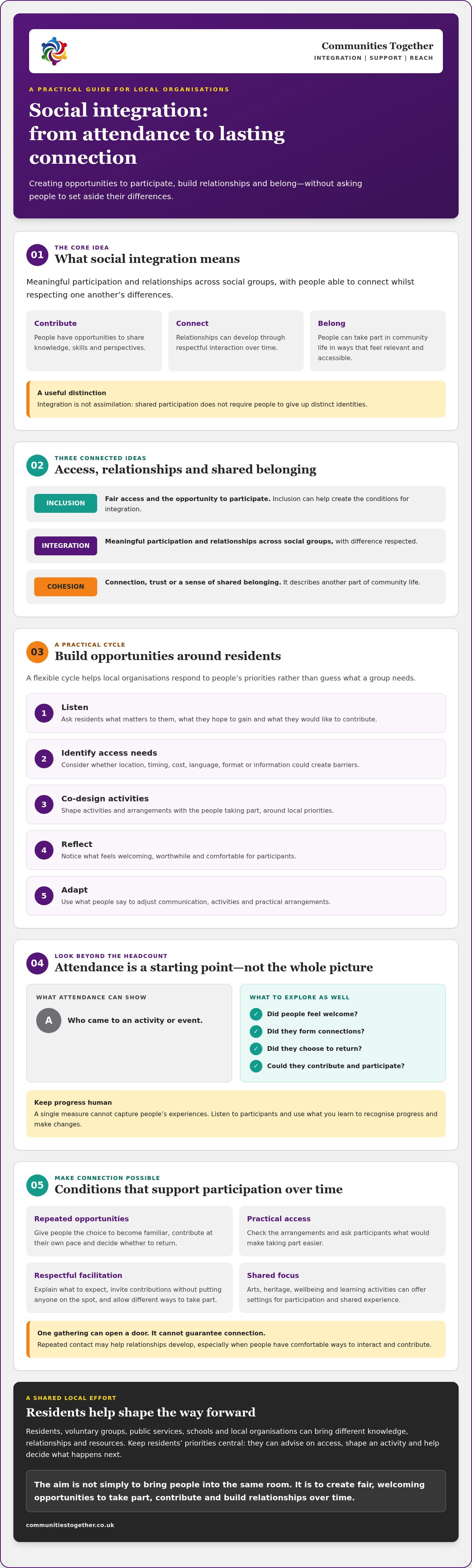
Social integration in a community means meaningful participation and relationships across social groups, with people able to connect whilst respecting one another’s differences. It’s more than sharing a street or attending the same event. It involves opportunities to contribute, exchange perspectives and take part in community life in ways that feel relevant and accessible.
Connection can support belonging, trust and shared understanding, while fair access helps people participate in local activities and decisions. These outcomes aren’t automatic, and a single programme can’t guarantee them. The Social integration overview offers further background on how the concept is understood and studied.
For a concise introduction to the concept, watch this video:
Integration is reciprocal. People may need opportunities and support to participate, while organisations and institutions need to consider whether their communication, activities and decision-making make participation possible. The aim isn’t to ask individuals to bridge every divide on their own. It’s to create conditions in which relationships can develop over time.
How Is Social Integration Different from Inclusion and Cohesion?
These ideas are closely related, but describe different parts of community life. Inclusion means fair access and the opportunity to participate. It can help create the conditions for integration. Cohesion describes connection, trust or a sense of shared belonging. Assimilation, by contrast, expects people to conform to a dominant culture. Integration can support shared participation without requiring people to give up distinct identities.
Who Helps Shape an Integrated Community?
Residents, voluntary groups, public services, schools and local organisations can all contribute, bringing different knowledge, relationships and resources. Residents should help shape priorities and activities, rather than being treated only as attendees or recipients. They might explain what would make a gathering accessible, advise on its format or help decide what happens next. Needs and barriers vary between neighbourhoods, so listening is more useful than making assumptions about who needs support or what will work.
Which Conditions Help Social Integration Develop Over Time?
Trust and connection are more likely to develop when people can take part repeatedly, respectfully and in ways that suit them. One gathering may offer a first point of contact. Ongoing opportunities give participants the choice to become familiar, contribute at their own pace and decide whether they want to return. This is a practical foundation for social integration, not a guaranteed outcome.
Consider access from the outset. Check whether the location, timing, cost, language, format or information about an activity could create barriers. Then ask participants what would make taking part easier. Welcoming facilitation helps too: explain what to expect, invite contributions without putting anyone on the spot, and make room for different ways of participating.
In short, support participation through repeated opportunities, practical access, respectful facilitation and activities shaped with the people taking part.
Why Do Trust and Repeated Contact Matter?
Seeing familiar faces over time can help people decide how they wish to engage. They might join a discussion, share a skill or observe at first. But bringing people from different backgrounds into the same room doesn’t, by itself, create meaningful interaction. Facilitators can help by offering shared tasks, listening to participants’ priorities and checking whether the format feels comfortable and worthwhile.
Pay attention to more than who attends. Ask what participants would like to contribute, what they hope to gain and what might make it difficult to come back. Their answers can guide practical changes to communication, activities and arrangements, rather than leaving organisers to guess what a group needs.
How Can Arts, Heritage and Learning Create Shared Ground?
Creative, heritage and learning activities can give people a common focus for conversation and collaboration, although no single approach will suit everyone. A shared activity might involve learning a skill, exchanging stories or exploring a cultural practice. Participants can contribute their own knowledge and experience, making it a two-way exchange rather than asking anyone to set aside their identity to fit in.
For example, a heritage activity could invite people to share different perspectives on a theme. A learning session could give participants the chance to teach as well as learn. Wellbeing and resilience workshops may also offer a setting for shared reflection, depending on participants’ interests and needs. The useful question is not whether an activity is inherently inclusive, but whether people helped shape it and can take part on fair, respectful terms.
Communities Together’s community engagement and capacity-building work offers a local context for considering how activities can be shaped around community priorities. Find out more about its community engagement work.
What Can Prevent Social Integration, and How Should Progress Be Assessed?
A busy event shows that people attended, but it can’t show on its own whether they felt welcome, connected with others or had a say in what happened. Social integration isn’t proven simply by bringing different groups into the same space. Attendance is useful information, but understanding the quality and continuity of participation calls for listening as well as counting.
Barriers may lie in the design of an activity, rather than in the people it hopes to reach. The format may be difficult to access, information may be unclear or unavailable in a suitable form, or local people may not have helped plan the activity. Confidence, language, representation and trust can also shape someone’s experience, but these vary between individuals and neighbourhoods. Explore the conditions instead of making assumptions about a cultural or social group.
Which Barriers Can Limit Participation?
Ask residents what makes involvement easier or more difficult, and offer different ways to respond. Some people may prefer a conversation, others a written response or feedback shared through someone they trust. Questions might cover practical arrangements, whether participants feel represented and whether they understand how their views will be used. This helps organisations adapt to local experience instead of guessing why participation is low or uneven.
What Are Meaningful Signs of Progress?
Assessment can combine activity outputs with participants’ accounts and observations over time. Alongside attendance, consider who takes part, who helps shape decisions and whether people choose to return or take on a different role. Voluntary feedback, reflective conversations and appropriate follow-up can reveal what participants value, provided feedback is gathered with consent and care.
Choose measures that match local aims. If the intention is to make an activity more welcoming, ask participants how the experience felt and what could be improved. If the aim is to share decision-making, consider whose perspectives informed the choices. These signs can guide reflection, but they shouldn’t be treated as universal targets or guaranteed proof of lasting connection.
Attendance shows that people came; listening and follow-up help explain how they experienced participation. Used together, these forms of evidence give organisations a more considered picture without reducing complex relationships to one score. Share what you learn with participants, invite their views on what should change, and revisit the approach as community priorities develop.
How Can Local Organisations Put Social Integration into Practice?
Putting social integration into practice calls for a clear process, with residents involved from the start and throughout delivery. Organisations can listen, identify access needs, co-design an activity, deliver it, reflect on what happened and adapt. This keeps the work responsive instead of assuming that a format suited to one group or neighbourhood will suit another.
How Should a Community Programme Begin?
Start by learning what residents value and what may make participation harder. Listening sessions can help, alongside other ways to contribute for people who may not wish or be able to attend a meeting. Ask about local priorities, preferred ways to take part and practical access needs before choosing an activity. Then agree a realistic purpose with residents and partners, so everyone understands what the programme is intended to explore or support.
Make participation options clear from the outset. Explain how people can share ideas, whether they can contribute in different ways and how their feedback will inform decisions. If residents raise a concern about access or the proposed format, discuss how the plan could change before delivery. This makes co-design part of decision-making, rather than simply asking for comments after the main choices have been made.
How Can Partners Sustain Participation and Learning?
Partnerships can bring together local knowledge, established relationships and practical skills, but responsibilities need to be clear. Agree who will communicate with participants, coordinate activity, gather feedback and respond to issues. Residents should remain central to setting priorities, while partners contribute what they can without duplicating effort or speaking on the community’s behalf.
Build in time to reflect with participants and partners, then explain what will happen as a result. If feedback suggests that information wasn’t clear or an activity didn’t feel relevant, consider adjustments together and check whether they help. This cycle of communication, reflection and adaptation can keep a programme connected to changing local priorities.
Local context matters. Communities Together works across Huddersfield, Halifax, Leeds, Bradford and Wakefield, where neighbourhood priorities and participation barriers may differ. Its community capacity-building work is relevant to how local organisations and partners can strengthen their approach while keeping residents’ perspectives in view.
How Communities Together Can Support Social Integration Locally
Putting social integration into practice means starting with what people in a community say they need, then working together to shape relevant opportunities for participation. Communities Together supports this through community engagement programmes and partnership and community capacity-building work. These provide a framework for collaboration, not a promise of particular outcomes. Relationships and belonging develop through people’s experiences over time.
What Can Collaborative Community Engagement Look Like?
Local groups and community members can help identify priorities, shape activities and reflect on how they are working. Communities Together’s South Asian arts and heritage activities, wellbeing and resilience workshops, and learning and personal development opportunities can provide settings for people to share knowledge, take part creatively or explore a topic together. Their value depends on how they’re planned and experienced, including whether participants have a genuine role in shaping them.
Heritage activities, for example, can recognise cultural knowledge and invite exchange without asking anyone to minimise their identity. Wellbeing or learning activities may offer another starting point for shared participation. These are possibilities, not universal solutions. Local partners and residents are best placed to consider what feels relevant and accessible in their context.
Communities Together works across Huddersfield, Halifax, Leeds, Bradford and Wakefield. Priorities and barriers can differ between places and communities, so collaboration begins with listening rather than applying one approach everywhere. Local organisations may contribute trusted relationships, knowledge of community priorities or complementary skills, while keeping residents involved in decisions.
What Is a Useful Next Step for a Local Group?
A local group can begin by setting out the change it hopes to explore, who should help shape the work and what support or partnerships may be useful. It can then discuss those priorities with Communities Together, including which activities might offer a suitable starting point and how participants could influence plans. The aim is a grounded conversation about local needs and possible collaboration, not a pre-set programme or guaranteed result.
If your group is considering its next steps, explore the organisation’s community engagement support.
Help Build Stronger Connections in Your Community
Lasting social integration isn’t demonstrated by attendance alone. It develops through meaningful opportunities to participate, relationships built with respect and local organisations willing to listen and adapt. By involving residents in shaping activities and reflecting on their experiences, communities can recognise progress without reducing it to a single measure.
Communities Together supports community engagement and capacity-building across Huddersfield, Halifax, Leeds, Bradford and Wakefield. Its South Asian arts, heritage, wellbeing and learning activities can provide settings for participation and exchange shaped around local priorities, rather than assumed outcomes. Each community brings its own needs, strengths and aspirations. A useful next step is to consider who should help shape the work and what support could be relevant.
Thoughtful conversations can help create space for people to contribute, connect and shape shared community life. Start with local voices, and build from there.
Frequently Asked Questions
What is social integration in a community?
Social integration is meaningful participation and relationship-building across social groups, whilst respecting difference. In practice, people have opportunities to contribute to shared community life, not simply attend the same activities. Residents, local organisations and public services all have a part to play in creating welcoming conditions. The approach should reflect local priorities, since people’s experiences, interests and preferred ways of taking part will vary.
How is social integration different from social inclusion?
Social inclusion focuses on fair access and the opportunity to participate, whilst integration also considers how relationships and connections develop between people and groups. Inclusion can help create the conditions for integration, but access alone doesn’t show whether participants feel involved or have meaningful opportunities to contribute. For example, providing clear information about an activity supports inclusion. Inviting participants to help shape its content can deepen their role in community life.
Can arts and heritage activities support social integration?
Arts and heritage activities can give people a setting to share knowledge, learn together and take part in cultural life. Their value depends on how they’re developed and whether participants find them relevant and accessible. A heritage activity might invite people to share perspectives or skills, creating opportunities for exchange without asking anyone to set aside their identity. Such activities can support participation, but they don’t guarantee lasting relationships.
How can organisations measure social integration?
Organisations can combine practical information, such as attendance and repeat participation, with voluntary feedback about people’s experiences. They might ask who helped shape decisions, whether participants felt welcome and what could make future involvement easier. Choose measures that reflect the programme’s local aims, and gather feedback with consent and care. No single count or score captures the full quality of relationships, so use evidence to support learning and adaptation.
What can prevent people from taking part in community activities?
Barriers can include inaccessible arrangements, unclear communication, language needs, limited confidence or a lack of trust in how an activity is organised. These factors vary between people and places, so don’t assume why someone isn’t participating. Ask residents what would make involvement easier, offer suitable ways to share views and explain how feedback will be used. Their responses can help organisers adjust the format and remove avoidable obstacles.
Does social integration mean that people should assimilate?
No. Assimilation expects people to conform to a dominant culture, whereas integration can support shared participation while valuing distinct identities, languages and cultural knowledge. A community activity shouldn’t require people to minimise who they are in order to belong. Organisers can create space for different perspectives and ways of contributing while agreeing on shared aims. Respectful exchange allows people to take part together without expecting everyone to become the same.
How can local groups support social integration in West Yorkshire?
Local groups can begin by listening to residents, agreeing a shared purpose and involving participants in decisions about activities and access. In Huddersfield, Halifax, Leeds, Bradford and Wakefield, Communities Together delivers community engagement and capacity-building programmes, alongside South Asian arts and heritage, wellbeing, learning and personal development activities. These can provide settings for participation shaped around local priorities. Groups can discuss their aims and potential collaboration with organisations familiar with their community.


Comments