
Self-Esteem Workshops in Bradford: Finding the Right Fit
Updated: Oct 23
What makes a confidence-building workshop useful? Often, it is the chance to develop practical skills while feeling part of a group. If you’re searching for workshops for improving self-esteem Bradford residents can take part in, start by considering what you want to explore and which setting feels comfortable. A clear purpose and a welcoming approach matter more than promises of a quick transformation.
In Bradford, people can explore confidence through community learning, wellbeing and resilience activities, or workplace training. These settings have different aims: a community workshop may focus on shared learning and connection, while workplace training is more likely to address professional situations. This guide explains how to compare approaches, what to look for in a workshop description and how to set a realistic personal goal. Communities Together delivers community-based wellbeing and resilience workshops, alongside learning and personal development opportunities, in Bradford and across Huddersfield, Halifax, Leeds and Wakefield.
Table of Contents
What can self-esteem workshops in Bradford help people develop?
Which Bradford workshop approaches best match different needs?
How can you assess whether a self-esteem workshop is the right fit?
What can Bradford residents expect from community confidence-building?
Explore community-based wellbeing and personal development with Communities Together
What can self-esteem workshops in Bradford help people develop?
Self-esteem is a person’s broader sense of self-worth, including how they regard themselves when something goes wrong or they do not meet a goal. A self-esteem workshop is a facilitated learning activity where participants can reflect, discuss ideas and practise skills as part of personal development. It can offer space for learning, but it cannot promise a fixed change or resolve complex personal challenges in a set time.
How is self-esteem different from confidence?
Confidence usually relates to a particular ability or situation, while self-esteem is a wider view of one’s worth. Someone might feel confident speaking about a familiar subject at work yet doubt their value in other areas of life. Another person may value themselves but feel unsure about trying an unfamiliar task. The ideas are connected, but they are not interchangeable. For a broader introduction to understanding self-esteem, it can help to consider how self-worth differs from belief in a specific ability.
A workshop may touch on both. Participants might reflect on how they see themselves while practising communication or exploring a new skill. For example, contributing an idea in a group discussion gives someone a chance to practise expressing a view. It does not, by itself, establish that their overall self-esteem has changed. Keeping the distinction in mind helps set realistic expectations and makes room for progress at an individual pace.
What can a community-based workshop contribute?
A respectful group setting can give people opportunities to reflect, learn and participate alongside others. Facilitated activities may invite participants to identify strengths, practise communication, develop skills or consider how they respond to everyday situations. Hearing different experiences can broaden perspective, provided people are treated with care and can choose how they take part.
Community participation can also create opportunities to listen, contribute and build relationships with people from different backgrounds. Those interactions may support a sense of belonging and stronger local connections, although people’s experiences will differ. Communities Together’s community engagement and personal development work brings learning, wellbeing and participation together in a community setting in Bradford and nearby areas.
It is useful to be clear about the scope. Community workshops for improving self-esteem Bradford residents may attend are learning and wellbeing activities, not clinical mental health treatment. They can sit alongside other forms of support, but they should not be treated as a substitute for treatment or as a guaranteed route through significant personal difficulties. A purposeful workshop makes room for reflection and shared learning while respecting each participant’s circumstances, choices and pace.
Which Bradford workshop approaches best match different needs?
Workshops may use similar language about confidence while serving different purposes. A resident seeking shared learning and local connection may prefer a community setting. A team may want to practise communication in a workplace context. To compare options, consider who will take part, what they hope to learn and whether the focus is community participation, personal development or work.
Community wellbeing and personal development workshops
Community-based learning may suit residents who want to develop skills alongside others, reflect on their experiences and take part in a shared activity. Wellbeing and resilience can be explored alongside personal development, with attention to how learning and supportive relationships relate to everyday life. This is a community learning context, not clinical care. Communities Together’s work in Bradford brings together wellbeing, resilience, personal development and local participation.
Group learning also allows people to hear perspectives different from their own, exchange ideas and build connections. For some, the shared setting is an important part of the experience. Others may prefer learning organised around a defined practical goal. Neither preference indicates how committed someone is. The useful question is whether the format feels relevant and accessible to the people taking part.
Workplace confidence training and practical life-skills courses
Workplace confidence training is generally designed around professional situations, such as communicating within a team or becoming more comfortable in a role. Practical life-skills learning may focus on employment-related development rather than community wellbeing. When comparing these formats with a community workshop, look at the stated learning aims: are they centred on work, personal development or participation and connection?
These differences can help Bradford residents compare workshops for improving self-esteem Bradford offers across different learning contexts. Ask yourself whether your priority is shared reflection and connection, a specific personal development goal, or confidence linked to work and employment. Communities Together’s community wellbeing and personal development work is community-centred, supporting residents interested in participation, resilience and local connections.
How can you assess whether a self-esteem workshop is the right fit?
A useful workshop description helps you picture the learning experience rather than simply promising a result. Begin by matching its purpose to what you want to develop: personal reflection, shared learning, practical skills or confidence in a work setting. Then consider who it is designed for and whether you would feel comfortable taking part in that group. A good fit is more likely when the subject, setting and approach are relevant to your circumstances.
Quick comparison checklist: Does the description explain the aims, intended participants, facilitation approach, accessibility and ways to participate? Does it set realistic expectations?
Purpose: Are the learning aims clear and relevant to your interests?
Audience: Is the activity intended for individuals, a community group or a workplace team?
Facilitation: Does the description explain how discussion and participation will be supported respectfully?
Accessibility: Can you judge whether the language, format and setting are workable for you?
Participation: Are there different ways to engage, such as listening, reflecting or sharing ideas?
What should a useful workshop description explain?
Look for a plain explanation of what participants may learn, who the workshop is for and how the learning is facilitated. It should distinguish between personal development, community wellbeing and workplace confidence. This is more informative than broad claims about transformation, and gives you a clearer idea of whether the content matches your goal. A good description also avoids guaranteeing that everyone will experience the same change.
Facilitation matters because it affects how people can contribute. Look for an approach that welcomes different experiences without implying that participants must disclose personal information or take part in a particular way. If your goal is individual development, consider whether a group format suits you. If you want to learn with others, check whether shared discussion is part of the activity. Workplace training may be a closer fit when your aims relate specifically to professional situations.
How do inclusion and community context shape the experience?
People are more able to participate when the language, cultural context and setting feel welcoming and accessible. These are practical considerations: they affect whether someone can follow the learning, feel respected and contribute at a comfortable level. Bradford residents have varied experiences and priorities, so one format will not suit everyone.
Communities Together connects participation with inclusion and stronger local relationships through its community engagement work. This may suit people looking for learning rooted in community life rather than a course centred on workplace performance. Consider whether the activity reflects local interests, makes room for different perspectives and supports participation without pressure. You can explore community engagement work to learn more about this locally grounded approach.
Before deciding, write down what you hope to take away and which setting seems most appropriate: individual development, community group learning or workplace training. For workshops for improving self-esteem Bradford residents are considering, clear aims, respectful facilitation and accessible ways to participate are useful comparison points. Keep expectations grounded: a workshop can create opportunities to reflect and learn, while personal development remains individual and cannot be guaranteed.
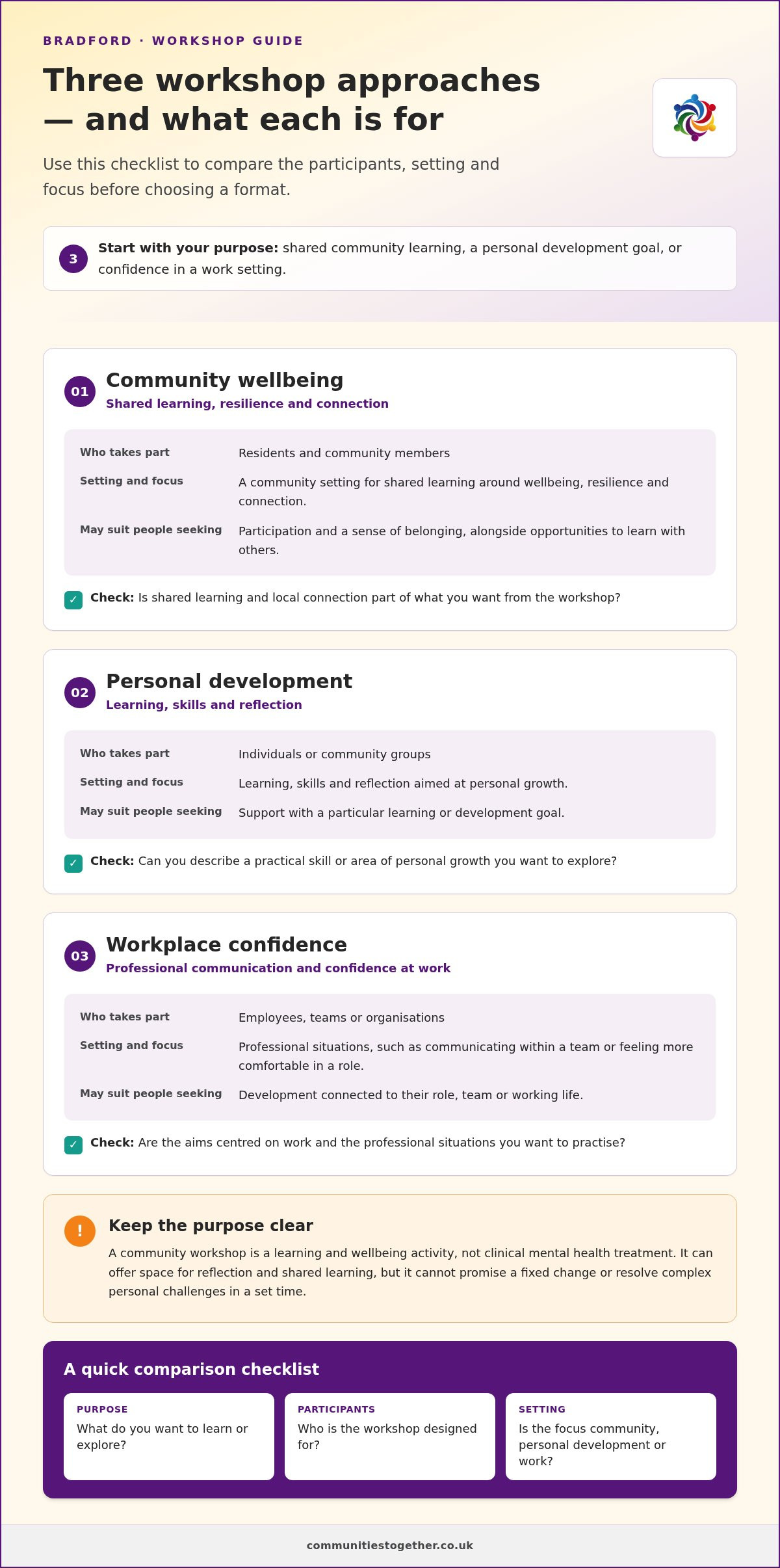
What can Bradford residents expect from community confidence-building?
A community learning experience can offer a practical route from identifying a personal aim to reflecting on what was useful. It need not be dramatic or follow the same pattern for everyone. One participant might want to feel more comfortable sharing ideas; another may want to develop a skill or connect with people locally. A clear, manageable goal helps make the experience relevant without turning it into a test of progress.
A practical route from joining to reflecting
Take part at your own pace and use the learning and discussion in a way that feels appropriate. A simple process might look like this:
Identify a goal. Consider what you hope to learn or feel more able to do. You might want to express an opinion, explore a new skill or take part in a community activity.
Join the learning. Take part in the facilitated activity and, if it feels comfortable, consider the perspectives and experiences shared by others. Listening is also a valuable form of participation.
Reflect and consider next steps. Think about which ideas, skills or insights you might use in daily life. Decide whether further learning or another community activity feels useful.
Reflection does not mean measuring yourself against other participants. You might notice that you contributed an idea, listened to a different point of view or identified a skill you would like to practise. These are examples of learning, not proof that a person’s confidence or self-esteem has changed in a particular way. Progress can be gradual, uneven and personal, so workshops for improving self-esteem Bradford residents attend are best understood as opportunities for development, not guarantees of a particular result.
How wellbeing, resilience and skills development connect
Wellbeing, resilience and practical skills can complement personal development by giving people ways to reflect on what matters to them and engage with everyday challenges. Learning to communicate an idea or take part in a shared activity, for example, can provide practical experience to build on. This is not therapy and does not promise a clinical effect; it is a learning context for personal development and connection. For individuals seeking personalised support alongside community sessions, Welloseek Pro - Brought to you by Welloseek (welloseek.com) connects people with holistic wellness professionals for virtual or in-person guidance.
Communities Together’s wellbeing and resilience work sits alongside learning and personal development opportunities, with community participation and inclusion at its centre. Explore the organisation’s wellbeing and resilience work to see how these areas connect. After taking part, ask yourself: what did I learn, what felt relevant and what would I like to explore further? This keeps the focus on personal meaning rather than a fixed outcome.
For Bradford residents, community confidence-building can be one part of a wider process of learning and connection. Its value may lie in developing a skill, clarifying a personal goal or feeling more able to participate. Each is worth recognising, while leaving room for learning to continue beyond a single activity.
Explore community-based wellbeing and personal development with Communities Together
Confidence can develop through opportunities to participate, learn and build relationships, as well as through individual reflection. Communities Together delivers community engagement programmes and wellbeing, resilience and personal development workshops in Bradford and across Huddersfield, Halifax, Leeds and Wakefield. These offer a non-clinical setting for people to explore learning and connection. They are not clinical treatment, and no workshop can guarantee a particular change in self-esteem. Their focus is on providing purposeful, inclusive opportunities to take part and develop at an individual pace.
A community-centred approach to wellbeing and development
Community engagement can connect learning with shared experiences and local priorities. In a respectful setting, taking part may provide opportunities to practise skills, consider different perspectives and strengthen relationships with others. Wellbeing, resilience and personal development are areas for learning, not promised outcomes. Participants can identify what they want to explore while recognising that everyone’s needs and progress differ.
For a broader view of collaborative activity, explore Communities Together’s wellbeing and resilience approach. Practical learning may offer a starting point for further development, whether you are interested in communication skills, participating more confidently or building on an existing interest. There is no prescribed route: participants can take from the experience what feels useful to them.
Take a next step in Bradford
Individuals, families and community stakeholders may have different aims, backgrounds and expectations. Some may want to strengthen local relationships; others may be looking for a welcoming setting for learning and personal growth. A community-centred approach makes space for different starting points, with participation and inclusion at its heart rather than an assumption that one programme or outcome suits everyone.
If you’re exploring workshops for improving self-esteem Bradford residents can take part in, Communities Together’s community programmes provide opportunities to engage with wellbeing, resilience and personal development. Think about what you hope to learn, whether shared participation feels right for you and what kind of local connection you would like to build. A single activity need not transform everything; opportunities to learn and contribute can be meaningful in their own right.
Explore Communities Together’s community programmes to find a starting point that reflects your interests and goals.
Take a considered next step towards growth
Choosing workshops for improving self-esteem Bradford residents can take part in is a chance to consider what you would like to explore next, not a demand to change everything at once. You might begin with a personal aim, an interest in learning alongside others or a wish to feel more connected to your community. Let that intention guide your next step and give yourself room to learn at a pace that feels right.
Communities Together offers a community setting for people interested in wellbeing, resilience and personal development. Whether you are considering your own participation or exploring opportunities with others, learn more about the organisation’s community programmes.
A meaningful step can begin with curiosity and a willingness to take part. Explore Communities Together’s community programmes to find a local opportunity for learning and connection.
Frequently Asked Questions
Is there a difference between self-esteem and self-confidence workshops?
Yes, although a workshop may address both. Self-esteem workshops tend to focus on how participants value themselves overall, while self-confidence sessions may centre on particular situations, such as speaking up in a meeting or trying an unfamiliar activity. Before choosing, consider what you want to practise or explore. A workshop focused on presentation skills, for example, may suit a specific confidence goal better than broader personal reflection.
Can community workshops help improve self-esteem?
They can offer opportunities for reflection, learning and participation, but each person’s experience differs and improvement is not guaranteed. A resident who finds it difficult to contribute in a group might listen at first and share an idea when ready. That experience can provide something practical to reflect on, without requiring people to compare progress or disclose personal experiences.
Are self-esteem workshops in Bradford suitable for community groups?
They can suit a group with a shared interest in learning, connection or personal development. A residents’ group might identify a common aim, such as creating more opportunities for members to contribute to local activities, while recognising that individuals may have different reasons for joining. Agreeing what the group hopes to gain helps participants decide whether a community learning format meets their needs.
What should I look for in a confidence-building workshop?
Look for clear learning aims, a description of the intended participants and practical information about how to take part. Does the workshop explain whether discussion is involved and whether people can contribute at their own comfort level? Consider whether the subject relates to your goal, such as expressing ideas, learning a skill or participating in a group. Be cautious of descriptions that promise the same result for everyone.
How do community wellbeing workshops differ from workplace confidence training?
Community wellbeing workshops generally focus on shared learning, participation and connection, while workplace confidence training is more likely to address professional situations. A community group might explore ways to take part in local activities; a workplace team may practise communicating ideas at work. The more relevant option depends on whether your priority is community involvement, personal learning or confidence linked to employment.
Are wellbeing and resilience workshops a form of mental health treatment?
No. Communities Together’s wellbeing and resilience workshops are non-clinical learning and development activities, not mental health treatment. They can provide space to consider wellbeing, build skills and take part in community learning, but they do not diagnose or treat mental health conditions or promise clinical outcomes. Choose a workshop whose stated purpose matches the kind of learning and support you are seeking.
Can personal development workshops support people from different backgrounds?
Personal development learning can welcome people with varied experiences when participation is inclusive and different perspectives are respected. Communities Together delivers community engagement and learning opportunities in Bradford, Huddersfield, Halifax, Leeds and Wakefield. Whether joining as an individual or through a local group, consider whether the activity’s aims and setting feel relevant to your interests and comfortable for you to take part in.
Comments