
Networking for Halifax Community Organisers: Local Guide
The busiest networking calendar isn’t necessarily the one that strengthens your community work. In Halifax, useful connections form when shared interests lead to practical support, not simply a longer contact list. If you’ve searched for “networking for community organisers Halifax”, you’re likely looking for relevant people and groups, and a clear way to approach them.
It’s understandable to be cautious about giving limited time to events that may not lead to collaboration. A focused introduction, a genuine offer to share knowledge and a thoughtful follow-up can help turn an initial conversation into a reciprocal relationship that supports local activity.
This guide will help you identify potential networks and collaborators, explain your project clearly and agree useful next steps without making networking another demand on your time. It also looks at how inclusive, sustained connections can support community work. Communities Together works across Halifax, Huddersfield, Leeds, Bradford and Wakefield, with community engagement, partnership and capacity-building work, as well as heritage, wellbeing and skills activities.
Table of Contents
Why networking matters for community organisers in Halifax
For community organisers, networking means building purposeful relationships: finding people and groups with shared interests, understanding what each can contribute and developing connections that may support future work. It isn’t simply attending events, collecting contacts or promoting a project. The value lies in what happens over time, as trust and clear expectations make it easier to share knowledge, explore collaboration and strengthen community capacity.
That distinction matters when time is limited. Halifax here means the town in Calderdale, West Yorkshire. A useful connection relates to your community’s priorities and is accessible to the people involved. The aim of networking for community organisers Halifax is not to be present everywhere, but to invest in conversations that could help address a defined need.
What does networking mean for a community organiser?
Productive networking is reciprocal. You bring knowledge of your community and its priorities, while staying open to other people’s experience and perspectives. Trust grows when everyone understands why they’re connecting, what they can offer and what they can’t promise. A first conversation may simply establish common ground; it doesn’t need to become a partnership immediately.
For example, an organiser planning activities for local residents might speak with another group to compare approaches to inclusive participation. They could exchange ideas and agree to share a resource without presenting the conversation as a confirmed partnership or expecting an immediate outcome. This kind of relationship-building reflects the wider principles described in community organising, where people come together around shared concerns.
Which local needs can a network help address?
Connections may help organisers learn from one another, identify appropriate places to signpost residents, understand community priorities and find people with complementary skills. For instance, a group with strong local relationships may know how residents prefer to hear about an activity, while another may bring relevant facilitation experience. Sharing those perspectives can help both groups plan their next steps more carefully.
These are possibilities, not guaranteed referrals, funding or measurable results. Start with a specific question, check that an opportunity is relevant and accessible, and consider whether the people most affected can take part meaningfully. This keeps networking grounded in community priorities rather than activity for its own sake.
Where Halifax community organisers can look for relevant connections
Begin with the need your project is trying to address, then map the kinds of people and organisations that may have relevant knowledge or relationships. In Halifax, possible starting points include voluntary and community groups, public services, cultural organisations and resident-led initiatives. Current Calderdale Council information and community-sector directories can help you identify possible contacts, but check each listing with its publisher before relying on it.
Keep local relationships central, while considering whether connections across West Yorkshire could offer complementary experience, shared learning or links to people working on similar themes. Communities Together works in Halifax, Huddersfield, Leeds, Bradford and Wakefield. A broader contact can widen your perspective, but it shouldn’t replace listening to residents and organisations rooted in the community your work aims to support.
A network is relevant when its people, purpose and ways of participating connect with your project’s priorities and the residents it aims to involve.
Which types of local networks might be useful?
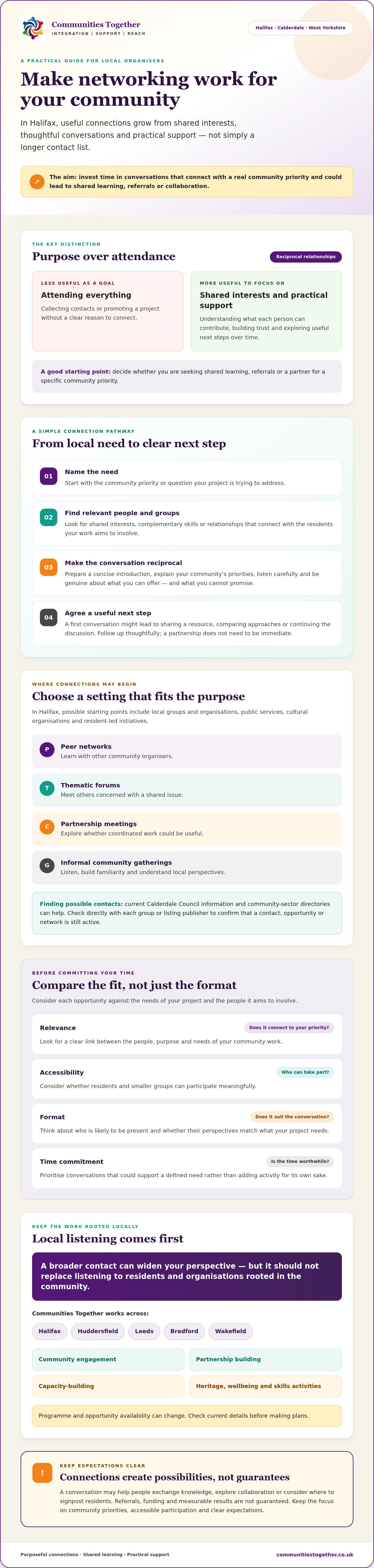
Different settings serve different purposes. Peer networks support learning between organisers; thematic forums bring together people concerned with a shared issue; partnership meetings give organisations a place to explore coordinated work; and informal community gatherings can create opportunities to listen and build familiarity. Consider who is likely to take part, including residents, organisers and service representatives, and whether their perspectives match what your project needs.
Community Foundation for Calderdale may be a useful lead to investigate, but check directly whether it currently lists relevant opportunities or networks before relying on it for introductions. For practical approaches to planning and developing community initiatives, the University of Kansas Community Tool Box offers step-by-step guidance that can help you clarify what you want a connection to contribute.
How can organisers check whether an opportunity is current?
Before attending or sharing an opportunity, look for the named organiser, purpose, intended audience, date and accessibility information. Confirm whether participation is open, by invitation or intended for particular organisations. If details are missing or unclear, contact the host rather than making assumptions. Note any unanswered questions, such as who can attend, what participants are expected to contribute and whether the format works for the people you hope to involve.
This check can make networking for community organisers Halifax more focused and inclusive. Communities Together works across Halifax and other West Yorkshire locations in community engagement, partnership and capacity building. If you’re considering whether that work relates to your priorities, you can explore community engagement work and enquire about relevance and availability.
How to compare networking options in Halifax before committing
A promising opportunity should fit your group’s priorities and be practical for the people you hope to involve. Before committing time, compare options against the same criteria rather than relying on a familiar name, a large attendance estimate or an impressive description. For networking for community organisers Halifax, a useful measure is whether people can learn from one another and identify a realistic next step.
What makes a network a good fit for your group?
Look for a clear connection between the network’s focus, your group’s current work and the people you serve. Check whether the format supports their participation, including whether people can contribute comfortably and access the information they need. A good fit should let your group offer something as well as receive support, such as local knowledge, lived experience or a skill another participant needs.
Consider the quality of the exchange, not the prestige of the host or the number of attendees. A smaller discussion that makes space for different voices may be more useful than a larger gathering where your priorities are difficult to raise.
How can you weigh formal forums against informal connections?
Formal forums may provide a defined agenda, regular structure and clearer roles, which can help when you need to discuss a shared issue or coordinate next steps. They may also require preparation and a consistent time commitment. Informal connections can make peer exchange easier and more flexible, although participants may need to agree the purpose and follow-up themselves.
Neither format is automatically better. If your immediate need is to explore an idea, an informal conversation may be enough. If you need to develop shared understanding over time, a structured forum may suit you better. Check any eligibility conditions and costs directly with the organiser rather than assuming they apply to every opportunity.
How to prepare, connect and follow up after a Halifax networking opportunity
A little preparation can help you use a conversation well without making it feel scripted. Decide what you want to learn or explore, introduce your work clearly, listen for shared priorities and agree a next step only if it feels useful to everyone involved. This keeps networking for community organisers Halifax grounded in mutual understanding, rather than a quick exchange of contact details.
What should you prepare before meeting other organisers?
Prepare a short introduction covering your role, the community your group works with and a current priority. For example: “I help organise activities with local residents, and we’re exploring how to make participation more accessible. I’d be interested to hear what has worked for your group.” Keep it specific enough to start a conversation, without sharing personal details about residents who haven’t agreed to that.
Before attending, think of one open question and one realistic area for possible collaboration or shared learning. You might ask how another group gathers residents’ views, then explain that you’d be interested in comparing approaches. Check the event arrangements, access needs and any participation requirements in advance, so you can focus on the conversation when you arrive.
How do you turn an introduction into a working relationship?
Listen as carefully as you introduce your own work. Ask what matters to the other person, clarify what each of you can offer and don’t assume a promising discussion commits either group to a partnership. If you’d like to stay in touch, ask permission before exchanging contact details and agree how those details may be used. Share information about residents only when you have a proper basis and their consent where needed.
Afterwards, send a timely, personalised message that refers to your discussion and confirms any action you both agreed. Where appropriate and welcome, offer something useful, such as a relevant resource or an introduction. Keep the tone respectful, and don’t press for a response or commitment if the other person needs time.
Useful follow-up names the agreed action, who will take responsibility for it and, where appropriate, when you’ll check in.
If the connection develops, review progress together and make space to adjust or pause if priorities change. Trust often grows through reliable small steps, not pressure to produce an immediate outcome. Clear expectations help both parties understand what happens next and decide whether further collaboration is right for them.
How Communities Together can support community connection in Halifax
For organisers exploring networking for community organisers Halifax, Communities Together is a potential point of contact for discussing community engagement and partnership work. The organisation works across Halifax, Huddersfield, Leeds, Bradford and Wakefield, delivering community engagement programmes and building partnerships and community capacity. This work can provide a starting point for discussing local priorities, shared learning and ways to support participation.
What kinds of community work does Communities Together deliver?
Its areas of work include South Asian arts and heritage activities, heritage and cultural preservation, wellbeing and resilience workshops, and learning, skills and personal development. These activities can create different ways for people to take part, share knowledge and explore what matters in their communities. Collaborative approaches can make room for varied perspectives, though the relevance of an activity depends on the people involved and the purpose of the work.
These programme areas don’t confirm that every activity is currently available in Halifax. If you’re considering a specific form of support, check directly with Communities Together about local availability and how its work might fit your group’s needs. You can also explore community capacity building in the UK as a starting point for learning about the organisation’s work.
What is a useful next step for a Halifax organiser?
Before making contact, prepare a short outline of your community, current priorities and the kind of support or connection you’re seeking. You might want to discuss inclusive engagement, explore shared learning or find out whether a programme area relates to a local activity. A clear description helps both sides assess whether there may be a useful fit, without assuming a partnership or outcome in advance.
Contact the organisation to confirm whether its services are relevant and whether a programme is currently available in Halifax. A conversation can clarify what is offered, who it may suit and whether there is a sensible next step. You don’t need a fully formed proposal; an honest account of your aims and questions is a helpful place to begin.
Build connections that support lasting community work
Effective networking for community organisers Halifax starts with a clear purpose: identify relationships that connect with local priorities, make space for residents’ voices and support reciprocal learning. Before committing time, assess each option for relevance, accessibility and the value people can contribute. Then prepare a concise introduction and agree a realistic next step.
Strong connections grow through thoughtful follow-up, clear expectations and respect for the people involved. Communities Together works across Halifax, Huddersfield, Leeds, Bradford and Wakefield, with community engagement, partnership and capacity-building work. Contact the organisation to discuss your needs and check whether its current work is relevant to your plans.
Every useful relationship can begin with one considered conversation. Keep listening, stay open to shared learning and take the next step at a pace that works for your community.
Frequently Asked Questions
Where can community organisers network in Halifax?
For networking for community organisers Halifax, first decide what kind of connection your group needs, then check current information from local public, voluntary and community organisations. Calderdale Council and community-sector organisations may be useful places to investigate, but verify whether a forum or event is active, relevant and open to your group. Check its purpose, date and access arrangements before making plans.
How can I find community groups in Halifax to collaborate with?
Look for groups whose work connects with a shared interest, such as reaching residents, cultural activity or skills development. Ask existing contacts for suggestions and check current local directories or organisation websites. Before proposing collaboration, learn about the group’s priorities and capacity. Then suggest a specific, reciprocal next step rather than assuming the group has resources available.
What should I say when introducing myself to another community organiser?
Briefly explain your role, the community or group you work with and one current priority. You could add why you wanted to speak with them, then ask an open question about their work. For example, say you’re exploring ways to involve more residents and ask how their group approaches participation. Keep your first request modest and give the other organiser room to share their interests and needs.
How do I know whether a networking event is worth attending?
Check whether the event’s purpose and intended participants connect with your current priorities, and whether its format, location and access arrangements work for you and your group. Weigh preparation and travel time against the potential to learn or contribute. If the audience or arrangements aren’t clear, ask the organiser before deciding. Afterwards, consider whether you made a useful connection or identified a practical next step.
How often should community organisers follow up after networking?
Follow up when there’s a clear reason, such as an introduction, resource or next conversation you agreed to share. Send a personalised message that recalls the discussion and confirms the proposed action, without creating pressure. If you don’t receive a reply, allow time before getting in touch again. The right pace depends on the relationship, the agreed action and each organisation’s capacity, so avoid treating follow-up as a fixed schedule.
Can small community groups benefit from networking if they have limited capacity?
Yes. Small groups can benefit by choosing relevant opportunities and setting realistic expectations. A focused conversation, useful introduction or shared learning may be more practical than attending numerous events. Decide what your group hopes to learn and what it can offer, and be clear about capacity before agreeing to work together. Communities Together works across Halifax, Huddersfield, Leeds, Bradford and Wakefield, with services including community engagement and capacity building.


Comments