
Measuring Social Impact in Halifax: A Practical Guide
What if the most useful evidence of a programme’s impact isn’t the easiest figure to count? For community organisations, measuring social impact Halifax programmes create starts with understanding what matters to the people involved, then gathering evidence that shows progress without placing unnecessary demands on participants.
It’s understandable to feel pulled between demonstrating value to funders and partners, choosing outcomes that genuinely reflect the work, and representing community experience fairly. A practical approach begins before activities start: agree what change the programme hopes to support, decide how you’ll recognise it, and make space for participants’ perspectives alongside straightforward numerical information.
This guide will help community organisations in Halifax set clear outcomes, choose accessible quantitative and qualitative evidence, and use findings to strengthen future work. Whether you’re planning community engagement, South Asian arts and heritage activities, or wellbeing and resilience workshops, the aim isn’t to collect data for its own sake. It’s to listen, learn and communicate what the evidence can responsibly tell you.
Table of Contents
What measuring social impact in Halifax means for community programmes
Build a Halifax social impact framework from needs to outcomes
Compare social impact measurement methods for Halifax projects
Collect and interpret impact evidence ethically and proportionately in Halifax
Use Halifax social impact findings to improve community programmes
What measuring social impact in Halifax means for community programmes
Measuring social impact means gathering and interpreting evidence about changes associated with a programme. It helps a group understand whether its work responds to needs people have identified, what participants say they gained, and where delivery may need to adapt. For organisations in Halifax, useful measurement starts by listening to the people a programme is intended to support, rather than treating assumptions about local residents as established fact.
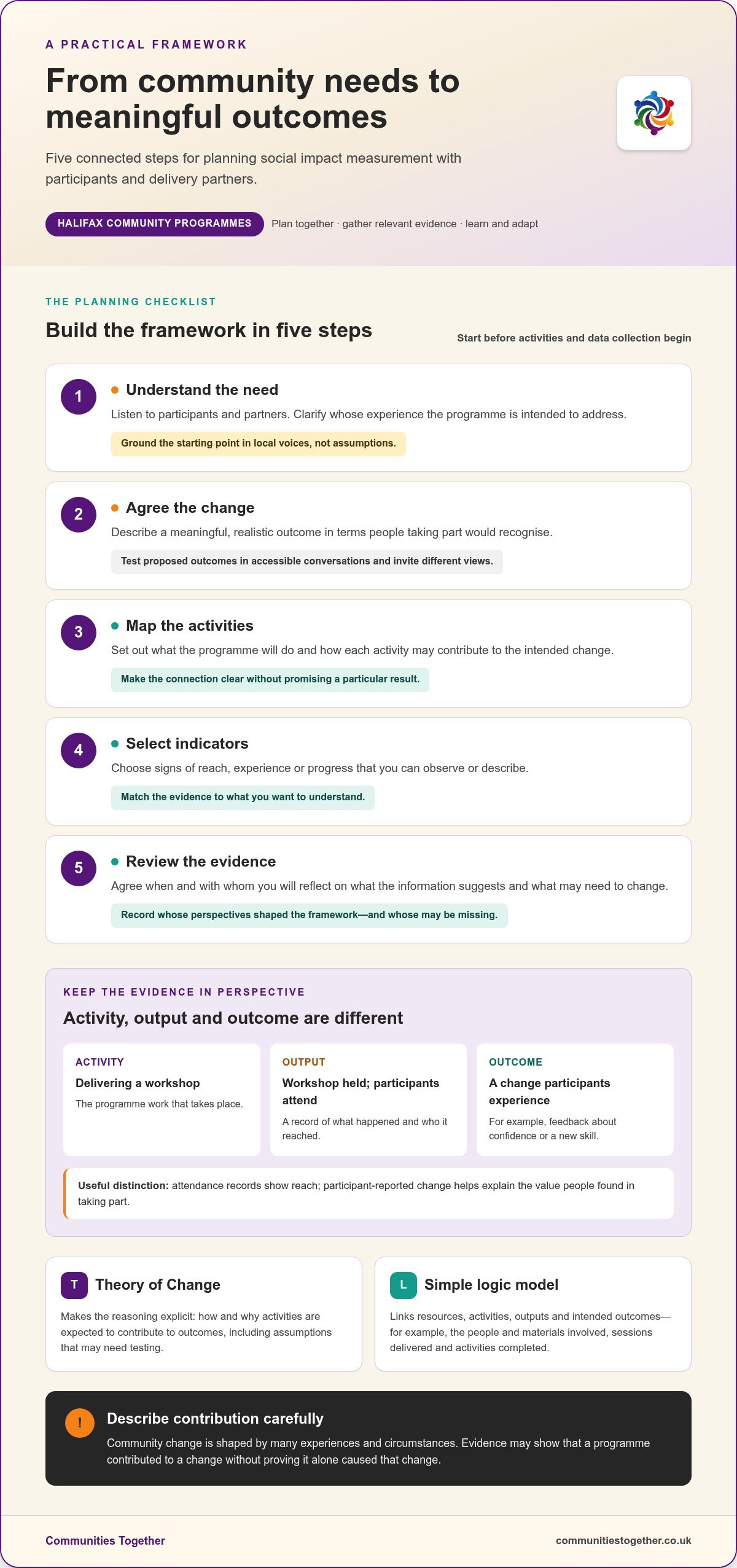
Measurement also supports learning and accountability. A group can explain what it set out to do, what evidence it collected and how it responded. Community change is shaped by many experiences and circumstances, however, so evidence may show that a programme contributed to a change without proving that the programme alone caused it. Being clear about this makes reporting more credible, not less valuable.
In practice, measuring social impact in Halifax means asking focused questions and interpreting answers with care. A framework for Social Impact Assessment (SIA) offers useful background on assessing social effects. For a community programme, the emphasis is on applying that thinking to intended outcomes, participant experience and learning.
How are activities, outputs and outcomes different?
Imagine a group runs a workshop. The activity is delivering the session; the output is what happened, such as the workshop taking place and participants attending. An outcome is a change participants experience, which might be reflected in their feedback about confidence or a new skill. These are different kinds of evidence: attendance records show reach, whilst participant-reported change helps explain the value people found in taking part.
Longer-term impact may relate to broader changes over time, but it should generally be described as a contribution unless stronger evidence supports direct attribution. This distinction helps groups avoid presenting delivery figures as proof of change.
What makes a Halifax measurement question useful?
Begin with a specific need and an intended change, identified with participants. For example, a heritage activity might explore whether participants feel they have meaningful opportunities to share knowledge, rather than assuming everyone values the same form of participation. Community engagement helps shape programme aims around what people say matters; the community engagement programme guide explores this connection.
Then consider who may find participation difficult and how experiences might differ within the community. Access, timing, communication and the format of an activity can all affect who takes part and whose views are heard. Treat these as questions to explore with local participants, not generalisations about Halifax. A useful question is specific enough to guide evidence collection, yet open to answers that challenge the programme’s initial expectations.
When outcomes are grounded in local voices, measurement can support practical decisions: what to retain, what to change and what the evidence cannot yet tell you. That balanced understanding gives community programmes a stronger foundation for learning and responsible reporting.
Build a Halifax social impact framework from needs to outcomes
A framework connects a community need to the changes a programme hopes to support, then sets out how the work will be delivered and what evidence can help assess progress. Measuring social impact is more useful when participants and delivery partners agree on this framework before activities and data collection begin. It gives everyone a shared reference point, while leaving room to adapt as local understanding develops.
Use this sequence to build a practical starting framework:
Understand the need. Listen to participants and partners, and clarify whose experience the programme is intended to address.
Agree the change. Describe a meaningful, realistic outcome in terms people taking part would recognise.
Map the activities. Set out what the programme will do and how each activity may contribute to the intended change.
Select indicators. Decide what signs of reach, experience or progress you can observe or describe.
Review the evidence. Agree when and with whom you’ll reflect on what the information suggests and what may need to change.
A Theory of Change makes the reasoning behind this sequence explicit. It explains how and why activities are expected to contribute to outcomes, including assumptions that may need testing. A simple logic model can complement it by linking resources, activities, outputs and intended outcomes. For example, a heritage programme might map the people and materials involved, the sessions delivered, the activities completed and the intended change participants have identified. These are planning connections, not promises that one activity will cause a particular result.
Agree outcomes with participants and delivery partners
Broad aims such as inclusion need to be translated into changes participants can recognise, rather than left as abstract ambitions. Use accessible conversations to test whether proposed outcomes reflect community priorities and invite different views. Record whose perspectives shaped the framework and note whose voices may be missing, so the group can consider how to include them as the programme develops.
Choose indicators that show progress without overclaiming
Pair each outcome with an indicator that can be observed or described, and keep the question it answers clear. A reach indicator shows who took part; an experience indicator captures how people describe the programme; a change indicator relates to the outcome being explored. Each provides a different insight, so avoid treating attendance or positive feedback alone as proof of lasting change.
Shared measurement also depends on clear partnership roles. Agree who will invite feedback, keep a record and bring evidence into review discussions. This is one way community capacity-building work can support collective learning and responsibility. Keep the framework concise enough to use, and revisit it when participant perspectives or delivery experience suggest the original assumptions need adjusting.
Compare social impact measurement methods for Halifax projects
Choose evidence methods according to the outcome you want to understand, the people involved and the time they can reasonably give. Attendance records help establish who took part, whilst a short survey can gather comparable responses about experience or reported change. Interviews and reflective stories offer more space to explore meaning, but take time to collect and interpret carefully.
These approaches answer different questions, so one source may not be enough. For measuring social impact in Halifax, groups can combine a straightforward record of participation with a small amount of participant feedback, adding methods only when they help clarify an outcome. The aim is useful evidence, not the greatest possible volume of data.
Indicator data can show whether a pattern is present; participant evidence can help explain how that change was experienced and what it meant.
When should a programme use surveys, interviews or group discussion?
Use a short survey when you need concise, consistently asked questions about participants’ experience or reported change. Interviews or group discussions are more useful when you need to understand the reasons behind a response, different interpretations or contrasting perspectives. Before deciding, consider language, accessibility, trust and participants’ time. A method is only useful if people can take part comfortably and understand what they’re being asked.
How can stories complement quantitative evidence?
A participant account can help explain how or why a change may have occurred, adding context to numerical patterns without proving that every participant had the same experience. Seek permission before sharing someone’s words, represent them accurately and take care with sensitive details. If a story illustrates a wider finding, make clear that it is one person’s perspective, not a substitute for broader evidence.
Combine methods in proportion to the question. If attendance records and a concise survey answer what the programme needs to know, extra interviews may add unnecessary burden. If responses raise questions that numbers cannot explain, a conversation or reflective account may offer a useful next layer of understanding.
Collect and interpret impact evidence ethically and proportionately in Halifax
Good evidence gathering respects participants’ time, choices and circumstances. Where feasible, build feedback into existing programme contact, such as a brief conversation at a session, rather than adding a separate form or reporting task. Explain why you’re gathering information, what you plan to do with it and who will be able to see it. Ask for consent in clear, accessible language, and make it easy for people to understand how they can choose whether to contribute.
Plan data handling just as carefully. Collect only details that help answer your agreed questions, avoid identifying people in reports unless there’s a clear reason and permission, and decide who can access information and how it will be stored. These practical steps help participants make informed choices and support responsible use of their experiences.
Inclusive evidence improves interpretation because it helps show whose experiences a finding reflects, what it may leave out and how local context shapes its meaning.
How can evidence collection include different community voices?
Offer suitable ways to contribute, such as spoken feedback or written responses, and consider whether the language, format or timing makes participation accessible. Before drawing conclusions about a wider community, review who contributed and who did not. One participant can share a valuable perspective, but shouldn’t be treated as representative of an entire cultural or neighbourhood group.
When measuring social impact, Halifax groups should examine gaps in participation as evidence to consider, not simply as a reason to discount feedback. If people who could not attend or respond may have different experiences, note that limitation and consider how future engagement could reach them more appropriately. This keeps conclusions grounded in the voices actually heard.
How should organisations interpret and report findings?
Compare findings with the starting point and intended outcomes where you have comparable evidence. Look beyond headline totals: notice variation in responses, accounts that differ from the overall pattern and results that were not expected. A positive change may have several possible explanations, whilst a mixed result can point to practical barriers or assumptions worth revisiting.
In reporting, distinguish what the evidence shows from what you infer. Describe limitations, alternative explanations and unexpected findings alongside positive results, without overstating what a programme can claim. Share learning in a format participants, delivery partners and funders can understand and use, and invite those involved to reflect on whether the interpretation feels fair. This turns evidence into a basis for thoughtful decisions, rather than a one-sided account of success.
For community engagement, arts and heritage, or wellbeing activity, a proportionate approach means gathering enough information to learn while treating people’s contributions with care. Ethical practice is not separate from measurement: it shapes the quality of the evidence and the trust on which meaningful participation depends.
Communities Together delivers collaborative community engagement programmes, South Asian arts and heritage activities, and wellbeing and resilience workshops. Explore collaborative community engagement programmes.
Use Halifax social impact findings to improve community programmes
Evidence becomes valuable when it informs a decision. Set a review point with participants and delivery partners to consider what the findings suggest, what remains uncertain and what the programme should do next. Keep the discussion focused on the outcomes agreed at the outset, while welcoming evidence that challenges the original assumptions. A review is not simply a report-writing task; it’s a chance to learn together and make the work more responsive.
Turn conclusions into specific actions. If participants describe an activity as useful but say the arrangements made it difficult to take part, the team might review access or delivery. If an intended outcome isn’t reflected in the evidence, consider whether the activity needs adjustment, the indicator is poorly matched or the original assumption needs revisiting. Retain approaches supported by the evidence and community feedback, and record why changes are made so learning can carry across programme cycles and partner organisations.
Close the feedback loop by telling participants and partners what you learned and what action will follow. This shows that their contributions have informed decisions, even where the findings are mixed or the next step is to gather a clearer picture. Keep the explanation accessible and avoid implying that evidence proves more than it can.
How can measurement support continuous programme improvement?
Use each review to decide whether to refine activities, access arrangements or outcome indicators for the next delivery cycle. Record the decision, the evidence behind it and any questions that remain, so learning isn’t lost when responsibilities are shared. In wellbeing and resilience activity, reflective programme learning can help teams consider how delivery responds to participants’ experiences without treating feedback as proof of a particular outcome.
What are practical next steps for Halifax organisations?
Begin with one programme, a small set of outcomes and evidence the team can sustain. Before collecting information, invite participants and delivery partners to review the questions, methods and intended use of findings. Then agree who will gather evidence, who will reflect on it and how learning will be shared. This keeps the process manageable and gives people a meaningful role in shaping it.
Communities Together delivers community engagement, South Asian arts and heritage, wellbeing and resilience, skills development and partnership capacity-building programmes across Halifax, Huddersfield, Leeds, Bradford and Wakefield. A shared approach to measurement can connect programme aims with participant experience and ongoing learning, without assuming in advance what changes a community values. For wellbeing activity, the wellbeing and resilience workshops guide offers a related context for thinking about collaborative programme practice.
Used thoughtfully, measuring social impact in Halifax can strengthen both accountability and adaptation: evidence informs decisions, and those decisions are shared with the people whose experiences helped shape the work.



Comments