
Cultural Participation Programmes: A Strategic Guide to Building Social Cohesion in 2026
Merely opening the doors to a venue doesn't bridge community divides; genuine belonging begins when people actively shape their own culture together. Across towns and cities like Leeds, Bradford, and Huddersfield, structured cultural participation programmes offer far more than passive entertainment. They create welcoming spaces where neighbours connect, tackle urban isolation, and keep regional traditions vibrant.
You've likely seen how easily different generations can drift apart without dedicated spaces to honour their roots, particularly as younger people risk losing touch with rich South Asian heritage amidst the fast pace of modern life. When communities lack inclusive hubs to gather, loneliness and disconnection can quickly weaken our local neighbourhoods.
In this guide, you'll discover how structured cultural participation programmes foster community resilience, preserve South Asian heritage, and strengthen the social fabric across Halifax, Wakefield, and the wider region. We'll share practical skills, capacity-building strategies, and collaborative frameworks that empower our West Yorkshire communities to thrive together in 2026.
Table of Contents
Defining Cultural Participation Programmes and Their Importance
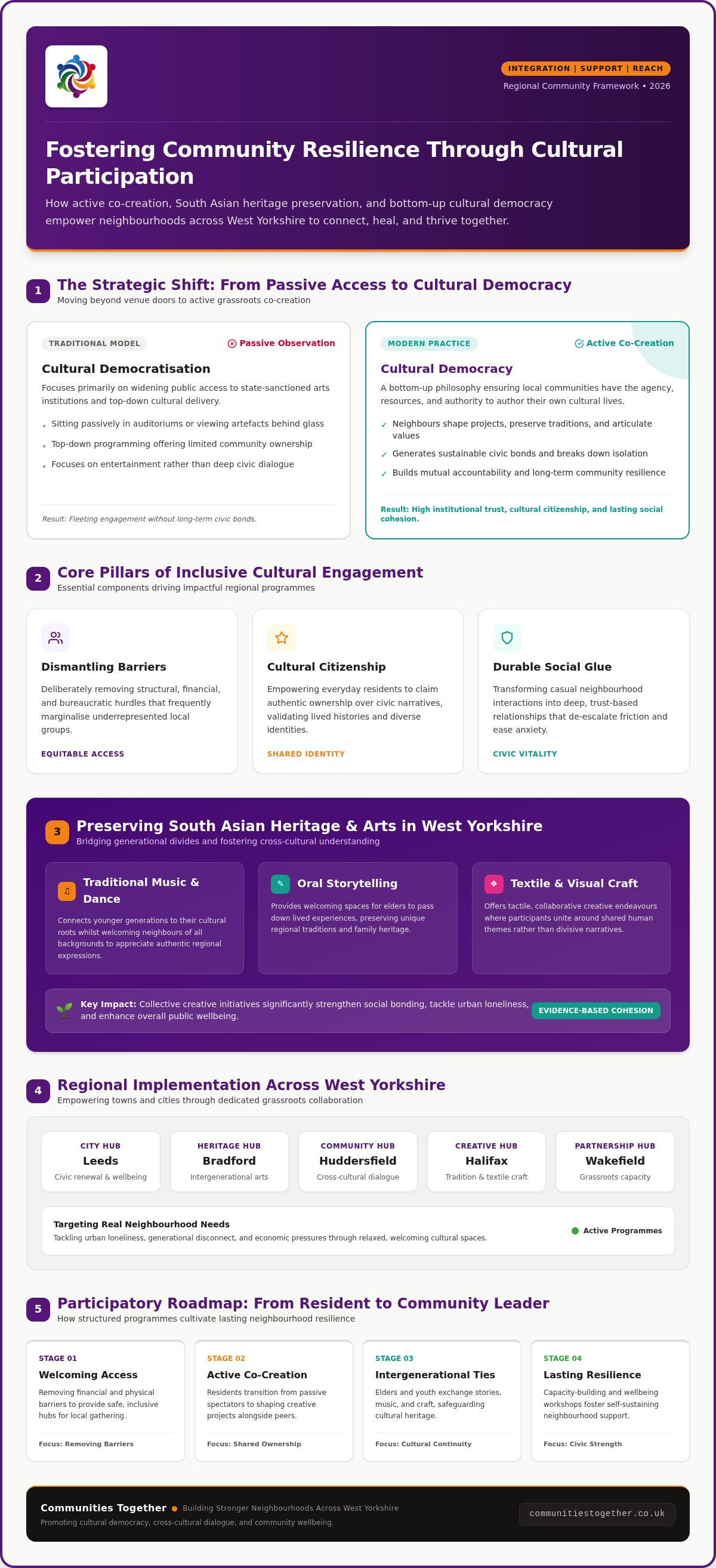
At its core, genuine cultural participation is far more than simply sitting in an auditorium or quietly observing artefacts behind museum glass; it represents an active, co-creative journey where residents shape artistic expressions, preserve local traditions, and articulate shared values alongside their neighbours. Watching a performance can certainly entertain, but shaping a community project teaches collaboration, breaks down social isolation, and builds mutual accountability amongst peers. Historically, public policy focused on cultural democratisation, which essentially meant widening public access to state-sanctioned arts institutions. In contrast, modern practice embraces cultural democracy, a bottom-up philosophy ensuring that communities have the agency, resources, and authority to author their own cultural lives. Established models of public participation demonstrate that when individuals transition from passive spectators to active contributors, they generate sustainable civic bonds that strengthen social cohesion across the UK far more effectively than top-down cultural delivery ever could.
The Core Elements of Inclusive Engagement
Meaningful engagement can't flourish without deliberate efforts to dismantle the structural, financial, and bureaucratic hurdles that frequently marginalise underrepresented groups. Well-designed cultural participation programmes recognise that every neighbourhood possesses distinct assets, traditions, and lived histories that deserve direct recognition. Across West Yorkshire, programmes must authentically mirror the region's diverse demographic landscape, particularly the vibrant intergenerational heritage found within South Asian communities in towns like Huddersfield and Halifax. By embedding the principles of cultural citizenship, facilitators empower everyday residents to claim genuine ownership over their civic narratives. This participatory framework builds institutional trust, validates personal identity, and ensures that community development remains an equitable, collaborative endeavour.
Why Cultural Participation Matters in 2026
As we progress through 2026, communities across Britain are actively addressing deep-seated challenges linked to urban loneliness, generational disconnect, and lingering economic pressures. In response, local authorities across Leeds, Bradford, and Wakefield are strategically prioritising grassroots culture as an essential instrument for civic renewal and public wellbeing. Structured cultural initiatives provide the welcoming social infrastructure required to mitigate persistent isolation, creating relaxed environments where cross-cultural dialogue occurs organically amongst diverse peer groups. By uniting residents around shared creative expression and heritage preservation, structured cultural participation programmes build durable community resilience, equipping local neighbourhoods to support one another through ongoing societal shifts.
The Strategic Role of Arts and Heritage in Social Cohesion
Shared heritage projects serve as an enduring social glue within multicultural neighbourhoods, transforming everyday interactions into deep, trust-based relationships. When residents collaborate on creative endeavours, they naturally dismantle misunderstandings and replace apprehension with mutual respect. Engaging with South Asian arts, such as traditional music, storytelling, and textile design, creates welcoming bridges that enable people of all backgrounds to appreciate diverse cultural expressions. Collaborative arts actively de-escalate neighbourhood friction by uniting participants around shared human themes rather than divisive narratives. An integrative review of evidence on arts participation demonstrates that collective creative initiatives significantly strengthen social bonding, reduce feelings of anxiety, and enhance overall civic vitality. By embedding these shared experiences within local cultural participation programmes, communities cultivate an environment where cross-cultural dialogue flourishes naturally. This collaborative dynamic underpins the wider mission of cultural heritage preservation in the UK, ensuring that diverse traditions are actively celebrated rather than forgotten.
Preserving South Asian Traditions in West Yorkshire
For second and third-generation residents across Bradford, Leeds, and Huddersfield, participatory heritage initiatives offer a vital anchor to their family lineage. Integrating South Asian arts heritage education into local schools and community centres ensures younger generations take genuine pride in their shared roots. Through capturing oral histories, sharing regional music, and practising traditional crafts, these workshops celebrate community elders whilst instilling practical creative skills in young people. This dual focus nurtures intergenerational respect, preserves invaluable cultural memory, and strengthens local identity across West Yorkshire.
Building Community Resilience Through Creative Expression
Creative expression directly supports individual mental wellbeing by providing safe, supportive environments where participants process shared challenges and build meaningful friendships. Structured cultural participation programmes and wellbeing workshops build lasting community capacity, equipping neighbours with practical problem-solving, communication, and project-planning skills. When individuals collaborate to produce communal art, they develop a collective endurance that helps them navigate wider social and economic pressures together. If your organisation wants to introduce these transformative opportunities locally, connecting with Communities Together provides a dedicated, community-centred partner for sustainable social impact.
Navigating Different Models: Access vs. Active Cultural Democracy
Evaluating cultural initiatives requires a framework that clearly distinguishes between surface attendance and deep, collaborative involvement. Traditional delivery often relies on passive consumption, where residents visit a gallery or watch a performance without contributing their own perspectives. In contrast, genuine cultural democracy places local people at the heart of the creative process through active heritage workshops, participatory planning, and co-curated exhibitions. Co-creation ensures that initiatives reflect authentic community priorities rather than external institutional assumptions. This collaborative approach yields significantly stronger outcomes for community capacity building UK, nurturing local leadership so that residents possess the confidence, governance skills, and resources to steer civic life long after an initial project concludes.
Passive Attendance (Access Model): Observing curated displays, buying performance tickets, or attending static heritage talks as a spectator.
Supported Involvement: Volunteering as invigilators, joining guided feedback sessions, or participating in introductory craft workshops.
Active Co-Creation (Democracy Model): Co-curating local exhibitions, directing oral history archives, and determining project funding allocations.
The Spectrum of Participation
Moving communities from passive recipients to active producers requires handing over creative authority to local residents. When individuals help curate exhibitions in centres like Huddersfield or Wakefield, their personal lived experiences directly shape public narratives. Residents might archive family heirlooms, record neighbourhood memories, or design interactive displays alongside professional facilitators. This shift transforms community members into recognised stewards of regional history, ensuring cultural spaces belong to everyone.
Overcoming Barriers to Participation
Dismantling systemic obstacles is essential for ensuring diverse neighbourhoods can engage freely. Cost, inflexible scheduling, intimidating civic venues, and a lack of visible representation often deter people from attending regional events. To welcome individuals from diverse South Asian backgrounds across Halifax and neighbouring boroughs, cultural participation programmes must work through trusted grassroots spaces like neighbourhood centres, places of worship, and community cafes. Methodical bridge-builders and local advocates play an indispensable role here, fostering comfortable environments where unrepresented groups feel valued, safe, and ready to contribute.
How to Engage with Local Cultural Initiatives in West Yorkshire
Connecting with local culture begins right on your doorstep. For residents living in Halifax, Bradford, and Leeds, joining grassroots initiatives offers a direct way to form lasting friendships whilst learning fresh skills. Participating in these spaces is central to building social cohesion through arts, turning routine weekly gatherings into supportive communal networks. Whether you want to explore traditional music, master folk crafts, or record regional family histories, structured cultural participation programmes provide the guidance and welcoming spaces needed to flourish.
Taking that initial step is straightforward when you know what to look for:
Identify your creative interests: Decide whether you want to focus on traditional South Asian heritage, contemporary storytelling, or practical creative crafts.
Check local neighbourhood networks: Review municipal arts notices, neighbourhood library listings, and community centre schedules for upcoming sessions.
Connect with grassroots facilitators: Reach out directly to community organisers to ask about accessibility, workshop formats, and transport links.
Finding the Right Programme for You
Finding an activity that resonates with your goals shouldn't feel overwhelming. Begin by checking community boards and regional arts listings, keeping an eye out for South Asian Heritage Month activities and intergenerational workshops. Prioritise cultural participation programmes that emphasise learning, personal development, and transparent inclusivity. When a group clearly welcomes diverse backgrounds, listens to lived experience, and provides practical skill-building, you know you've found an uplifting environment.
Organising Your Own Community Project
Launching a grassroots initiative often starts with a single conversation among neighbours about preserving a local tradition or bringing people together. Establish a small working group, identify a clear social purpose, and reach out to established regional non-profits for capacity-building advice. Partnering with established organisations helps you secure community venues in Huddersfield or Wakefield, navigate project planning, and manage local funding successfully through shared social responsibility.
Partnering with Communities Together for Sustainable Social Impact
Communities Together operates as a dedicated non-profit social enterprise rooted in Huddersfield, serving as a trusted facilitator for genuine community connection across West Yorkshire. We design and deliver structured cultural participation programmes that bring neighbours together through shared creativity, local storytelling, and vibrant heritage celebration. With specialist expertise in South Asian arts and heritage preservation, our team supports local communities in honouring their traditions whilst cultivating mutual understanding amongst residents of all backgrounds. Alongside our heritage initiatives, we offer dedicated wellbeing and resilience workshops that provide a supportive, friendly space where participants can decompress, learn practical coping mechanisms, and form lasting friendships with their peers.
Our Approach to Capacity Building
Sustainable community growth relies on giving people the confidence and agency to lead their own cultural journeys. Our work centres on continuous learning, practical skills, and personal development, providing attendees with transferable capabilities in event delivery, communication, and creative facilitation. By identifying local strengths and listening carefully to community elders and young people alike, our tailored engagement initiatives actively reduce social isolation amongst diverse groups in Wakefield, Leeds, and surrounding districts. We view our organisation as a dependable bridge-builder and methodical advocate. We don't simply deliver one-off sessions; we establish the robust social infrastructure necessary for communities to sustain their own creative projects over the long term.
Join Our Mission in West Yorkshire
Strengthening the social fabric of our region requires shared purpose, open dialogue, and collaborative partnerships. Whether you represent a grassroots group in Bradford, an educational organisation in Halifax, or a municipal team in Huddersfield, we welcome opportunities to co-create initiatives that make a lasting difference. Partnering with a principled, expert facilitator ensures your community projects are culturally authentic, methodically planned, and thoroughly grounded in local priorities. We invite civic leaders, volunteers, and stakeholders across West Yorkshire to connect with us, explore collaborative opportunities, and discover how structured cultural participation programmes can foster deep social harmony, celebrate heritage, and build enduring community resilience across our towns and cities.
Strengthening Our Shared Future Across West Yorkshire
Fostering deep, enduring social cohesion requires moving beyond passive cultural attendance towards genuine, collaborative co-creation. When neighbours gather to preserve living traditions, record regional histories, and acquire practical skills together, they establish the vital foundation for collective resilience. Working alongside specialist facilitators in South Asian heritage and arts allows local groups to overcome barriers, mitigate urban isolation, and nurture mutual understanding across Huddersfield, Halifax, Bradford, Leeds, and Wakefield.
Investing in structured cultural participation programmes ensures that diverse voices are respected, empowered, and woven into our regional social fabric. By cultivating welcoming spaces where heritage is celebrated and capacity is methodically built, we create neighbourhoods where everyone feels a lasting sense of belonging. The journey toward a more connected, resilient West Yorkshire begins with a shared commitment to active engagement.
Frequently Asked Questions
What exactly are cultural participation programmes and who are they for?
Cultural participation programmes are structured, community-led initiatives designed to actively involve residents in creative expression, heritage preservation, and collaborative decision-making. Unlike traditional arts events where attendees merely observe, these sessions welcome people of all ages, backgrounds, and abilities to co-create projects together. Whether you are an elder wishing to share personal histories or a younger person learning traditional crafts, these programmes offer an inclusive, friendly environment for everyone across West Yorkshire.
How do these programmes help to reduce social isolation in urban areas like Leeds?
They tackle urban loneliness by providing consistent, welcoming communal spaces where residents can gather regularly around purposeful activities. In bustling urban centres like Leeds, establishing genuine connections across different demographic groups can prove challenging. By focusing on shared storytelling, creative projects, and mutual problem-solving, structured cultural programmes transform unfamiliar neighbours into trusted allies, rebuilding local social networks and offering vulnerable individuals a dependable sense of community belonging.
Can cultural participation projects really improve my personal wellbeing?
Yes, creative participation noticeably enhances personal wellbeing by reducing anxiety, fostering self-worth, and creating supportive social circles. Whilst Communities Together does not provide clinical mental health treatment, our non-clinical wellbeing and resilience workshops offer proven communal benefits. Working collaboratively on creative projects provides a calming space to decompress, discuss life challenges openly with peers, and cultivate practical emotional resilience that supports everyday mental wellness.
What is the difference between cultural democratisation and cultural democracy?
Cultural democratisation focuses on top-down delivery, expanding public access so diverse communities can consume state-funded cultural institutions and established fine arts. Cultural democracy, conversely, treats everyday community expression as equally valuable, shifting resources and creative control directly to local residents. Rather than merely inviting individuals to visit established museums, cultural democracy supports communities in producing, archiving, and governing their own cultural heritage on their own terms.
How can I find South Asian heritage workshops in the Huddersfield or Bradford area?
Residents in Huddersfield, Bradford, or Halifax can discover active heritage sessions through local library notices, regional arts councils, and community centres. Connecting directly with specialist non-profit organisations like Communities Together is another effective route, as we regularly deliver South Asian arts and heritage activities across the region. You can also explore local council community listings or visit our website to view upcoming initiatives.
Are there any costs involved in joining a community engagement programme?
Many cultural participation programmes are funded through regional public grants, charitable trusts, or local council partnerships, making them free or highly subsidised for local participants. Specific fee structures or materials contributions depend on individual workshop organisers and regional project funding. We always suggest checking the specific details on the organiser's official website or contacting the project facilitators directly prior to registration.
How do heritage projects help second-generation South Asians connect with their roots?
Heritage projects offer younger and second-generation British South Asians tactile, immersive links to their cultural ancestry through music, oral storytelling, and traditional artisanal skills. Participating in intergenerational archives allows residents to record family journeys, bridge communication gaps with community elders, and celebrate cultural pride within their local neighbourhoods. These shared creative explorations reaffirm personal identity whilst fostering mutual respect across multiple generations in West Yorkshire.
What skills can I expect to learn through these community-led initiatives?
Participants gain a broad variety of practical, transferable skills that extend far beyond artistic techniques. Depending on the initiative, you can develop expertise in oral history documentation, project planning, collaborative leadership, and cross-cultural communication. In addition, our focused learning, skills, and personal development sessions strengthen creative problem-solving and community organising capabilities, equipping you to facilitate positive social change in your local area.


Comments