
Community Group Development Training: Emerging Trends and Strategies for 2026
What if the most effective way to address the growing crisis of social isolation in West Yorkshire is not through digital innovation, but through a radical reimagining of how we preserve and utilise our shared cultural heritage? Many dedicated organisers currently feel the strain of traditional structures that fail to engage younger generations, overlook the profound value of diverse cultural identities, and struggle to maintain the collective endurance required for lasting social impact. It's clear that the methods of the past often lack the nuanced sensitivity needed to foster true togetherness in our increasingly complex urban environments.
This article explores how modern community group development training is evolving to integrate cultural heritage, emotional resilience, and strategic partnerships as the foundational pillars of progress. We'll examine the emerging trends of 2026 to provide a comprehensive understanding of how you can use heritage as a practical skill set, build structural strength within your group, and facilitate the sustainable local partnerships necessary for long-term stability. By adopting these methodical strategies, you'll be better equipped to weave together the threads of tradition and progress to create a more inclusive, harmonious, and resilient future for all residents.
Table of Contents
Understanding the Evolution of Community Group Development Training in 2026
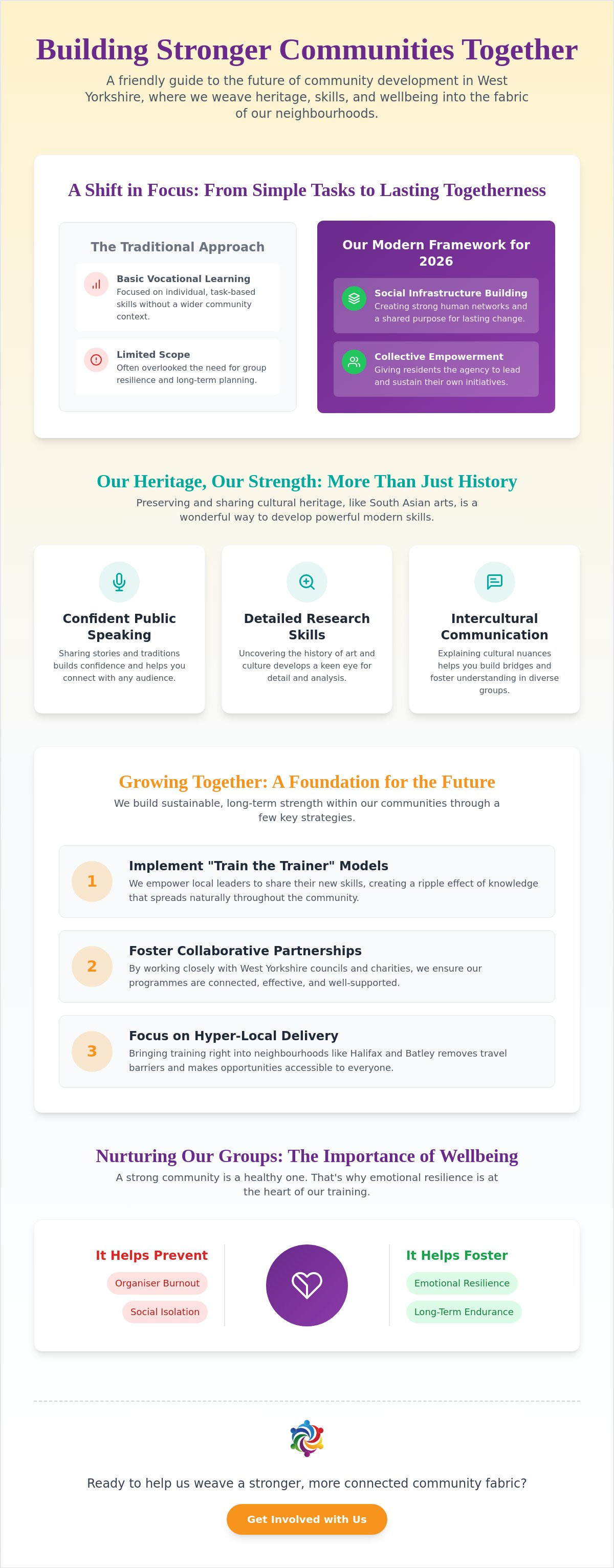
It's clear that modern community group development training represents a shift towards a holistic methodology that prioritises collective empowerment, structural strength, and long-term sustainability over simple task-based learning. This evolution signals a transition from traditional vocational models to a more sophisticated framework of social infrastructure building, ensuring that local residents possess the agency to facilitate meaningful change within their own neighbourhoods. By viewing Community development as a continuous process of growth, organisations can better identify local skills gaps and foster an environment where inclusive engagement becomes the standard for all civic participation.
To better understand the foundational principles of this evolution, watch this introductory overview:
The Shift Towards Social Infrastructure
In towns such as Dewsbury and Huddersfield, skills training acts as the essential glue that binds diverse populations together, creating a sense of shared identity and mutual responsibility. The 2026 landscape emphasises the rise of soft skills, including collaborative organising, conflict resolution, and strategic facilitation, which are necessary to navigate the complexities of modern social dynamics. Professional training from institutes like Intact Academy can further support this by providing local leaders with advanced skills in team coaching and organisational change. The emphasis on conflict resolution is particularly relevant as groups seek to bridge generational divides and integrate new arrivals into existing social fabrics. Training that focuses on these competencies doesn't just improve individual capabilities; it strengthens the entire community's ability to self-govern and resolve internal disputes. Social infrastructure consists of the human networks and relational ties that sustain community life through shared purpose and collective action. By investing in these human assets, we build the capacity for groups to endure challenges, maintain stability, and achieve social harmony across the region.
Why Local Context Matters in Leeds and Bradford
The industrial heritage of the North continues to influence modern learning needs, as the legacy of textile manufacturing and engineering shapes the collective identity of diverse groups in Leeds and Bradford. Understanding this historical context is vital for designing programmes that resonate with local experiences whilst addressing contemporary economic pressures. When we acknowledge the specific social fabric of West Yorkshire, we move away from a one-size-fits-all approach that often ignores the nuances of cultural continuity. Effective training must account for the linguistic diversity and varied educational backgrounds found amongst our residents, ensuring that the curriculum is as inclusive as it is rigorous. Hyper-local delivery is equally critical, as providing training within the immediate vicinity of participants in Halifax or Batley reduces travel barriers and ensures that opportunities remain accessible to those with limited mobility. Local partnerships with councils and charities strengthen the delivery of these community programmes, allowing for a more integrated approach to skills development that is both grounded in tradition and oriented towards future progress.
Heritage and Arts: The "Hidden" Skills Powering Social Cohesion
Cultural preservation is frequently mischaracterised as a purely retrospective or passive activity, yet it represents a sophisticated and rigorous skill set that is essential for modern civic leadership. Within the specific context of community group development training, the act of identifying, researching, and documenting heritage requires a high degree of analytical precision and effective communication. These activities don't merely look backwards; they equip participants with the ability to synthesise complex historical narratives, manage archival data, and present findings to diverse audiences with professional clarity. By formalising these cultural practices, we transform them into a vital mechanism for building the structural strength and collective endurance of local organisations.
When individuals engage in South Asian arts and heritage projects, they often experience a profound shift in their professional confidence and public speaking abilities. This process facilitates a "Return on Belonging," which occurs when individuals witness their cultural heritage being formally recognised and valued in a professional setting. This recognition enhances self-worth, increases social mobility, and encourages a long-term commitment to community service amongst those who may have previously felt marginalised by traditional institutional structures. It's a methodical approach to empowerment that treats cultural identity as a professional asset rather than a barrier to integration.
This heritage-based approach also yields significant intergenerational benefits, as it creates a structured environment where older residents can share technical knowledge and oral histories with younger generations. This exchange strengthens the social fabric of local families whilst building a shared repository of communal wisdom that is both resilient and adaptive. By fostering these connections, we ensure that the unique social fabric of West Yorkshire remains vibrant and that the skills of the past are preserved to inform the progress of the future.
South Asian Arts as a Tool for Engagement
Traditional crafts and performance arts require immense discipline, technical precision, and collaborative effort, all of which are directly transferable to modern professional environments. In Huddersfield, these artistic endeavours serve to bridge the gaps between different ethnic backgrounds, facilitating meaningful dialogue through shared creative expression and mutual respect. Our community engagement programmes utilise these cultural starting points to build trust, encourage deeper participation, and establish a reliable foundation for wider social initiatives. By using the arts as a catalyst for togetherness, we can more effectively address the challenges of social isolation and generational disconnect.
Preserving Traditions whilst Building Modern Capacities
Digital storytelling allows younger generations in West Yorkshire to modernise heritage preservation, using contemporary tools to document the lived experiences of their elders in a way that is accessible and engaging. This synergy between tradition and technology strengthens cultural identity, which is intrinsically linked to improved mental wellbeing and resilience. As highlighted by the Center for Community Resilience, fostering such robust social connections is vital for building the collective endurance needed to face systemic challenges and social fragmentation. Cultural literacy is a vital modern skill for a globalised workforce, providing the necessary foundation for navigating diverse environments, building inclusive networks, and fostering mutual respect. Incorporating these elements into community group development training ensures that local leaders are equipped with the empathy and expertise required to facilitate lasting harmony.
For those seeking to implement these strategies, exploring our South Asian Arts and Heritage Activities provides a practical framework for integrating culture into your development plans.
Building Community Capacity through Collaborative Partnerships
Building community capacity requires more than just individual skill acquisition; it necessitates the creation of robust, multi-agency networks that link local councils, charitable organisations, and community businesses into a unified front. Through comprehensive community group development training, we can establish a "train the trainer" model that ensures knowledge is not merely transferred but deeply embedded within the local organisational fabric. This approach fosters a self-sustaining skills ecosystem that continues to thrive long after initial grant funding has been exhausted, providing a stable foundation for future growth. By facilitating these connections, we move beyond the limitations of short-term projects to achieve a state of collective endurance and structural strength. To see how these concepts of stability and structural strength are managed in professional residential settings, you can discover Shepherd HomeOwners' Association.
Asset-Based Community Development (ABCD) serves as a vital framework in urban settings, shifting the focus from perceived deficits to the inherent strengths, talents, and resources already present within the neighbourhood. By recognising these assets, we facilitate a more organic form of empowerment that respects the existing social fabric whilst introducing new methodologies for strategic expansion. This shift in perspective is essential for building trust and ensuring that development initiatives are led by the community, for the community, rather than being imposed from the outside.
Empowering Local Leaders in Halifax and Wakefield
In areas like Halifax and Wakefield, identifying "community champions" is essential for facilitating local learning opportunities that feel authentic and grounded in lived experience. Providing formal recognition or accreditation for what is often seen as informal community work validates the expertise of these leaders, granting them the institutional weight needed to influence broader policy. Peer-to-peer mentoring further enhances this process by reducing the clinical, detached atmosphere often associated with traditional classroom training, replacing it with a rhythmic exchange of knowledge based on mutual respect and shared goals. These human networks are the primary drivers of social cohesion, ensuring that progress is both inclusive and representative of the local population's diverse needs.
Strategic Infrastructure for Non-Profit Groups
Community engagement charities play a pivotal role in managing complex multi-agency partnerships, acting as the authoritative bridge-builders between grassroots groups and larger governing bodies. Building resilience into the local organisational fabric allows these groups to withstand economic shifts and policy changes, ensuring that social delivery remains consistent and reliable. Practical steps for small groups include engaging in collaborative bids, where resources are pooled to access larger funding streams that would otherwise be out of reach for individual entities. This collaborative approach to community group development training and resource management ensures that even the smallest organisations can contribute to the region's overall social prosperity. By working together, we create a more stable and accountable sector that is better equipped to facilitate long-term social benefits for all residents of West Yorkshire.
To explore how these collaborative models can be applied to your specific context, our Partnership and community Capacity Building services offer a methodical framework for strengthening your group's impact.
Addressing Wellbeing and Resilience as Core Competencies
True community progress is fundamentally impossible if the individuals involved are struggling with the debilitating effects of burnout, chronic stress, or social isolation. In the evolving landscape of 2026, community group development training is increasingly prioritising the integration of wellbeing workshops into standard skills curricula, recognising that emotional endurance is the bedrock of any successful social initiative. This shift reflects a growing understanding that resilience training isn't merely about individual self-care; it's a strategic necessity for navigating the rapid social and economic changes that often disrupt the stability of local neighbourhoods. By treating personal stability as a professional skill, we ensure that community leaders possess the internal resources required to facilitate long-term harmony, maintain organisational momentum, and achieve structural strength.
In urban centres such as Leeds and Bradford, the implementation of non-clinical interventions provides a vital alternative to traditional health services, offering residents a way to manage stress through collective action and creative expression. These programmes focus on building the capacity for self-regulation, mutual support, and psychological flexibility, which are essential for maintaining the focus of community projects during periods of uncertainty. By addressing these needs within a developmental framework, we can prevent the escalation of social crises whilst fostering a culture of accountability, stability, and care.
Reducing Social Isolation through Structured Learning
The structured learning environment acts as a vital social outlet for those feeling isolated, providing a consistent space where residents can build meaningful connections through shared educational pursuits. When individuals work towards common objectives, the resulting shared goals serve to reduce community tensions, build mutual trust, and encourage a sense of collective purpose. Communal learning environments facilitate the creation of "weak ties" that significantly strengthen local social safety nets by providing diverse points of contact and support outside of immediate family circles. These broader networks are essential for information sharing, resource access, and the overall resilience of the neighbourhood.
Personal Development for Long-Term Resilience
Focusing on emotional intelligence and stress reduction equips participants with "workplace-ready" community skills that are highly valued in both the public and private sectors. These activities serve as a preventative measure, addressing the root causes of social fragmentation before they manifest as long-term health or economic crises. There is a direct and measurable link between an individual's personal confidence and their willingness to engage in wider civic life, as those who feel emotionally secure are more likely to take on leadership roles and advocate for collective interests. By facilitating personal growth, maintaining emotional stability, and encouraging civic participation, we build the necessary foundation for a more active, engaged, and resilient citizenry.
To begin integrating these principles into your own organisation, our Wellbeing and Resilience Workshops provide a methodical approach to building collective endurance.
Practical Steps to Organise Inclusive Skills Initiatives
Organising an effective programme requires a methodical and structured approach that prioritises local agency, cultural continuity, and long-term sustainability. The first essential step involves conducting a thorough community audit to understand existing assets, identify specific local needs, and map out the human networks that already sustain the neighbourhood. This process ensures that community group development training is built upon a reliable foundation of local knowledge rather than external assumptions. Once these assets are identified, organisers must design curricula that are both culturally sensitive and accessible in terms of language and physical location, ensuring that the learning experience respects the diverse identities of the participants. This alignment between delivery and context is what allows for the successful integration of tradition and progress.
Recruiting local facilitators is a critical component of this strategy, as it ensures the programme feels authentic and is perceived as being "by the community, for the community." These facilitators act as authoritative bridge-builders who possess the lived experience necessary to translate complex concepts into practical, relatable actions that resonate with their peers. To maintain long-term relevance, organisations must implement robust feedback loops that allow for the continuous refinement of the training based on the evolving requirements of the participants. Finally, celebrating success through community showcases serves to build long-term momentum, providing a platform to demonstrate the measurable impact of the skills acquired and to inspire collective pride in the group's progress. These celebrations are not merely social events; they are a vital mechanism for reinforcing the collective endurance of the group.
Ensuring Inclusivity for Diverse Yorkshire Groups
Removing structural barriers is fundamental to ensuring that diverse Yorkshire groups can participate fully in these developmental initiatives. This involves providing practical support such as childcare, covering transport costs, and offering flexible workshop timing to accommodate those with varied work and family commitments. Creating "safe spaces" is equally vital, particularly for marginalised groups who may require an environment where they can learn, experiment, and grow without fear of external judgement or social pressure. Using South Asian heritage as a "hook" for engagement allows organisers to draw upon familiar cultural threads to introduce broader personal development, facilitating a transition from traditional preservation to modern skill acquisition. By acknowledging the profound value of cultural identity, we create a more inclusive pathway for residents to engage in civic life and build structural strength.
How Communities Together Supports Your Journey
Communities Together is dedicated to facilitating this journey by providing comprehensive partnership and community capacity building services across West Yorkshire. Our expertise in heritage and cultural preservation allows us to collaborate with groups in Leeds and Bradford to design programmes that are both grounded in tradition and oriented towards future social prosperity. We understand that every neighbourhood has a unique social fabric, and we possess the professional literacy required to weave together these threads into a resilient and harmonious whole. We invite you to partner with us as we work to facilitate stability, harmony, and social responsibility through methodical skills development.
Facilitating Lasting Social Prosperity through Collective Action
The landscape of 2026 demands a shift from isolated activities to a comprehensive framework where cultural identity and emotional resilience are recognised as vital professional competencies for all local leaders. By facilitating strategic partnerships across Huddersfield, Leeds, and Bradford, we can ensure that local organisations possess the structural strength required to maintain stability whilst addressing the complex challenges of social isolation. Implementing a methodical approach to community group development training allows us to weave together the threads of South Asian arts and inclusive wellbeing workshops, creating a robust social safety net that values tradition and progress in equal measure. As specialists in heritage preservation and community capacity building, we remain committed to acting as an authoritative bridge-builder for those seeking to facilitate lasting social benefits within their neighbourhoods. We invite you to join our mission to strengthen West Yorkshire through community skills development. Together, we'll build a foundation for collective growth that ensures every resident feels empowered to contribute to the region's enduring social prosperity.
Frequently Asked Questions
What exactly is community group development training?
This training represents a holistic framework designed to empower local collectives through the acquisition of strategic, operational, and interpersonal competencies. It facilitates the building of robust social infrastructure, ensuring that groups possess the necessary agency to maintain structural strength, achieve long-term stability, and foster social harmony within their immediate neighbourhoods.
How does community skills development help with social isolation in Leeds?
Community skills development addresses social isolation by creating structured learning environments where residents can engage in shared educational pursuits, collaborative organising, and mutual support. In Leeds, these programmes facilitate the creation of human networks and social safety nets, reducing the sense of detachment by providing diverse points of contact and a shared sense of collective purpose.
Can South Asian arts really count as a "skill" for development?
South Asian arts and heritage activities represent a sophisticated skill set that encompasses technical precision, archival research, and intercultural communication. Engaging in these traditional practices builds professional confidence and public speaking abilities, transforming cultural identity into a tangible asset for facilitating togetherness, navigating diverse professional environments, and preserving communal wisdom for future generations.
How can small community groups in Bradford access skills training?
Small organisations in Bradford can access community group development training by engaging in collaborative partnerships with larger charities, local councils, and community businesses. By participating in "train the trainer" models and pooling resources through joint funding bids, even the smallest collectives can benefit from high-level capacity building, strategic skill acquisition, and professional facilitation.
What are the most in-demand community skills for 2026?
The most sought-after competencies for 2026 include digital storytelling for heritage preservation, conflict resolution, and emotional resilience workshops. There is a growing demand for local leaders who can facilitate inclusive engagement, manage complex multi-agency partnerships, and maintain collective endurance whilst navigating the challenges posed by rapid social and economic transitions.
Is there funding available for community skills development in West Yorkshire?
Various funding streams exist to support skills development, including local authority grants, community foundation awards, and national lottery funding dedicated to social cohesion and heritage. Groups should also investigate the UK Shared Prosperity Fund and specific West Yorkshire Combined Authority initiatives that prioritise adult learning, cultural preservation, and the building of resilient local economies.
How do you measure the success of a community learning programme?
Success is measured through a combination of qualitative feedback loops, increased participation rates, and the long-term sustainability of the group's social impact. Effective evaluation considers the growth of social infrastructure, the reduction of reported isolation amongst members, and the successful implementation of new projects that demonstrate the practical application of community group development training in real-world settings.
Who can participate in Communities Together workshops?
Participation in Communities Together workshops is open to all residents of West Yorkshire who are committed to strengthening the social fabric of their local areas. Our programmes are designed to be inclusive and accessible, welcoming individuals from diverse backgrounds, including those involved in South Asian heritage groups, local charities, and grassroots organisations seeking to build their internal capacity and social resilience.


Comments