
Community Capacity Building Programmes UK: A 2026 Guide to Local Empowerment
The true strength of a British neighbourhood resides not in its physical infrastructure, but in the collective expertise, formal governance, and shared resilience of the individuals who call it home. It's common to feel a sense of isolation or to find yourself under-resourced when trying to launch local initiatives, especially when the complexities of financial management, organisational structure, and diverse demographic engagement seem like insurmountable hurdles. By participating in structured community capacity building programmes UK, local groups can transform these challenges into opportunities for growth, ensuring they have the tools to foster long-term stability, develop vital leadership skills, and create a sustainable social infrastructure that serves everyone.
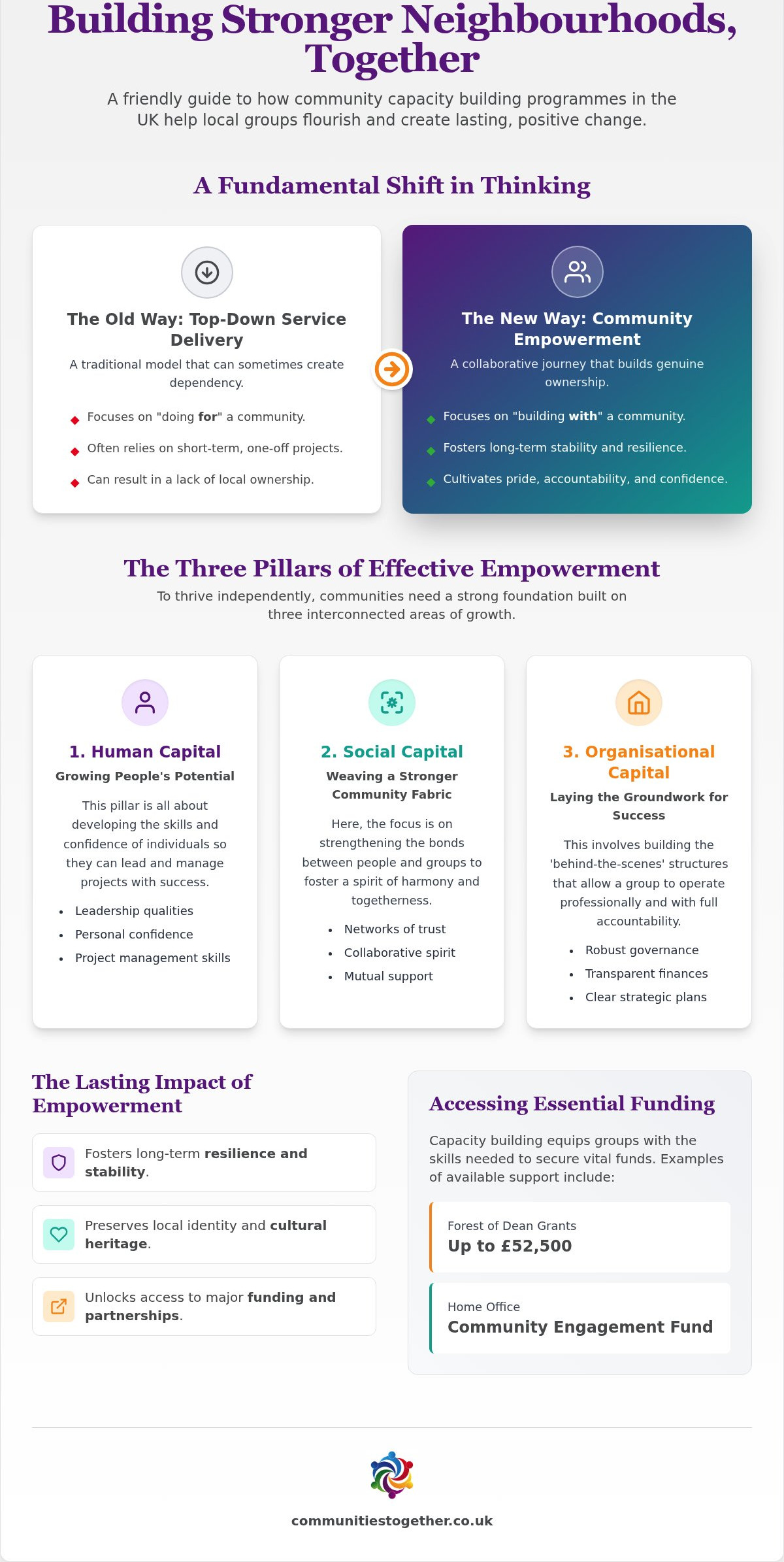
This 2026 guide explores how you can access essential funding such as the £52,500 Forest of Dean grants or the Home Office Community Engagement Fund, whilst also building the deep social ties and cultural continuity required to empower your neighbourhood for years to come. We'll look at the practical steps needed to facilitate local empowerment and maintain the momentum of your projects through professional partnership, heritage preservation, and skills development. By bridging the gap between passionate intent and formal delivery, your group can become a reliable foundation for collective growth and social harmony.
Table of Contents
What is Community Capacity Building in the UK Context?
In the context of the United Kingdom, defining What is Community Capacity Building? involves much more than just the allocation of financial resources; it describes a supportive and collaborative journey that enables local groups to take ownership of their own futures. This process represents a fundamental shift from traditional "top-down" service delivery to a model of genuine empowerment, where external facilitators work alongside residents to identify strengths, nurture local talent, and build the confidence needed to lead. By moving away from "doing for" a community and instead focusing on "building with" them, community capacity building programmes UK create a sense of accountability and pride that ensures local initiatives remain resilient, sustainable, and deeply rooted in the unique needs of the neighbourhood.
For diverse towns across the country, particularly within the vibrant landscapes of West Yorkshire, this approach is vital for maintaining social cohesion and fostering a shared sense of belonging amongst residents from all backgrounds. Strengthening the social capital of a neighbourhood involves weaving together the threads of trust, mutual support, and cultural understanding to create a fabric that's strong enough to withstand external pressures. To better understand this concept, watch this helpful video:
The Core Elements of Local Capacity
Effective empowerment is built upon three distinct but interconnected pillars that provide the structural strength necessary for long-term success. First, human capital focuses on developing the individual skills, leadership qualities, and personal confidence of residents so they can effectively manage local projects. Second, social capital seeks to strengthen the networks, trust, and collaborative spirit between different groups to promote harmony and togetherness. Finally, organisational capital involves building the essential behind-the-scenes structures, such as robust governance frameworks, transparent financial systems, and clear strategic plans, which allow a group to operate with professionalism and accountability.
Why 2026 is a Pivotal Year for Community Resilience
As we move through 2026, the need for hyper-local engagement has never been more apparent, especially as communities in Leeds, Bradford, and Huddersfield work together to address the lingering effects of social isolation through collaborative wellbeing workshops. Local groups are increasingly recognised as the primary drivers of cultural preservation, using South Asian arts and heritage activities to maintain cultural continuity whilst building collective endurance. This shift towards local leadership ensures that empowerment isn't just a temporary intervention but a permanent foundation for growth, allowing neighbourhoods to facilitate their own progress, maintain their unique identities, and achieve a state of lasting social stability.
The Three Core Pillars of Effective Capacity Building Programmes
To achieve a state of lasting social stability, community capacity building programmes UK must look beyond simple resource allocation and instead focus on a holistic framework that integrates skill development, infrastructure support, and strategic networking. This methodical approach ensures that local groups don't just survive on a project-to-project basis but instead develop the collective endurance required to thrive independently over the long term. By weaving wellbeing and resilience into the very foundations of organisational growth, facilitators can help residents address social isolation whilst simultaneously building the professional literacy needed to manage complex community assets.
Learning and Personal Development for Leaders
Nurturing the confidence of local advocates is a delicate but essential process that requires inclusive training tailored to the specific cultural context of the neighbourhood. Effective leadership development involves more than just technical instruction; it requires the cultivation of sophisticated communication skills that allow advocates to bridge gaps between diverse demographics and foster a sense of togetherness. For those seeking to deepen their expertise, exploring Skills and Personal Development UK: A Comprehensive Guide to Growth in 2026 provides a roadmap for individual and collective advancement. These programmes empower individuals to speak with an authoritative voice, ensuring that the needs of their community are heard by stakeholders and governing bodies alike.
Building Sustainable Social Infrastructure
Creating a stable foundation for community-led projects requires a focus on organisational capital, where groups are supported to establish robust governance structures without losing the warm and welcoming atmosphere that defines local action. This involves facilitating financial literacy amongst organisers to ensure they can navigate the complexities of grant applications and long-term financial planning with confidence. By utilising established Community Development Resources as part of community capacity building programmes UK, local groups can adopt best practices for managing heritage and arts projects, ensuring that cultural continuity is maintained through professional accountability. It's about building a "wise facilitator" model where the internal mechanics of a group are serious and reliable, yet the outward engagement remains deeply collaborative and inclusive.
The final pillar involves the creation of strategic partnerships that link hyper-local groups with wider networks, facilitating a "bridge-builder" mentality that leverages shared knowledge and resources for the benefit of all. These connections provide the structural strength necessary for social responsibility to flourish, allowing groups in Leeds, Bradford, and Huddersfield to share successes and overcome common challenges together. If you're looking to strengthen your group’s impact, you might consider how our partnership and community capacity building initiatives can help you weave these threads of resilience into your local fabric. When professional infrastructure meets local identity, the result is a sustainable social ecosystem that supports every resident.
Strategic Partnership vs Service Delivery: Building Sustainable Foundations
In the pursuit of long-term social harmony, it's essential to distinguish between the temporary relief of one-off service delivery and the enduring strength of strategic partnerships. One-off interventions often fail to create lasting change in urban areas because they don't address the underlying lack of infrastructure or the pervasive sense of isolation that can affect under-resourced neighbourhoods. By contrast, community capacity building programmes UK focus on a model of collaborative growth, moving away from traditional top-down service models to foster a genuine sense of shared ownership amongst residents. In towns like Halifax and Huddersfield, these partnerships amongst local organisations provide a stable foundation for collective growth, ensuring that every project acts as a stepping stone towards a more resilient and empowered future.
The Power of Collaborative Wellbeing
Resilience workshops and wellbeing interventions are most effective when delivered through a partnership model that prioritises togetherness over individualised treatment. By connecting individuals through shared learning and personal development, these initiatives reduce isolation whilst building the social capital necessary for a neighbourhood to thrive. For a deeper look at how these elements combine to support local groups, you can read our Collaborative Wellbeing and Resilience Workshops: A Complete Guide for UK Communities. This approach ensures that personal growth contributes directly to the overall stability of the community, creating a virtuous cycle of mutual support, cultural continuity, and collective endurance.
Measuring Social Impact in Local Neighbourhoods
True success in community engagement is measured not merely by "numbers through the door" but by the measurable increase in a group's structural strength and its ability to maintain its unique identity. Accountability and reporting are vital components for any non-profit, as they demonstrate a deep commitment to social responsibility and provide the evidence needed to secure long-term funding. By focusing on qualitative outcomes, such as increased trust between diverse demographics or the preservation of South Asian arts, facilitators can provide a comprehensive overview of how community capacity building programmes UK contribute to the long-term resilience of a town. This rigorous approach to impact ensures that every action is purposeful, every partnership is productive, and every community is empowered to lead its own development with confidence.
How Local Groups Can Access and Implement Capacity Building Support
Accessing community capacity building programmes UK begins with a deliberate and honest evaluation of your group's existing strengths, its current operational gaps, and the specific social objectives you wish to achieve within your neighbourhood. Identifying these needs allows you to seek out facilitators who possess a deep understanding of the unique cultural and social landscape of West Yorkshire, ensuring that the support you receive is both relevant and impactful. Finding inclusive community programmes that align with your cultural values is essential for building a network of peers where you can share best practices, material resources, and collective encouragement. This collaborative approach transforms the process from a solitary struggle into a shared journey of professional growth, structural strength, and social responsibility.
With specific funding opportunities available in 2026, such as the £52,500 Forest of Dean Community Grants or the £150,000 Home Office Community Engagement Fund for organisations working with Windrush communities, having the organisational capacity to apply is crucial. These funds are designed for groups that have already established the necessary governance and financial literacy to manage projects effectively between August 2026 and March 31, 2027. By preparing your group today, you'll be ready to secure these resources whilst maintaining a focus on your core mission.
Steps to Strengthening Your Community Group
To effectively strengthen your community group, you should first conduct a comprehensive audit of your current skills to determine where your organisation excels and where additional training is required in areas like governance, finance, or engagement. Once these gaps are identified, reaching out to local facilitators for support with engagement skills training can provide the necessary expertise to bridge those divides and enhance your group's overall effectiveness. Building a detailed development plan serves as a roadmap for collective growth, enabling you to navigate the complexities of external partnerships whilst maintaining your focus on long-term resilience and togetherness.
Inclusive Engagement for Diverse Communities
Ensuring that your programme is welcoming to people from all backgrounds is fundamental to the success of any local initiative, as it fosters a sense of togetherness and mutual respect amongst diverse demographics. Using heritage and arts activities can act as a friendly and accessible entry point for engagement, allowing residents to connect through shared cultural continuity before moving on to more formal structural development. For a comprehensive overview of these strategies, you can consult our Community Capacity Building in the UK: A 2026 Guide to Strengthening Local Infrastructure. This focus on inclusivity ensures that your group remains a stable foundation for the entire neighbourhood, facilitating progress that is both equitable and sustainable.
Collaborative Growth: The Communities Together Approach to Local Empowerment
Communities Together operates as an authoritative bridge-builder for neighbourhoods across Huddersfield, Halifax, and Leeds, facilitating a process of collaborative growth that prioritises social responsibility, harmony, and structural integrity. Our specific methodology for community capacity building programmes UK is rooted in the conviction that sustainable social infrastructure can only be achieved when it's built upon a foundation of individual wellbeing and collective resilience. By inviting local organisations to join us in this mission, we help weave together the complex threads of the social fabric, acting as a professional conduit for growth whilst ensuring that every initiative remains grounded in the lived experience and cultural aspirations of the residents it serves. This approach ensures that progress isn't just a series of isolated events but a steady, deliberate movement towards a more equitable and stable society.
We believe that a neighbourhood's endurance depends on its ability to facilitate its own progress, maintain its unique identity, and achieve a state of lasting social stability. Our role is to act as a wise facilitator, providing the expertise and resources necessary to help local leaders develop the confidence they need to manage their own assets and initiatives. By focusing on long-term social benefits rather than short-term excitement, we help create a culture of accountability and purpose that supports the neighbourhood's growth for many years to come.
Heritage as a Tool for Capacity Building
Cultural continuity is far more than the simple preservation of the past; it's a vital instrument for building structural strength, fostering a sense of belonging, and establishing a collective identity in the present. By integrating South Asian arts and heritage preservation into our broader structural development frameworks, we empower residents to reclaim their history and build a stable foundation for future progress that respects their traditions. These arts-based projects do more than celebrate heritage; they facilitate the development of essential transferable skills amongst local participants, including project management, public engagement, and collaborative leadership. For those interested in the broader context of these efforts, our guide on Cultural Heritage Preservation in the UK: A Comprehensive Guide to Protecting Our Shared History offers deeper insights into how protecting our shared history facilitates long-term community endurance and social harmony.
Joining Our Community Engagement Programmes
We extend a warm and supportive invitation to local groups in Bradford, Wakefield, and beyond to participate in our workshops and community engagement programmes. Our community capacity building programmes UK are meticulously designed to support organisations in becoming self-sustaining, resilient, and professionally literate entities that possess the expertise to navigate the complexities of governance, finance, and partnership building. By partnering with Communities Together, your group gains access to a reliable foundation of professional expertise and a methodical advocate dedicated to your long-term success. We don't just seek to deliver one-off services; we aim to build a stronger social fabric through principled expertise, deliberate planning, and a deep commitment to the measurable impact of our collective actions on the neighbourhoods we serve.
Empowering Your Neighbourhood for a Sustainable Future
Building a resilient neighbourhood requires a deliberate shift from temporary interventions to the creation of a permanent, professional infrastructure that respects and celebrates your local identity. By engaging with community capacity building programmes UK, your group can transition from simply receiving services to actively leading development through robust governance, strategic partnerships, and enhanced financial literacy. We've explored how integrating cultural preservation, such as South Asian arts and heritage, provides a unique foundation for collective endurance and social harmony across West Yorkshire.
Communities Together stands as an earnest and professional bridge-builder, dedicated to facilitating social cohesion in Leeds, Bradford, and Huddersfield. As experienced facilitators of South Asian cultural heritage, we're here to support your organisation in becoming a self-sustaining force for good. We invite you to take the next step in your journey towards local empowerment and structural strength.
Your passion for your community is the most valuable resource you have. With the right support, that energy can transform into a lasting legacy of togetherness and growth for generations to come.
Frequently Asked Questions
What exactly is a community capacity building programme?
A community capacity building programme is a structured initiative that seeks to strengthen the internal skills, governance, and resources of local groups so they can lead their own development projects effectively. These programmes focus on fostering long-term resilience by providing training in leadership, financial management, and partnership building. By participating in community capacity building programmes UK, your group gains the professional literacy needed to secure funding, maintain social infrastructure, and achieve lasting social benefits for your neighbourhood.
How does capacity building improve social cohesion in diverse areas?
Capacity building improves social cohesion by strengthening the social capital and mutual trust between diverse demographics within a neighbourhood. These programmes facilitate shared learning experiences and collaborative projects that encourage residents to work together towards common goals, such as cultural preservation or local improvement. By creating a stable foundation for interaction, these initiatives help reduce social isolation, promote harmony, and ensure that every individual feels a sense of belonging whilst contributing to the collective growth of their town.
Can small, informal groups access capacity building support in West Yorkshire?
Yes, small and informal groups in West Yorkshire can definitely access support, as many funding bodies recognise the vital role of grassroots action. For instance, the Forest of Dean District Council offers grants of up to £500 specifically for non-constituted groups during the 2026-2027 period. Local facilitators provide engagement skills training and mentorship to help these groups establish formal governance, allowing them to transition from informal gatherings to structured organisations capable of delivering significant social impact and securing larger financial partnerships.
What is the difference between community development and capacity building?
Whilst the two concepts are closely related, community development is the overarching goal of improving the social and economic wellbeing of an area, whereas capacity building is the specific process of strengthening a group's tools and expertise. Think of development as the desired destination and capacity building as the engine that drives you there. This process involves building "behind-the-scenes" structures, such as robust financial systems and leadership skills, which ensure that development initiatives are sustainable, accountable, and locally led.
How do South Asian arts and heritage projects help build community capacity?
South Asian arts and heritage projects act as powerful vehicles for capacity building by helping residents develop transferable skills whilst preserving their cultural identity. Participants often gain experience in project management, public speaking, and event organisation through these activities, which builds their personal confidence and professional literacy. These projects create a friendly entry point for engagement, fostering cultural continuity and collective endurance that strengthens the social fabric and encourages diverse groups to take an active role in local leadership.
Are there free community engagement programmes available in Leeds or Bradford?
There are various free community engagement programmes available across Leeds and Bradford, often supported by government funds like the Home Office Community Engagement Fund 2026-2027. This £150,000 fund specifically supports grassroots organisations working with Windrush communities between August 2026 and March 2027. Local non-profits and council-led initiatives frequently offer workshops and training at no cost to participants, ensuring that financial barriers don't prevent passionate individuals from accessing the skills needed to empower their local neighbourhoods.
How can I measure the success of a capacity building programme for my group?
Measuring success involves looking beyond simple attendance numbers to evaluate the qualitative and quantitative growth of your group's internal infrastructure. You might track the number of new partnerships established, the amount of external funding secured, or the implementation of new governance policies. Additionally, measuring social impact through resident feedback on increased trust and reduced isolation provides a comprehensive overview of how community capacity building programmes UK have strengthened the collective resilience and social responsibility of your local organisation.
Why is personal resilience important for community leaders?
Personal resilience is the essential foundation for community leadership because it ensures that advocates can maintain their momentum and commitment whilst navigating the complexities of local organising. Leaders who participate in wellbeing and resilience workshops are better equipped to manage stress, foster harmony amongst team members, and lead with quiet confidence. This internal strength allows them to act as stable anchors for their groups, facilitating long-term progress and ensuring that the organisation remains a reliable foundation for collective growth.


Comments