
Bringing Communities Together UK: A Strategic Guide to Social Cohesion in 2026
Updated: 2 days ago
Whilst the UK's creative industries contributed a remarkable £146 billion to the national economy in 2024, the most profound impact of this sector is often found in its capacity to fortify our local neighbourhoods through the role of arts in community building UK. You likely understand that the challenges of fragmented local services, rising social isolation in urban centres, and a lack of engagement from diverse cultural groups require more than just temporary fixes; they demand a methodical approach to social cohesion.
By facilitating collaborative workshops, preserving cultural heritage, and building sustainable community infrastructure, we can create environments that promote long-term stability, harmony, and social responsibility. This guide provides practical frameworks for engagement and explores how initiatives like West Yorkshire’s "Seasons of Culture 2026" are leveraging the £150,000 Creative Communities Fund to bridge divides. We'll examine how these strategic efforts are empowering local authorities and community groups to weave a more resilient social fabric that supports collective growth, cultural continuity, and enduring togetherness.
Table of Contents
Understanding the Landscape of Community Connection in the UK
The Transformative Role of Cultural Heritage and South Asian Arts
Evaluating Models for Capacity Building and Local Partnerships
Practical Steps for Organising Resilient Neighbourhood Initiatives
Strengthening West Yorkshire: The Communities Together Approach
Understanding the Landscape of Community Connection in the UK
Bringing communities together is the intentional process of fostering inclusive engagement, social cohesion, and mutual understanding to ensure that every resident feels a sense of belonging within their local area. This approach requires us to move beyond superficial interactions and instead focus on creating deep, lasting connections that can bridge cultural divides and build a shared future for all. In regions like West Yorkshire, where the social landscape is rich and varied, these efforts are essential for maintaining a harmonious society that values every voice and perspective whilst promoting a sense of collective endurance.
We've seen that traditional top-down approaches often fail to reach diverse demographics because they lack the nuance and local knowledge required to engage people effectively. By contrast, the role of arts in community building UK offers a more organic way to connect, allowing residents to participate in community engagement programmes that are designed by and for the people who live there. This focus on community-led infrastructure ensures that projects are sustainable, relevant, and capable of addressing the specific needs of neighbourhoods in Huddersfield, Halifax, and Bradford through the lens of shared creativity and heritage.
To better understand the foundations of this work, watch this helpful video regarding the intersection of creativity and connection:
Addressing the Challenge of Modern Social Isolation
Digital shifts and evolving urban planning have significantly impacted physical community centres, often leaving residents without the shared spaces necessary for organic interaction amongst diverse populations. Social isolation is a structural barrier to collective growth and individual wellbeing in 2026. We believe that non-clinical interventions, such as wellbeing and resilience workshops, are crucial for improving individual resilience within a broader group context, helping people to develop the emotional tools they need to thrive whilst feeling supported by their peers. By focusing on these non-clinical methods, we can facilitate personal development that strengthens the entire community from the ground up.
The Vital Importance of Social Cohesion for Resilience
Social cohesion acts as a vital buffer against economic and social shocks in local neighbourhoods, providing a stable foundation for residents to navigate periods of uncertainty and change. By Understanding Community Cohesion as a policy framework, we can better appreciate how it facilitates the acquisition of new skills, creates personal development opportunities, and strengthens local community infrastructure. At Communities Together, we're dedicated to fostering this collaborative growth through partnership and community capacity building to ensure long-term stability and social responsibility across the region. This methodical approach allows us to weave together the complex threads of our social fabric, ensuring that our work in the role of arts in community building UK remains a professional conduit for collective growth and regional prosperity.
The Transformative Role of Cultural Heritage and South Asian Arts
South Asian arts and heritage activities function as a professional conduit for intercultural dialogue, creating a structured environment where shared understanding can flourish amongst diverse groups. By honouring these traditions, we provide a sense of continuity, pride, and belonging that is essential for the social fabric of the United Kingdom. The role of arts in community building UK is particularly evident when we consider how cultural participation can measurably reduce social isolation amongst elderly and marginalised populations whilst celebrating tradition. High-quality arts education remains a critical component of this work, as it expands access to cultural traditions for the next generation and ensures that the threads of our shared history remain vibrant and relevant.
Preserving Traditions to Build Shared Future Identities
Heritage projects that focus on documenting oral histories, preserving traditional South Asian crafts, and facilitating intergenerational knowledge transfer are vital for building collective memory. These initiatives foster mutual respect and cultural literacy, ensuring that the wider community benefits from a more inclusive historical narrative that acknowledges the contributions of all residents. By protecting these narratives, we create a foundation for future identities that are grounded in both tradition and progress. For those seeking deeper strategic insights into this process, our Cultural Heritage Preservation in the UK guide offers a comprehensive overview of protecting our shared history through methodical engagement.
Arts-Based Interventions as a Catalyst for Inclusion
Structured workshops in dance, music, and visual arts provide a neutral space for collaboration, allowing residents from different backgrounds to meet, interact, and build lasting relationships that transcend social barriers. This process uses artistic expression to facilitate difficult conversations about identity, belonging, and social change, effectively transforming potential conflict into a catalyst for inclusion. We've seen significant success in West Yorkshire where South Asian cultural activities have successfully integrated into broader regional festivals, enhancing visibility and fostering a more cohesive public identity. These interventions don't just provide entertainment; they act as a methodical tool for social engineering, helping to weave together disparate groups into a single, resilient community.
By engaging with professional South Asian arts and heritage activities, local authorities and community groups can support the role of arts in community building UK, ensuring that cultural preservation remains a stable foundation for collective growth and social responsibility. This approach prioritises long-term harmony and provides a reliable framework for building a more inclusive and connected society.
Evaluating Models for Capacity Building and Local Partnerships
When we evaluate the long-term efficacy of social interventions, it's essential to distinguish between the funding-first model, which often prioritises immediate but fleeting outputs, and the capacity-building model, which focuses on the structural empowerment of local groups. Community capacity building is the intentional process of equipping residents with the tools to manage their own growth, maintain local infrastructure, and build collective resilience against future challenges. By fostering collaborative partnerships between non-profits, schools, and local authorities, we can create a unified support system that ensures no individual is left behind. This interconnected approach is particularly effective in ensuring that community resilience workshops reach the most isolated residents in urban centres, transforming the role of arts in community building UK from a series of disparate events into a sustainable foundation for social progress.
Community Organising versus Capacity Building Strategies
Specialised non-profit organisations, such as Communities Together, act as vital bridges between institutional stakeholders and local residents, ensuring that resources are allocated effectively and that community voices are heard at every level of decision-making. Project facilitators must possess a high degree of professional literacy in social welfare and cultural heritage to navigate the complexities of community development and to maintain the integrity of local traditions whilst promoting modern social cohesion. By providing this expert guidance, non-profits help to weave together the various threads of the social fabric, creating a resilient network that supports both individual wellbeing and collective endurance. For those seeking a detailed strategic framework, our Community Capacity Building in the UK guide provides an in-depth analysis of how to strengthen local infrastructure through methodical partnership building and professional advocacy. This structural approach ensures that the role of arts in community building UK remains a professional conduit for growth, stability, and regional harmony.
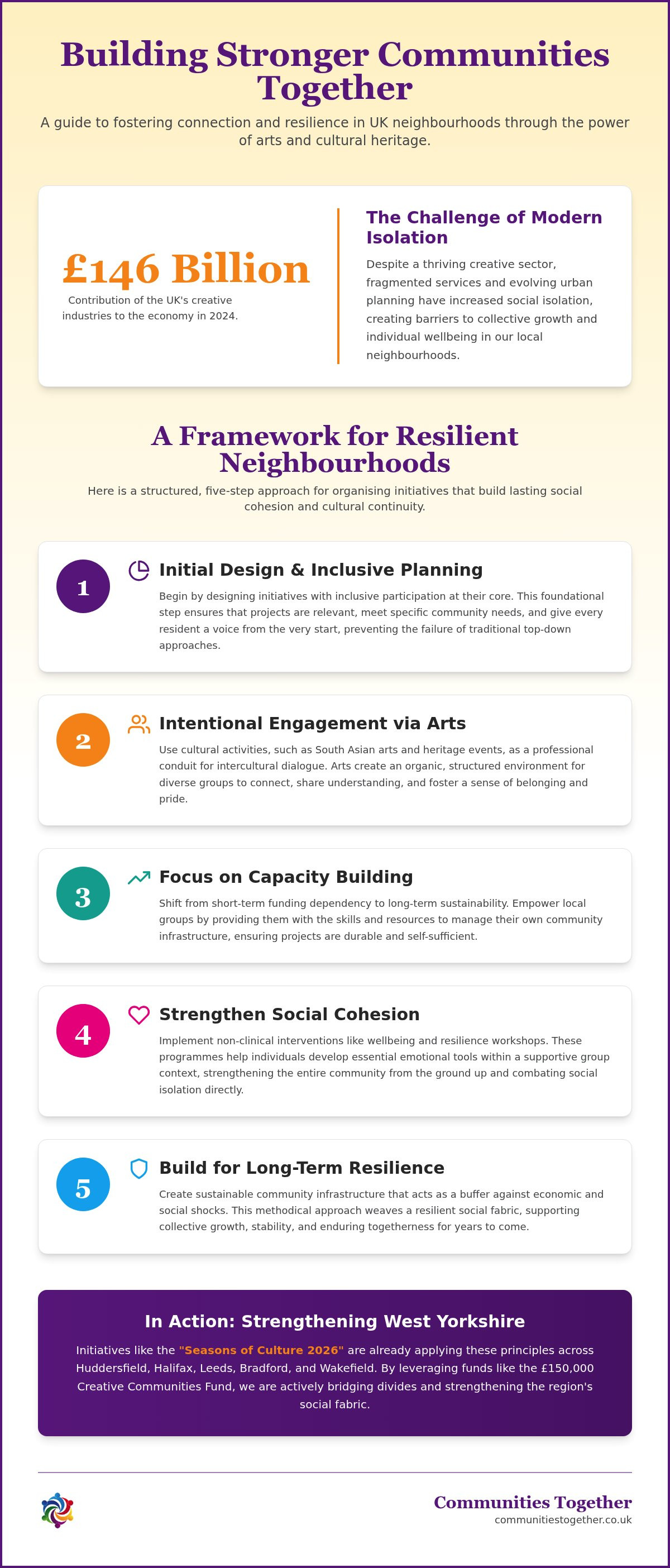
Practical Steps for Organising Resilient Neighbourhood Initiatives
To translate the theoretical frameworks of social cohesion into tangible outcomes, we must adopt a methodical approach that prioritises inclusive participation from the very inception of a project. The role of arts in community building UK is most effective when it's integrated into the foundational design of neighbourhood initiatives rather than being treated as a secondary consideration or an afterthought. By facilitating a structured environment where residents can contribute to the design phase, we ensure that programmes are culturally relevant, socially responsible, and capable of addressing the specific challenges of urban isolation.
Designing Inclusive Engagement Programmes for Local Impact
Launching a successful community project requires a disciplined five-step process that moves from initial research to long-term sustainability. This journey begins with a community needs audit to identify social isolation patterns, cultural representation gaps, and existing local assets that can be leveraged for collective growth. We then establish a diverse steering group that reflects the local demographic of Leeds, Bradford, or Huddersfield to ensure that decision-making power is shared amongst the people who will benefit most from the initiative. The third step involves developing a blended curriculum that combines practical skills development with cultural participation and heritage education, creating a holistic experience that supports both personal growth and community bonding.
Step 1: Conduct a thorough community needs audit focusing on social isolation, cultural representation, and existing local assets.
Step 2: Establish a diverse steering group that accurately reflects the local demographic of West Yorkshire urban centres.
Step 3: Develop a curriculum that blends professional skills development with cultural participation and South Asian heritage education.
Step 4: Integrate wellbeing and resilience workshops into standard community meetings to address individual emotional needs.
Step 5: Facilitate partnership building with local authorities to ensure the project has the infrastructure for long-term endurance.
Fostering Personal Resilience Through Collaborative Workshops
Whilst some traditional models of community organising focus primarily on political advocacy, our approach emphasises the integration of wellbeing and resilience workshops to address the internal barriers to engagement. These workshops are structured to promote personal development, emotional wellbeing, and collective endurance, providing residents with a safe space to navigate the complexities of modern life. Learning new skills in a group setting, such as traditional South Asian crafts or visual arts, builds trust and empathy between formerly disconnected neighbours, effectively weaving together the threads of the social fabric. We also prioritise South Asian heritage workshops for schools to engage younger generations, ensuring that cultural preservation remains a vibrant part of their future identity. For those ready to implement these strategies, our Collaborative Wellbeing and Resilience Workshops guide provides the necessary templates and strategic frameworks for success.
By following this methodical path, we can transform the role of arts in community building UK into a reliable engine for social harmony and professional community development. It's about building the structural strength of our neighbourhoods whilst honouring the individual stories that make them unique.
Strengthening West Yorkshire: The Communities Together Approach
Communities Together operates with a mission to facilitate social cohesion by leveraging South Asian arts and heritage activities as a foundation for regional stability, harmony, and social responsibility. By focusing on the unique socio-economic needs of Yorkshire residents, we deliver wellbeing and resilience workshops that provide a structured path toward recovery, mutual understanding, and collective endurance. Our work across Huddersfield, Halifax, Leeds, Bradford, and Wakefield has demonstrated that the role of arts in community building UK is most effective when it's rooted in local lived experience and professional accountability. We invite stakeholders, local authorities, and community groups to collaborate on future heritage and cultural preservation projects to ensure the social fabric of West Yorkshire remains resilient for generations to come.
Empowering Huddersfield, Leeds, and Bradford Through Partnership
Our approach to partnership and community capacity building has led to the development of sustainable infrastructure in key urban centres where social isolation once felt insurmountable. In Leeds, for example, our inclusive community programmes have significantly reduced social isolation by providing targeted cultural engagement that resonates with diverse demographics and fosters a renewed sense of pride in place. By establishing these professional conduits for growth, we enable local groups to manage their own resources, facilitate their own dialogues, and maintain their own cultural continuity. We encourage organisations seeking to enhance their local impact to partner with Communities Together for future initiatives that prioritise stability and harmony across the region's diverse neighbourhoods.
Accessing Learning and Skills Development Opportunities
Beyond cultural preservation, our personal development workshops offer residents in 2026 a methodical way to enhance their employability, confidence, and professional literacy. These programmes bridge the gap between traditional cultural heritage and modern professional skills acquisition, ensuring that participants are equipped to contribute to the regional economy whilst maintaining their cultural identity. By integrating learning, skills, and personal development into our broader mission, we provide a holistic support system that fosters both individual resilience and collective growth. For a more comprehensive overview of our organisation's impact, please reference our Strategic Community Engagement Programmes guide, which details our long-term vision for social cohesion and cultural heritage preservation. This structural approach ensures that the role of arts in community building UK remains a professional conduit for growth, stability, and regional prosperity.
Building a Resilient Future Through Cultural Connection
Integrating strategic community engagement with cultural heritage preservation provides a robust framework for strengthening the social fabric across the United Kingdom. We've seen how moving beyond top-down models towards community-led capacity building allows for the creation of sustainable infrastructure that supports diverse populations, ensures long-term stability, and promotes mutual understanding. As specialist facilitators in South Asian arts and heritage activities, we've witnessed first-hand how these methodical initiatives reduce social isolation whilst fostering a deep sense of pride and continuity across West Yorkshire.
The role of arts in community building UK serves as a professional conduit for collective growth, enabling neighbours to bridge cultural divides through shared creativity, wellbeing workshops, and resilience training. By prioritising professional partnership building and methodical engagement, we can ensure that our local neighbourhoods remain stable, inclusive, and prepared for any future challenges. We're here to support your journey in creating a more harmonious society through our proven frameworks, dedicated advocacy, and specialist expertise in cultural development.
We look forward to working alongside you to weave a stronger, more connected future for every resident in our community.
Frequently Asked Questions
How can I start a community engagement programme in my local area?
Starting a programme begins with conducting a thorough community needs audit to identify social isolation patterns, cultural representation gaps, and existing local assets within your specific neighbourhood. You should then establish a diverse steering group that reflects the local demographic to ensure that decision-making power is shared amongst residents from the inception phase. This methodical approach ensures that your initiative is culturally relevant, socially responsible, and capable of addressing the unique socio-economic challenges found in urban centres like Leeds or Bradford.
What are the benefits of South Asian heritage projects for diverse schools?
South Asian heritage projects provide schools with a structured environment to foster cultural literacy, mutual respect, and intergenerational knowledge transfer amongst students from varied backgrounds. These activities expand educational access to rich cultural traditions whilst helping younger generations build a sense of pride and shared identity through creative participation. By integrating these projects into the curriculum, schools can effectively reduce social barriers and promote a more inclusive historical narrative that acknowledges the diverse contributions of all residents in West Yorkshire.
Can cultural heritage activities really reduce social isolation?
Cultural heritage activities serve as a professional conduit for intercultural dialogue and shared understanding, which measurably reduces social isolation in urban environments by fostering togetherness and collective endurance. By providing residents with a sense of continuity, pride, and belonging, these initiatives create safe spaces for organic interaction and the building of lasting relationships. This process is essential for strengthening the role of arts in community building UK, as it transforms potential social fragmentation into a foundation for regional harmony.
What is the difference between community organising and capacity building?
Community organising typically follows an advocacy-led approach that focuses on achieving short-term policy changes or political wins through collective action and holding power-holders to account. By contrast, community capacity building is an infrastructure-led strategy designed to empower local groups to manage their own growth, resources, and long-term resilience. This methodical focus on building structural strength ensures that social cohesion programmes remain sustainable and continue to provide value to the neighbourhood long after initial funding cycles have concluded in cities like Wakefield.
Are wellbeing and resilience workshops suitable for all age groups?
These workshops are designed to be inclusive and are tailored to meet the specific emotional and developmental needs of residents across all age groups to promote individual wellbeing. They use non-clinical interventions to improve personal resilience, promote personal development, and foster a sense of collective endurance within a broader group context. Whether engaging school children in cultural preservation or supporting elderly residents through shared crafts, these sessions provide a reliable framework for building trust and empathy amongst formerly disconnected neighbours.
How do Communities Together support local groups in West Yorkshire?
We act as an authoritative bridge-builder and methodical advocate by providing specialist expertise in South Asian arts, heritage activities, and partnership building to enhance social cohesion. Our team facilitates community engagement programmes that strengthen local infrastructure across Huddersfield, Halifax, Leeds, Bradford, and Wakefield to ensure long-term stability and social responsibility. By offering professional literacy in social welfare and cultural heritage, we support local groups in navigating complex development threads and creating a stable foundation for collective growth and regional prosperity.
What role do arts and heritage play in social cohesion?
Arts and heritage function as a vital buffer against social shocks by providing a neutral platform for collaboration, mutual respect, and the celebration of diverse traditions. This work is central to the role of arts in community building UK, as it allows residents to weave together disparate social threads into a single, resilient fabric. By preserving cultural continuity and facilitating intercultural dialogue, these activities ensure that every voice is valued and that the community remains grounded in both tradition and progress.
How can local businesses support community infrastructure building?
Local businesses can support community infrastructure by entering into collaborative partnerships that facilitate resource sharing, skills exchange, and professional mentorship for local groups. By investing in community capacity building, businesses contribute to the long-term stability and economic resilience of the regions where they operate, such as Wakefield or Halifax. This commitment to social responsibility helps to maintain a harmonious environment, which ultimately benefits the entire local economy through improved social cohesion and a more empowered, skilled workforce within the region.


Comments