
Non-Profit Community Engagement in the UK: A Strategic Best Practice Guide

True community resilience is not merely the byproduct of occasional participation or well-intentioned outreach, but rather the result of a deliberate synthesis between cultural preservation, structural support, and collective ownership. Many organisations across the country find that despite their best efforts, community initiatives often remain fragmented, struggling to engage diverse demographic groups or provide a clear framework for measuring long-term social impact. Achieving meaningful non-profit community engagement UK wide requires a transition from transactional service delivery to a model that prioritises the building of community capacity, the facilitation of inclusive dialogue, and the maintenance of cultural continuity.
You likely recognise the difficulty of fostering deep connections amongst isolated populations whilst simultaneously managing the pressures of accountability and measurable outcomes. This strategic guide offers a comprehensive overview of the frameworks required to foster genuine social cohesion and community resilience within the non-profit sector. By reading on, you'll discover how to implement sustainable partnerships between organisations and residents, improve social cohesion metrics in local districts, and develop the robust structures necessary to ensure your mission leaves a lasting legacy of stability and harmony.
Key Takeaways
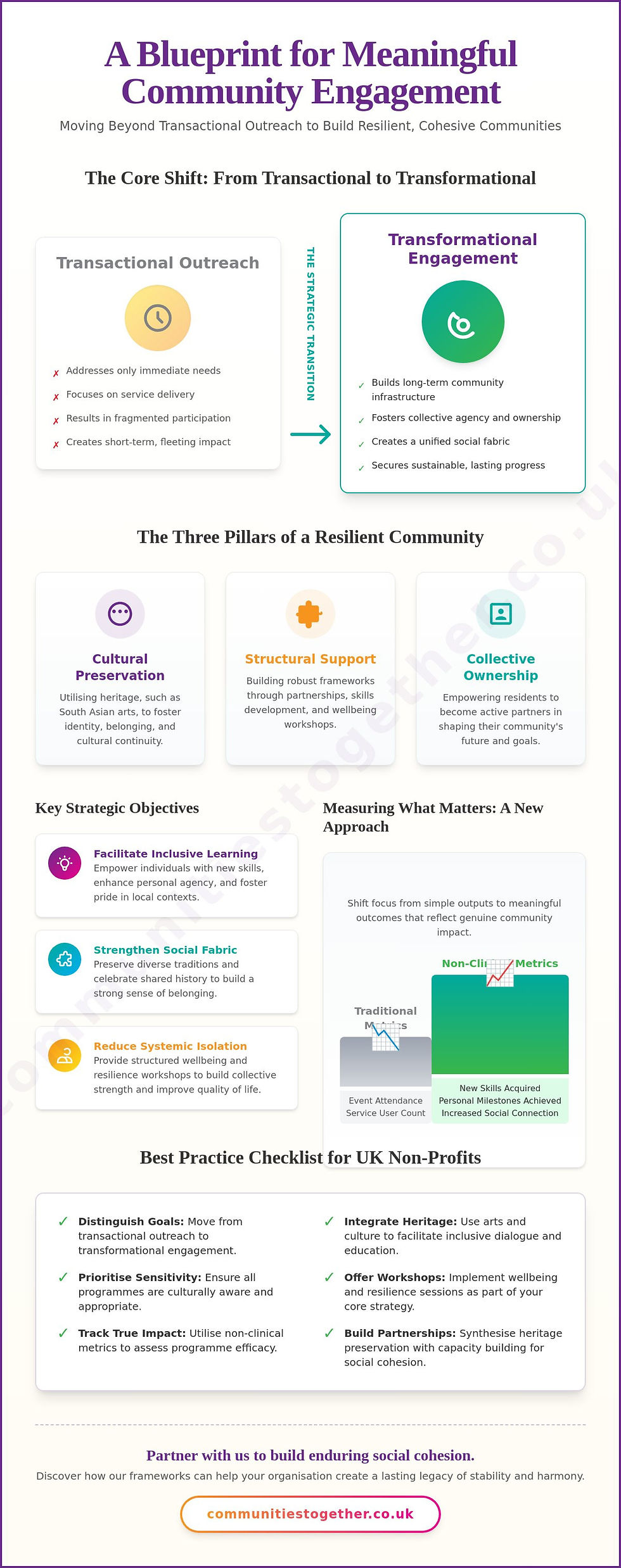
Establish a clear distinction between transactional outreach and transformational engagement to ensure the development of a resilient, long-term community infrastructure.
Understand the strategic role of South Asian arts and heritage preservation in facilitating inclusive dialogue and expanding educational access amongst diverse demographic groups.
Implement a comprehensive checklist for non-profit community engagement UK that prioritises cultural sensitivity whilst integrating wellbeing and resilience workshops into broader social strategies.
Utilise non-clinical metrics to assess the efficacy of community programmes by tracking the acquisition of new skills and the achievement of personal development milestones.
Explore the benefits of structured partnerships that synthesise heritage preservation with capacity building to foster enduring social cohesion and collective ownership.
Table of Contents
What is Non-Profit Community Engagement in the UK?
In the context of the British third sector, What is Non-Profit Community Engagement is best understood as a strategic process of collaborative partnership between organisations and local residents that moves beyond the limitations of mere service delivery. This model of non-profit community engagement UK relies upon the vital distinction between transactional outreach, which often addresses immediate needs without altering underlying social structures, and transformational engagement, which actively builds long-term community infrastructure, fosters collective agency, and secures sustainable progress. By prioritising non-clinical interventions, organisations can effectively address the profound sense of social isolation found amongst diverse urban populations, providing a pathway toward togetherness that doesn't rely solely on medicalised frameworks but rather on social connection, mutual support, and shared purpose. Community engagement represents a multi-layered approach to social cohesion that incorporates heritage preservation, inclusive learning, and structural resilience to create a unified social fabric.
When an organisation commits to this level of depth, it's not simply looking for participants for a single event; it's facilitating a synthesis of local knowledge and professional expertise to maintain the cultural continuity that communities need to thrive. Effective non-profit community engagement UK requires a methodical approach where every action is designed to facilitate growth, maintain stability, and build the collective endurance necessary to face contemporary social challenges.
The Evolution of Community Cohesion in 2026
The landscape of social delivery has undergone a significant shift as we approach 2026, with place-based philanthropy increasingly influencing how non-profits operate across West Yorkshire. This movement prioritises the specific needs of local districts, encouraging social enterprises to facilitate cultural participation whilst maintaining a high degree of professional accountability to their stakeholders, partners, and governing bodies. In post-industrial towns such as Huddersfield and Halifax, these models are particularly vital for fostering togetherness, as they work to bridge the gaps left by economic transition through the revitalisation of local identity and the strengthening of community bonds. It's a process of weaving together the complex threads of social fabric to ensure that progress doesn't come at the expense of tradition.
Strategic Objectives of Engagement Programmes
To achieve lasting impact, engagement programmes must be built upon clear strategic objectives that align with the broader mission of social welfare and cultural heritage. These objectives include:
Facilitating inclusive learning and skills development to empower individuals, enhance their personal agency, and foster a sense of pride within their local contexts.
Strengthening the social fabric by preserving diverse traditions, celebrating shared history, and maintaining the cultural continuity that provides residents with a sense of belonging and structural strength.
Reducing systemic isolation by providing structured wellbeing and resilience workshops that offer participants the tools to navigate personal challenges, build collective strength, and improve their overall quality of life.
Through these targeted actions, non-profits act as methodical advocates for social change, ensuring that every initiative contributes to a more harmonious and resilient society that values both individual growth and collective stability.
The Role of Arts and Heritage in Inclusive Community Programmes
The integration of cultural heritage into social strategies represents a sophisticated evolution in non-profit community engagement UK, moving beyond surface-level participation to address the deep-seated needs of identity, belonging, and social resilience. By utilising South Asian arts and heritage activities, organisations can facilitate a process that expands educational access, fosters cultural continuity, and provides a structured environment for personal development. Heritage preservation projects serve as a vital neutral convenor, creating a safe and inclusive space where disparate community groups can engage in constructive dialogue, share ancestral narratives, and discover commonalities through the lens of a shared local history. This synthesis of tradition and engagement ensures that cultural identity is not merely preserved but actively employed as a foundational pillar for building individual endurance and collective strength.
Effective programmes recognise that the development of individual resilience is inextricably linked to a secure sense of cultural identity, which provides the stability necessary for residents to navigate the complexities of modern urban life. Integrating learning and skills development within the framework of traditional arts workshops allows participants to acquire practical competencies whilst simultaneously reconnecting with their roots. To explore how these methodologies are applied in practice, organisations may benefit from engaging with South Asian arts and heritage activities that prioritise both tradition and modern community needs.
Preserving South Asian Arts Heritage
Creating high-quality cultural participation opportunities that celebrate the rich history of Leeds and Bradford allows residents to reclaim their narratives whilst fostering cultural continuity for future generations. Educational workshops designed to bridge the generational gap through shared South Asian traditions help to maintain the threads of history that connect elders with the youth, thereby reducing social exclusion in Wakefield and the surrounding districts. These initiatives provide a methodical way to ensure that cultural heritage remains a living, breathing part of the community's structural strength, rather than a static relic of the past.
Arts for Social Cohesion: A Strategic Vehicle
Moving beyond the temporary excitement of one-off festivals, sustained arts-based community engagement programmes provide a stable platform for building community capacity and measuring the long-term impact of creative interventions. These sustained efforts allow facilitators to track the acquisition of new skills and the improvement of social cohesion metrics in local districts over time. By focusing on South Asian heritage activities as a tool for inclusion, non-profits can demonstrate a high degree of professional literacy in social welfare, proving that creative expression is a reliable and serious conduit for achieving harmony and social responsibility.
Best Practice Checklist for Non-Profit Community Engagement UK
Practitioners within the sector must move beyond intuitive outreach toward a formalised best practice framework that ensures every interaction is purposeful, inclusive, and culturally sensitive. Establishing clear protocols for engagement involves more than just scheduling meetings; it requires a deep understanding of the diverse cultural backgrounds that define our local districts, ensuring that every voice is not only heard but respected within the decision-making process. By integrating wellbeing and resilience workshops into the heart of these broader community strategies, organisations can transition from addressing symptoms to building the structural strength necessary for residents to thrive independently. To avoid the fragmentation of efforts in areas like Huddersfield, it's essential to develop robust partnership frameworks that encourage collaboration rather than competition, ensuring that resources are utilised with maximum efficiency and social impact. The gold standard of community engagement is defined by a balanced synthesis that prioritises heritage preservation whilst simultaneously facilitating the acquisition of modern skills and personal development.
A methodical approach to non-profit community engagement UK wide ensures that every statement of intent is balanced by a measurable statement of impact. This allows facilitators to maintain the quiet confidence of an established expert whilst acting as a professional conduit for collective growth. When these structural frameworks are in place, the resulting social cohesion is not a temporary phenomenon but a stable foundation for the future.
Designing Inclusive Programmes
Creating truly accessible initiatives requires a methodical evaluation of the barriers that prevent participation amongst the most isolated demographic groups. Non-profits should conduct thorough accessibility audits of community centres and project venues throughout West Yorkshire to ensure that physical and social environments are welcoming to all. Language and communication strategies must be tailored to reach isolated groups in Bradford and Leeds, utilising diverse media and community-specific networks to bridge the informational gap. Co-production serves as a vital tool in this process, as involving residents in the design and delivery of personal development opportunities ensures that programmes remain relevant, inclusive, and deeply rooted in the actual needs of the community.
Building Community Capacity and Partnerships
Long-term success depends on the ability to identify and support local "bridge-builders"-those trusted individuals who possess the cultural literacy to facilitate trust between non-profits and residents. Developing formal partnership agreements with local authorities and other social enterprises provides a stable foundation for collective growth, allowing for a more thorough distribution of expertise and resources. Strategies for sustaining community infrastructure must look beyond initial funding cycles, focusing on capacity building that empowers local groups to maintain their own progress. This methodical approach ensures that the bonds of togetherness remain strong, providing a reliable conduit for ongoing social responsibility and harmony.
Measuring the Impact of Wellbeing and Resilience Workshops
The evaluation of social efficacy within the sector requires a shift toward sophisticated, non-clinical metrics that can accurately reflect the nuances of human growth, togetherness, and collective endurance. Effective non-profit community engagement UK relies on the ability to demonstrate that initiatives are not merely temporary interventions but are instead building the structural strength necessary for long-term stability. By tracking the acquisition of new skills, the achievement of personal development milestones, and the improvement of social cohesion metrics amongst participants, organisations can provide a comprehensive overview of their impact to stakeholders and partners. Evaluating the reduction in social isolation through longitudinal community surveys allows facilitators to move beyond immediate feedback, providing a deeper understanding of how sustained engagement influences the structural strength of a neighbourhood over several years. Linking cultural participation to broader social outcomes, such as improved community resilience and collective endurance, demonstrates the profound value of heritage-based interventions in a way that resonates with both residents and governing bodies.
For organisations seeking to implement these evaluative frameworks whilst fostering a culture of accountability, engaging in structured wellbeing and resilience workshops provides a practical and methodical starting point for building community capacity. This approach ensures that every statement of intent is balanced by a measurable statement of social delivery.
Quantitative vs Qualitative Social Impact
A thorough impact report must balance statistical data with narrative success stories to provide a holistic view of community progress in districts like Huddersfield and Halifax. Measuring "social capital" serves as a primary indicator of success, as it reflects the density of trust, the strength of local networks, and the capacity for mutual support within a specific area. Transparent reporting is essential for maintaining the confidence of funding bodies, ensuring that the organisation remains a reliable and serious conduit for social responsibility. This methodical documentation of both numbers and lived experiences allows non-profits to present a compelling case for the continued support of inclusive engagement strategies.
Fostering Long-term Community Resilience
The transition from reactive crisis intervention to proactive resilience building is a hallmark of high-level community development in urban neighbourhoods. Peer-support networks play a vital role in this process, as they facilitate the maintenance of community wellbeing through shared experience and mutual aid. Skills development programmes contribute significantly to this stability, providing individuals with the tools to navigate economic challenges whilst strengthening the social fabric of their local context. By focusing on these long-term outcomes, non-profits act as authoritative bridge-builders, ensuring that the progress made today serves as a stable foundation for the generations of tomorrow.
Partnering with Communities Together for Social Cohesion
Communities Together facilitates a structured approach to non-profit community engagement UK wide by delivering a methodical synthesis of arts, heritage, and wellbeing initiatives that provide a stable foundation for social progress. Our organisation acts as a professional conduit for collective growth, utilising a high degree of professional literacy in social welfare to ensure that every programme contributes to the maintenance of cultural continuity, the reduction of social isolation, and the strengthening of community bonds. By leveraging our established expertise in South Asian arts and heritage preservation, we create high-quality participation opportunities that allow residents to reclaim their narratives whilst building the structural strength necessary for long-term social stability. This strategic model ensures that engagement isn't a temporary or transactional event but rather a transformational process that empowers individuals and fosters a deep sense of togetherness across the diverse districts of West Yorkshire.
Our commitment to building community capacity is reflected in our collaborative partnerships throughout Leeds, Bradford, and Huddersfield, where we work alongside local authorities and residents to facilitate progress that is both grounded in tradition and oriented toward future development. Participants in our West Yorkshire programmes don't just attend workshops; they access comprehensive learning, skills, and personal development opportunities that are meticulously designed to enhance their individual agency and collective resilience. By prioritising stability, harmony, and social responsibility, Communities Together serves as a reliable and serious foundation upon which local populations can build a more cohesive and inclusive future.
Expert Facilitation of Heritage and Wellbeing
We employ a methodical approach to delivering wellbeing and resilience workshops, ensuring that these non-clinical interventions are deeply integrated into the cultural fabric of the neighbourhoods we serve. By preserving South Asian cultural traditions whilst simultaneously expanding educational access, we provide a structured environment where residents can explore their identity and develop the tools necessary for collective growth. Our work in Wakefield and Halifax provides concrete examples of how heritage preservation can act as a neutral convenor, successfully building community infrastructure that bridges social divides and maintains the threads of history that connect disparate groups.
Taking the Next Steps in Community Development
If your organisation is seeking to transition from fragmented outreach to a robust framework for building community capacity, our team is available to help you develop bespoke programmes tailored to the unique needs of your local area. Joining our network of community partners and stakeholders offers the benefit of shared expertise, professional accountability, and a proven model for fostering genuine social cohesion. We invite you to Contact Communities Together to discuss your community engagement requirements and discover how our synthesis of arts, heritage, and wellbeing can facilitate a lasting legacy of stability and harmony within your district.
Building a Legacy of Social Resilience and Cohesion
The transition toward a more integrated model of non-profit community engagement UK wide requires a steadfast commitment to structural frameworks that prioritise cultural continuity, personal development, and collective ownership. By synthesising heritage preservation with modern skills development, organisations can facilitate a process that moves beyond transactional outreach to build the enduring community capacity necessary for long-term social stability. It's through the methodical application of inclusive engagement protocols, the maintenance of transparent reporting, and the integration of resilience workshops that non-profits can truly measure their impact on social cohesion within our local districts.
With over 20 years of experience in heritage preservation and community delivery, Communities Together stands as a principled expert in facilitating these complex social threads. As specialists in South Asian arts and cultural engagement, we possess a proven track record of building social resilience across West Yorkshire, providing a stable foundation for residents to thrive. We invite you to Partner with Communities Together to strengthen your local social fabric and ensure your mission facilitates a lasting legacy of harmony and collective progress. Together, we can maintain the structural strength of our communities for generations to come.
Frequently Asked Questions
What are the main benefits of community engagement for UK non-profits?
The primary benefits of non-profit community engagement UK wide include the cultivation of social capital, the enhancement of service relevance through co-production, and the establishment of long-term structural resilience. By facilitating deep-seated partnerships, organisations ensure their initiatives are grounded in local reality, which improves social cohesion metrics and fosters a sense of collective ownership amongst residents.
How can heritage projects help in reducing social isolation in diverse communities?
Heritage projects reduce social isolation by acting as neutral convenors that facilitate dialogue, celebrate shared ancestral narratives, and foster cultural continuity amongst disparate demographic groups. These initiatives provide a stable platform for individuals to reconnect with their roots whilst building new social networks, effectively bridging the gaps created by urban fragmentation and cultural displacement.
What is the difference between community outreach and community engagement?
Community outreach is typically a transactional process of information dissemination or service delivery, whereas community engagement is a transformational strategy that prioritises collaborative partnership, mutual accountability, and the building of community capacity. Engagement requires a multi-layered approach where residents are active participants in the design and delivery of social infrastructure, rather than passive recipients of external aid.
How do you measure the success of a community resilience workshop?
The success of a community resilience workshop is assessed through non-clinical metrics that track the growth of social capital, the acquisition of new personal development skills, and the improvement of collective endurance over time. Evaluators utilise longitudinal surveys and narrative success stories to document how participants have strengthened their internal support networks and enhanced their ability to navigate systemic challenges.
Why is South Asian heritage preservation important for social cohesion in Yorkshire?
South Asian heritage preservation is vital for social cohesion in Yorkshire because it validates the cultural identity of a significant portion of the population whilst creating a shared historical narrative that includes all residents. By celebrating these traditions in cities like Bradford and Leeds, non-profits facilitate generational bridge-building, reduce systemic exclusion, and maintain the threads of cultural continuity that provide structural strength to the region.
Can non-profits partner with Communities Together for local project delivery?
Non-profits are encouraged to partner with Communities Together to facilitate structured engagement through the delivery of arts, heritage, and wellbeing programmes that prioritise social responsibility and collective growth. Our organisation acts as a methodical advocate for community capacity building, providing the expertise and structural frameworks necessary to ensure that local projects achieve measurable and sustainable social impact.
What skills are developed through community learning and development programmes?
Community learning and development programmes facilitate the acquisition of leadership skills, cultural literacy, and practical vocational competencies that empower individuals within their local contexts. These initiatives move beyond basic instruction to foster personal agency, improve social confidence, and equip participants with the tools required to maintain their own progress and contribute to the structural strength of their neighbourhoods.
How can I find community engagement programmes in Huddersfield or Leeds?
You can identify community engagement programmes in Huddersfield or Leeds by consulting local authority social welfare directories or by engaging with established facilitators like Communities Together. Our West Yorkshire programmes are specifically designed to reach isolated demographic groups, providing a reliable conduit for residents to access South Asian arts, heritage activities, and wellbeing workshops that foster togetherness and resilience.


Comments